St Mary's Cathedral Sydney: What to Expect Inside and Out
St Mary's Cathedral is Sydney's most significant Gothic Revival building, rising above College Street opposite Hyde Park. Entry is free, the interior rewards a slow visit, and the surrounding precinct makes it easy to combine with the city's best parkland and museums.
Quick Facts
- Location
- 2 St Mary's Road, Sydney NSW 2000 — corner of College Street and St Mary's Road, opposite Hyde Park
- Getting There
- St James, Museum, or Town Hall stations (each approx. 7-min walk); city buses stop near Hyde Park and Town Hall
- Time Needed
- 30–60 minutes for a self-guided visit; longer if you attend a service or join a tour
- Cost
- Free entry (confirm with the Cathedral before visiting)
- Best for
- Architecture lovers, quiet reflection, photography, history, and anyone pairing a visit with Hyde Park or the Art Gallery of NSW
- Official website
- stmaryscathedral.org.au
What You're Looking At: Scale, Stone, and Setting
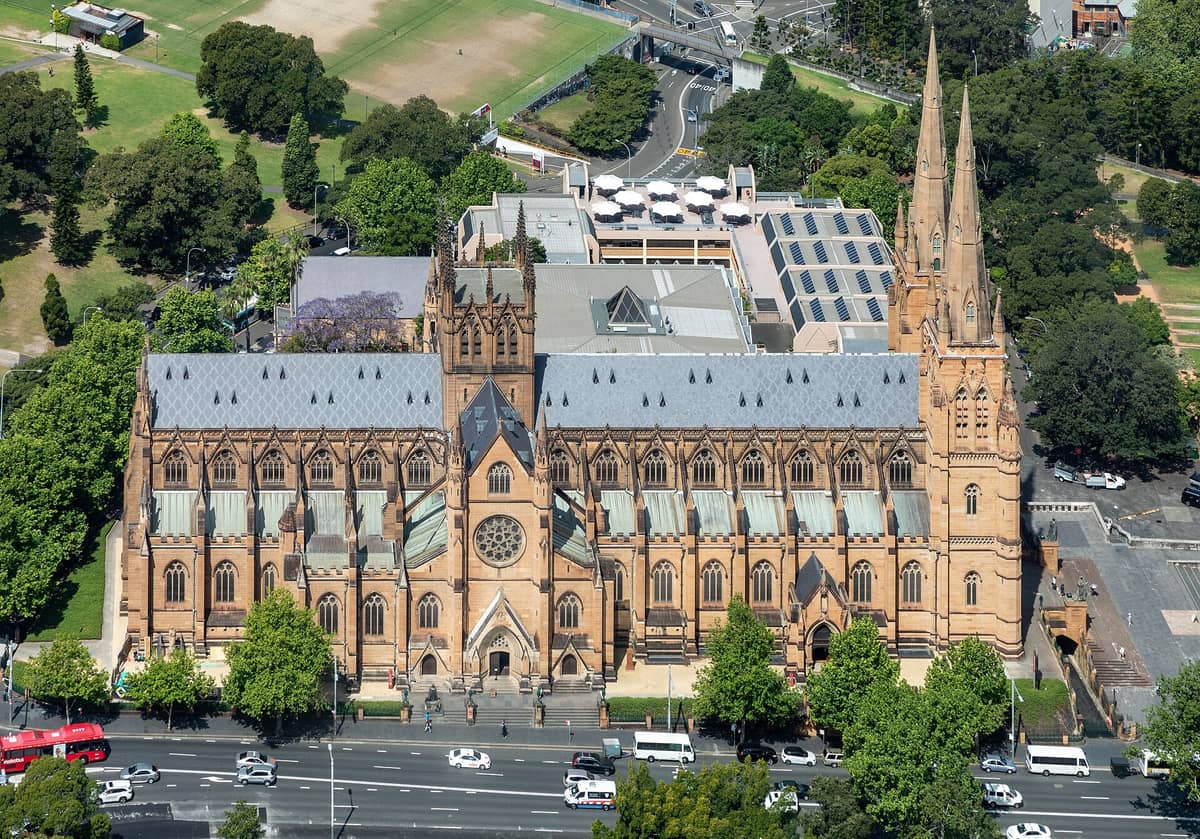
St Mary's Cathedral is one of the largest Gothic Revival churches in the Southern Hemisphere and unquestionably Sydney's most architecturally ambitious religious building. Standing 107 metres long with a twin spires rising approximately 75 metres, the structure dominates the eastern edge of the CBD in a way that photographs rarely convey. You need to stand on the College Street footpath, facing east toward the Cathedral across Hyde Park, to properly understand how much sky the Cathedral occupies.
The exterior is built from warm-toned Pyrmont sandstone, the same material used across many of Sydney's colonial-era public buildings. In flat midday light, the stone looks almost grey. In late afternoon, particularly in the hour before sunset, it turns a deep amber that makes the facade glow against the park greenery opposite. If you can only visit once, late afternoon is the moment for exterior photography.
The twin spires at the Cathedral's southern end were completed in 2000, finishing a design that had been left incomplete for over a century. Their addition changed the Sydney skyline in a subtle but definitive way. From the Royal Botanic Garden and parts of Hyde Park, the spires now frame views toward the CBD's glass towers, creating an unusual juxtaposition of centuries on a single sightline.
History: A Cathedral Built in Stages Over 130 Years
The site has been associated with Catholic worship in Sydney since 1821, when the first modest chapel was constructed here. The foundation stone for the present Cathedral was laid in 1868, and construction of the first major stage continued until 1900. Work on the second stage ran from 1912 to 1928. The spires, based on the original plans by architect William Wardell, were not realised until 2000 — meaning the Cathedral took over 130 years to reach its intended form.
William Wardell, who also designed St Patrick's Cathedral in Melbourne, was trained in England and converted to Catholicism under the influence of Augustus Pugin, the theorist of Gothic Revival architecture. His design for St Mary's draws directly on the principles of English cathedral architecture: pointed arches, ribbed vaulting, flying buttresses, and an elongated nave that channels the eye toward the sanctuary. The result is a building that would not look out of place in Northern Europe, placed instead in a harbour city founded only decades before construction began.
ℹ️ Good to know
Opening hours: Monday to Friday 6:30 am to 6:30 pm; Saturday and Sunday 6:30 am to 7:00 pm. Hours may be extended during the daylight saving period and around Christmas. Services take place throughout the day and week — the Cathedral remains open to visitors between services, but moving through the nave during Mass is not appropriate. Check stmaryscathedral.org.au for the daily service schedule before you visit.
Tickets & tours
Live prices and dates from our booking partner. If you book, we may earn a commission at no extra cost to you.
The Rocks historic walking tour
From 20 €Instant confirmationFree cancellationBeginner surf lesson at Bondi Beach
From 79 €Instant confirmationFree cancellationSydney whale-watching cruise with breakfast or lunch
From 62 €Instant confirmationFree cancellationBlue Mountains Waterfalls Full-Day Tour with Lunch and Dinner
From 171 €Instant confirmationFree cancellation
Inside the Cathedral: What to Prioritise
Stepping through the main entrance from College Street, the interior is immediately quieter and cooler than the street outside. The nave is long and high, with clerestory windows filtering light from above. On overcast days, the interior feels genuinely dim — intentionally so, in keeping with the Gothic tradition where light is used selectively as a spiritual tool rather than for general illumination. On clear mornings, the stained glass on the eastern side sends coloured light across the stone columns in a way that shifts perceptibly as the sun moves.
The stained glass windows are among the most significant in Australia. Several date from the late nineteenth and early twentieth centuries and depict scenes from scripture in the rich jewel-toned palette typical of the Gothic Revival period. Study them from the nave rather than rushing past — the detail rewards close attention, and the lower panels often include donor inscriptions or local historical references that tell you something about who financed the building's interior.
The crypt beneath the Cathedral houses a terrazzo floor depicting the Creation story, completed in the early twentieth century and considered one of the finest examples of its kind in the country. Access to the crypt may be restricted during services or events; check with Cathedral staff at the entrance. The floor's scale and intricacy are not something most visitors expect, and it tends to be genuinely less crowded than the nave above.
💡 Local tip
Photography tip: The Cathedral allows photography for personal, non-commercial use. The best interior light falls on the stained glass windows between roughly 9:00 am and 11:00 am on sunny mornings, when eastern light enters at a low angle. A wide-angle lens helps capture the full nave. Flash photography is discouraged. Tripods are not permitted during services.
How the Experience Changes by Time of Day
Early mornings, particularly on weekdays before 8:00 am, are the quietest. The Cathedral is open from 6:30 am, and at this hour it functions primarily as a place of daily worship for the local Catholic community. The atmosphere is contemplative. A handful of people sit in prayer; the lighting is low; organ or choral practice sometimes carries through the nave. If peaceful observation is what you want, this is the window to aim for.
Midday, especially on weekdays, brings office workers cutting through the grounds, lunchtime visitors from the surrounding CBD, and the occasional school group. The precinct outside the Cathedral sees consistent foot traffic throughout the working week. The interior remains calm relative to the street, but it is not the solitary experience of early morning.
Weekend afternoons draw a broader mix: tourists, families completing a park circuit, and visitors who have combined the Cathedral with a walk through Hyde Park or a visit to the nearby Art Gallery of New South Wales. Sunday mornings see the Cathedral at its most active as a functioning parish, with multiple Masses scheduled. Attending a service is genuinely welcome, but visitors who want to explore the architecture should plan around the service times listed on the official website.
The Grounds and Surrounding Precinct
The Cathedral sits within a small precinct of its own, with paths running around the exterior. The southern forecourt, from which the twin spires are most visible, is a useful meeting point and a reasonable spot to sit and take in the building's scale without going inside. A statue of the Virgin Mary stands in the grounds; the Cathedral's perimeter gardens are simply maintained rather than ornamental, so do not expect elaborate planting.
Across College Street, Hyde Park provides an obvious and pleasant extension to any Cathedral visit. The park's Archibald Fountain sits on the central axis, and the ANZAC Memorial at the park's southern end is a short walk through the avenue of fig trees. Together, the Cathedral and Hyde Park form a natural pairing for a 90-minute circuit that covers architecture, public art, and green space without any transit required.
The Art Gallery of New South Wales is a 10-minute walk north through the Domain, and the Australian Museum is directly across William Street — making the Cathedral an easy anchor point for a half-day covering the CBD's eastern cultural corridor.
⚠️ What to skip
Dress code: As an active Catholic cathedral, modest dress is expected inside. Shoulders and knees should be covered. Very short shorts, sleeveless tops without coverage, or beachwear are not appropriate. There is no enforcement mechanism at the door, but visitors should respect the space accordingly.
Practical Details and Accessibility
Getting here by public transport is straightforward. St James, Museum, and Town Hall stations are each approximately seven minutes on foot. City buses serving the Elizabeth Street and College Street corridors stop close to Hyde Park. If you are arriving by taxi or rideshare, College Street in front of the Cathedral allows drop-offs during non-peak hours.
The Cathedral's official visitor information does not publish detailed accessibility specifications. If you have mobility requirements, contact the Cathedral directly on +61 2 9220 0400 before your visit to confirm access arrangements for entrances, interior movement, and the crypt. The grounds are level from the College Street side, but the interior's historic stone floors and pew configuration may present challenges for some visitors.
Self-guided visits require no booking and no ticket. For those wanting structured context, the Cathedral offers guided tours; check the visitor information page at free things to do in Sydney or the official website for tour schedules and availability. Group visits are best arranged in advance by contacting the Cathedral directly.
Honest Assessment: Who Will and Won't Get Much from This Visit
St Mary's Cathedral is worth visiting for anyone with an interest in architecture, religious art, or the history of colonial Sydney. The building is genuinely impressive, free to enter, and located so centrally that the opportunity cost of a 30-minute visit is minimal. The crypt's terrazzo floor alone is unusual enough to justify stopping in if you are passing through the CBD.
Visitors expecting interactive displays, guided interpretation at every turn, or a museum-style experience will find the Cathedral relatively sparse in that regard. It is first and foremost a working church, not a heritage attraction with interpretive infrastructure. If you are travelling with young children who need stimulation rather than quiet, the Cathedral interior will be a short stop at best. The same applies to travellers who have already visited major European cathedrals and are looking for something distinctly Australian in character — the Gothic Revival style here is deliberately European in reference.
For travellers building a broader Sydney itinerary, see the 3 days in Sydney guide for suggestions on how to sequence this stop alongside the harbour and eastern suburbs.
Insider Tips
- The crypt's terrazzo Creation floor is often overlooked by visitors who only scan the nave. Ask a Cathedral volunteer or staff member at the entrance whether it is accessible during your visit — it is one of the most underappreciated interior features in the building.
- For the best exterior photographs, position yourself on the western footpath of College Street, using Hyde Park's trees as foreground framing. The late afternoon light between 4:00 pm and 5:30 pm (depending on season) turns the sandstone a deep gold that midday light completely flattens.
- Weekday mornings before 8:00 am offer a genuinely different experience from daytime tourist hours. The Cathedral is open from 6:30 am, and at that hour you are mostly sharing the space with worshippers rather than visitors, which changes the atmosphere considerably.
- The Cathedral's southern forecourt, facing the twin spires, is less used than the main College Street entrance. Walking around the perimeter of the building gives you a much better sense of the flying buttresses and the architectural detail that visitors who only enter from the front entirely miss.
- If you are visiting during the Vivid Sydney light festival (typically May to June), check whether St Mary's is included in the lighting program — in some years the Cathedral's facade has been incorporated into projections, which transforms the nighttime exterior completely.
Who Is St Mary's Cathedral For?
- Architecture and design enthusiasts interested in Gothic Revival construction and its Southern Hemisphere context
- Travellers seeking free, centrally located cultural stops that can fill a 30–60 minute gap between other CBD appointments
- Photographers looking for a landmark that shoots differently at dawn, midday, and dusk
- Visitors pairing a Hyde Park walk with interior heritage — the two sites form a natural circuit
- Anyone wanting a quiet, cool pause in the middle of a busy CBD day
Nearby Attractions
Other things to see while in Sydney CBD:
- ANZAC Memorial
Standing at the southern end of Hyde Park, the ANZAC Memorial is one of Sydney's most significant commemorative sites. Free to enter and open daily, it combines powerful Art Deco architecture with thoughtful exhibitions tracing Australia's wartime history from the First World War to recent conflicts.
- Art Gallery of New South Wales
The Art Gallery of New South Wales spans two architecturally distinct buildings on The Domain, offering free access to one of Australia's most significant art collections. From colonial-era Australian works to contemporary Pacific and Aboriginal art, the gallery rewards visitors who know where to look.
- Australian Museum
The Australian Museum is Sydney's oldest museum, founded in 1827, with free general admission and collections spanning science, culture, and nature. Located opposite Hyde Park in the CBD, it suits curious travellers with two to three hours to spend indoors.
- Sydney Chinatown
Sydney Chinatown occupies the Haymarket precinct around Dixon Street, a pedestrianised mall bookended by ornate gates and lined with restaurants, bakeries, and produce shops. Free to enter and accessible by train, it rewards visitors who know when to go and what to look for.
Planning a trip? Discover personalized activities with the Nomado app.