Hospice of St. Catherine: A Medieval Landmark in the Heart of Rhodes Old Town
Built in 1391 by a Knight Admiral and rebuilt after Ottoman siege and earthquake, the Hospice of St. Catherine is one of the most architecturally layered medieval structures in Rhodes Old Town. Though access inside is limited, its stonework, heraldic carvings, and position in the former Jewish quarter make it a compelling stop for anyone tracing the island's Knights Hospitaller history.
Quick Facts
- Location
- Medieval Town of Rhodes, former Jewish quarter (La Juderia), near the Gate of St. Catherine
- Getting There
- Walkable from any entrance to Rhodes Old Town; no vehicle access inside the medieval walls
- Time Needed
- 15-30 minutes for exterior exploration; longer if combined with a walking tour of the Old Town
- Cost
- Free to view exterior; interior access unconfirmed — check locally before visiting
- Best for
- History enthusiasts, architecture lovers, and medieval Old Town walkers
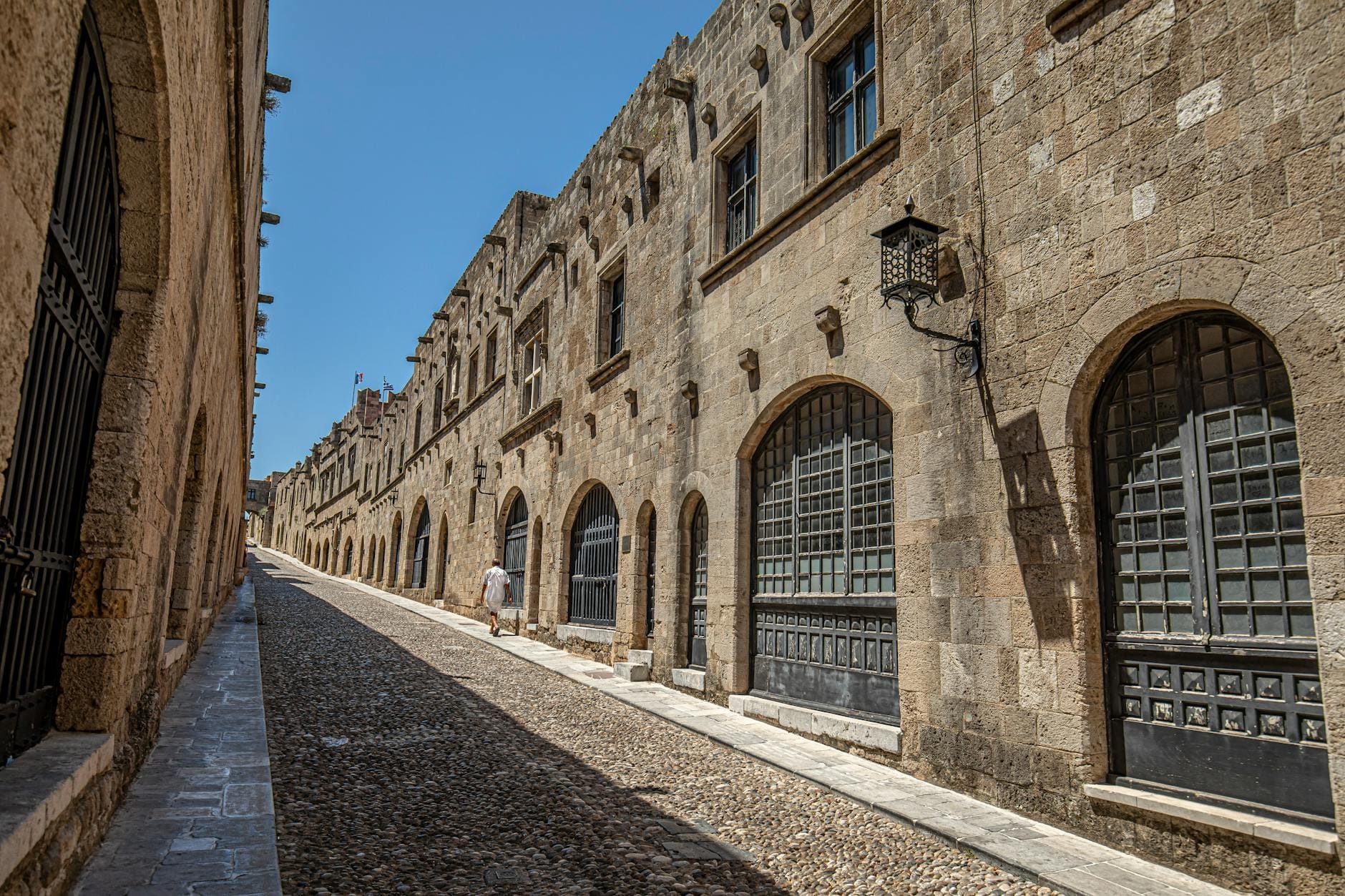
What Is the Hospice of St. Catherine?
The Hospice of St. Catherine (Greek: Ξενώνας Αγίας Αικατερίνης) is a medieval building in Rhodes Old Town constructed in 1391–92 by the Italian Domenico d'Allemagna, admiral of the Order of the Knights Hospitaller. Its original purpose was to house and care for pilgrims and visiting dignitaries passing through the powerful trading and military outpost that Rhodes represented at the time. It sits in the former Jewish quarter of the medieval city, an area known historically as La Juderia, close to the Gate of St. Catherine, and its facade projects visibly into the surrounding street axis.
The building you see today is not the original structure in a pure sense. It was badly damaged during the Ottoman siege of 1480 and further destabilized by the earthquake of 1481. Reconstruction followed, led by Costanzo Operti, and the building was completed in 1516 by Costanzo Operti under Grand Master Fabrizio del Carretto. Two coats of arms from that period are still visible on the exterior, serving as stone-carved records of the patrons who funded the rebuild. A thorough restoration project carried out over the following ten years beginning in 1986 stabilized and preserved the structure as a heritage centre, earning it recognition in European heritage conservation circles.
⚠️ What to skip
Interior access to the Hospice of St. Catherine is not reliably confirmed. Recent visitor reports suggest the building may be closed to the public. Treat this as an exterior landmark and verify local access on arrival rather than making it the anchor of your itinerary.
The Architecture: What to Look For on the Exterior
Even viewed from the street, the Hospice of St. Catherine repays close attention. The stonework reflects the layered rebuilding of the structure across two distinct periods: the late 14th-century original and the early 16th-century reconstruction. The proportions of the building, with its arched openings and dressed limestone facade, follow the architectural conventions common to Knights Hospitaller construction across the eastern Mediterranean. If you have already visited the Street of the Knights, you will notice a family resemblance in material and craft, though the hospice carries a quieter, less monumental character.
The 1516 coats of arms embedded in the facade are the most visually specific detail to seek out. They are carved in relief and placed to assert the identity of the patrons who funded the post-earthquake rebuild. For anyone following the Knights Hospitaller history of Rhodes, these heraldic carvings are a direct material link to the political and military culture of the Order. Look for them carefully: without knowing they exist, most visitors walk past without noticing.
The position of the building in the street plan is itself architecturally significant. It projects into the street axis in a way that was deliberate rather than incidental, a common device in medieval urban planning to assert institutional presence on a public route. This is a detail that reads more clearly if you step back far enough to take in the full street perspective rather than approaching the facade head-on.
Tickets & tours
Hand-picked options from our booking partner. Prices are indicative; availability and final rates are confirmed when you complete your booking.
Sunset catamaran cruise with dinner in Rhodes
From 70 €Instant confirmationFree cancellation3-Hour All Inclusive Sun and Sea Swimming Cruise in Rhodes
From 55 €Instant confirmationFree cancellationRhodes Sunset Cruise with Greek BBQ and Unlimited Drinks
From 65 €Instant confirmationFree cancellationPalace of the Grand Master Ticket and Audio Tour by App
From 30 €Instant confirmation
The Setting: La Juderia and the Gate of St. Catherine
The hospice sits in what was once the Jewish quarter of the medieval city, a neighbourhood with its own dense history. The area around it, close to the harbour gates of the Old Town, was one of the more commercially active zones of medieval Rhodes, connecting the port with the interior of the walled city. Walking this quarter today, you move through a landscape of Ottoman-era houses, Byzantine foundations, and Crusader-period structures layered so closely together that it is often impossible to tell at a glance which century you are looking at.
The Gate of St. Catherine, nearby, was one of the principal entry points from the commercial harbour zone into the medieval city, used by merchants, pilgrims, and sailors. The hospice's location adjacent to this route was deliberate: it placed the institution precisely where arriving travellers would encounter it. Standing here in the early morning, before tour groups fill the lanes, the spatial logic of the medieval city is easier to feel. The streets are quiet enough that you can hear your own footsteps on the worn stone and pick out the sound of shutters opening above you.
Visiting in Context: How This Fits Into a Rhodes Old Town Walk
The Hospice of St. Catherine works best as one component of a longer walk through Rhodes Old Town rather than a standalone destination. If you are spending time in the medieval city, it fits naturally into a circuit that includes the Street of the Knights and the Palace of the Grand Master at the upper end of the Old Town, and the Archaeological Museum and the Suleman Mosque in the central zone. The hospice occupies the southern portion of the walled city, closer to sea level, which means a walk from the Palace of the Grand Master to the Gate of St. Catherine gives you a full north-to-south traverse of the medieval urban fabric.
For a structured approach to the whole district, the Rhodes Old Town walking tour guide covers the full route with historical context for each major structure. Allow at least three hours for a complete walk that includes the hospice, or half a day if you plan to enter the Palace of the Grand Master and the Archaeological Museum.
💡 Local tip
Visit the area around the Gate of St. Catherine between 8am and 9am. The light is at its most useful for photography on the stone facades, and the lanes are largely empty. By 10am, guided groups begin filling the southern quarter in numbers.
Time of Day and Crowd Patterns
The former Jewish quarter sits slightly off the main tourist circuit that connects the Gate of Liberty, the Street of the Knights, and the main market square. This means it tends to be quieter than those central routes even in peak summer months. Midday in July and August brings heat that reflects sharply off the pale stone walls and lanes, making the area uncomfortable for lingering. If you are visiting in high summer, morning or late afternoon are the practical options.
In shoulder season, specifically May, June, September, and October, the entire Old Town is significantly more comfortable to explore on foot. Temperatures in this range allow for longer walks without shade-seeking, and the quality of the light in October in particular gives the limestone facades a warmth that high-summer midday light flattens completely.
Photography Notes
The Hospice of St. Catherine is not a photogenic subject in the conventional sense: it is a large, somewhat worn stone building on a narrow lane, without the dramatic silhouette of, say, the Fort of St. Nicholas or the visual spectacle of the acropolis at Lindos. What it offers photographically is texture: the relationship between the 14th-century stonework and the 16th-century additions, the heraldic carvings, the play of shadow in the arched openings. A wide-angle lens is impractical in the narrow lane; a 35mm equivalent or a short telephoto will serve you better for isolating architectural details.
Morning light from the east catches the facade at a low angle for most of the year, which is useful for bringing out the relief on the coats of arms. Afternoon light disappears from the lane quickly as the surrounding buildings cast shadow, making the morning window the more reliable option.
Honest Assessment: Is It Worth the Detour?
The Hospice of St. Catherine is not the most visually dramatic structure in Rhodes Old Town. It does not have the monumental scale of the Palace of the Grand Master or the dramatic setting of the inn facades on the Street of the Knights. For most first-time visitors to Rhodes with limited time, it will not rank above the major sites. However, for anyone with a specific interest in the Knights Hospitaller period, medieval urban planning, or the layers of destruction and reconstruction that shaped the city, it is a genuinely interesting stop.
Its restoration history also carries weight for those interested in heritage conservation. The 1986-1995 project that stabilized the building was recognised at the European level, and the challenges of that restoration, working on a structure that had been damaged by siege, earthquake, and centuries of secondary use, are part of what makes the building historically significant beyond its original function.
Travellers who want atmospheric medieval streets without committing to a museum ticket will find the surrounding quarter pleasant to walk regardless of whether the hospice itself is accessible. Those who need a defined experience with guaranteed interior access should confirm the current situation locally before making this a specific destination.
Insider Tips
- The coats of arms from 1516 are easy to overlook because they sit at a height and angle that doesn't catch the eye at walking pace. Stop at the far side of the lane, look up at the facade, and take a moment to locate them before approaching. You will see them more clearly from a few metres back.
- The lane network around the Gate of St. Catherine is one of the less-walked parts of the Old Town. If you want to photograph medieval Rhodes without other tourists in frame, this quarter delivers consistently better results than the Street of the Knights or the main square.
- The hospice is within easy walking distance of the harbour gates. Combining a visit here with a look at the Gate of St. Catherine and a short walk to the waterfront gives you a useful sense of the medieval city's relationship with its port, which is central to understanding why the Knights fortified and developed Rhodes so extensively.
- If you are visiting in summer and find the midday heat makes extended exploration impractical, this part of the Old Town has narrower lanes with more shade than the upper city. It is a more manageable midday zone than the exposed areas near the Palace of the Grand Master.
- Ask at your accommodation or at the local tourist information point whether the interior is currently open before visiting. Access status appears to have changed over time, and a five-minute phone call or inquiry can save unnecessary disappointment.
Who Is St Catherine Hospice For?
- History enthusiasts tracing the Knights Hospitaller presence in Rhodes
- Architecture and heritage conservation researchers
- Photographers seeking textured medieval streetscapes away from main tourist routes
- Visitors doing a full Old Town walking circuit who want to cover the southern quarter
- Travellers interested in the layered Ottoman, Byzantine, and Crusader history of the same urban space
Nearby Attractions
Other things to see while in Rhodes Old Town:
- Archaeological Museum of Rhodes
Housed in the 15th-century Hospital of the Knights, the Archaeological Museum of Rhodes brings together artifacts spanning the Archaic to Roman periods, including celebrated Hellenistic marble statues and intricate floor mosaics. It is one of the most historically layered museum experiences in the Aegean, where the building itself is as compelling as the collection inside.
- Hammam Turkish Baths
Built in 1558 during the Ottoman occupation, the Great Hamam is the sole surviving bathhouse within Rhodes' UNESCO-listed Medieval Town. Currently closed to the public but recently restored, it remains one of the most architecturally distinctive buildings in Arionos Square, worth understanding in context before you arrive.
- Harbour Gates
The Harbour Gates mark the medieval boundary between Mandraki Harbour and the walled city built by the Knights of Saint John. Free to visit at any hour, they are the most atmospheric entry point into Rhodes Old Town, framing a view that has barely changed in six centuries.
- Palace of the Grand Master of the Knights of Rhodes
The Palace of the Grand Master of the Knights of Rhodes is the most architecturally commanding structure in the medieval city. Built in the early 14th century and dramatically restored under Italian rule, it anchors the northwestern corner of the Old Town with towers, colonnaded courtyards, and a permanent collection that spans antiquity to the Ottoman period.