Sopelana Beach: A Strong Surf Beach Within Metro Reach of Bilbao
Sopelana Beach (Playa de Sopelana) is an 800-metre stretch of Atlantic sand on the Basque coast, roughly 9 km north of Bilbao. Reachable by Metro Bilbao Line 1, it draws surfers, families, and cliff walkers alike, with free access year-round and seasonal services during the bathing season.
Quick Facts
- Location
- Sopela (Sopelana), Biscay — approx. 9 km north of Bilbao city centre
- Getting There
- Metro Bilbao Line 1: Sopela or Larrabasterra stations (approx. 15–20‑min walk to beach, with Larrabasterra the main access for the Sopela beaches)
- Time Needed
- 2–5 hours depending on activity (surf lesson, walk, swimming)
- Cost
- Free public beach; Metro fare applies for transit
- Best for
- Surfers, families, geology enthusiasts, day-trippers from Bilbao
What Sopelana Beach Actually Is
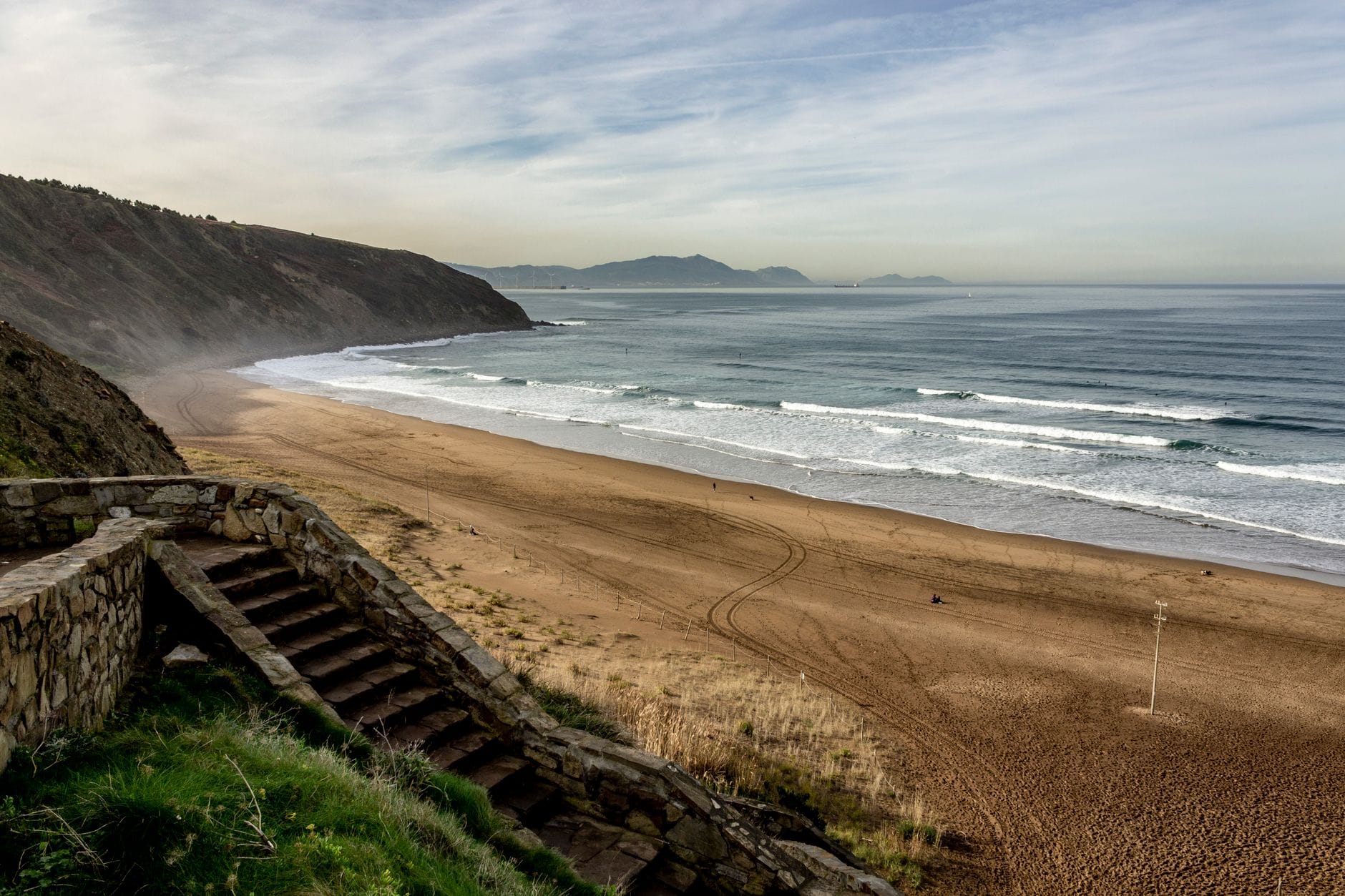
Sopelana Beach, known locally as Playa de Sopelana, is an 800-metre sandy arc sitting on the Cantabrian coast in the municipality of Sopela (the official Basque name, formerly written Sopelana). It forms part of a continuous coastal strip together with the adjoining Arriatera and Atxabiribil beaches, meaning that at low tide you can walk a surprisingly long stretch of largely uninterrupted sand without ever reaching a car park or a breakwater.
What makes this beach stand out in the Bilbao day-trip category is the combination of real surf, genuine cliffs, and a Metro connection that gets you here from the city centre in around 30 minutes without a car. It is not a polished resort beach with lounger rentals and cocktail bars. The infrastructure is functional — showers, toilets, changing cabins, a couple of casual bars, and seasonal lifeguards and medical staff — but the setting does the heavy lifting.
ℹ️ Good to know
Beach access is free and open at all times. Lifeguards, showers, and seasonal services operate during the main bathing season (typically summer months). Check local listings for current lifeguard hours before swimming.
Getting There from Bilbao
Take Metro Bilbao Line 1 northbound toward the coast. The two relevant stations are Sopelana and Larrabasterra, both within walking distance of the beach. From either station, the walk to the sand takes roughly 15 minutes on foot, descending gradually toward the cliff edge and then down to the beach level. The metro ride from central Bilbao stations takes approximately 30 minutes. For current fares and timetables, check the Metro Bilbao transport guide before you travel, as fares and schedules are updated periodically.
The Barik rechargeable card offers discounted metro fares compared to buying single tickets at the machine. If you are spending more than a day or two in the city, it pays for itself quickly. Driving is possible, but parking near the beach fills by mid-morning on any sunny summer weekend, and the metro journey is genuinely straightforward.
💡 Local tip
Take the Larrabasterra station exit if you want to approach via the cliff path first, which gives you an elevated view of the full beach before descending. Sopelana station is slightly more direct if you are heading straight to the sand.
Tickets & tours
Live prices and dates from our booking partner. If you book, we may earn a commission at no extra cost to you.
San Juan de Gaztelugatxe guided tour from Bilbao
From 65 €Instant confirmationFree cancellationSan Sebastian, Hondarribia, Hendaye, and Getaria from Bilbao
From 54 €Instant confirmationFree cancellationGaztelugatxe and Mundaka small group guided tour from Bilbao
From 50 €Instant confirmationFree cancellationBilbao walking tour
From 16 €Instant confirmationFree cancellation
The Beach at Different Times of Day
Early morning, roughly before 9am, Sopelana belongs to the surfers. The car park has a handful of vans, boards lean against bumpers, and the water is occupied by people who drove in from Bilbao before the day warmed up. The smell of salt and cold Atlantic air is strong, the light hits the cliffs at a low angle, and the café near the beach access may not yet be open. It is the best time to photograph the coastline without figures crowding the foreground.
By late morning on a clear summer day, families with children begin to fill the central stretch of sand. The beach is long enough that there is always room to spread out, but the area nearest the ramp access gets congested. Surfers migrate to the edges where the break is cleaner. The bar near the beach serves coffee, cold drinks, and basic snacks, and by midday it has a short queue.
Late afternoon, especially between 5pm and sunset, is arguably the most enjoyable window for non-surfers. The midday crowd starts to thin, the light softens and turns warm on the sandstone cliffs, and the temperature is still comfortable for swimming if the season is right. On weekdays in June or September, you can have a genuinely quiet experience even in what counts as high season for northern Spain.
Surfing at Sopelana
Sopelana is one of the most established surf beaches in the Bilbao metropolitan area. The Atlantic swell arrives with enough consistency and power to support both beginners and intermediate surfers, and a local surf school (Escuela de Surf Sopelana) operates on the beach offering lessons and board rentals during the season. The break is generally a beach break, which means it shifts position depending on sandbar formation and swell direction, but it produces rideable waves across a wide range of conditions.
Beginners taking a first lesson will find the environment manageable, particularly on smaller swell days in summer. More experienced surfers tend to focus on the ends of the beach where the wave shape is more defined. The water temperature in the Cantabrian Sea is cold by Mediterranean standards: expect roughly 14–16°C in winter and 18–20°C in the warmest summer months, so a wetsuit is standard equipment year-round for anyone spending extended time in the water.
If surfing is a central reason for your Basque Country trip, it is worth knowing that Sopelana fits naturally into a broader coastal exploration. The nearby beaches of Bakio and Mundaka offer very different surf conditions, with Mundaka in particular holding a world-class left-hand reef break. See the Mundaka guide for more detail on that wave and the town around it.
The Geological Secret in the Cliffs
This is the detail that most beach guides skip entirely, and it is genuinely worth knowing. The cliffs flanking the Atxabiribil section of this coastal strip contain a visible Cretaceous–Paleogene (K–Pg, historically K/T) boundary layer. This thin band of sediment, approximately 10 centimetres thick, marks the geological moment of the mass extinction event approximately 66 million years ago that ended the age of the dinosaurs.
You can see it with the naked eye in the cliff face — a noticeably different stripe of rock running horizontally through the layered sedimentary sequence. It is not roped off or ticketed. You can walk directly to it at low tide. For anyone with an interest in geology or natural history, this alone justifies the visit even on a day when the weather does not cooperate for swimming or surfing.
💡 Local tip
Visit the Atxabiribil cliff section at low tide to get close to the K/T boundary layer. Bring a field guide or use a geology app to identify the distinct clay-rich layer. Do not attempt to remove rock samples — the site has scientific value and is part of a protected coastal environment.
Weather, Seasons, and Honest Expectations
Bilbao and its coastline operate under a humid oceanic climate. That means rain is distributed throughout the year, including summer. A sunny forecast can shift within hours, and the Atlantic does not behave like the Mediterranean. July and August offer the most reliable beach conditions, with warm temperatures and lower rainfall probability, but even then you should check the forecast the morning of your visit rather than committing a week in advance.
June and September can be excellent, particularly on weekdays when the beach sees far fewer visitors. October onwards the water temperature drops and the swell picks up in size, making it more interesting for experienced surfers but less inviting for casual swimmers. If you are planning a beach day alongside cultural visits, the best time to visit Bilbao guide covers the seasonal tradeoffs in more detail.
On overcast or light-rain days, Sopelana is still worth visiting for the cliff walk between beaches and the geological formations — but swimming and surfing become uncomfortable. The beach does not have covered shelters, so if the forecast shows persistent rain, this is a day to prioritise the city's indoor options instead.
Practical Walkthrough for a Day Visit
Pack layers regardless of the season. Even in August, a light jacket is useful once you are wet or the afternoon breeze picks up. Bring your own food if you plan to spend a full day, as the beach bar is limited in options and can be slow at peak times. Sunscreen matters more than you might expect in northern Spain — the Atlantic light reflects off the water and sand effectively, and the mist or cloud cover does not block UV radiation.
The beach surface is fine, compact sand, pleasant for walking barefoot and comfortable for lying on. Towards the cliff edges the surface transitions to rockier ground, so footwear is useful if you plan to explore beyond the central sandy stretch. The ramp access from the street level above is manageable for pushchairs and for visitors with limited mobility, though the cliffside paths between beaches involve uneven terrain and are not wheelchair-accessible.
Sopelana pairs well with a visit to Getxo, the coastal suburb reached a few stops earlier on Line 1. Getxo has its own seafront promenade, the celebrated Bizkaia Bridge, and calm beaches more suited to young children. Combining both in one day is realistic. See the Bizkaia Bridge guide and the Getxo neighbourhood overview for more context.
Photography Notes
The most photogenic spots are the cliff viewpoints above the beach, particularly looking south along the coast toward Bilbao's green hills, and the geological formations at the Atxabiribil end. Golden hour before sunset is exceptional when the cliffs catch warm light and the Atlantic turns a deep metallic blue. A wide-angle lens covers the full bay sweep; a longer focal length is useful for isolating surfers in the water against the cliff backdrop.
Midday under flat cloud produces flat photographs — the sand loses texture and the water looks grey. Either shoot early, shoot late, or use that middle part of the day to explore the cliff paths and geological features instead.
Insider Tips
- The Larrabasterra metro station approach lets you walk along the cliff top before descending to the beach, giving you an elevated perspective of the full Sopelana arc that most visitors miss by arriving directly via the Sopelana station ramp.
- The K–Pg (K/T) geological boundary layer in the Atxabiribil cliff is accessible only at low tide — check a tide table before you go, not after you arrive.
- Weekday mornings in June and September offer the closest thing to a deserted Atlantic beach within metro reach of a major city. August weekends are a different experience entirely.
- The surf school on the beach offers lessons that can be booked in advance during summer, but walk-in availability exists on quieter days. Lessons are taught in the calmer, shallower sections of the beach — appropriate for absolute beginners.
- If the swell is large, the undertow near the cliff edges can be strong even when the central beach looks calm. Swim between the flag markers and follow lifeguard instructions during the supervised season.
Who Is Sopelana Beach For?
- Surfers looking for a consistent Atlantic beach break within metro distance of Bilbao
- Families wanting a proper sandy beach without a long drive from the city
- Geology and natural history enthusiasts keen to see the Cretaceous-Paleogene boundary in person
- Day-trippers combining a beach visit with a coastal walk along the cliffs between Sopelana, Arriatera, and Atxabiribil
- Photographers targeting dramatic cliff-and-surf Atlantic coastal scenes, especially at golden hour
Nearby Attractions
Combine your visit with:
- Bakio Beach
Stretching nearly a kilometre along the Bizkaia coast, Bakio Beach is the largest and most complete sandy beach within easy reach of Bilbao. With reliable surf, a long promenade, full facilities, and Blue Flag certification, it draws everyone from families to serious wave riders.
- Bermeo
Perched on the rugged Biscay coast about 35 kilometres northeast of Bilbao, Bermeo is one of the Basque Country's oldest and most significant fishing towns. With a harbour still piled with nets, a medieval old quarter dating to 1236, and a front-row seat to one of northern Spain's most dramatic coastlines, it rewards travellers who venture beyond the city.
- Castillo de Butrón
Rising from dense Biscayan woodland just over 20 km from Bilbao, Castillo de Butrón is one of the most visually striking pieces of architecture in the Basque Country. Originally a medieval tower-house, it was radically rebuilt in neo-Gothic style in 1878 and today stands as a classified Historic Monument. Interior access is currently not available to the general public, but the exterior alone makes the short drive worthwhile.
- San Juan de Gaztelugatxe
A 10th-century hermitage perched on a jagged sea islet connected to the mainland by a cobbled stone bridge and 241 steps. San Juan de Gaztelugatxe sits roughly 45 minutes by car from Bilbao and delivers one of the most visually striking landscapes on the entire Atlantic coast of Spain. Free to enter, but requiring advance reservation in peak season.
Planning a trip? Discover personalized activities with the Nomado app.