Butrón Castle: The Neo-Gothic Fortress Outside Bilbao Worth the Detour
Rising from dense Biscayan woodland just over 20 km from Bilbao, Castillo de Butrón is one of the most visually striking pieces of architecture in the Basque Country. Originally a medieval tower-house, it was radically rebuilt in neo-Gothic style in 1878 and today stands as a classified Historic Monument. Interior access is currently not available to the general public, but the exterior alone makes the short drive worthwhile.
Quick Facts
- Location
- Barrio Butrón, Gatika, Biscay — just over 20 km from Bilbao city centre
- Getting There
- Bizkaibus A3225 (Bilbao Plaza Moyúa to Barrio Butrón stop), then ~5-minute walk. By car via N-637 and local roads BI-2704/BI-3112/BI-3105.
- Time Needed
- 1–2 hours (exterior visit and woodland walk)
- Cost
- Exterior: free. Guided interior tours (when available during restoration works) have been temporarily suspended; under-16s are not admitted when tours operate. Verify current availability before visiting.
- Best for
- Architecture lovers, history enthusiasts, day-trippers from Bilbao, photographers
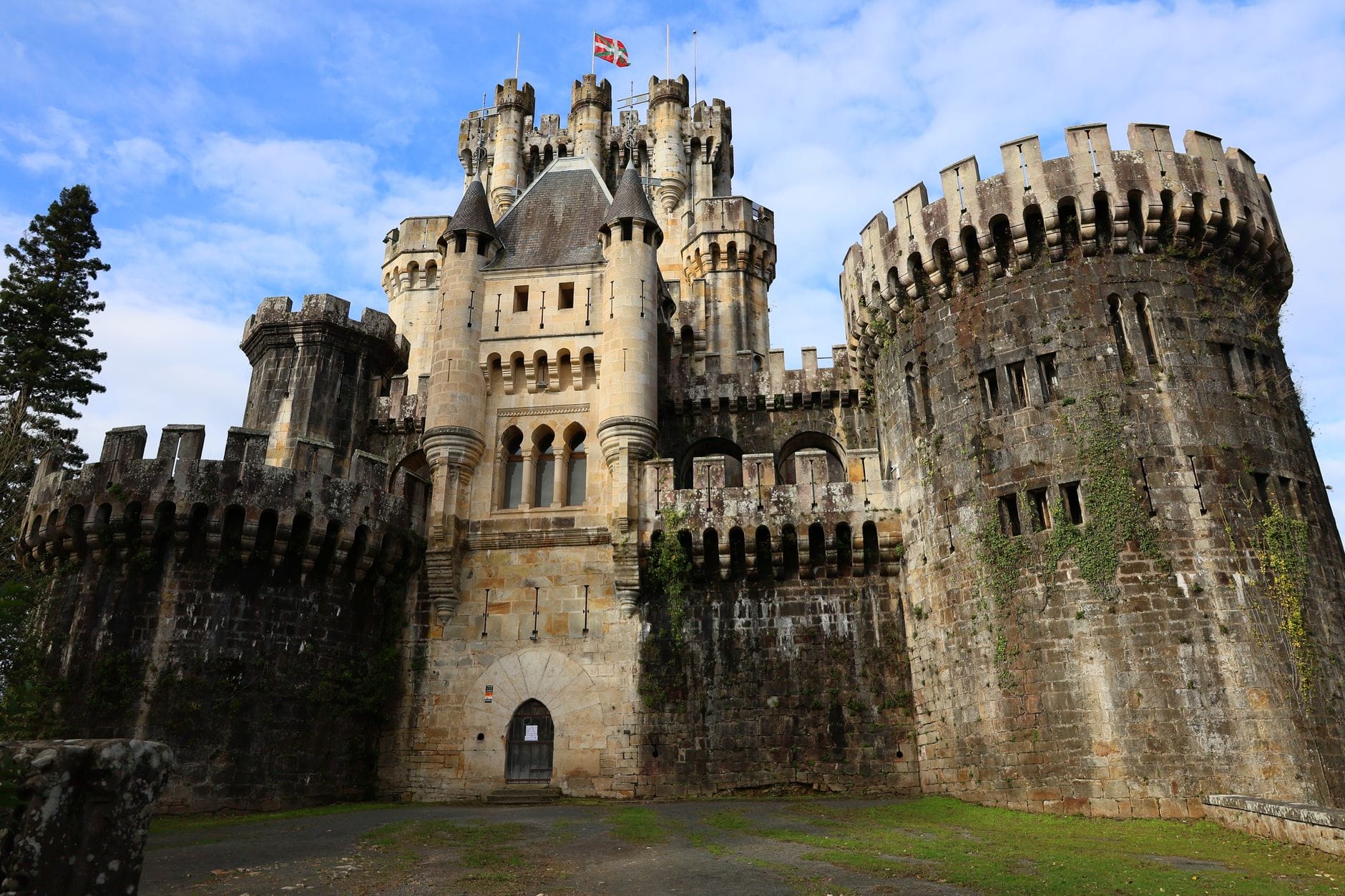
What Is Butrón Castle?
Castillo de Butrón is a classified Historic Monument standing in the forested hills of Gatika, in the Uribe region of Biscay, just over 20 km northwest of Bilbao. From the road, it appears with an almost theatrical abruptness: a cluster of grey stone towers and turrets pressing above the canopy of oak and chestnut, looking more like something transported from the Rhine Valley than a building with roots in 13th-century Basque history.
What you are seeing is largely the product of an 1878 restoration by architect Francisco de Cubas, who rebuilt the then-ruined medieval castle in an elaborate neo-Gothic style. It has since become one of the most photographed structures in the province of Biscay. The original structure dates to the mid-13th century, began as a tower-house, and was converted into a defensive castle during the 14th century.
⚠️ What to skip
Interior guided tours have been suspended and there is currently no fixed public timetable or regular access to the inside of the castle. Before making a special trip to see the interior, confirm any exceptional openings directly through local operators or the Basque Tourism website. The exterior and grounds can be appreciated freely without booking anything.
The Architecture: What You Are Actually Looking At
Francisco de Cubas was one of Spain's leading neo-Gothic architects in the second half of the 19th century, and Butrón is arguably his most dramatic secular project. The design draws heavily on French and German Romantic castle imagery: multiple cylindrical towers crowned with conical slate roofs, crenellated battlements, pointed arch windows, and a vertical composition that appears deliberately theatrical from every approach angle. It is openly romantic in the architectural sense, meaning it prioritises emotional impact and visual narrative over historical accuracy.
That said, Cubas did not start from nothing. He worked around the surviving fabric of the medieval Butrón family stronghold, incorporating traces of the original fortification into his 1878 design. The tension between genuine medieval masonry and confident 19th-century invention gives the building an ambiguous quality that rewards close inspection. Look at the stonework and you can spot the transitions between the layers of history.
For visitors who want architectural context for this kind of romantic revivalism, the Bilbao architecture guide places Butrón within the broader story of Biscay's 19th-century building culture, including the industrial-era expansion that was reshaping Bilbao at exactly the same moment Cubas was rebuilding the castle.
Tickets & tours
Live prices and dates from our booking partner. If you book, we may earn a commission at no extra cost to you.
San Juan de Gaztelugatxe guided tour from Bilbao
From 65 €Instant confirmationFree cancellationSan Sebastian, Hondarribia, Hendaye, and Getaria from Bilbao
From 54 €Instant confirmationFree cancellationGaztelugatxe and Mundaka small group guided tour from Bilbao
From 50 €Instant confirmationFree cancellationBilbao walking tour
From 16 €Instant confirmationFree cancellation
The Visit: What to Expect When You Arrive
Arriving by car, you cross a small bridge from the parking area roughly 100 metres from the castle. On foot from the Bizkaibus stop in Gatika, the walk takes around five minutes along a straightforward path. The approach on foot through the trees is genuinely atmospheric, especially in the softer light of morning or on an overcast autumn afternoon when the stonework takes on a deeper grey tone and the surrounding woodland smells of damp earth and fallen leaves.
Without an active guided tour, your visit focuses on the exterior. You can walk the perimeter, photograph the towers from multiple angles, explore the edge of the surrounding woodland, and read the interpretive information available on site. The castle's scale becomes clearer as you move around it: the main tower complex rises imposingly against the treeline, and its full footprint only reveals itself as you circle the building.
Mornings on weekdays see very few visitors, which allows for unhurried photography and a quieter atmosphere in the woods. Weekends in summer bring more families and day-trippers from Bilbao, but the site rarely reaches the kind of crowding that makes movement uncomfortable. The contrast with the busy riverfront of Abandoibarra, where the Guggenheim draws large queues, is significant.
💡 Local tip
For the best exterior photographs, position yourself on the far side of the bridge shortly after arrival. From there, you get the full reflection of the main tower cluster in the water of the small stream below, particularly effective in the hour after sunrise when the light hits the towers from the east.
How Weather Shapes the Experience
Biscay has a humid oceanic climate: mild winters, warm summers, and rain distributed across the year. Rain is not a reason to avoid Butrón. In fact, overcast or lightly rainy conditions give the stonework a more authentic, saturated colour and reduce harsh shadows in photographs. The woodland around the castle becomes more atmospheric in wet conditions, with mist sometimes settling in the valley around the building.
The period from May to September tends to offer the highest proportion of dry days and the warmest temperatures, making it the most comfortable time for an extended outdoor visit. Late autumn and winter are statistically wetter but also quieter, and the bare trees in winter months actually open up views of the towers that the summer foliage partially obscures.
Wear shoes with grip regardless of season. The paths around the castle and through the woodland can be slippery after rain, and the terrain is uneven in places. This is a woodland heritage site, not a manicured park.
Getting There from Bilbao: Practical Details
By car, the drive from central Bilbao takes approximately 20–25 minutes under normal traffic conditions. The most direct route uses the Artxanda tunnel, then follows the N-637 before switching to local roads BI-2704, BI-3112, and BI-3105 toward the Butrón neighbourhood in Gatika. Free parking is available in a small car park about 100 metres from the castle entrance, across the bridge.
By public transport, take Bizkaibus line A3225 from Plaza Moyúa in central Bilbao, direction Laukiz/Mungia, and alight at the Barrio Butrón stop in Gatika. From there it is roughly a 5-minute walk to the castle. Bus schedules and fares are subject to change; check current timetables via Bizkaibus before travel. For a broader overview of getting around the Bilbao area, the getting around Bilbao guide covers public transport options across Biscay.
Combining Butrón with Other Nearby Sights
Butrón sits in the Uribe comarca, which puts it within reach of the Basque coast. The town of Getxo and its beaches are accessible on the same day, as is the remarkable Bizkaia Bridge at Portugalete, a UNESCO-listed transporter bridge connecting the two banks of the Nervión estuary. Combining these into a single day trip from Bilbao gives a genuinely varied picture of Biscay: medieval and neo-Gothic heritage, 19th-century industrial engineering, and Atlantic coastline, all within a compact geographic area.
If your interest leans toward natural landscapes rather than built heritage, the Urdaibai Biosphere Reserve is roughly 30 km further northeast, and the sea stack of Gaztelugatxe is accessible the same day if you have a car. For a fuller picture of day-trip options from Bilbao, this Basque Country itinerary structures several of these routes clearly.
Is It Worth the Trip?
Butrón Castle is visually extraordinary. The exterior justifies the journey on its own terms for anyone interested in architecture, Romantic-era historical fantasy, or simply a striking photograph. The woodland setting adds genuine atmosphere that a purely urban monument cannot replicate.
One caveat: interior access is genuinely uncertain. The building has changed private ownership multiple times and guided tours have been intermittently suspended. If your primary motivation is to see the interiors, do not travel without first confirming that tours are currently operating. Making the trip purely for an exterior visit is reasonable; making it with expectations of a full guided interior experience could result in disappointment.
Visitors who want a full day of culture around Bilbao might consider pairing Butrón with the Guggenheim Museum Bilbao or the Museo de Bellas Artes de Bilbao for interior museum experiences with guaranteed access — and save Butrón for the afternoon drive back, when the light on the towers is at its most dramatic.
ℹ️ Good to know
Accessibility: The castle is approached via a parking area and a small bridge. The official Biscay tourism site lists accessibility information for reaching the castle by bus and car, but full step-free or wheelchair access inside the building is not confirmed. Visitors with mobility requirements should verify current conditions before travel.
Insider Tips
- The best exterior viewing angle is from the far side of the bridge on the approach path — this gives you the towers framed against the treeline with the stream in the foreground. The angle is most effective in morning light from the east.
- Visit on a weekday morning to have the grounds almost entirely to yourself. Weekend afternoons in summer bring the most visitors, though the site never gets uncomfortably crowded.
- Bare-tree season (December to February) actually improves sightlines to the upper towers from within the woodland. Many summer visitors miss the full silhouette because the canopy partially obscures it.
- Before leaving the area, the village of Gatika itself is worth a brief walk. It is a quiet, representative example of a rural Biscayan settlement and contrasts interestingly with the theatrical castle just outside it.
- If you are driving, keep the tank topped up before leaving the Bilbao metropolitan area. Petrol stations thin out quickly on the local roads through Uribe, and getting caught short in this area adds unnecessary inconvenience to an otherwise easy day trip.
Who Is Castillo de Butrón For?
- Architecture enthusiasts drawn to neo-Gothic Romantic design and its relationship to medieval originals
- Photographers looking for a dramatic, non-urban subject within easy reach of Bilbao
- Day-trippers with a car who want to combine heritage, coastline, and Biscayan countryside in a single loop
- History-minded travellers interested in the Butrón noble lineage and Basque medieval heritage
- Families with older children looking for an atmospheric outdoor experience beyond Bilbao's city centre
Nearby Attractions
Combine your visit with:
- Bakio Beach
Stretching nearly a kilometre along the Bizkaia coast, Bakio Beach is the largest and most complete sandy beach within easy reach of Bilbao. With reliable surf, a long promenade, full facilities, and Blue Flag certification, it draws everyone from families to serious wave riders.
- Bermeo
Perched on the rugged Biscay coast about 35 kilometres northeast of Bilbao, Bermeo is one of the Basque Country's oldest and most significant fishing towns. With a harbour still piled with nets, a medieval old quarter dating to 1236, and a front-row seat to one of northern Spain's most dramatic coastlines, it rewards travellers who venture beyond the city.
- San Juan de Gaztelugatxe
A 10th-century hermitage perched on a jagged sea islet connected to the mainland by a cobbled stone bridge and 241 steps. San Juan de Gaztelugatxe sits roughly 45 minutes by car from Bilbao and delivers one of the most visually striking landscapes on the entire Atlantic coast of Spain. Free to enter, but requiring advance reservation in peak season.
- Gorbea Natural Park
Rising to 1,482 metres above the green hills south of Bilbao, Gorbea Natural Park is the largest protected natural area in the Basque Country. Spanning over 20,000 hectares of beech forest, karst terrain, and mountain pasture, it offers a wilderness experience within reach of the city.
Planning a trip? Discover personalized activities with the Nomado app.