Gorbea Natural Park: The Basque Country's Largest Wild Landscape
Rising to 1,482 metres above the green hills south of Bilbao, Gorbea Natural Park is the largest protected natural area in the Basque Country. Spanning over 20,000 hectares of beech forest, karst terrain, and mountain pasture, it offers a wilderness experience within reach of the city.
Quick Facts
- Location
- Between Bizkaia and Álava provinces, approx. 50–60 km south of Bilbao. Main access via Areatza or Altube.
- Getting There
- By car via N-240 or N-622 (approx. 1 hour from Bilbao). Bizkaibus lines A-3917 or A-3927 serve Areatza/Zeanuri from Bilbao.
- Time Needed
- Half day for lower trails and visitor centre; full day for the summit ascent to Mount Gorbea (1,482 m).
- Cost
- Free. No entry fee. Guided activities with independent operators may have separate costs.
- Best for
- Hikers, nature lovers, families seeking forest walks, photographers, and anyone needing a full break from city life.
- Official website
- www.gorbeiaeuskadi.com/parque-natural-de-gorbeia
What Is Gorbea Natural Park?
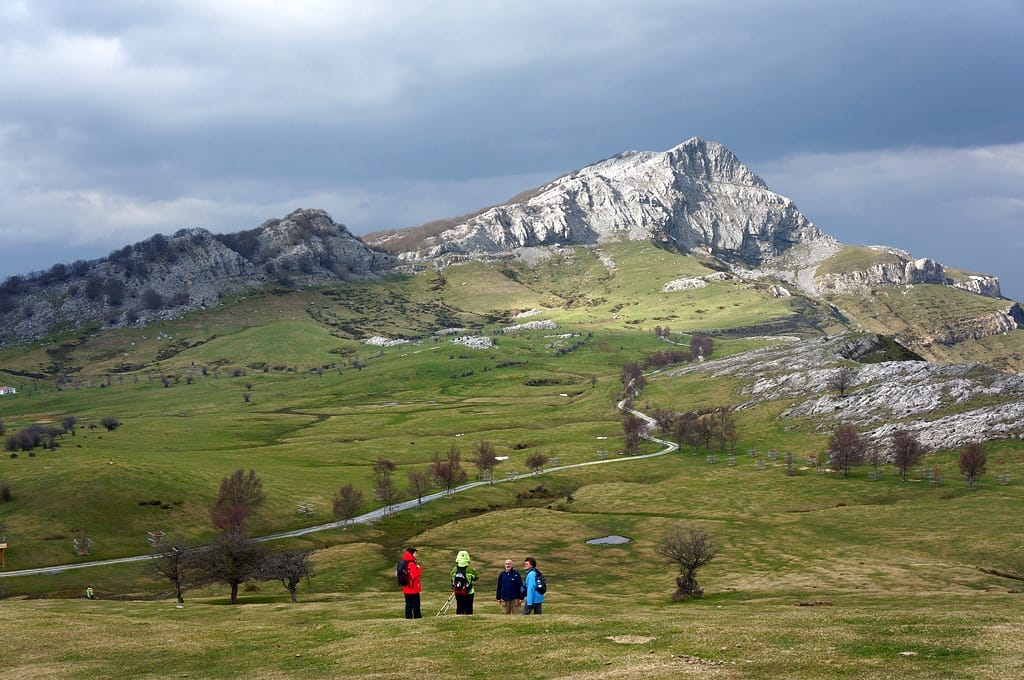
Gorbea Natural Park (Basque: Gorbeia Parke Naturala; Spanish: Parque Natural del Gorbea) is the largest natural park in the Basque Country, covering approximately 20,016 hectares across the provinces of Bizkaia and Álava. Declared a protected area by the Basque Government in 1994, it centres on Mount Gorbea, the highest peak in Bizkaia, rising to 1,482 metres above sea level. The park sits roughly 50 to 60 kilometres south of Bilbao, making it a realistic day trip from the city for walkers, hikers, and anyone who needs to trade the urban estuary landscape for something quieter and greener.
The terrain is striking in its variety. Beech and oak forests cover the lower slopes, their canopies dense enough in summer that the air temperature drops noticeably as you enter them. Higher up, the landscape opens into moorland and mountain pasture, grazed by the same sheep and cattle breeds local farmers have kept here for generations. The park also contains significant karst formations: sinkholes, caves, and underground drainage systems that make the geology as interesting as the scenery above ground.
ℹ️ Good to know
Gorbea has no entry gates or ticketing infrastructure. Access is free, and the park is open at all times. Two visitor centres — one in Areatza (Bizkaia side) and one in Sarria (Álava side) — provide maps, trail information, and exhibitions during their opening hours.
The Summit Cross: Gorbea's Most Recognisable Landmark
The most iconic feature of the park is the iron cross that stands at the summit of Mount Gorbea, approximately 18 metres tall and visible for considerable distances on clear days. Erected in the early 20th century, the cross has become a landmark of Basque mountain culture, appearing on everything from postcards to regional hiking society badges. The walk to the summit is the single most popular route in the park, and for good reason: the views on a clear day extend across the Basque Country and, in exceptional conditions, as far as the Cantabrian coast.
The ascent from common starting points such as the Pagomakurre or Larreder recreational areas typically takes three to four hours at a moderate pace. The route is well-marked but involves significant elevation gain and some exposed ridge walking near the top. The final stretch in particular can be steep, with the path narrowing to rocky terrain that requires sure footing. This is not a casual stroll, and the summit should not be attempted in poor weather: mist rolls in quickly at this altitude, and the exposed upper slopes offer no shelter.
⚠️ What to skip
Mountain weather in the Basque Country changes rapidly, even in summer. Always check forecasts before heading to the Gorbea summit, bring waterproof layers, and start early. The upper ridges can be invisible in cloud by early afternoon on unstable days.
Tickets & tours
Live prices and dates from our booking partner. If you book, we may earn a commission at no extra cost to you.
San Juan de Gaztelugatxe guided tour from Bilbao
From 65 €Instant confirmationFree cancellationSan Sebastian, Hondarribia, Hendaye, and Getaria from Bilbao
From 54 €Instant confirmationFree cancellationGaztelugatxe and Mundaka small group guided tour from Bilbao
From 50 €Instant confirmationFree cancellationBilbao walking tour
From 16 €Instant confirmationFree cancellation
Forests, Trails, and Lower Walks
Not every visit to Gorbea needs to be a summit bid. The park's network of lower trails through its beech and oak forests is genuinely rewarding on its own terms. In autumn, the forest floors are carpeted with rust-coloured leaves, and the light through the canopy at that time of year has a quality that photographers specifically travel here for. In spring, the same forests smell of wet earth and wildflowers, and the streams running off the mountain are at their fullest.
The recreational areas around Pagomakurre and Larreder serve as natural gathering points. On weekday mornings they are almost empty. Arrive on a Sunday in July and you will find Basque families with coolers and folding chairs, hikers returning from early starts, and trail runners completing circuits. The park absorbs the crowds reasonably well given its size, but if solitude is the goal, midweek visits are considerably more peaceful. The Urkiola Natural Park to the northeast offers similar forested terrain and is slightly closer to Bilbao, making it a useful comparison if you are choosing between the two.
Trail difficulty ranges from flat forest paths suitable for families with young children to technical routes over rocky ridgelines. The visitor centres in Areatza and Sarria stock printed trail maps, and the staff can advise on current conditions. If you arrive without a map, download a GPX file before leaving the city: mobile signal in parts of the park is unreliable.
How to Get There from Bilbao
The most practical way to reach Gorbea from Bilbao is by car. The main route follows the N-240 towards Vitoria-Gasteiz via the Barazar pass, which runs along the eastern edge of the park and provides several access points. An alternative approach from the north uses the local road BI-3513 between Orozko and Artea, while the N-622 connects Vitoria-Gasteiz with the Altube area on the Álava side. Total driving time from central Bilbao is roughly one hour, depending on which access point you target.
For those without a car, a bus service running between Bilbao and Vitoria-Gasteiz passes through or near the Altube and Barazar access points. Schedules and stops should be verified directly with the operator before travelling, as service frequency varies by day and season. The lack of reliable public transport is a real limitation: Gorbea is not as easily reached without a vehicle as some of Bilbao's other day-trip destinations. For reference, the Gaztelugatxe sea stack and the coast require similar planning but have marginally better bus connections in high season.
Visitor Centres and Practical Information
Two visitor centres (parketxes) serve as the main information points for the park. The Bizkaia Parketxe is located in Areatza at Gudairen Plaza 1, and opens 10:00 to 14:00 and 16:00 to 18:00. The Álava Parketxe is in Sarria (Lekanda s/n, 01139 Sarria) and opens Tuesday to Sunday from 10:00 to 14:30 and 16:00 to 19:00. Both centres provide trail maps, information on park ecology and history, and staff who can advise on current route conditions. Hours are subject to seasonal variation, so confirm before arriving.
There are no restaurants or shops within the park itself beyond the recreational areas, which may have basic facilities depending on the season. Bring food and water for any walk longer than two hours. Water sources exist on the mountain, but treating or filtering before drinking is advisable. Parking at the main recreational areas is free, though spaces fill early on summer weekends.
Visitors with reduced mobility should contact the parketxes directly for current accessibility information. The lower recreational areas are more accessible than the high-mountain zones, but official sources do not provide detailed step-free access data for specific trails. For a more accessible Bilbao-area nature experience closer to the city, Doña Casilda Park and Etxebarria Park both offer flat terrain and are reachable by public transport.
When to Go and What to Expect by Season
Gorbea is a four-season destination with a different character at each time of year. Late spring (May and June) offers the most reliable combination of mild temperatures, green landscapes, and longer daylight hours. The trails are not yet crowded, wildflowers are out on the lower slopes, and the risk of summer heat exhaustion is minimal. Summer (July and August) brings more visitors, particularly on weekends, and afternoon thunderstorms are common in the mountains. Start the summit walk no later than 8am if you want to be down before conditions deteriorate.
Autumn (September to November) is arguably the most photogenic season, with beech forest turning amber and gold across the hillsides. Temperatures are comfortable for walking, and the crowds thin considerably after mid-September. Winter closes off the summit route entirely for less experienced hikers: snow and ice make the upper slopes dangerous without crampons and appropriate gear, and the ridge can be inhospitable. If you are planning a winter visit to the Basque Country and want to understand the seasonal picture more fully, the guide to Bilbao in winter covers what the region looks and feels like in the colder months.
Photography Tips and What to Capture
The summit cross is the obvious photographic target, and the early morning light on clear days makes it striking, with mist sometimes lingering in the valleys below while the peak is already in full sun. The beech forests are best photographed in autumn and in soft, overcast light, which filters evenly through the canopy and avoids the harsh shadows of direct midday sun. The karst formations and sinkholes in the lower park offer unusual geometric shapes that reward photographers willing to leave the main trails.
Wildlife photography requires patience. The park supports populations of deer, wild boar, and a range of raptors including red kites. Dawn and dusk are the most productive times, particularly in the quieter zones away from the recreational areas. For context on the wider natural landscapes within reach of Bilbao, the Urdaibai Biosphere Reserve to the north is particularly rewarding for birdwatching.
Insider Tips
- The Pagomakurre recreational area on the Bizkaia side is significantly less crowded than Larreder on weekday mornings. Arrive before 9am in summer and you may have the forest to yourself for the first hour of any walk.
- The Areatza parketxe stocks printed trail maps that are more detailed than anything available as a free download. Pick one up before setting out — GPS apps can struggle in the denser forest sections where the canopy blocks signal.
- If you are driving from Bilbao on the N-240, stop at the Barazar pass viewpoint before descending into the park. On clear mornings it offers an orientation view of the whole massif that helps you understand the geography before you are inside it.
- The summit cross is less crowded and more photogenic on weekday mornings. Weekend afternoons in summer can see dozens of hikers at the top simultaneously, which removes any sense of solitude from what is otherwise a remote-feeling ascent.
- The Basque concept of 'txoko' culture means local walking clubs often do organised routes through Gorbea on Saturday mornings. You are unlikely to get lost following the groups, but you will also not have the trails to yourself. Plan accordingly.
Who Is Gorbea Natural Park For?
- Serious hikers targeting the Gorbea summit (1,482 m) and the iconic iron cross
- Families looking for gentle forest walks and equipped recreational areas without the full summit commitment
- Photographers chasing beech forest colour in October and November
- Travellers spending two or more days in Bilbao who want at least one full day of nature away from the city
- Birdwatchers and wildlife observers willing to start at dawn for the best sightings
Nearby Attractions
Combine your visit with:
- Bakio Beach
Stretching nearly a kilometre along the Bizkaia coast, Bakio Beach is the largest and most complete sandy beach within easy reach of Bilbao. With reliable surf, a long promenade, full facilities, and Blue Flag certification, it draws everyone from families to serious wave riders.
- Bermeo
Perched on the rugged Biscay coast about 35 kilometres northeast of Bilbao, Bermeo is one of the Basque Country's oldest and most significant fishing towns. With a harbour still piled with nets, a medieval old quarter dating to 1236, and a front-row seat to one of northern Spain's most dramatic coastlines, it rewards travellers who venture beyond the city.
- Castillo de Butrón
Rising from dense Biscayan woodland just over 20 km from Bilbao, Castillo de Butrón is one of the most visually striking pieces of architecture in the Basque Country. Originally a medieval tower-house, it was radically rebuilt in neo-Gothic style in 1878 and today stands as a classified Historic Monument. Interior access is currently not available to the general public, but the exterior alone makes the short drive worthwhile.
- San Juan de Gaztelugatxe
A 10th-century hermitage perched on a jagged sea islet connected to the mainland by a cobbled stone bridge and 241 steps. San Juan de Gaztelugatxe sits roughly 45 minutes by car from Bilbao and delivers one of the most visually striking landscapes on the entire Atlantic coast of Spain. Free to enter, but requiring advance reservation in peak season.
Planning a trip? Discover personalized activities with the Nomado app.