San Juan de Gaztelugatxe: The Basque Coast's Most Dramatic Hermitage
A 10th-century hermitage perched on a jagged sea islet connected to the mainland by a cobbled stone bridge and 241 steps. San Juan de Gaztelugatxe sits roughly 45 minutes by car from Bilbao and delivers one of the most visually striking landscapes on the entire Atlantic coast of Spain. Free to enter, but requiring advance reservation in peak season.
Quick Facts
- Location
- Between Bakio and Bermeo, Bizkaia coast — approx. 45 minutes by car from Bilbao
- Getting There
- By car: about 45 min from Bilbao via BI-631 and BI-2101. Seasonal bus service available via Bizkaibus
- Time Needed
- 1.5 to 2 hours including the climb, hermitage visit, and return
- Cost
- Free. Timed-entry reservation required in high season and on holidays (also free, via Provincial Council of Bizkaia)
- Best for
- Coastal scenery, photography, hiking, cultural history, day trips from Bilbao
- Official website
- sanjuangaztelugatxe.com/en
What You're Actually Looking At
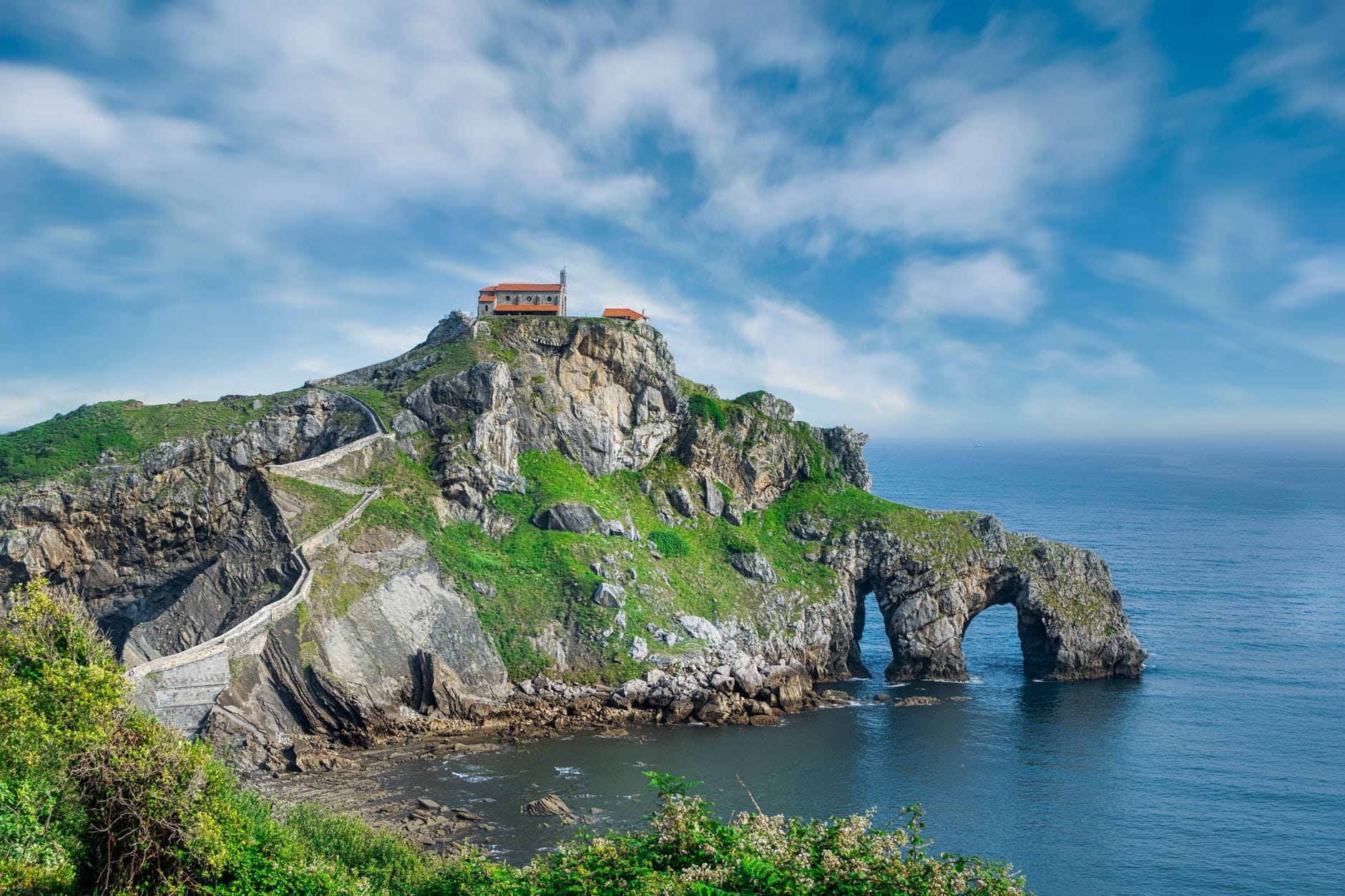
San Juan de Gaztelugatxe is a small, rocky islet rising from the Bay of Biscay, connected to the Basque mainland by a narrow stone bridge and a steep cobbled path that winds upward in tight switchbacks to a whitewashed hermitage at the top. The hermitage sits roughly 80 metres above sea level and is dedicated to St John the Baptist, with origins documented back to the 10th century. The word Gaztelugatxe itself comes from Basque and translates roughly as 'castle rock,' which is exactly what this place looks like when the sea is rough and waves crash against the cliffs below.
The islet is part of a protected coastal landscape on the Biscay coast, positioned between the fishing town of Bermeo to the northeast and the beach town of Bakio to the southwest. What strikes most visitors immediately is not one single feature but the whole composition: the grey-green Atlantic churning around flysch and limestone coastal rock, the bright white hermitage sitting at the summit like a full stop at the end of a long sentence of rock, and the slow procession of people climbing the path in both directions.
ℹ️ Good to know
Gaztelugatxe gained international recognition after appearing as Dragonstone in the TV series Game of Thrones (seasons 7 and 8). Visitor numbers increased sharply after 2017. The site was already significant as a place of Basque pilgrimage long before the cameras arrived — but the TV connection is now unavoidable, and it does affect crowd levels.
The Climb: What to Expect Step by Step
From the car park, a path descends first through low scrubland before reaching the stone bridge that connects the mainland cliff to the islet. This initial descent is easy. What follows is not. The cobbled path rises steeply from the bridge, zigzagging upward through 241 steps to the hermitage door. The steps are uneven, worn smooth in places, and often damp. The railing on one side is helpful but not continuous. Expect to stop and catch your breath at least once, and to pause simply because the view demands it.
The climb takes most people between 15 and 25 minutes going up, and slightly less coming down, though descending on wet cobblestones requires care. Sturdy footwear with grip is not optional on this terrain — it is the difference between a comfortable visit and a stressful one. The path is not suitable for pushchairs, wheelchairs, or anyone with significant mobility limitations. The site's operators are transparent about this: there is no accessible alternative route.
At the top, the hermitage of St John the Baptist is modest in scale but loaded with atmosphere. In high season it typically opens Tuesday to Saturday from 11:00 to 18:00 and Sunday from 11:00 to 15:00. Inside, visitors often ring the bell and make a wish. The site is closely associated with St John's Day traditions and long-standing local devotion. The sound of the bell carries across the cliff face and out to sea.
⚠️ What to skip
The path can be temporarily closed without notice during rough sea conditions or strong winds, particularly in autumn and winter. Check the official site or contact local tourism offices before making a long journey in off-season months.
Tickets & tours
Hand-picked options from our booking partner. Prices are indicative; availability and final rates are confirmed when you complete your booking.
San Juan de Gaztelugatxe guided tour from Bilbao
From 65 €Instant confirmationFree cancellationGaztelugatxe and Mundaka small group guided tour from Bilbao
From 50 €Instant confirmationFree cancellationGaztelugatxe, Mundaka and Gernika from Bilbao
From 105 €Instant confirmationFree cancellationBiscay Bridge, Gaztelugatxe and txakoli tasting small group tour
From 40 €Instant confirmationFree cancellation
How the Experience Changes By Time of Day
Arriving early in the morning, before 9:00, gives you the site in near silence. The light on the Atlantic at that hour is flat and silver, the cliffs still in shadow, and the path almost empty. The smell of sea salt and wet rock is strongest before the midday warmth dries out the air. Seabirds, including yellow-legged gulls and shags, work the cliff ledges below the bridge. In spring and early summer, wild flowers push through the cliff-edge scrub.
By 10:30 on any clear summer morning, the car park fills quickly and the path becomes a two-way procession. The experience is still worthwhile, but the solitude is gone. Midday brings the largest crowds, particularly on weekends and during the school holiday period from late June through August. Late afternoon, from around 16:00 onward, sees numbers drop noticeably as day-trippers head back, and the light turns warmer and more photogenic. If you can only visit during peak season, late afternoon is the better half of the day.
In autumn and winter the site is dramatically different. Fewer visitors, rougher seas, lower cloud wrapping the summit, and the occasional complete closure. Some photographers and committed walkers prefer these months precisely because the raw coastal atmosphere is unfiltered. But the hermitage may be closed, and the path is slippery. The trade-off is real.
Cultural and Historical Context
Gaztelugatxe has been a site of religious significance in the Basque Country for over a thousand years. The hermitage's origins in the 10th century place it firmly in the early medieval period of Basque coastal Christianity, a time when small chapels and oratories were established at sites of natural drama as much as strategic importance.
The pilgrimage on 24 June, the feast of St John the Baptist, draws Basque devotees who make the climb on that day specifically, often from Bermeo on foot. This is not a tourist event but a living tradition, and encountering it gives a different perspective on what the site means locally. Outside of pilgrimage dates, the hermitage functions as a place of quiet devotion and, increasingly, as a destination in its own right.
Gaztelugatxe sits within the broader coastal landscape of Biscay, close to the town of Bermeo, one of the oldest fishing ports in the Basque Country. Combining both in a single day trip makes strong geographic and cultural sense, since Bermeo's harbour, old town, and fishing museum add depth to what would otherwise be purely a landscape excursion.
Getting There: Practical Transport Details
The majority of visitors arrive by car. From Bilbao, take the BI-631 toward the airport, then follow the BI-2101 toward Bakio. From Bakio, the road to the Gaztelugatxe car park is clearly signposted. The drive takes about 45 minutes in normal traffic. The car park is small by the standards of the crowds this site attracts, and in summer it fills before 10:00 on weekends. Overflow parking exists along the approach road, but adds walking time.
In summer, the seasonal Bizkaibus line A3517 runs direct from Bilbao, making the site accessible without a car. Outside of that window, reaching Gaztelugatxe by public transport requires connections through Bakio or Bermeo via local Bizkaibus services, which adds time and complexity. Verify current schedules with Bizkaibus before your trip, as timetables change between seasons.
If you are based in Bilbao and planning a coastal day, consider pairing this trip with Bakio beach, which sits just a few kilometres southwest and offers a long sandy stretch ideal for a rest after the climb. For those exploring the wider coast, the Urdaibai Biosphere Reserve lies just east of Bermeo and makes for an excellent extension to a full day out of Bilbao.
Reservations and Entry: What You Actually Need to Do
Entry to the natural site is free year-round. However, during peak periods, a free timed-entry reservation is required for capacity management. These periods include busy summer dates, weekends, and major holidays. Reservations are managed online through the Provincial Council of Bizkaia's system, linked from the official site at sanjuangaztelugatxe.com.
The reservation system assigns a time slot for your arrival at the car park area. You do not need to print anything; confirmation on a phone screen is accepted. Slots do fill up, especially for Saturday and Sunday mornings in July and August. Booking a week or more in advance is advisable for weekend visits in peak season. The process is straightforward but not optional: turning up unannounced on a busy weekend without a reservation may result in being turned away from the car park.
💡 Local tip
Book your free timed-entry slot as soon as your travel dates are confirmed. Weekend slots in July and August can fill within days of becoming available. Weekday slots are easier to secure and generally mean fewer people on the path.
Photography Tips and Viewpoints
The classic view of Gaztelugatxe, the one that appears on every travel feature, is taken from the mainland cliff to the southwest of the bridge, looking northeast with the islet, bridge, and hermitage all in frame. This viewpoint is accessible from the path before you descend to the bridge, and it requires no climbing. In morning light the hermitage catches direct sun from the east; in afternoon light the cliffs glow orange and the sea turns deep blue or green depending on cloud cover.
From the summit, the view extends along the Biscay coastline in both directions. To the northeast, the cliffs continue toward Bermeo and the mouth of the Urdaibai estuary. To the southwest, Bakio's beach curves into view on clear days. A wide-angle lens or a phone in panorama mode captures more of the scale. Wind at the summit is often strong enough to affect handheld shots; brace against something solid or use a small tripod.
For context on the broader Bilbao-to-coast day trip, the Bilbao beaches guide covers the full range of options along the Biscay coast, including transport logistics and how to combine coastal stops efficiently.
Who Should Think Twice Before Coming
Gaztelugatxe is not for everyone. Visitors with mobility limitations, joint problems, or a fear of exposed heights will find the climb difficult and the path unsettling in places. There is no lift, and reaching the summit requires tackling the steep steps. The site is also not well suited to very young children who are not confident walkers, particularly on the way down when tired.
Visitors hoping for a serene, crowd-free spiritual experience during peak summer should also manage expectations. July and August weekends bring large numbers of visitors, including many who have come specifically because of the Game of Thrones connection. The atmosphere at the top can feel more like a busy scenic overlook than a place of contemplation. If quiet matters to you, a weekday visit in May, June, September or October is a meaningfully different experience.
Insider Tips
- The official car park fills early on summer weekends. Arriving before 8:30 gets you ahead of the main wave and means the path is quiet for the first hour of your visit.
- Wind at the summit can be cold even on warm days. A light windproof layer in your bag costs nothing in weight and makes the time at the top much more comfortable.
- The bell inside the hermitage is rung three times as part of the local tradition of making a wish. If the hermitage is open when you arrive, go inside rather than just photographing the exterior — the interior is small but the ritual adds something to the visit.
- The approach road from Bakio offers several unofficial pull-off points with views of the islet from above and at a distance. These spots, before you reach the car park, provide an aerial perspective that is different from anything you get once you are on the path itself.
- Combine Gaztelugatxe with a stop in Bermeo for lunch. The town is 10 minutes by car and has a working harbour, good seafood restaurants, and an old quarter worth an hour of exploration. It shifts the day from a single photo-stop into a more complete experience of the Biscay coast.
Who Is San Juan de Gaztelugatxe For?
- Walkers and hikers looking for a coastal route with a strong destination at the end
- Photographers chasing dramatic Atlantic coastal scenery in different weather conditions
- Travellers interested in Basque cultural and religious history beyond urban Bilbao
- Day-trippers from Bilbao wanting a full contrast to the city without a long journey
- Fans of on-location travel who want to see the real landscape behind the Game of Thrones filming
Nearby Attractions
Combine your visit with:
- Bakio Beach
Stretching nearly a kilometre along the Bizkaia coast, Bakio Beach is the largest and most complete sandy beach within easy reach of Bilbao. With reliable surf, a long promenade, full facilities, and Blue Flag certification, it draws everyone from families to serious wave riders.
- Bermeo
Perched on the rugged Biscay coast about 35 kilometres northeast of Bilbao, Bermeo is one of the Basque Country's oldest and most significant fishing towns. With a harbour still piled with nets, a medieval old quarter dating to 1236, and a front-row seat to one of northern Spain's most dramatic coastlines, it rewards travellers who venture beyond the city.
- Castillo de Butrón
Rising from dense Biscayan woodland just over 20 km from Bilbao, Castillo de Butrón is one of the most visually striking pieces of architecture in the Basque Country. Originally a medieval tower-house, it was radically rebuilt in neo-Gothic style in 1878 and today stands as a classified Historic Monument. Interior access is currently not available to the general public, but the exterior alone makes the short drive worthwhile.
- Gorbea Natural Park
Rising to 1,482 metres above the green hills south of Bilbao, Gorbea Natural Park is the largest protected natural area in the Basque Country. Spanning over 20,000 hectares of beech forest, karst terrain, and mountain pasture, it offers a wilderness experience within reach of the city.