Museum Sint-Janshospitaal: Bruges' Medieval Hospital Turned Art Sanctuary
Museum Sint-Janshospitaal (Saint John's Hospital) is one of the oldest preserved hospital buildings in Europe, with origins in the 12th century. Today it houses a remarkable collection of Hans Memling paintings alongside medieval medical instruments, pharmacy artifacts, and centuries of institutional history. Located on Mariastraat in the Dijver canal quarter, it is a serious contender for the most historically layered museum in Bruges.
Quick Facts
- Location
- Mariastraat 38, 8000 Brugge — Dijver canal quarter, historic centre
- Getting There
- 15-minute walk from Markt; 10 minutes from Bruges train station on foot via Katelijnestraat
- Time Needed
- 1.5 to 2.5 hours
- Cost
- Adults €15 / Ages 18–25 €13 / Ages 13–17 €7 / Under 13 free
- Best for
- Art history lovers, medieval architecture, Flemish Primitives, quiet museum-goers
- Official website
- www.museabrugge.be/en/visit/locations/sint-janshospitaal
What Is Sint-Janshospitaal?
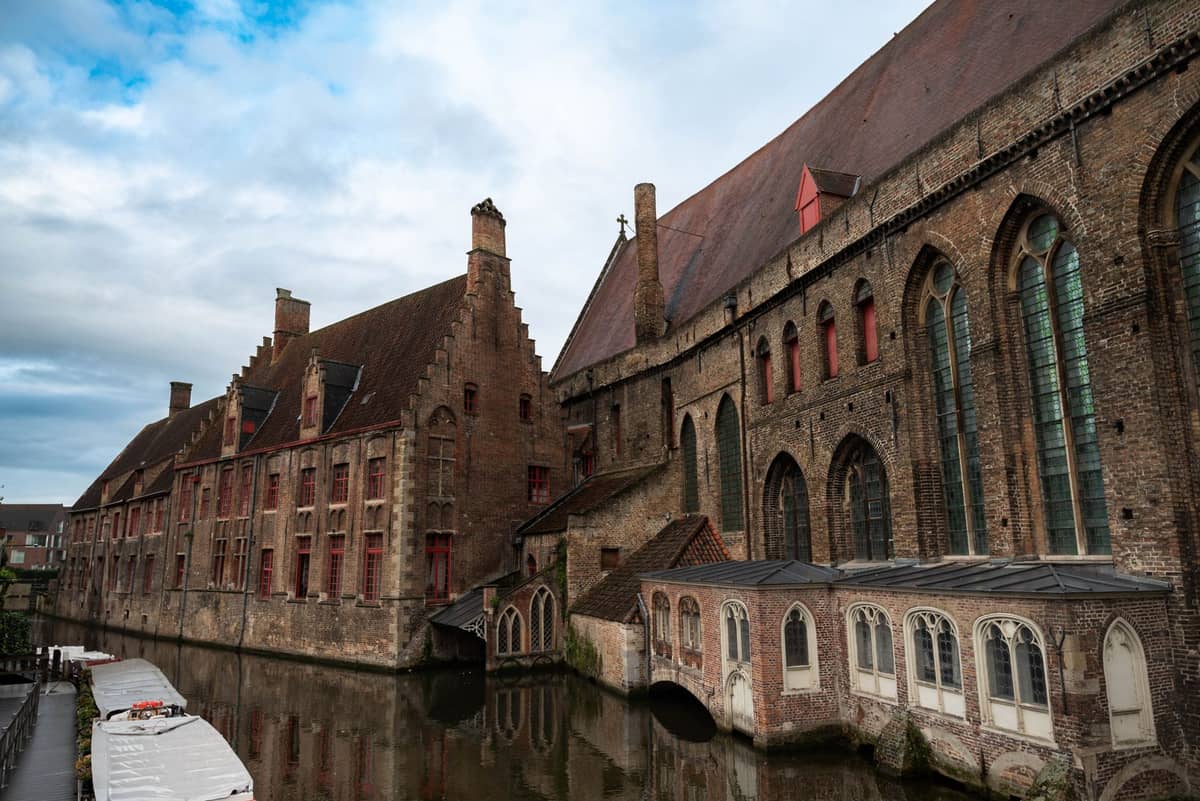
Museum Sint-Janshospitaal — officially Museum St John's Hospital in English, operated by Musea Brugge — is one of the oldest preserved hospital complexes in Europe. Its origins trace back to the 12th century, when it was established as a combined hospital and pilgrims' shelter at a time when Bruges was one of the wealthiest trading cities in northern Europe. For roughly seven centuries, the complex functioned as a working medical institution before transitioning into its current role as a museum.
The building itself tells as much of a story as anything inside it. The great ward, where patients once lay in rows of beds beneath a vaulted wooden ceiling, now serves as the primary exhibition space. The transition from infirmary to gallery happened gradually, and the architecture preserves that layered history: thick stone walls, low arched doorways worn smooth at the edges, and the pharmacy still stocked with 17th-century earthenware jars. You are not looking at a reconstruction. This is the original fabric.
💡 Local tip
The museum is closed on Mondays. Opening hours are Tuesday to Sunday, 09:30–17:00. On 24 and 31 December the museum closes at 16:00; it is closed entirely on 25 December and 1 January. On Ascension Day it closes at 12:30.
The Memling Masterpieces: Why Most Visitors Come
The primary draw for most visitors is the collection of paintings by Hans Memling, the German-born Flemish Primitive master who settled in Bruges in the 1460s and died here in 1494. Sint-Janshospitaal commissioned several of his most significant works, and they have remained in the building ever since. The collection includes the Triptych of Jan Floreins, the Triptych of Adriaan Reins, and the Mystic Marriage of St Catherine — all created specifically for this institution.
The most celebrated single object in the collection is the Shrine of Saint Ursula, a gilded oak reliquary shaped like a miniature Gothic chapel. Memling painted six narrative scenes from the legend of Saint Ursula on its side panels, each panel dense with architectural detail, draped fabric, and faces of individual character. At roughly 87 centimetres tall, it rewards close inspection in a way that reproductions never capture. The level of surface finish — gold leaf, fine brushwork, the way light falls differently on the painted versus gilded surfaces — is only apparent in person.
If you find yourself wanting deeper context for Flemish Primitive painting before or after your visit, the Groeningemuseum is a ten-minute walk away and holds the other major concentration of this period in Bruges, including Jan van Eyck's Madonna with Canon van der Paele.
Tickets & tours
Hand-picked options from our booking partner. Prices are indicative; availability and final rates are confirmed when you complete your booking.
Historium Bruges entrance tickets
From 19 €Instant confirmationFree cancellationBruges food tour with full meal
From 139 €Instant confirmationFree cancellationBruges walking audio guided tour
From 9 €Instant confirmationBruges Family Walking Tour
From 259 €Instant confirmationFree cancellation
Beyond the Paintings: Medical History and the Hospital Itself
The Memling works occupy one wing of the museum, but the full complex covers considerably more ground. The hospital's history as a medical institution is documented through a substantial collection of instruments, documents, and objects: surgical tools that are both technically precise and unsettling in equal measure, apothecary jars still containing traces of 17th-century preparations, and patient records that give an unexpected human dimension to the statistics of medieval healthcare.
The old pharmacy, located in a low-ceilinged room off the main ward, is one of the quieter corners of the museum and one of the more memorable. The wooden shelving runs floor to ceiling, and the jars are labelled in Latin. The smell of old wood and stone is faint but present. It takes a moment to register that this is not a period reconstruction: the fittings are genuinely old, and the room functioned exactly as displayed until the hospital closed its medical operations.
The 17th-century chapter room and the attic spaces accessible on the upper level add further layers to the visit, showing how the institution expanded and adapted over centuries. For visitors who arrived specifically for Memling, these sections can come as a surprise: this is a museum that genuinely repays more than an hour of attention.
What the Visit Actually Feels Like
On weekday mornings, particularly before 11:00, the museum is noticeably quiet. The main ward holds perhaps a dozen visitors at most, and the Shrine of Saint Ursula can be approached without competing for position. Natural light enters from tall windows along the north wall, and the stone floor keeps the space cool even in summer. The acoustic quality is particular: footsteps echo against the vaulted ceiling, and voices carry further than expected, which tends to make people speak more softly.
By midday in peak summer months (July and August), the dynamic shifts. Guided tour groups arrive, and the main Memling gallery can feel crowded around the Shrine. If your visit falls during peak season, the practical advice is to arrive at opening time or to come after 15:30, when day-trippers from Brussels and Ghent tend to be heading back to their transport.
The museum is managed at a measured pace: there is no audio guide pressure, no timed entry, and the flow through the rooms is intuitive. Signage is in Dutch, French, and English. Some rooms are darker than modern museum norms, which suits the painted altarpieces well but means the fine detail of some documents requires patience.
ℹ️ Good to know
Photography without flash is generally permitted in the permanent collection. The Shrine of Saint Ursula is displayed in a case with controlled lighting; avoid using a flash or bright phone torch, which can disturb other visitors examining the surface detail.
Architecture and Setting: The Building as Exhibit
Sint-Janshospitaal stands on Mariastraat, directly adjacent to the Onze-Lieve-Vrouwekerk (Church of Our Lady) to the north. The exterior, in pale limestone and brick, has the measured horizontality of Flemish Gothic institutional architecture rather than the vertical drama of a cathedral. The entrance is understated: a modest portal set into a long street facade, easily missed if you are walking quickly.
The relationship between this building and the surrounding streetscape is part of what makes the Dijver canal quarter coherent as a destination. The Church of Our Lady immediately to the north contains the Michelangelo Madonna and is a separate admission; the Gruuthusemuseum is a short walk further along the same street. These three institutions together represent one of the densest concentrations of medieval art and architecture in northern Europe, and they are genuinely within minutes of each other on foot.
For a broader overview of Bruges' Gothic architecture before your visit, the Bruges Gothic architecture guide provides useful context on how Sint-Janshospitaal fits into the city's architectural heritage.
Practical Details for Your Visit
The museum is at Mariastraat 38, 8000 Brugge. On foot from the Markt, the walk takes around 15 minutes south along Steenstraat and then Mariastraat. From Bruges train station, the walk is approximately 10 minutes via Katelijnestraat, heading northeast into the historic centre. There is no dedicated car parking at the museum; the nearest public parking is at the 't Zand or Katelijne car parks, both within a 10-minute walk.
Admission prices (as of 2026): adults €15, ages 18–25 €13, ages 13–17 €7, under 13 free, seniors 65+ €15. Tickets can be purchased at the entrance or through the Musea Brugge website. A combined Musea Brugge pass covering multiple city museums is available and represents better value for visitors planning to see several collections in one trip.
Accessibility: Musea Brugge confirms that visitors with physical disabilities can visit the museum. An elevator is available, and folding chairs without backrests are provided. The medieval fabric of parts of the building means some areas have thresholds or uneven surfaces; visitors with specific mobility requirements are advised to contact Musea Brugge directly before visiting to confirm current access arrangements.
⚠️ What to skip
The museum closes on Mondays year-round. It also has reduced or no opening on several Belgian public holidays. If your Bruges trip falls on a Monday, plan your museum day around the Groeningemuseum or Gruuthusemuseum instead, and check opening hours for all attractions in advance.
Who Gets the Most From This Museum
Sint-Janshospitaal is genuinely one of the more rewarding museums in Bruges, but it is not the right choice for every visitor. The Memling collection is extraordinary for anyone with even a passing interest in Flemish Primitive painting or late medieval art. The medical history sections add a dimension that most art museums do not attempt. And the building itself, functioning as architecture rather than neutral container, makes the experience feel grounded in place and time.
Visitors who find pre-Renaissance painting difficult to engage with, or who are primarily in Bruges for canal views and chocolate, may find the €15 entry steep relative to their enjoyment. The Historium on the Markt offers a more accessible and theatrical introduction to Bruges' medieval past, while the Bruges chocolate guide covers the city's more sensory pleasures. Sint-Janshospitaal rewards patience and prior interest; it is not a quick tick.
Children under 13 enter free, which makes the admission cost reasonable for families, but the museum's pace and content are better suited to older children and teenagers with some context about the medieval period. Very young children may find the darker rooms and clinical medical exhibits unsettling.
Insider Tips
- Arrive at 09:30 on a weekday morning. The Shrine of Saint Ursula is almost always crowd-free for the first 45 minutes after opening, and you can spend as long as you need examining the panels without anyone waiting behind you.
- The museum shop carries a small but well-curated selection of Memling reproductions and scholarly publications unavailable at most gift shops. If you are serious about Flemish Primitive painting, it is worth browsing before you leave.
- The courtyard visible from the main ward corridor is not always clearly signposted as accessible. Look for the door near the pharmacy section: the courtyard gives a sense of the scale of the original hospital complex and is a calm place to pause.
- The Musea Brugge combination ticket covers Sint-Janshospitaal alongside the Groeningemuseum, Gruuthusemuseum, and several other city museums. If you are visiting more than two Musea Brugge sites, the combined pass is significantly better value than individual admissions.
- On rainy days, Sint-Janshospitaal is one of the few Bruges attractions that actually improves in atmosphere. The light through the high ward windows on an overcast day is closer to the conditions in which Memling's altarpieces were originally meant to be seen.
Who Is Saint John's Hospital (Sint-Janshospitaal) For?
- Art history enthusiasts, particularly those interested in Flemish Primitive painting and Hans Memling
- History-focused travellers wanting to understand how medieval institutions shaped urban life
- Visitors seeking a quieter alternative to the crowds at the Markt and Belfort
- Families with older children and teenagers studying medieval European history
- Photographers interested in low-light architectural interiors and painted altarpieces
Nearby Attractions
Other things to see while in Dijver Canal Quarter:
- Hof Arents
Hof Arents is a free public park in the heart of Bruges, set along the Dijver near the Church of Our Lady and the Gruuthuse domain. Once part of the historic Gruuthuse estate, it offers canal views and a quiet break in the historic centre.
- Boniface Bridge (Bonifaciusbrug)
The Bonifaciusbrug is a small pedestrian bridge over a canal in the heart of Bruges, tucked behind the Church of Our Lady and near the Gruuthusemuseum. Built in 1910 but styled to look centuries older, it offers one of the city's most reproduced canal views. Entry is free and the surrounding garden is open daily.
- Groeninge Museum
The Groeningemuseum on Dijver holds one of the most concentrated collections of Flemish Primitive painting anywhere in the world, including landmark works by Jan van Eyck and Hans Memling. Compact enough to absorb in two hours, serious enough to reward repeat visits, it anchors Bruges' reputation as a city of medieval artistic genius.
- Gruuthuse Museum
The Gruuthuse Museum occupies a late medieval city palace on the Dijver canal, tracing Bruges' history from the Middle Ages to the 19th century through furniture, tapestries, weapons, and devotional art. It is one of the few places in Bruges where the building itself is as significant as what it contains.