Shanghai Propaganda Poster Art Centre: A Window into China's Visual Past
Tucked onto the 7th floor of an office tower in Changning District, the Shanghai Propaganda Poster Art Centre holds one of the world's most significant private collections of Chinese political posters from the 1940s to the 1970s. It is compact, quietly curated, and genuinely unlike anything else in the city.
Quick Facts
- Location
- 7F, East Tower, 726 Yan'an West Road, Changning District, Shanghai
- Getting There
- Jiangsu Road Metro Station (Lines 2 & 11), approx. 10–15-minute walk
- Time Needed
- 45–90 minutes
- Cost
- Approx. 20–25 CNY adult admission (verify before visiting)
- Best for
- History buffs, design enthusiasts, China watchers, photography lovers
- Official website
- http://www.shanghaipropagandaart.com
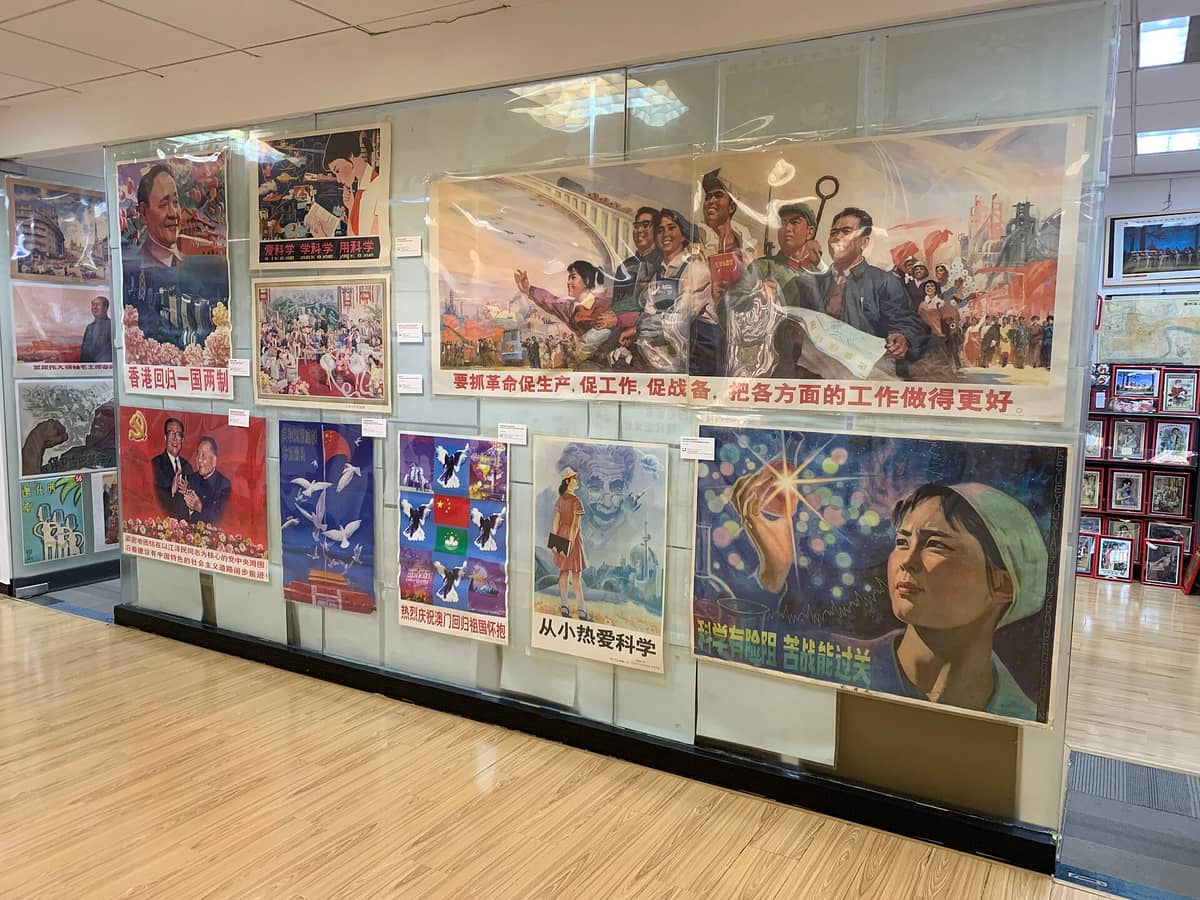
What This Place Actually Is
The Shanghai Propaganda Poster Art Centre is a private museum dedicated to Chinese political posters produced roughly between the 1940s and the late 1970s. It is not a government institution. The collection belongs to Yang Peiming, a private collector who spent decades acquiring posters that most Chinese households quietly discarded after the Cultural Revolution ended. The museum's current official Chinese name, 上海杨培明宣传画收藏艺术馆, directly honors his role as the collection's custodian.
The posters span the founding years of the People's Republic, the Great Leap Forward, the Cultural Revolution, and the immediate post-Mao period. What makes this collection arresting is not just its political content but its graphic design. These images were made by trained artists working within strict ideological frameworks, and the results are often visually sophisticated: bold primary colors, heroic compositional angles, figures rendered with a muscularity borrowed partly from Soviet socialist realism and partly from traditional Chinese illustration.
ℹ️ Good to know
The museum is now listed at its current 7th-floor office tower location at 726 Yan'an West Road. Several older travel articles still list the former Huashan Road address. Use 726 Yan'an West Road, East Tower, 7F when navigating. Several older travel articles still list the former address. Use 726 Yan'an West Road, East Tower, 7F when navigating.
Finding the Place: Navigation Notes
Getting here requires a small amount of determination. The museum sits inside the Huamin Han Zhen International complex at 726 Yan'an West Road, an office and commercial tower that gives no external indication of what is on the 7th floor. From Jiangsu Road Station (Lines 2 and 11), the walk takes roughly nine minutes heading east along Yan'an West Road. Enter the East Tower, take the elevator to the 7th floor, and follow signs for Room K.
If you are using a ride-hailing app such as Didi, search for the Chinese name 上海杨培明宣传画收藏艺术馆 rather than the English name, which often fails to resolve to the correct building. This part of Changning District sits between the commercial energy of Huaihai Road and the quieter residential streets to the west. It is not a tourist corridor, which adds to the sense that you are finding something slightly off the standard circuit.
⚠️ What to skip
Do not rely on Google Maps alone in mainland China. Use Baidu Maps or Gaode Maps, or show a taxi or Didi driver the Chinese address: 上海市长宁区延安西路726号华敏翰尊东楼7楼K座.
Tickets & tours
Hand-picked options from our booking partner. Prices are indicative; availability and final rates are confirmed when you complete your booking.
Shanghai city and Zhujiajiao water town private tour with lunch
From 371 €Instant confirmationFree cancellationShanghai private tour with iconic landmarks of the old and new city
From 284 €Instant confirmationFree cancellationShangai Yuyuan Garden entrance tickets
From 9 €Instant confirmationFree cancellation
The Collection: What You Will See
The posters are displayed in a series of rooms that feel more like a serious archive than a flashy gallery. The lighting is controlled, the wall spacing is generous, and the labeling is in both Chinese and English. This is not a space that tries to overwhelm you with quantity. Instead, the selection feels deliberately curated, with thematic groupings that move through different periods and propaganda functions.
Early pieces from the late 1940s and 1950s show the optimism of national consolidation: workers and farmers marching forward, industrialization celebrated with factory smokestacks rendered almost romantically. As you move into Cultural Revolution material from the 1960s and early 1970s, the imagery becomes more intense. Mao appears frequently, often bathed in golden light. Red Guards stride across landscapes. Slogans are incorporated directly into compositions as graphic elements. The color palette becomes more saturated, the figures more angular.
Later posters from the transitional late-1970s period show a subtle shift in tone: children return to schoolbooks, scientists appear alongside peasants, and the imagery of class struggle softens into something closer to national development. This arc across three decades is legible even without a detailed knowledge of Chinese political history, and the museum's English labels help contextualize key moments.
How the Visit Feels at Different Times of Day
The museum opens at 10:00 and sees its lightest traffic on weekday mornings, when the office tower is occupied mainly with workers who pay the small gallery no attention. Arriving between 10:00 and 11:30 on a Tuesday or Wednesday gives you an experience that is close to private. The rooms are quiet enough to hear the faint hum of climate control systems, and you can stand in front of a large-format poster for several minutes without anyone behind you.
Weekend afternoons attract more visitors, including a mix of expatriates, Chinese visitors with a historical interest, and the occasional school group. Even at its busiest, the space does not feel crowded in the way that larger Shanghai museums can on public holidays. Last entry is around 16:30, and the museum closes at 17:00. Late afternoon visits on clear days mean that natural light entering the east-facing windows creates a warm tonal shift in the rooms, which some visitors find affects how they read the poster colors.
Photography and the Souvenir Shop
Photography of the collection is generally permitted for personal use, though you should confirm this with staff at entry. The posters reward close attention from a photographic standpoint: the printing techniques of the era (typically lithography and screen printing) are visible at close range, with registration marks, color separations, and paper texture all legible if you photograph at a slight angle to the surface. A standard smartphone camera handles the controlled lighting well, though a phone with good low-light performance will produce cleaner results.
The museum sells reproduction prints, postcards, and books. The reproductions are printed on paper that approximates the weight and texture of original poster stock. Several visitors note that the souvenir shop is one of the more thoughtful in the city: the selection is small, the quality is consistent, and nothing is priced at the inflated levels you encounter at more commercial attractions. A set of postcard reproductions makes for a genuinely distinctive memento of Shanghai that you will not find anywhere else.
Historical and Cultural Context
Chinese propaganda posters served a specific mass-communication function in a period when television was rare and literacy rates were uneven across the population. Posters were printed in enormous runs and distributed to work units, schools, and public spaces. They were intended to be read quickly and emotionally, to communicate Party directives and model behavior without requiring text comprehension. The artists who made them were often graduates of fine arts academies and worked within a system that valued technical skill even as it constrained subject matter. This context matters when looking at the work, because the tension between artistic training and ideological constraint produces images that reward formal analysis alongside historical reading. For more on how Shanghai's cultural institutions frame this period, the Shanghai History Museum at the base of the Oriental Pearl Tower provides useful comparative context on 20th-century urban life.
The decision to maintain this collection in Shanghai is itself meaningful. The city's relationship with the Mao era is complicated: Shanghai was both a site of intense Cultural Revolution activity and, before 1949, a cosmopolitan port city with deep connections to foreign capital and culture. That a private collector chose to preserve this material, and to display it in a context that allows critical engagement rather than pure nostalgia or condemnation, is part of what makes the centre worth visiting. For travelers exploring Shanghai's more unconventional cultural offerings, the M50 Creative Park and the Power Station of Art offer different angles on how the city processes its industrial and ideological past through contemporary art.
Practical Details and Accessibility
Admission is approximately 25 CNY for adults, though this should be verified before your visit as pricing has changed at least once in recent years. The museum is reported to be closed on Mondays, open Tuesday through Sunday from 10:00 to 17:00 with last entry at 16:30. These hours are subject to change; calling ahead or checking the official site before visiting is advisable, particularly around public holidays.
The 7th-floor location is reached by elevator in the East Tower, which makes the space accessible to visitors with mobility limitations in terms of vertical access. The internal layout has not been formally documented in accessibility directories, so visitors with specific requirements should contact the museum directly before visiting. The office tower lobby requires you to sign in or show your purpose at reception on some days, so having the museum name written in Chinese is useful.
💡 Local tip
Wear comfortable shoes. The walk from Jiangsu Road Station takes about 10–15 minutes on flat pavement. If the weather is warm, the air-conditioned gallery provides welcome relief. Bring cash for entry and the souvenir shop, as card acceptance is not guaranteed.
Who Will Not Enjoy This
Travelers who want large-scale, immersive museum experiences will find this space modest. It is a single-collector archive in a repurposed office suite, not a grand institution. Visitors expecting extensive English interpretation of every piece, audio guides, or interactive displays will be disappointed. Children under ten are unlikely to engage with the material, and there is nothing designed for them. If your priority is sweeping Shanghai skyline views or high-energy attractions, your time is better spent at the Shanghai Tower observation deck or along the Bund promenade.
Insider Tips
- Search for the museum using its Chinese name 上海杨培明宣传画收藏艺术馆 on Baidu Maps or when giving directions to a driver. The English name often fails to resolve to the correct building.
- Arrive on a weekday morning, ideally Tuesday to Thursday between 10:00 and 11:30, for the closest thing to a private viewing. The space can feel genuinely solitary at these times.
- Photograph poster surfaces at a slight angle rather than straight on. This reveals the original lithographic printing texture and color separation details that disappear in flat shots.
- Budget extra time for the souvenir shop. The reproduction prints and postcard sets are small-format and genuinely well-made. A selection from here is among the most distinctive souvenirs available in Shanghai.
- If the East Tower lobby requires sign-in, simply write the museum's Chinese name on your phone and show it to reception.
Who Is Shanghai Propaganda Poster Art Centre For?
- Travelers with a serious interest in 20th-century Chinese history and politics
- Graphic designers and visual artists interested in propaganda aesthetics and print techniques
- Repeat visitors to Shanghai who have covered the main landmarks and want something genuinely different
- Writers, academics, and journalists researching the Mao era or Cultural Revolution
- Anyone who wants a quiet, unhurried museum experience away from large crowds
Nearby Attractions
Combine your visit with:
- Chongming Island
Chongming Island sits at the mouth of the Yangtze River, a vast alluvial island that functions as Shanghai's rural counterweight. Wetland reserves, a national forest park, cycling paths through farmland, and virtually no high-rises make it a genuinely different Shanghai experience.
- ERA Acrobatics Show
Running nightly at Shanghai Circus World in Jing'an District, ERA2 – Spirit of Shanghai is the city's flagship acrobatics production. Expect gravity-defying stunts, dramatic lighting, and a 60-to-100-minute show that needs no translation. Here is everything you need to know before buying a ticket.
- Jade Buddha Temple
The Jade Buddha Temple (玉佛禅寺, Yùfó Chán Sì) is one of Shanghai's most significant active Buddhist monasteries, housing two exceptional jade Buddha statues brought from Burma in the late 19th century. Unlike many temples that have become purely ceremonial attractions, this one functions as a working monastery, with monks in residence and daily rituals that visitors can witness firsthand.
- Jinshan City Beach
Jinshan City Beach (金山城市沙滩景区) is a man-made coastal resort on Hangzhou Bay, about 60 km south of central Shanghai. It is the closest thing to a genuine beach day the city offers, with designated swimming zones, a long promenade, and seasonal facilities. This guide covers what to realistically expect, when to go, and how to get there.