Setti Fatma Waterfalls: A Complete Guide to the 7 Cascades of the Ourika Valley
About 60 km southeast of Marrakech, the Setti Fatma Waterfalls rise through a series of seven cascades above a Berber village in the High Atlas foothills. The hike is rewarding but demanding, and the surrounding valley is one of the most striking day trips from the city.
Quick Facts
- Location
- Setti Fatma village, Ourika Valley, Al Haouz Province — approx. 60 km southeast of Marrakech
- Getting There
- Shared grand taxi or private vehicle from Marrakech; local minibuses from Bab er-Rob run to the village but are slow and crowded
- Time Needed
- Half day minimum (3–5 hours including travel); full day recommended
- Cost
- Free entry; local guide approx. 100–200 MAD, parking approx. 10–20 MAD
- Best for
- Nature lovers, hikers, day-trippers from Marrakech, families with older children
What the Setti Fatma Waterfalls Actually Are
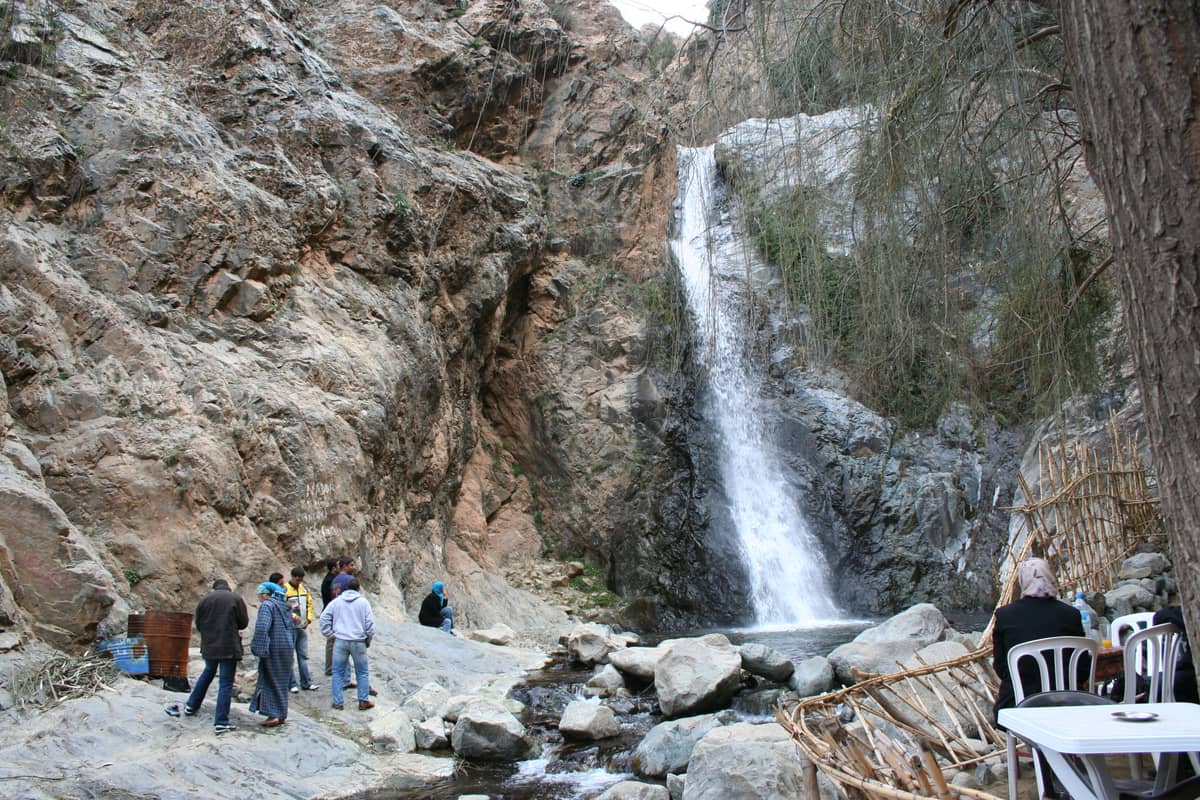
The Setti Fatma Waterfalls, known locally as Les 7 Cascades de Setti Fatma, are a series of seven cascades that tumble down the rocky flanks of the High Atlas above the Berber village of Setti Fatma on the Ourika River. The village itself sits at roughly 1,450 metres elevation, and the uppermost waterfall is several hundred metres higher still. The terrain changes noticeably as you climb: what begins as a well-worn path through café terraces becomes a hands-and-feet scramble over boulders and slippery rock faces by the upper falls.
Most visitors only reach the first one or two cascades, which are impressive enough — wide curtains of white water dropping into shallow pools ringed by mossy rock. The upper five require real effort: exposed ledges, fixed rope sections, and sections where the trail disappears into the streambed. They reward those who push on with solitude, altitude views across the valley, and a genuine sense of having earned the view.
ℹ️ Good to know
Entry to the waterfalls is free. Costs to budget: local guide (100–200 MAD per group), parking (10–20 MAD), donkey ride on the lower path (50–150 MAD). Guided day tours from Marrakech for the hike to the falls typically cost several hundred MAD per person rather than a few dozen.
How to Get There from Marrakech
Setti Fatma sits at the end of the Ourika Valley road, roughly 60 km southeast of Marrakech. Local minibuses as well as shared grand taxis leave from the Bab er-Rob area of Marrakech's medina and cover the route in about 60–90 minutes, depending on stops. The road follows the Ourika River through increasingly dramatic gorge scenery, passing Berber villages and market stalls. It is a beautiful drive in its own right. For more detail on transport options within the region, see the getting around Marrakech guide.
Renting a private car or booking a day tour from Marrakech gives you more flexibility, especially if you want to stop along the Ourika Valley road. Tours typically depart in the morning and include a lunch stop at one of the riverside restaurants before the hike. If you are driving, parking is available near the village entrance for around 10–20 MAD.
⚠️ What to skip
The Ourika Valley road can flood after heavy rainfall, particularly between November and March. Flash floods have caused fatalities in this area historically. Check local conditions before travelling during the rainy season, and do not attempt the hike if the river is running high.
Tickets & tours
Live prices and dates from our booking partner. If you book, we may earn a commission at no extra cost to you.
Full Day Economic Tour of Ouzoud Waterfalls from Marrakech
From 39 €Instant confirmationFree cancellationOuzoud Waterfalls private tour from Marrakech
From 20 €Instant confirmationFree cancellationEssaouira, Ourika Valley and Ouzoud Waterfalls tours from Marrakech
From 99 €Instant confirmationFree cancellationPrivate tour to Ouzoud Waterfalls from Marrakech
From 75 €Instant confirmationFree cancellation
The Hike: What to Expect at Each Stage
From the village, the path to the first waterfall takes around 30–45 minutes at a moderate pace. The lower trail passes through clusters of cafés and souvenir stalls that line the river bank. Vendors are persistent but easy to move past. The sound of the water gets louder quickly once you leave the main strip and cross the first set of stepping stones.
The first cascade is the most photogenic and the most crowded. It drops into a broad pool where local children swim in summer. If you stop here and turn back, you have still had a good excursion. But the trail continues steeply to the right, and each subsequent fall offers a different character: narrower channels, deeper pools, more exposed rock faces. By the third and fourth cascades, the crowd has thinned considerably.
The path to the upper cascades is not marked and requires scrambling over loose rock. Fixed ropes are present at some sections but their condition varies. This is where hiring a local guide from the official guides office in the village makes practical sense, not just as a formality. The guides know which footholds are stable and which are not. Budget around 100–200 MAD for a group, negotiated before you start.
💡 Local tip
Wear closed-toe shoes with grip — sandals and flat-soled trainers are not adequate for the upper falls. The rock surfaces are often wet and smooth. Trekking poles help on the descent.
Best Time to Visit: Seasons and Time of Day
Spring (March to May) is the most rewarding time to visit. Snowmelt from the High Atlas peaks keeps the Ourika River full and the cascades are at their most powerful, with water volume noticeably higher than in summer. The valley is green and cool, temperatures are comfortable for hiking, and the light in the gorge is soft and clear. For broader context on Marrakech's seasons, the best time to visit Marrakech guide covers the full year in detail.
Summer (June to August) brings the largest crowds, particularly on weekends when Marrakech families use the valley as a cool escape from city heat. The falls themselves are lower in volume but the pools are ideal for swimming. Weekday mornings before 10am are significantly quieter than weekend afternoons. Autumn is similar to spring in terms of conditions, though the river runs lower. Winter visits are possible on clear days but the upper falls carry a real ice risk on exposed sections, making them dangerous without proper footwear.
Regardless of season, arriving early makes a meaningful difference. By 9am the valley is quiet and the light on the falls is direct and clean. By noon in summer the lower path fills with group tours and the cafés are at capacity. The walk itself takes most of the morning if you reach the upper cascades, so an early start is both practical and rewarding.
The Village and the Valley Beyond
Setti Fatma village is a working Berber settlement, not a tourist reconstruction. The cafés along the river are mostly family-run, with plastic chairs set out over the water on wooden platforms. The food is straightforward: tagines, omelettes, mint tea, and fresh bread. Prices are reasonable, though some places charge more for the riverside view. The village hosts a moussem (annual religious festival) each August, drawing pilgrims and traders from across the region — worth knowing about if you plan to visit at that time, as accommodation fills quickly and the valley becomes crowded. The Ourika Valley as a whole makes for an excellent day trip from Marrakech, with several points of interest along the road before you even reach Setti Fatma.
Beyond the waterfalls, the valley offers additional walking for those who want to explore further. Trails lead into the hills above the village toward more remote Berber communities, though these require local knowledge and a full day. The Ourika Valley is a different landscape from the desert and dune experiences to the south, and the contrast with Marrakech's urban density is pronounced from the moment you leave the city.
Photography, Practicalities, and Accessibility
The lower falls photograph well in morning light, when direct sun hits the water from above the gorge walls. Midday light in summer creates harsh shadows on the rock faces. A wide-angle lens captures the scale of the first cascade; a telephoto compresses the valley behind you nicely on the way up. The water is fast-moving and white, so exposure compensation is useful to avoid blown highlights.
The path to the waterfalls is not accessible by wheelchair and is challenging for anyone with limited mobility. The lower trail involves uneven stone surfaces and river crossings on stepping stones. The upper falls require confident scrambling. Children who are comfortable on rough terrain can manage the first two or three cascades, but the upper sections are unsuitable for young children. Older, active children often find the climb exciting.
Bring more water than you think you need — the climb is more strenuous than it appears from the village, and there are no water sources on the upper trail. Modest dress is appropriate for the village itself, in line with general guidance for rural Morocco. For more on appropriate attire throughout the region, the Marrakech what to wear guide is a useful reference.
Is It Worth the Trip?
The Setti Fatma Waterfalls are not the grand, dramatic spectacle that some tour marketing implies. If you have seen large waterfalls elsewhere in the world, the scale here will not surprise you. What makes the visit worthwhile is the combination: the drive through the Ourika Valley, the Berber village atmosphere, the gorge landscape, and the physical satisfaction of reaching the upper falls. It is a good half-day out from Marrakech that delivers something meaningfully different from the city's medina, palaces, and souks. Those who come expecting Niagara will leave disappointed. Those who come for a mountain hike with cultural texture will leave satisfied. If you are already considering the Ourika Valley as part of your itinerary, Setti Fatma is the logical end point of that route.
Travellers who are not comfortable with uneven terrain, who dislike persistent vendor attention, or who are visiting in peak summer on a weekend should reconsider or adjust expectations. For those seeking a more dramatic Atlas experience, Ouzoud Waterfalls to the northeast of Marrakech offer a more visually spectacular waterfall experience, though with a longer drive.
Insider Tips
- Hire a guide from the official guides office inside the village, not from touts at the entrance. The official guides wear ID badges, know the route to the upper falls, and charge a fixed rate negotiated upfront.
- If you visit on a weekday in spring, you may have the upper falls almost entirely to yourself. Weekend visits in July and August mean sharing the lower path with large group tours.
- The riverside café terraces are a pleasant stop for lunch, but check your bill before paying — a few places add items not ordered. Simple tagine and mint tea is the reliable order.
- Bring a dry bag or waterproof cover for your camera and phone. The lower path involves crossing the river on stepping stones, and spray from the first cascade is significant when water levels are high.
- Some local families offer basic guesthouses in or near Setti Fatma village, allowing an overnight stay that lets you reach the falls at first light before any groups arrive — a completely different experience from a day trip.
Who Is Setti Fatma Waterfalls For?
- Hikers and active travellers wanting a physical excursion outside the city
- Travellers on a multi-day Marrakech itinerary looking for landscape contrast
- Families with older children who are confident on rough ground
- Photography enthusiasts interested in water, gorge, and mountain light
- Anyone visiting Marrakech in spring when the Atlas snowmelt makes the falls most impressive
Nearby Attractions
Combine your visit with:
- Agafay Desert
Just 30 to 40 kilometres southwest of Marrakech, the Agafay Desert is a rocky plateau of roughly 300 to 400 square kilometres that delivers dramatic open-sky landscapes without a multi-day Sahara expedition. It is not the sand-dune desert many visitors picture, but that distinction is part of its appeal: a raw, mineral terrain framed by the snow-capped peaks of the High Atlas, accessible within an hour of the city.
- Aït Benhaddou
Rising from the southern slopes of the High Atlas, the Ksar of Aït Benhaddou is a UNESCO World Heritage Site and one of Morocco's most architecturally striking places. Built from pisé earth and palm wood, this fortified village has stood at the crossroads of trans-Saharan trade for centuries — and remains partly inhabited today.
- Anima Garden
Set along the Ourika road 27 km south of Marrakech, Anima Garden is a three-hectare art-and-nature space created by Austrian artist André Heller. Sculptures, water features, and carefully curated plantings coexist in a setting that feels both otherworldly and deeply rooted in Moroccan landscape. It rewards slow exploration and offers a genuine contrast to the pace of the medina.
- Essaouira
Essaouira is a UNESCO-listed fortified coastal city on Morocco's Atlantic coast, roughly 2.5 to 3 hours from Marrakech by road. Its 18th-century medina, ocean-facing ramparts, and salt-aired souks offer a complete change of pace from the heat and intensity of the inland city. Entry to the medina is free.
Planning a trip? Discover personalized activities with the Nomado app.