Seitan Limani Bay: Crete's Most Dramatic Cove (And How to Visit It Wisely)
Seitan Limani, also known as Stefanou Beach, is a narrow sea cove carved into the cliffs of the Akrotiri Peninsula northeast of Chania. Its turquoise water and sheer rock walls are genuinely spectacular, but reaching it requires a steep 15-minute descent on an uneven trail, and summer crowds can overwhelm the tiny beach. Know what you're getting into before you make the drive.
Quick Facts
- Location
- Akrotiri Peninsula, ~22–24 km northeast of Chania city center
- Getting There
- Car only; drive toward Chania Airport, follow signs to Chordaki, then Seitan Limania. Park at the clifftop lot.
- Time Needed
- 2–4 hours including the walk down and back
- Cost
- Free entry. No facilities on site.
- Best for
- Photographers, experienced swimmers, adventurous couples, early risers
What Seitan Limani Actually Is
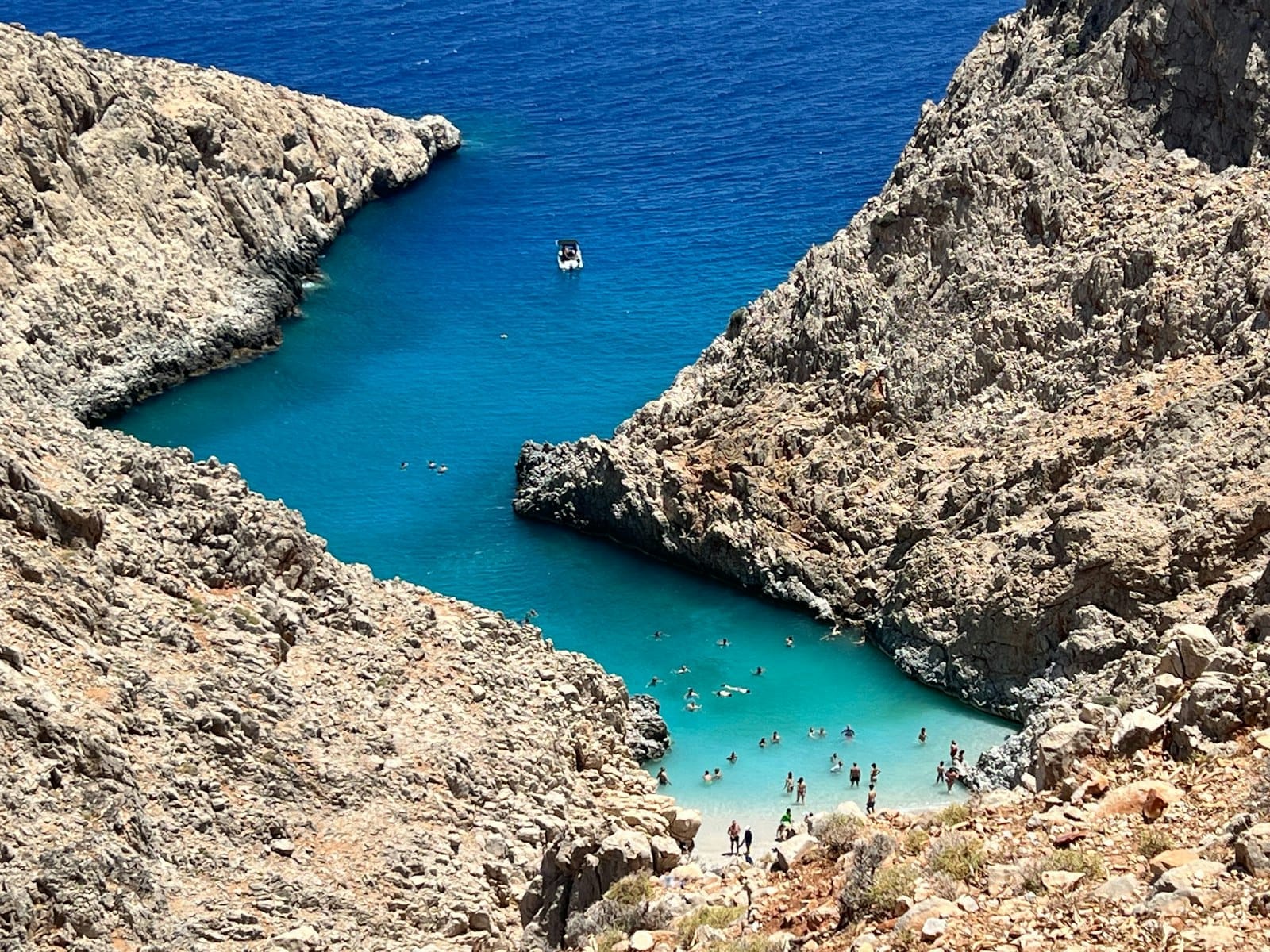
Seitan Limani (Greek: Σεϊτάν Λιμάνια) translates loosely as "Devil's Ports," a name inherited from the Ottoman period and believed to reference either the bare, forbidding rock faces or the dangerously unpredictable waves that surge through the cove during rough weather. It is also called Stefanou Beach or Agiou Stefanou Beach on some maps and signs. Whatever you call it, the place is geologically unusual: a pair of narrow sea inlets carved into the pale limestone cliffs of Cape Akrotiri, filled with water so visibly turquoise it looks digitally altered. It isn't.
The beach itself is a thin strip of coarse sand mixed with small pebbles, tucked between cliff walls that rise sharply on both sides. There are no sunbeds, no umbrellas, no kiosks, no toilets, and no shade except what the cliff casts in early morning and late afternoon. What you get is unobstructed natural scenery, goats occasionally picking their way down the rocks, and water that is clear enough to see the bottom at serious depth.
⚠️ What to skip
This is an unorganized, facility-free beach. Bring at least 1 liter of water per person, sun protection, and closed-toe shoes for the descent. There is nothing to buy once you leave the parking area.
The Descent: What the Trail Is Really Like
From the clifftop parking area, the footpath to the beach takes roughly 15 minutes going down and closer to 20 coming back up. That doesn't sound like much until you're on it. The trail is a mix of stone steps, compacted earth, and loose gravel, and it drops steeply toward the waterline. In summer, the rock surface heats up significantly, and any moisture from sea spray or morning dew makes the lower section slippery. Flip-flops and sandals are a genuine hazard here. Wear sports shoes or light hiking footwear.
The path is exposed for most of its length, meaning no handrails and no shade. On the way up in the midday heat, this becomes noticeable quickly. If you are not comfortable with uneven, steep terrain, this beach is not a good match. The same applies to young children, elderly visitors, and anyone with mobility limitations. There is no wheelchair access and no alternative route to the water.
💡 Local tip
Arrive before 9 AM in July and August. The parking area fills early, the trail gets congested, and the small beach becomes genuinely overcrowded by mid-morning. Early arrival also means the cliffs still cast shade across part of the cove.
Tickets & tours
Hand-picked options from our booking partner. Prices are indicative; availability and final rates are confirmed when you complete your booking.
Visit a Family-Run Olive Mill with Food Tasting in Heraklion
From 19 €Instant confirmationFree cancellationSnorkeling experience in Crete
From 45 €Instant confirmationFree cancellationSpinalonga self-guided audio tour on your phone
From 12 €Instant confirmationFree cancellationMalia to Sissi private tuk-tuk journey with tastings
From 45 €Instant confirmationFree cancellation
The Water and the Swimming
The swimming here is the reason people make the trip. The cove is sheltered enough that the water is typically calm when the broader sea is not especially rough, and the color is a result of the pale limestone seabed combined with the depth gradient of the inlet. Sea temperatures around the Akrotiri Peninsula run approximately 23°C in June, rising to around 28°C by August, and staying warm into late September.
Entry is from the pebbly beach at the base of the cove. The water deepens quickly, so confident swimmers will find plenty of room to move, while weaker swimmers should be more cautious. When the open sea is rough, swell can push through the narrow inlet with surprising force. There are no lifeguards. Check conditions before getting in, and pay attention to how the water is moving.
If you want to compare Crete's most celebrated beaches, Seitan Limani sits in a different category from the broad sandy stretches of the island's west coast. For contrast, see the guide to Elafonissi Beach or the remote Falassarna Beach, both of which are more accessible and better suited to families.
How the Experience Changes Through the Day
Early morning, before 8:30 AM, is when Seitan Limani is closest to what the photographs suggest: still water, no crowd noise, the cliff walls holding shadow over part of the cove, and the color of the water shifting from pale grey to turquoise as the light increases. You can hear the water moving against the rock, faint and rhythmic. Occasionally a goat will appear on the cliff face above. If you want this version of the place, you have to earn it with an early start.
By 10 AM in peak season, the parking area is at capacity and the trail has a steady stream of people in both directions. The beach, which is not large, becomes crowded enough that finding space to set down a towel requires patience. The acoustic character of the cove amplifies voices, so the sense of isolation disappears entirely. Midday is the least rewarding time to visit, both for the crowd levels and the overhead sun, which eliminates the shadow contrast that makes the cliffs look so dramatic in photographs.
Late afternoon, from around 4:30 PM onward, the crowds thin as day-trippers leave. The light becomes more directional, and the western cliff casts a long shadow that begins to cool the beach. This is the second-best window for photographers and anyone seeking a quieter experience. The water also tends to be slightly calmer in the evening as afternoon winds ease.
Getting There: The Only Realistic Option Is a Car
There is no public bus service to Seitan Limani. The access road from Hordakia (Chordaki) is narrow, winding, and unsuitable for large vehicles, but standard rental cars handle it without difficulty. From Chania city center, the drive takes approximately 30 to 40 minutes depending on traffic near the airport junction. Follow signs toward Chania Airport (IATA: CHQ), then continue through toward Hordakia and look for Seitan Limania signs. The final stretch involves a single-track road where oncoming traffic requires one car to pull aside. Take it slowly.
Renting a car is the standard approach for exploring the Akrotiri Peninsula and the Chania region more broadly. If you are planning a longer trip around the island's western half, the Crete road trip guide covers practical logistics including road conditions and regional distances.
ℹ️ Good to know
The parking area is free and unpaved. In peak season it fills by 9 AM on weekends. If you arrive to a full lot, do not block the access road. Some visitors wait for spaces; others turn back and return earlier the next day.
Photography: What Works and What Doesn't
The overhead aerial view of Seitan Limani, showing the turquoise water contained by pale cliff arms, is the image that drives most of the traffic to this beach. That shot is taken from the clifftop trail before descending, typically with a wide lens or a drone. Drone flight over beaches in Greece is regulated; check current Civil Aviation Authority rules before bringing one.
From beach level, the best compositions use the narrow slot of sky between the cliff walls, the reflection of rock color in the water, and the texture of the limestone. Midday light creates flat, washed-out images. Early morning or late afternoon, when the sun is at a lower angle and the cliffs catch directional light, produces far more depth. A polarizing filter cuts through the water surface if you want to show the seabed detail.
In summer, getting a clean shot without other visitors in frame requires either very early arrival or patience. The cove is too narrow to frame a wide composition that excludes the beach crowd during peak hours.
Who Should Skip This Beach
Seitan Limani has been considerably overhyped on social media relative to what most visitors actually experience in July and August. The photograph that circulates online shows a near-empty cove in perfect light. The reality in peak season is a packed, noisy beach accessible only after a physically demanding trail. Visitors expecting a serene escape will often find the opposite.
Families with young children should think carefully. The trail is not suitable for strollers, small children in arms are a safety risk on the steeper sections, and the beach itself offers no shade or play space. Older travelers or anyone with knee or ankle issues will find the return climb genuinely strenuous in summer heat.
Those looking for easier beach access with equally impressive water in the Chania region have better options. Balos Lagoon is more logistically complex to reach but offers flat access once you arrive, and the shallow, warm water suits all ages. For the Chania area's broader beach context, the best beaches in Crete guide gives a full comparison.
Insider Tips
- The second, smaller inlet to the right of the main cove is less photographed and usually less crowded. If the main beach is packed, walk around the base of the rock divider to find extra space.
- Wear a rash guard or light shirt even if you plan to swim. The sun reflects off the pale limestone and the water surface simultaneously, and sunburn happens faster here than on open beaches.
- Bring water shoes or reef shoes in addition to hiking footwear. The pebble entry into the water has sharp edges, and the rock shelf near the waterline is rough underfoot.
- The access road passes through Chordaki village, where a small kafeneion occasionally operates. It is worth checking whether it is open before you descend, so you know if there is anywhere nearby to get water or coffee on the way back.
- Visit in late September or early October. Crowds drop sharply after the first week of September, sea temperatures remain above 24°C, and the light at that time of year is lower and warmer for photography.
Who Is Seitan Limani Bay For?
- Confident swimmers and snorkelers who want dramatic, clear water
- Photographers willing to arrive early for the light and the empty cove
- Adventurous couples looking for a beach that requires some effort to reach
- Travelers visiting in shoulder season (May, June, September, October) when crowds are manageable
- Day-trippers combining the Akrotiri Peninsula with Chania's Old Town
Nearby Attractions
Other things to see while in Chania:
- Archaeological Museum of Chania
Opened in 2022 in a purpose-built 6,000 m² building in the Chalepa suburb, the Archaeological Museum of Chania traces western Crete's story from the Palaeolithic era through the 4th century AD. With over 4,100 finds, tactile exhibits, and a location just outside the Old Town, it rewards anyone who wants more than a beach holiday.
- Balos Lagoon
Balos Lagoon sits at the northwestern tip of Crete, where a shallow, turquoise-green pool forms between the Gramvousa Peninsula and the rocky spur of Cape Tigani. The sand is faintly pink from crushed shells and coral. The crowds in July and August are real. Here is what the experience actually involves.
- Chania Old Town
Chania Old Town is a living archive of civilizations stacked on top of one another, from Neolithic Kydonia to Venetian merchant palaces to Ottoman minarets. Free to enter and open at all hours, it rewards slow exploration more than rushed sightseeing.
- Elafonissi Beach
Elafonissi Beach sits on Crete's remote southwestern tip, where crushed shells from microscopic foraminifera tint the sand pink and a shallow lagoon connects the shore to a small protected island. Free to enter and genuinely striking, it draws large summer crowds that reward early arrivals and discourage afternoon visits.