Sanzen-in Temple: Ohara's Ancient Tendai Retreat
Sanzen-in Temple sits in the mountain village of Ohara, about an hour north of central Kyoto. A former imperial-lineage temple of the Tendai sect, it draws visitors with layered moss gardens, 1,000-year-old garden pools, and a quietude that most city-centre temples cannot match. The journey itself, through a narrow valley lined with pickled-vegetable shops and cedar slopes, is part of the experience.
Quick Facts
- Location
- 540 Raigoin-cho, Ohara, Sakyo-ku, Kyoto 601-1242
- Getting There
- Bus No. 17 from Kyoto Station to Ohara (~60 min), then 10 min uphill walk; or Kyoto Bus No. 19 from Kokusaikaikan Station (Karasuma Line)
- Time Needed
- 1.5 to 2.5 hours on site; allow half a day including transit from central Kyoto
- Cost
- Adults ¥700, junior/high school students ¥400, elementary students ¥150. Cash payment typical.
- Best for
- Autumn foliage, moss garden photography, temple history, escaping city crowds
- Official website
- www.sanzenin.or.jp/en
What Sanzen-in Is and Why the Journey Matters
Sanzen-in Temple (officially Sanzen-in Monzeki, 京都大原三千院) is one of Kyoto's most historically significant Tendai sect temples, and it sits far enough from the city centre to feel like a different world entirely. The Ohara valley, roughly an hour north of Kyoto Station by bus, was historically known as Gyozan and served for centuries as a mountain retreat for aristocratic priests and imperial-lineage monastics. The designation 'monzeki' indicates that this temple was traditionally headed by members of the imperial family or high nobility, a status that shaped both its architecture and its collections.
The approach through Ohara is genuinely part of the experience. The lane from the bus stop climbs steadily past small shops selling shibazuke (purple pickled vegetables, a regional specialty), dried herbs, and local crafts. Cedar and maple trees close in overhead as the path narrows. By the time the temple's stone-and-plaster gate comes into view, the noise of the city has been replaced by birdsong and the distant sound of the Takano River tributary running below. That transition is deliberate and worth savoring slowly.
💡 Local tip
The 10-minute uphill walk from the Ohara bus stop involves uneven stone paving and a gentle but continuous incline. Wear shoes with grip. Visitors with limited mobility should note that the garden paths inside the temple also include stone steps and sloped sections without full wheelchair access.
The Gardens: Moss, Maple, and Stone
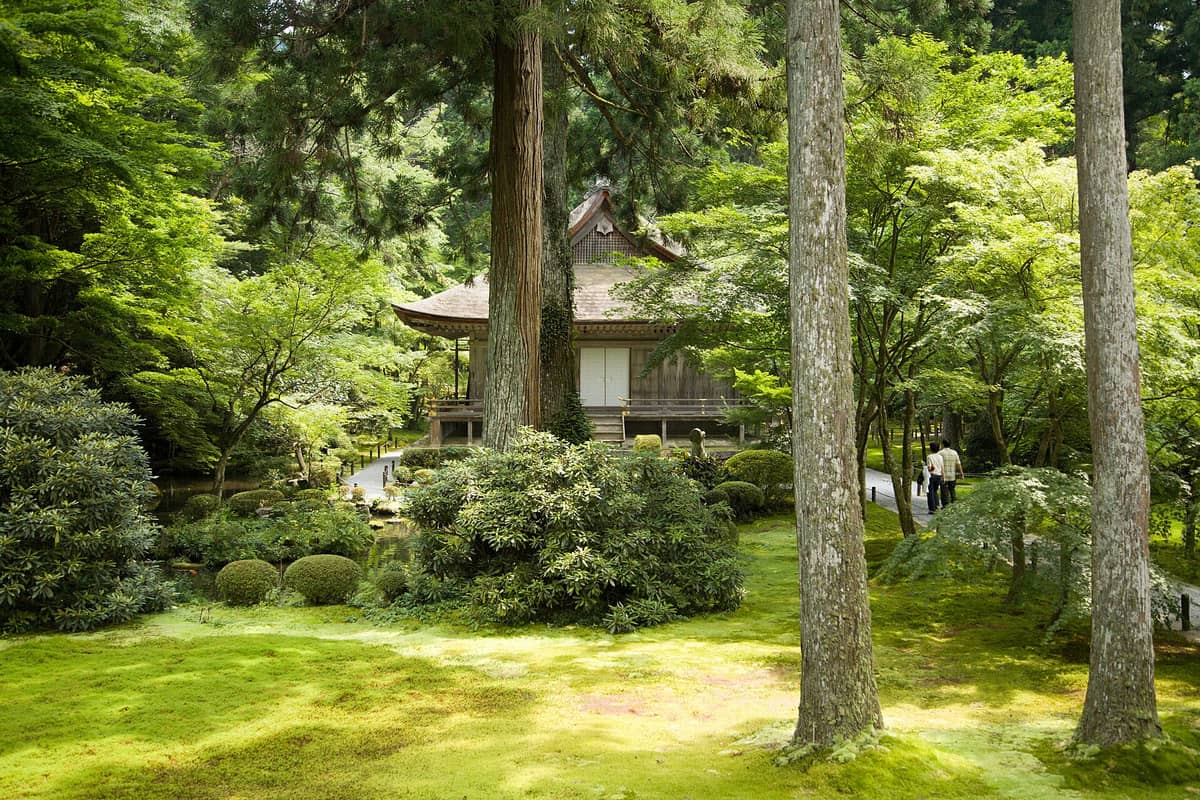
The centerpiece of Sanzen-in is its strolling garden, Yusei-en, a composition of deep green moss, granite stepping stones, and ancient maples that changes character entirely depending on the season and time of day. In early morning, when mist still sits in the valley and direct sunlight has not yet reached the garden floor, the moss appears almost luminous, a dense carpet of at least a dozen species covering boulders and tree roots in unbroken green. The garden smells faintly of damp earth and cedar resin.
Small stone figures of Ojizou-sama (guardian deity statues) are scattered throughout the moss, some so thoroughly absorbed by the growth around them that only their rounded heads protrude. These figures, with their slightly smiling expressions and moss-capped heads, have become one of Sanzen-in's most photographed details. They are not ancient artifacts placed for display; they are devotional objects that have simply been absorbed into the garden over decades, and that distinction gives them a different quality than posed temple art.
In autumn, typically mid-November in the Ohara valley, the maples above the moss garden turn deep red and orange. The combination of scarlet canopy and emerald floor is genuinely striking and draws more visitors than any other time of year. If autumn foliage is your primary motivation, plan well in advance. For more context on timing across Kyoto, theKyoto in autumn guidecovers foliage peaks across the city's major districts, including the northern villages.
Tickets & tours
Hand-picked options from our booking partner. Prices are indicative; availability and final rates are confirmed when you complete your booking.
Kyoto Sanzen-in, Arashiyama and Bamboo Grove Full Day Tour
From 47 €Instant confirmationFree cancellationKyoto Coast, Amanohashidate and Ine Bay 1-Day Trip from Osaka or Kyoto
From 46 €Instant confirmationFree cancellationKyoto Arashiyama insider walking tour
From 66 €Instant confirmationFree cancellationMatcha green tea tour in Kyoto's Uji Market
From 130 €Instant confirmationFree cancellation
The Temple Halls: Architecture and Sacred Art
Inside the main compound, the Kyakuden (guest hall) and the Shinden (main shrine hall) represent distinct architectural periods and purposes. The Kyakuden is notable for its painted sliding screens, fusuma, which display landscape and floral motifs executed in ink and mineral pigment. These are not reproduction panels; walking slowly along the veranda gives an unobstructed view of works that have been maintained in place rather than removed to a museum setting.
The Ojo Gokuraku-in hall, set slightly apart within the garden, is architecturally one of the most important structures at the temple. Dating to 986 CE, it houses a principal image of Amida Nyorai flanked by two bodhisattvas, Kannon and Seishi. The figures are designated Important Cultural Properties. The hall's interior is notably compact, and the three gilded figures fill the space in a way that feels immediate rather than distant, quite different from the cavernous main halls found at temples like Sanjusangen-do or Nishi Hongan-ji in the city centre.
ℹ️ Good to know
Photography inside the Ojo Gokuraku-in hall and other interior spaces may be restricted or prohibited. Signs are posted at each entrance. Always confirm before raising your camera.
How the Experience Changes by Time of Day
Opening time (08:30 in the main season, 09:00 in winter) is the quietest window of the day. The bus from Kyoto Station takes about an hour, which means the earliest realistic arrival is around 09:30 to 10:00 for most visitors. This early window rewards those who make the effort: the garden is cool, the moss retains its moisture and colour, and tour groups have not yet arrived. Photography in the garden is genuinely easier without other visitors in frame.
By midday, particularly on weekends and during peak autumn weeks, the garden fills noticeably. The approach lane becomes crowded and wait times develop at the ticket booth. Afternoon light in autumn does reach portions of the garden and creates warm backlighting through the maple canopy, so midday visits are not without merit, but the tranquility is different. The temple typically empties again in the final hour before closing, which can also be a pleasant window, though the last bus back to Kyoto should be confirmed before lingering.
Getting There and Practical Logistics
Ohara is not served by the Kyoto subway or any private railway. Access is entirely by bus. From Kyoto Station, Kyoto City Bus No. 17 runs directly to the Ohara bus stop and takes approximately 60 minutes, longer during rush hour or peak tourist seasons. From Kokusaikaikan Station, the northern terminus of the Karasuma subway line, Kyoto Bus No. 19 reaches Ohara in about 23 minutes, which is a faster option if you are already in northern Kyoto. For general transit orientation across the city, see thegetting around Kyoto guide.
Opening hours are 08:30 to 17:00 from March through December 7, and 09:00 to 16:30 from December 7 through February. The temple has no regular closing days. Admission is ¥700 for adults, ¥400 for junior and high school students, and ¥150 for elementary school students. Payment is typically expected in cash, so carry yen before arriving. There are no ATMs immediately at the temple.
Sanzen-in pairs well with other Ohara sites on the same visit. Jakko-in, a nunnery on the opposite side of the valley with its own quiet garden, and Shorin-in, a smaller temple close to Sanzen-in, are both walkable. A half-day in Ohara, combining two or three sites and a bowl of tofu or soba at one of the valley restaurants, makes for a coherent and unhurried trip. If you are building a wider northern Kyoto itinerary, seeKyoto's lesser-visited areas for more ideas outside the city centre.
Seasonal Conditions and Weather Considerations
The Ohara valley sits at a higher elevation than central Kyoto and is noticeably cooler, particularly in the morning and evening. In winter, temperatures can drop to near freezing and light snow is possible, which creates a striking but cold visit; dress in warm layers and check bus schedules, as services can be affected by ice. Summer visits (July and August) are humid but the moss garden is lush. Spring, especially late April and May, brings fresh green maple leaves above the moss, a subtler but equally pleasant contrast to the autumn colours. Kyoto's weather patterns by season are covered in more detail in theKyoto weather guide.
Rain actually benefits the moss garden, deepening its colour and reflecting light across the stones. A light drizzle during an off-peak weekday might be the single best condition for visiting, provided you carry a compact umbrella. Heavy rain makes the stone paths slippery and the uphill approach unpleasant.
Honest Assessment: Is Sanzen-in Worth the Trip?
Sanzen-in requires a genuine commitment: roughly two hours of transit for a round trip from central Kyoto, plus entry cost and time on site. For visitors with only one or two days in Kyoto, that trade-off deserves honest consideration. The temple's gardens and architecture are exceptional, but if your Kyoto itinerary is already packed with major sites likeKinkaku-ji, Fushimi Inari, and Kiyomizu-dera, adding Ohara may stretch the day uncomfortably.
Where Sanzen-in genuinely earns its place is for visitors who have already covered the city-centre landmarks, those spending four or more days in Kyoto, travellers specifically interested in Tendai Buddhism or Japanese garden design, and anyone visiting in autumn who wants an alternative to the crowds at Eikan-do or Tofuku-ji. The Ohara valley offers a quality of quiet that is increasingly hard to find in Kyoto proper, and Sanzen-in is the best single reason to make the trip.
Visitors seeking easy, compact temple experiences or those with limited mobility should note the real physical demands of the Ohara visit: the uphill approach from the bus stop, uneven stone paths inside the garden, and the absence of elevators or ramps throughout most of the complex. This is not an attraction that can be fully experienced from a wheelchair or mobility scooter.
Insider Tips
- The Ojizou-sama moss statues are clustered in the lower portion of Yusei-en garden, near the Ojo Gokuraku-in hall. Most visitors photograph them from the main path, but a slower walk along the garden's inner edge reveals angles where the figures are fully framed by moss with no stone path visible, a much cleaner composition.
- Buses back to Kyoto from Ohara can become very full in the late afternoon during autumn peak season. If you plan to leave after 15:00 on a weekend in November, arrive at the bus stop 15 to 20 minutes early and be prepared to wait for a second bus.
- The temple's two secondary gardens, Shuheki-en and Kankinoen, are included in the single admission price but receive far fewer visitors than the main moss garden. Shuheki-en, a dry karesansui garden near the Shinden hall, is worth a few minutes for the contrast in texture and mood.
- Shibazuke, the purple pickled vegetable Ohara is famous for, is sold by small family shops along the approach lane. Several shops offer free tastings. Buying a small packet here is a more direct local souvenir than anything sold in Kyoto city centre markets.
- Winter visits (December through February) bring noticeably fewer crowds and occasionally snow on the garden, but the shorter opening hours (closing at 16:30) and the last buses from Ohara mean you need to plan your departure carefully or risk missing the final service.
Who Is Sanzen-in Temple For?
- Repeat Kyoto visitors who have covered the main city-centre temples and want depth over convenience
- Autumn foliage seekers looking for a less-crowded alternative to Eikan-do and Tofuku-ji
- Garden and moss photography enthusiasts, particularly in early morning light
- Travellers interested in Tendai Buddhist architecture and Important Cultural Property art objects
- Anyone wanting a half-day out of the city that feels meaningfully different from urban Kyoto
Nearby Attractions
Other things to see while in Ohara:
- Rurikō-in Temple
Rurikō-in Temple in Yase opens its gates only twice a year, during spring and autumn, to reveal floors so polished they mirror the surrounding maple trees. The result is one of the most quietly dramatic rooms in all of Kyoto, though the crowds that gather to photograph it are anything but quiet.