Fushimi Inari Taisha: The Torii Gate Mountain That Rewards Early Risers
Fushimi Inari Taisha is Kyoto's most photographed shrine, where thousands of vermillion torii gates climb through cedar forest to the summit of Mount Inari. Entry is free, the grounds never close, and the full hiking circuit is far more rewarding than the postcard views near the entrance suggest.
Quick Facts
- Location
- 68 Fukakusa Yabunouchi-cho, Fushimi-ku, Kyoto 612-0882
- Getting There
- JR Inari Station (JR Nara Line) — shrine entrance is directly outside. Keihan Fushimi-inari Station is a 5-minute walk east.
- Time Needed
- 30 min for lower precinct only; 2–3 hours for the full Mount Inari circuit (approx. 4 km round trip)
- Cost
- Free — no tickets, no reservations required. Open 24 hours year-round.
- Best for
- Hikers, photographers, solo travelers, early-morning visitors seeking quiet
- Official website
- inari.jp/en
What Fushimi Inari Taisha Actually Is
Fushimi Inari Taisha is the head shrine of all Inari shrines in Japan, dedicated to the kami Inari, the deity associated with rice, commerce, and foxes. The site's origins date to 711 CE, making it a shrine with over 1,300 years of history in the Kansai region. The shrine sits at the base and extends up the full 233-meter height of Mount Inari, south of Kyoto's city center in the Fushimi district.
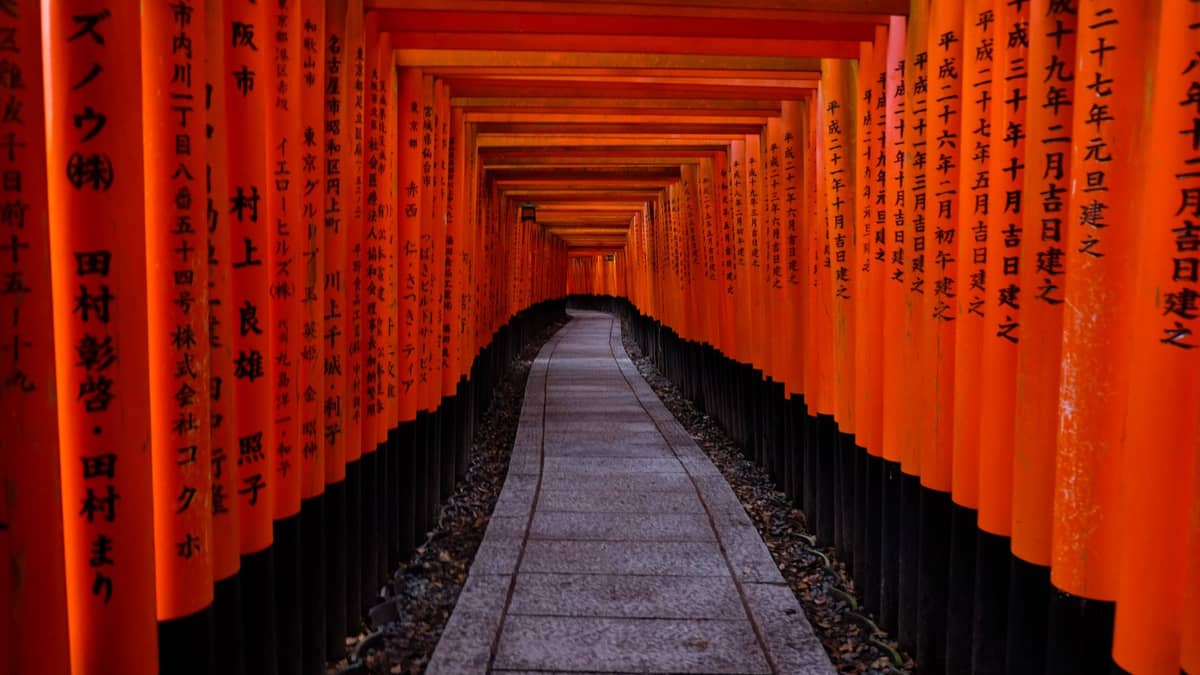
The famous Senbon Torii, literally 'thousand torii gates,' form a near-continuous tunnel of vermillion lacquered wood that lines the pilgrimage route from the lower precincts to the mountain summit. The gates are not a decorative installation — they are donations from businesses and individuals seeking blessings from Inari, each carved with the donor's name and the date of installation. Walk the inner side of any gate and you will see this text clearly, turning what looks like scenery into a living record of Japanese religious practice over centuries.
ℹ️ Good to know
Admission is completely free. There are no tickets to book, no timed entry slots, and no reservations required. The shrine grounds and gate paths are open around the clock, every day of the year.
The Experience by Time of Day
Timing your visit is the single most important decision you will make. By mid-morning, especially on weekends and during peak seasons, the lower torii gate tunnels near the main hall are packed to the point where moving freely becomes difficult. Between roughly 9 AM and 3 PM, the iconic orange-tunnel photographs require patience and luck to capture without dozens of strangers in the frame.
Arriving before 7 AM changes the experience entirely. The lower precinct is near-silent except for the sound of crows in the cedars and the occasional clap of hands from an early worshipper at the main hall. The air smells of damp stone, cedar resin, and the faint sweetness of incense from shrine offerings. The wooden torii cast long shadow lines across the gravel path, and the light at this hour has a particular copper quality that suits the vermillion lacquer. This is when the site makes sense as a place of worship rather than a tourist corridor.
Evening visits, particularly after 6 PM in summer and after 5 PM in winter, bring their own character. Most day-trippers have descended by then. Some sections of the path are lit, but the upper mountain becomes progressively darker and quieter. Certain tea stalls and food vendors near the lower and middle sections stay open into the evening. If you are comfortable with uneven paths in low light and carry a phone torch, a dusk visit can be genuinely atmospheric. The mountain is considered sacred, and visiting at night is an established tradition in Japanese religious culture, not an unusual act.
Tickets & tours
Hand-picked options from our booking partner. Prices are indicative; availability and final rates are confirmed when you complete your booking.
Fushimi Inari hidden hiking tour
From 50 €Instant confirmationFree cancellationGuided day tour from Osaka to Nara Park, Arashiyama and Fushimi Inari
From 59 €Instant confirmationFree cancellationOsaka Culinary Journey with Ramen, Sushi and Tea Ceremony
From 59 €Instant confirmationFree cancellationKyoto Coast, Amanohashidate and Ine Bay 1-Day Trip from Osaka or Kyoto
From 46 €Instant confirmationFree cancellation
The Hiking Route: What to Expect
Many visitors turn back after the famous lower tunnel sections, which takes roughly 20 to 30 minutes on foot. This is a perfectly reasonable choice and captures the site's most visually concentrated stretch. However, the full circuit to the summit and back is around 4 kilometers and takes most visitors 2 to 3 hours, depending on pace and stops.
The route climbs through a sequence of smaller shrine precincts, stone fox statues, and stalls selling grilled skewers and tea. Around the midpoint at Yotsutsuji intersection, there is a partial view over southern Kyoto and Osaka on clear days. This is where many hikers take a break and decide whether to continue. Above this point the crowds thin dramatically, the torii gates become less continuous, and the path passes through sections of genuine mountain forest. The upper shrines feel like working places of worship rather than tourist destinations.
The terrain involves stairs — many of them, and some steeply graded. Wear shoes with grip. In summer, bring water; there are limited vending machines partway up but none near the top. In autumn and winter the path can be wet and slippery in places after rain. The route is circular: you descend by a different path, arriving back near the main precinct.
⚠️ What to skip
The full hike is not accessible for wheelchair users. The main hall and lower precinct are barrier-free, but the Senbon Torii and mountain paths involve sustained stair climbing that makes the circuit impractical for those with limited mobility. Visitors who cannot manage stairs can still access the most impressive lower gate sections.
Historical and Cultural Context
Understanding what you are walking through changes how the site feels. Inari is one of the most widely worshipped kami in Japan, with tens of thousands of shrines across the country dedicated to this deity. Fushimi Inari Taisha is the central institution that oversees them all, which explains both the scale of this site and the extraordinary concentration of donated torii gates: this is the destination of pilgrimage for people praying for agricultural success, business prosperity, and household safety.
The fox figures (kitsune) seen throughout the shrine compound are not the deity itself but messengers of Inari. You will notice they often hold symbolic objects in their mouths — a jewel, a key, a sheaf of rice, a scroll — each representing a different aspect of the shrine's blessing. The colour palette of white fox statues against red-painted wooden structures against dark cedar is not accidental; it is a coherent visual language built up over more than 1,300 years. For more on the cultural layer beneath Kyoto's shrine culture, theguide to Kyoto's most significant shrines provides useful context.
Photography Practical Notes
The standard photograph of the tunnel looking into orange receding gates is taken at the first major torii section immediately above the main hall. Getting this shot without people requires either arriving before 7 AM or visiting in winter on a weekday. In peak season (late March to early May, late October to mid-November), that window shrinks further.
More interesting images, and ones that require no crowd management, exist higher on the mountain. The sections where gates become sparse, where small stone shrine precincts sit in pools of light between trees, and where the path narrows to single file — these are photographically richer and almost never crowded. A wide-angle lens handles the lower tunnels; a short telephoto compresses the stacked gates effectively from a distance.
Rain softens the colours and deepens the orange of the lacquer significantly. A quiet drizzly morning can produce better images than a bright weekend afternoon.
Getting There and Practical Logistics
The easiest access is via the JR Nara Line to JR Inari Station. The shrine entrance is directly in front of the station exit, making it one of the most straightforward transit connections of any major Kyoto attraction. From Kyoto Station, the journey takes about 5 minutes. Alternatively, the Keihan Main Line stops at Keihan Fushimi-inari Station, which is about a 5-minute walk to the shrine gate. For a broader look at moving around the city, theguide to getting around Kyoto covers all transit options in detail.
The Fushimi district itself, south of central Kyoto, has a different character than the temple-heavy areas to the east and north. The streets around the shrine mix tourist shops with neighborhood life, and the area is less saturated with foreign visitors than Higashiyama or Arashiyama at midday.
If you are combining the shrine with the Fushimi sake district, located roughly 15 minutes' walk northwest of the shrine, a half-day covers both comfortably. The sake district is among the more undervisited areas of Kyoto relative to its interest.
💡 Local tip
The shrine has both an inner and outer torii gate route at the base. Most visitors take the inner (covered) route. Taking the outer path on the return gives you a different visual angle on the same corridor, and is noticeably less congested.
Seasonal Considerations
Summer visits (June through August) mean humidity that intensifies the cedar-and-incense smell of the forested sections. Temperatures can reach 32 to 33°C, and the climb to the summit in full sun is strenuous. Carry water and consider a very early start to beat both the heat and the crowds.
Autumn (October to November) is Kyoto's most visited season, and Fushimi Inari reflects this. The mountain does not offer significant autumn colour compared with sites likeEikan-do Zenrin-ji, so the crowds are primarily people working through a Kyoto checklist rather than visitors specifically drawn by the season. This is worth knowing if your goal is the mountain itself rather than autumn leaves.
Winter mornings, particularly after overnight snow, transform the site more dramatically than any other season. Snow accumulates on the torii caps and the stone foxes, the path is empty by 7 AM, and the colour contrast between white snow and red lacquer is stark and striking. January and February see fewer tourists citywide, and Fushimi Inari is quieter across the whole day than it will be at any other time of year.
Insider Tips
- The prayer reception and shrine office services operate roughly 08:30 to 16:00, but the paths and all outdoor precincts are open at any hour. If you want to experience the mountain at 5 AM in summer or midnight in December, that is entirely possible and not unusual for Japanese visitors.
- Food stalls along the lower and middle sections of the path sell tofu-wrapped rice (inari sushi, named after this very shrine), grilled quail eggs on skewers, and tea. Hours vary but most are open by 9 AM on weekdays. The upper mountain has no food vendors — carry your own if you plan to summit.
- The return descent path (the outer loop) passes through sections with virtually no torii gates and fewer visitors, allowing you to see the mountain's natural forest character and smaller subsidiary shrines that most people completely miss.
- Each torii gate has donor information inscribed on the back (the inner face, when ascending). Reading these makes for a completely different kind of engagement with the route — prices for gate donations run from around ¥400,000 for a small gate to over ¥1,000,000 for the largest ones, which gives you a sense of the financial scale of devotion to this shrine.
- If you want the widest-angle, most unobstructed view of the descending gate corridor, position yourself at a slight curve in the path rather than shooting straight down a flat section. The apparent density of gates increases dramatically when viewed at an angle.
Who Is Fushimi Inari Taisha For?
- Hikers and walkers who want a physical experience alongside cultural depth — the full summit circuit earns the views
- Photographers, particularly those who can commit to early-morning or off-season visits when the lower tunnels are quiet
- Solo travelers comfortable with some independent trail navigation on the upper mountain sections
- Visitors interested in Japanese religious practice who want something more layered than a quick temple visit
- Winter travelers looking for an uncrowded major Kyoto attraction with dramatic visual potential after snowfall
Nearby Attractions
Other things to see while in Fushimi:
- Fushimi Sake District
Fushimi is one of Japan's most celebrated sake-producing areas, a southern Kyoto neighborhood where white-walled breweries line narrow canals and the craft of brewing rice wine has shaped the local landscape for centuries. Visitors can walk freely through the streets, tour the Gekkeikan Okura Sake Museum, ride a traditional canal boat, and sample sake directly from the source.