Sanyuan Palace: Guangzhou's Oldest Taoist Temple
Sanyuan Palace (三元宫) in Yuexiu District is the oldest and largest Taoist temple in Guangzhou, with roots stretching back roughly 1,600 years. Admission is free, the location is central, and the atmosphere shifts noticeably between a quiet weekday morning and a packed lunar festival day.
Quick Facts
- Location
- No. 11 Yingyuan Road, Yuexiu District, Guangzhou
- Getting There
- Metro Line 2, Sun Yat-sen Memorial Hall Station (Exit C), then ~50 m walk
- Time Needed
- 45 minutes to 1.5 hours
- Cost
- Free admission
- Best for
- History seekers, Taoist culture, photography, quiet mornings
What Is Sanyuan Palace?
Sanyuan Palace (三元宫) holds a distinction that few religious sites in southern China can match: it is the oldest surviving Taoist temple in Guangzhou, with a history spanning roughly 1,600 years. That puts its origins in the Eastern Jin dynasty, long before the city took on its current form or name. For most of that history it was known as Yuegang Temple (越岗院), a name that reflected its position on a low ridge above the surrounding terrain. The site was rebuilt and given its present name during the Ming dynasty, when the palace was dedicated to the Three Primordials (三元), a set of heavenly officials in Taoist cosmology associated with heaven, earth, and water.
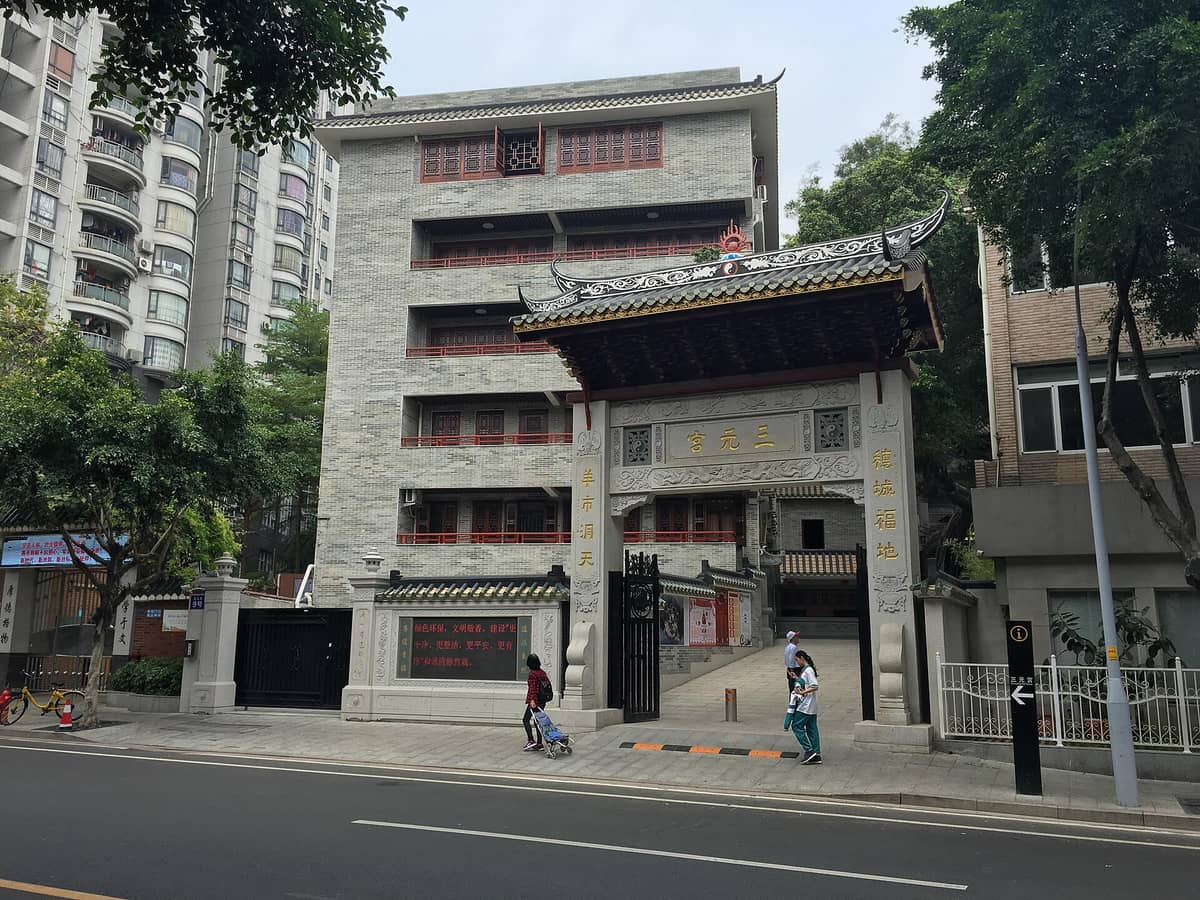
Today the palace sits in central Yuexiu District, tucked behind a modest entrance gate on Yingyuan Road. The surrounding streets are ordinary Guangzhou urban fabric: fruit sellers, pharmacies, commuters. Nothing announces that you are about to enter one of the oldest continuously used religious sites in the city. That contrast is, in some ways, the whole point. Sanyuan Palace is not a reconstructed heritage showpiece; it is a working temple that locals actually use.
Arrival and First Impressions
The entrance is a short walk from Exit C of Sun Yat-sen Memorial Hall Station on Metro Line 2. Turn left out of the exit, walk roughly 50 meters, and the temple gate appears on your right. There is no ticket booth, no queue, no admission fee. You simply walk in.
💡 Local tip
Standard opening hours are 8:00 AM to 5:00 PM daily. On the 1st and 15th days of the lunar calendar, the temple opens earlier, reportedly from 7:00 AM, to accommodate worshippers observing those traditional dates. These are the busiest days of the month.
The first thing you notice inside is the smell: sandalwood incense burning in large bronze urns, thick enough to linger on your clothing after you leave. The smoke drifts upward past dark timber eaves and across the rooflines of successive halls. On a weekday morning, the courtyard is calm. A handful of worshippers move between the altars, placing incense sticks, murmuring prayers. Elderly visitors tend to arrive early; younger visitors appear more often on weekends.
Architecture and Layout
The complex is laid out along a traditional axial plan, with a succession of halls arranged from front to back. The main gate leads into a forecourt, then deeper into the primary shrine halls dedicated to Taoist deities. The buildings show the influence of Lingnan architectural style, the regional variant of southern Chinese temple construction characterized by restrained ornamentation on the exterior and richly decorated interior altar spaces. Roof ridges carry ceramic figures, and the carved wooden panels inside the halls are detailed enough to warrant close inspection.
The scale is substantial for a city-center temple. Sanyuan Palace is described as not only the oldest but also the largest Taoist complex in Guangzhou, and walking the full circuit of its halls takes more time than a quick glance at the entrance would suggest. For context on Guangzhou's broader temple landscape, the Guangzhou temples guide covers both Taoist and Buddhist sites across the city.
Unlike some heavily restored temple complexes, sections of Sanyuan Palace show genuine patina: worn stone paving, smoke-darkened ceilings above altar tables, and wooden pillars rubbed smooth at shoulder height by years of passing visitors. This is not a shortcoming; it is evidence of continuous use, which is arguably more meaningful than a pristine reconstruction.
How the Experience Changes Through the Day
Early morning, roughly 8:00 to 10:00 AM on a regular weekday, is the calmest window. The light at that hour falls at a low angle through the open courtyards, catching the incense smoke and giving the bronze urns a warm tone. The few worshippers present are generally observant rather than curious, so the atmosphere is genuinely devotional rather than performative.
By midday, foot traffic picks up with tourists and locals on lunch breaks from nearby offices. The space handles moderate crowds without feeling cramped, but the contemplative quality of the early hours gives way to something more general. Afternoons vary significantly depending on the day of the week and the lunar calendar. The most crowded periods are the 1st and 15th of each lunar month, when worshippers come specifically to mark those dates with offerings and prayers. On those days, the incense smoke is heavier, the main halls are full, and the overall sensory intensity is considerably higher.
ℹ️ Good to know
If you are visiting primarily for photography or quiet observation, a Tuesday or Wednesday morning between 8:30 and 10:00 AM will give you the best conditions. Avoid the 1st and 15th of the lunar month unless you specifically want to witness active communal worship.
Historical and Cultural Context
Sanyuan Palace's age places it in a different category from most of what visitors see in Guangzhou. The city's rapid modern development erased or buried much of its ancient fabric, which makes the survival of a 1,600-year-old functioning temple complex genuinely significant. The Eastern Jin dynasty, when the site was first established, predates the Tang dynasty by roughly 300 years. The Ming dynasty reconstruction that gave the palace its current name and formal dedication aligned the site with a period when Taoism received significant imperial patronage across China.Yuexiu District has the highest density of historical sites in Guangzhou, and Sanyuan Palace is among the oldest of them.
Taoist temples in Guangzhou never achieved the same tourist profile as the city's Buddhist sites, in part because Buddhism arrived in Guangzhou with more direct imperial sponsorship and left more visible architectural monuments. Sanyuan Palace is therefore worth visiting precisely because it represents a thread of religious life that is less marketed and less curated for outside audiences. The rituals practiced here are continuous with regional Taoist traditions rather than adapted for display.
For visitors who want to go deeper into Guangzhou's religious and cultural heritage, the Temple of the Six Banyan Trees and the Temple of the Five Immortals offer Buddhist and Taoist perspectives respectively, both within a short distance of Sanyuan Palace in central Yuexiu.
Practical Walkthrough
Plan 45 minutes at a minimum to walk the full sequence of halls without rushing. An hour and a half is comfortable if you want to sit in the courtyards, read the inscriptions, and watch the rhythm of the place without feeling pressed. There is no audio guide or official tour structure; the experience is self-directed.
Dress modestly. Shorts and sleeveless tops are technically permissible since there is no enforced dress code at the entrance, but covered shoulders and legs are appropriate given that the halls are active places of worship rather than museum galleries. Remove hats when entering the shrine halls. Photography is generally permitted in the open courtyards and exterior spaces; exercise discretion when worshippers are actively praying at the altars.
There are no formal accessibility notes provided by the temple, and the sources available do not confirm the presence of ramps, accessible restrooms, or other mobility provisions. Visitors with mobility requirements should contact the temple directly or plan for the possibility of uneven stone paving and stepped thresholds between halls.
⚠️ What to skip
Tap water in Guangzhou is not recommended for drinking without boiling or filtration. Bring a sealed water bottle, especially in summer when the heat inside the temple courtyards can be significant. The rainy season (April to September) also brings high humidity, which makes morning visits considerably more comfortable than afternoon ones.
Who Should Think Twice
Sanyuan Palace is not a destination for visitors looking for panoramic views, interactive exhibits, or air-conditioned galleries. There is no museum component, no gift shop of note, and no English-language interpretation of the halls or their religious significance. If your interest in temples is primarily visual or architectural rather than cultural or historical, the experience may feel incomplete without background knowledge brought from outside. Visitors who find active incense smoke irritating should also be aware that the levels inside are substantial, particularly near the main altar halls.
Those focused on Guangzhou's modern architecture or commercial energy would be better served starting in Zhujiang New Town or along the Pearl River waterfront. Sanyuan Palace rewards visitors who come specifically to understand the older layers of the city.
Insider Tips
- The 1st and 15th of the lunar calendar are the most atmospheric days to visit if you want to witness serious communal worship, but they are also noticeably more crowded. If that trade-off matters to you, a regular weekday morning is quieter.
- The entrance on Yingyuan Road is easy to miss at a walking pace. Look for the traditional gate structure set slightly back from the street rather than a prominent sign facing traffic.
- Cantonese is the dominant language you will hear inside; Mandarin is understood but Sanyuan Palace is very much a local-neighborhood temple rather than an internationally staffed institution. Basic Mandarin greetings are appreciated.
- The courtyards offer good natural light for photography in the morning hours. By midday, the overhead sun creates harsh contrast that flattens the carved architectural details. A polarizing filter helps with the smoke haze.
- Because admission is free and the location is central, Sanyuan Palace pairs naturally with a walk to Sun Yat-sen Memorial Hall or Yuexiu Park, both within easy walking distance. Building it into a broader Yuexiu morning loop is more efficient than making it a standalone trip.
Who Is Sanyuan Palace For?
- Travelers interested in Taoist history and southern Chinese religious culture
- History-focused visitors wanting to move beyond Guangzhou's modern surface
- Early risers looking for a quiet, atmospheric start to the day in central Guangzhou
- Photographers drawn to incense smoke, aged timber, and traditional ceremonial objects
- Visitors combining a morning walk through Yuexiu's heritage sites
Nearby Attractions
Other things to see while in Yuexiu:
- Beijing Road Pedestrian Street
Beijing Road Pedestrian Street runs through the historic heart of Yuexiu District, layering modern retail over more than a thousand years of commercial history. Entry is free, the metro drops you right at the door, and the glass-covered archaeological ruins embedded in the pavement are an unexpected highlight worth stopping for.
- Canton Orchid Garden
Tucked inside Yuexiu District, the Canton Orchid Garden is a compact but carefully curated public garden dedicated entirely to orchid cultivation. At RMB 8 entry, it offers a rare pocket of calm in central Guangzhou, best appreciated in the cooler months when the flowers are at their peak.
- Ersha Island
Ersha Island sits in the Pearl River between Guangzhou Bridge and Haiyin Bridge, covering 1.26 square kilometers of parks, cultural venues, and tree-lined promenades. Free to enter and open around the clock, it offers a rare change of pace from the city's commercial core.
- Five Rams Statue
Carved from over 130 pieces of granite and completed in the late 1950s, the Five Rams Statue stands as one of Guangzhou's most recognizable landmarks. Located inside Yuexiu Park, it is free to visit and open daily, and is often best experienced in the early morning when the park is quiet and the light is soft.