San Pietro in Vincoli: Michelangelo's Moses and Rome's Most Overlooked Basilica
San Pietro in Vincoli is a 5th-century basilica in the Monti district that holds two extraordinary things: the iron chains said to have bound St. Peter in Jerusalem, and Michelangelo's monumental Moses, sculpted for the tomb of Pope Julius II. Entry is free, crowds are manageable, and the experience is compact enough to absorb in under an hour.
Quick Facts
- Location
- Piazza di San Pietro in Vincoli 4/A, Monti, Rome
- Getting There
- Metro Line B – Cavour; buses 75, 84, 117
- Time Needed
- 30–60 minutes
- Cost
- Free entry
- Best for
- Art lovers, Renaissance history, anyone near the Colosseum
What San Pietro in Vincoli Actually Is
The Basilica di San Pietro in Vincoli, which translates as the Basilica of Saint Peter in Chains, sits on a small piazza in the Monti district, roughly halfway between the Colosseum and the Esquiline Hill. It is a working Catholic basilica, not a museum, and that distinction shapes the experience entirely. There are no ticket queues, no audio guide rental desks, no timed entry slots. You walk in, your eyes adjust to the cool interior light, and within seconds you are standing in front of one of the most powerful works of Renaissance sculpture ever made.
The church draws two very different types of visitors: pilgrims who come for the relic of St. Peter's chains, displayed beneath the high altar in a gilded reliquary, and art travelers who come specifically for Michelangelo's Moses. In practice, most visitors are drawn by the Moses and leave unexpectedly moved by the basilica itself, which is a quieter and more atmospheric space than the well-trodden circuit of the Pantheon or St. Peter's Basilica.
ℹ️ Good to know
Opening hours: Daily 8:00 AM–12:30 PM and 3:00 PM–7:00 PM. The midday closure is strictly observed. Arrive before noon or after 3:00 PM. Hours can vary on Sundays and religious holidays, so check ahead if timing is critical.
The History Behind the Building
The basilica's origins trace to the 5th century AD, when Pope Leo I commissioned a church to house a set of iron chains venerated as the very fetters that bound the apostle Peter during his imprisonment in Jerusalem. According to the legend recorded in medieval accounts, when these chains were brought to Rome and held near the chains from Peter's later captivity under Emperor Nero, the two sets miraculously fused together. The unified relic became one of the most significant objects of early Christian devotion in the city.
The church was substantially restored in the 11th century under Pope Adrian I, and again in the 15th century when Cardinal Giuliano della Rovere, the future Pope Julius II, undertook a major renovation of the structure. It was Julius II who later commissioned Michelangelo, in 1505, to design an elaborate freestanding tomb that would be placed in the basilica. The original ambition of that project was staggering: a multi-story monument with dozens of figures. What survives today is a fraction of that vision, but the Moses alone is enough to justify the commission's legacy.
The building itself reflects its long history in its fabric. The nave columns are ancient granite, likely recycled from earlier Roman structures. The coffered ceiling dates to the early 18th century. The overall effect is layered rather than unified, which gives it a lived-in quality that more polished Roman churches sometimes lack.
Tickets & tours
Live prices and dates from our booking partner. If you book, we may earn a commission at no extra cost to you.
St. Peter's Basilica, Vatican Museums, Sistine Chapel reserved entry
From 81 €Instant confirmationFree cancellationGuided tour of Galleria Borghese and of Villa Borghese gardens
From 69 €Instant confirmationFree cancellationVatican: Basilica, Dome and underground early bird tour
From 50 €Instant confirmationFree cancellationPasta-making class, tasting and prosecco with local chef in Rome
From 79 €Instant confirmationFree cancellation
Michelangelo's Moses: What to Look For
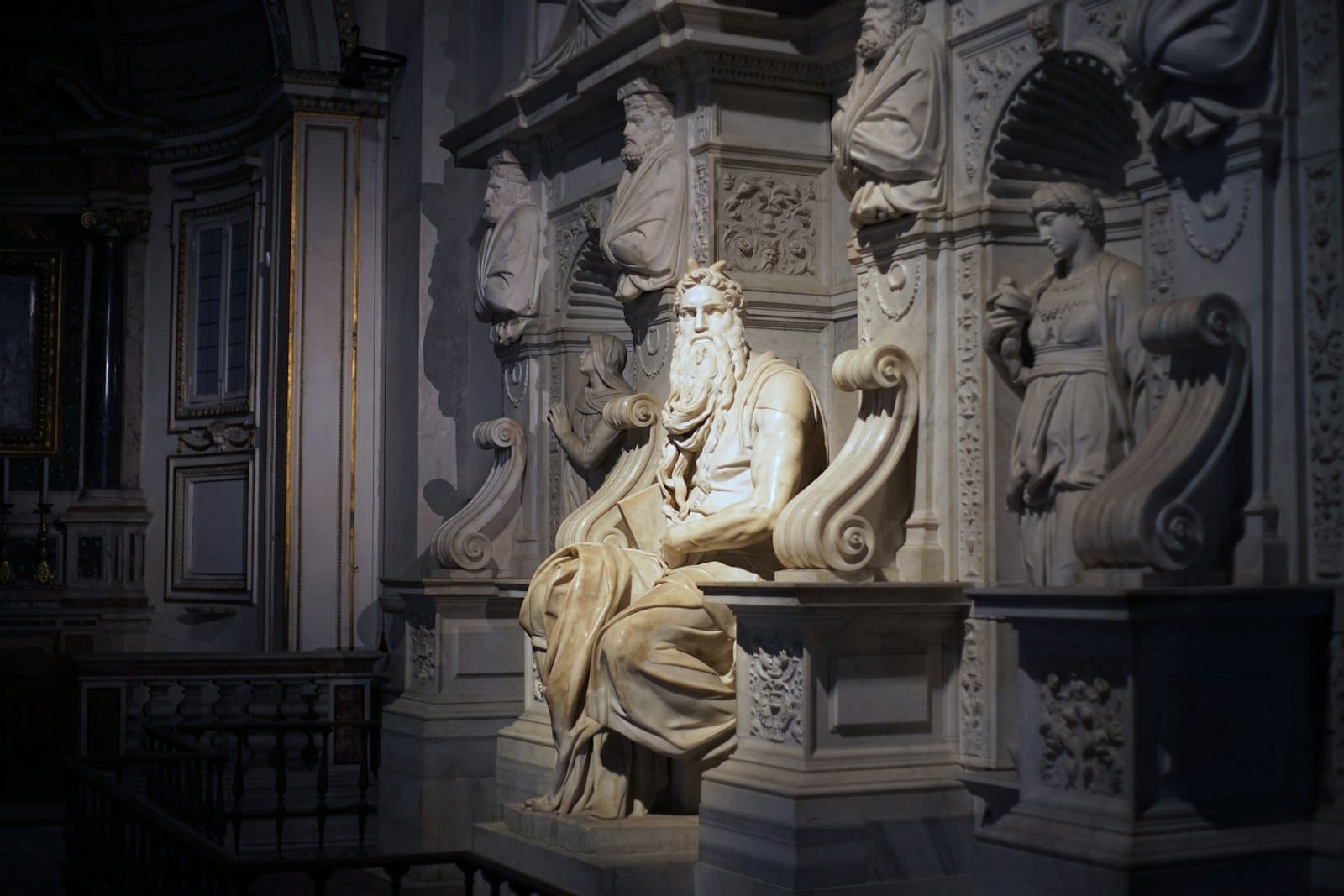
The Moses is positioned at the end of the right nave, set into a marble monument that occupies the full height of the wall. Michelangelo worked on the figure from around 1505 to 1515, with interruptions caused by Julius II redirecting him to paint the Sistine Chapel ceiling. The statue depicts Moses at the moment he descends from Mount Sinai carrying the tablets of the law, catching sight of the Israelites worshipping the golden calf. The tension in the figure is extraordinary: the right leg is drawn back as if he is about to stand, the tablets are gripped with knuckle-straining force, the beard cascades in carved streams that seem almost fluid.
The horns on Moses's head are not a mistake or an insult. They derive from the Latin Vulgate translation of the Hebrew word 'karan', which can mean either 'horned' or 'radiant with light'. Medieval and Renaissance artists routinely depicted Moses with horns as a marker of divine encounter, and Michelangelo followed that convention. It is worth knowing before you arrive so the detail reads as intentional rather than puzzling.
The flanking figures of Rachel and Leah, also by Michelangelo, are often overlooked by visitors focused on Moses. They represent the contemplative and active lives respectively, and while less technically dramatic, they reward close attention. The effigy of Julius II above the monument is later work by Maso del Bosco, not by Michelangelo himself.
💡 Local tip
Bring a coin for the light box near the monument. The Moses is positioned in a relatively dim chapel alcove, and the coin-operated illumination gives you a much clearer view of the carving detail, particularly the treatment of the beard and drapery. Without it, you are relying on natural light that shifts through the morning and afternoon.
The Relic and the Rest of the Interior
Beneath the high altar, in a bronze and crystal reliquary, lie the chains of St. Peter. They are visible through the glass case and draw a steady stream of pilgrims, particularly on the feast day of San Pietro in Vincoli on August 1st, when the chains are traditionally displayed for veneration. On ordinary days the area beneath the altar is calm and accessible.
The basilica also contains a 7th-century mosaic in the apse depicting St. Sebastian, which is one of the older intact mosaics in Rome outside the major pilgrimage churches. It is easy to miss while most visitors are focused on the Michelangelo monument, but it is worth a few minutes. The nave's twenty ancient columns create a rhythm of light and shadow that makes the interior feel longer than it is.
If you are building a broader itinerary around Rome's churches, the guide to Rome's best churches places San Pietro in Vincoli in context alongside the city's major basilicas and lesser-known gems.
How the Experience Changes by Time of Day
Morning visits, especially between 8:30 and 10:00 AM, offer the most peaceful experience. The air inside the basilica retains the coolness of the night, the light through the side windows is soft and angled, and the relatively few visitors mean you can stand in front of the Moses without anyone else in your immediate field of view. This is when the sculptural detail reads best without the distraction of noise or motion.
By late morning, group tours arrive, often led by guides speaking at full volume directly in front of the monument. The space is not large enough to absorb this comfortably. Between 10:30 AM and 12:00 PM on popular days, the area near the Michelangelo tomb can feel genuinely crowded for a free, non-ticketed attraction. If you arrive mid-morning and find a tour group in place, the 7th-century apse mosaic and the relic altar are worth occupying yourself with until they move on.
Afternoon visits after 3:30 PM tend to be quieter than late morning, particularly on weekdays. The light shifts to the western windows and the interior takes on a warmer tone. The evening summer hours until 7:00 PM are a worthwhile option if you are exploring the Monti neighborhood on foot and want to avoid the midday heat entirely.
Getting There and the Neighborhood Around It
The basilica is reached most easily on foot from the Cavour Metro station on Line B, which is about a five-minute walk. From the Colosseo Metro station, the walk is ten to fifteen minutes uphill through the edge of the Monti district. The most atmospheric approach is via the Salita dei Borgia, a covered staircase that climbs from Via Cavour directly to the church's forecourt. The staircase is narrow, slightly worn, and lined with graffiti-marked walls on one side. It sets the tone for a church that sits slightly apart from the main tourist flow.
Monti itself is worth time before or after the visit. The Monti neighborhood has some of Rome's better independent coffee shops and aperitivo bars concentrated around Via del Boschetto and Via dei Serpenti, both within a few minutes' walk of the piazza.
San Pietro in Vincoli fits naturally into the same half-day as the Colosseum and Roman Forum. Given that those two require advance booking and significant time, the basilica works well as a gentle decompression between major ticketed sites.
Practical Notes: Dress Code, Photography, and Accessibility
As an active place of worship, the basilica enforces a modest dress code. Shoulders must be covered and shorts or short skirts are not permitted. Scarves and cover-ups are not distributed at the entrance the way they are at St. Peter's Basilica, so come prepared. The dress code is applied at the door.
Photography without flash is generally permitted for personal use, but avoid photographing during active services. The coin-operated light near the Moses makes it possible to get clear interior shots without needing a tripod or high ISO settings. The monument is positioned against a wall rather than in the round, so the most useful angle is straight on from approximately four to five meters back.
The main entrance is at ground level on the piazza, but reaching the piazza itself requires climbing the Salita dei Borgia steps from Via Cavour, which are not wheelchair accessible. There is no alternative flat approach documented from that direction. Visitors with mobility limitations should factor this in when planning.
⚠️ What to skip
The basilica is closed during the 12:30 PM–3:00 PM midday break, and this is enforced. Do not plan a post-lunch visit without confirming you arrive after 3:00 PM. On Sundays and Catholic feast days, access may be restricted during services.
Is It Worth Your Time?
For anyone with an interest in Renaissance art, the answer is straightforwardly yes. The Moses is among a small number of works in Rome that justify a specific detour, and the fact that entry is free makes it one of the better-value hours you can spend in the city. It is not an experience that requires context or preparation to be affecting, though knowing the background of the Julius II tomb commission deepens the encounter considerably.
Visitors who have already spent a full day at the Vatican Museums and are experiencing art fatigue may find the brief, focused experience here a relief rather than an addition. There is only one major work to absorb, the space is compact, and there is no obligation to spend more than thirty minutes.
Who might skip it: travelers with no particular interest in Renaissance sculpture or early Christian history, or those whose schedule is already packed with higher-priority sites. The basilica does not offer the architectural grandeur of Rome's major pilgrimage churches, and the interior, while atmospheric, is modest in scale. If you are on a very tight itinerary and must choose between this and a site you have specifically planned for, prioritize the planned site.
If you are trying to maximize free attractions in the city, the guide to free things to do in Rome includes several other no-cost sites that pair well with this visit.
Insider Tips
- The Salita dei Borgia staircase from Via Cavour is the most direct and atmospheric approach, but it is easy to miss. Look for the covered passage just off the main road and follow it up to the piazza. Google Maps sometimes routes visitors the long way around.
- The coin-operated light near the Moses is not optional if you care about detail. Without it, particularly on overcast days or during morning shadow, the lower half of the statue, including the feet and drapery, is poorly lit. Keep a 50-cent or 1-euro coin accessible.
- August 1st is the Feast of San Pietro in Vincoli. The chains are removed from the reliquary and presented for public veneration, which draws larger-than-usual crowds but also creates a genuinely rare liturgical atmosphere. Worth attending if you happen to be in Rome.
- The Maso del Bosco effigy of Julius II above the tomb is often mistaken for Michelangelo's work. Only Moses, Rachel, and Leah are by Michelangelo. The upper sections of the monument were completed by other sculptors after the original project was drastically scaled back.
- If the Moses alcove is occupied by a tour group when you arrive, do not leave. Groups cycle through in fifteen to twenty minutes. Use the waiting time to examine the ancient nave columns and the apse mosaic, which most visitors walk past entirely.
Who Is San Pietro in Vincoli For?
- Renaissance art enthusiasts who want to see Michelangelo outside the Vatican
- Travelers exploring the Colosseum area who have an extra hour
- Pilgrims and visitors interested in early Christian relics and church history
- Budget travelers: this is one of Rome's great free experiences
- Anyone seeking a quieter, less-crowded alternative to Rome's most visited churches
Nearby Attractions
Other things to see while in Monti:
- Baths of Diocletian
The Terme di Diocleziano once covered 13 hectares and welcomed up to 3,000 Romans daily. Today, part of the Museo Nazionale Romano, this monumental complex rewards visitors who come prepared, with vaulted halls, open-air courtyards, and inscriptions that bring Rome's imperial scale into focus.
- National Roman Museum
The Museo Nazionale Romano is one of Rome's most important archaeological collections, spread across four distinct sites. Its crown jewel, Palazzo Massimo alle Terme, holds Roman sculptures, imperial frescoes, and coin collections that rival anything in the city. This guide tells you exactly what to expect, where to focus your time, and how to get the most from each visit.
- Quirinal Palace
Perched on Rome's highest hill and spanning 110,500 square meters, the Quirinal Palace has served popes, kings, and presidents across five centuries. Today it opens its doors to visitors, offering access to state rooms, sweeping art collections, and one of the finest views in the city.
- San Clemente Basilica
San Clemente Basilica in Rome's Monti district is three buildings stacked on top of each other across 2,000 years of history. The 12th-century upper church is free to enter; the underground excavations reveal a 4th-century basilica, a Roman house, and an ancient Mithraic temple for €10. Few sites in Rome compress so much time into a single visit.
Planning a trip? Discover personalized activities with the Nomado app.