Saloma Link: Kuala Lumpur's Illuminated Pedestrian Bridge Worth Crossing After Dark
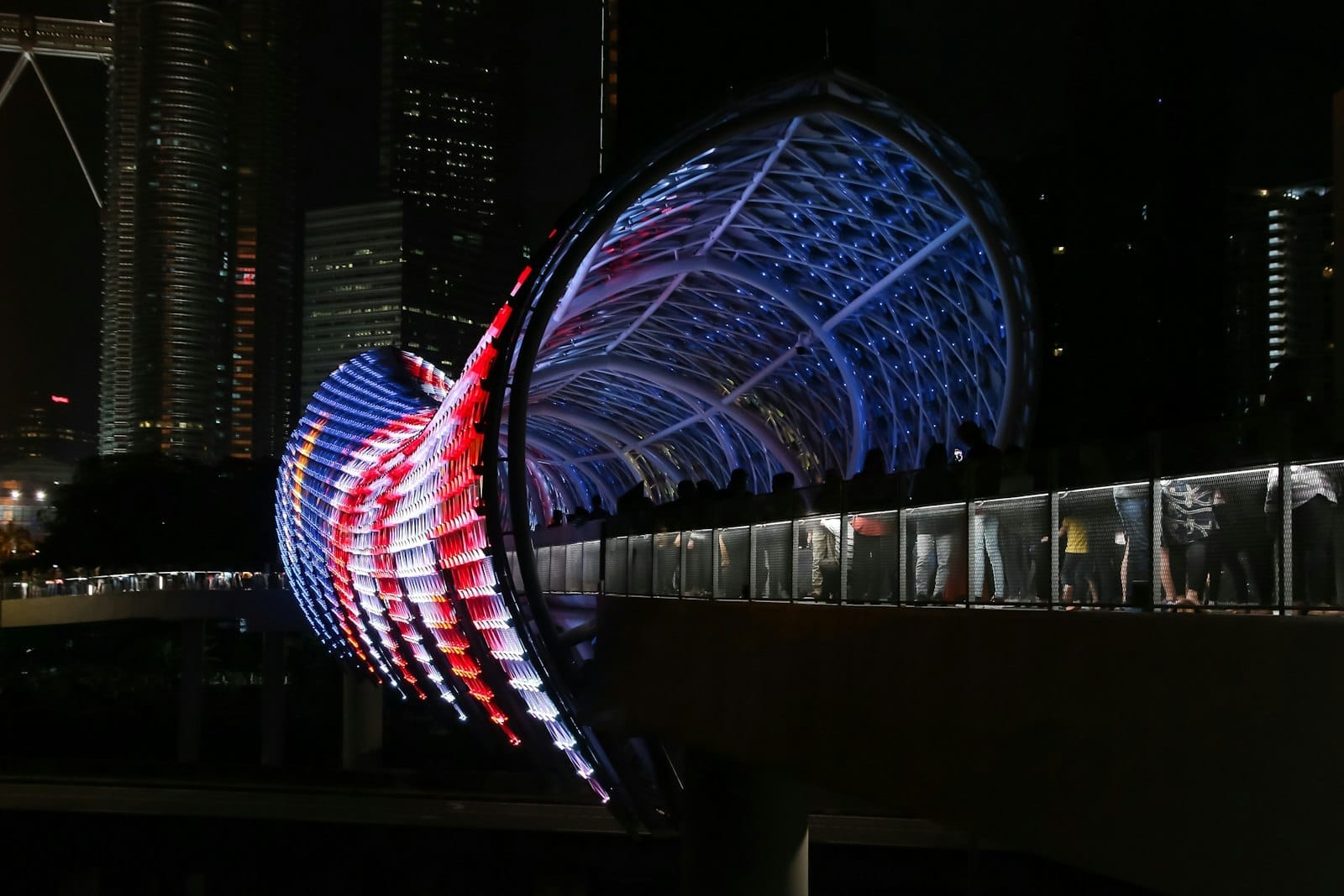
Saloma Link is a 69-metre pedestrian bridge connecting the Kampung Baru district to the KLCC area across the Klang River. Designed with sweeping curves and a nightly light show, it is one of Kuala Lumpur's most visually distinctive pieces of urban infrastructure — and one of the few bridges in Southeast Asia built primarily for walkers.
Quick Facts
- Location
- Jalan Ampang, connecting Kampung Baru and KLCC, Kuala Lumpur
- Getting There
- Ampang Park MRT (Putrajaya Line) or Dang Wangi LRT (Kelana Jaya Line)
- Time Needed
- 20–40 minutes for the crossing and photos
- Cost
- Free
- Best for
- Night photography, architecture lovers, and connecting between Chow Kit and KLCC on foot
What Is Saloma Link?
Saloma Link is a 69-metre single-span steel pedestrian bridge spanning the Klang River and the DUKE Highway in Kuala Lumpur. Opened on 5 February 2020, it was named after the late Malaysian singer and actress Saloma, one of the most beloved entertainers in the country's cultural history. The bridge forms a physical and symbolic link between two very different urban zones: the dense, working-class energy of Kampung Baru to the north, and the polished commercial district of KLCC to the south.
The structure was designed by local firm Arkitek LLA and is considered one of the more thoughtfully executed pieces of public infrastructure built in Kuala Lumpur in recent years. Unlike many pedestrian bridges that feel like an afterthought — narrow, airless, functional at best — Saloma Link has a proper architectural identity. The twin arches, white steel frame, and LED lighting system make it recognisable at a distance, especially from Jalan Ampang at night.
💡 Local tip
The bridge is free to cross at all hours. The LED light display runs from approximately 7 PM to 10 PM, cycling through colours slowly rather than flashing — which makes it far more photogenic than it sounds.
How the Bridge Changes by Time of Day
Visiting Saloma Link during the day and at night are genuinely different experiences. In daylight, the white steel lattice shell structure are clean and angular against the sky, but the bridge reads more as a functional crossing than a spectacle. You'll notice the width of the deck — wide enough for cyclists and pedestrians side by side — and the views down to the murky Klang River below. Depending on the time of year, the river carries silt and debris that remind you this is a working waterway, not a decorative canal.
After sunset, the transformation is significant. The integrated LED system illuminates the 4,100 diamond facade panels in gradients of blue, pink, gold, and white, shifting slowly over time. The surrounding darkness makes the structure appear to float above the highway. From the midpoint of the bridge, you can see the Petronas Twin Towers to the south — close enough to frame cleanly in a photograph, far enough to appreciate their scale. This view alone draws photographers who set up tripods along the railing on weekend evenings.
Weekday mornings bring a different crowd: commuters in office wear using the bridge as a shortcut between Chow Kit and KLCC. The pace is purposeful, and you'll be passed by people checking their phones mid-stride. On weekend evenings, the tempo shifts entirely. Groups gather at the midpoint to take photos, couples linger near the railings, and the atmosphere is more relaxed. Traffic on the DUKE Highway below creates a low, constant hum that mixes with the sound of motorbikes from Jalan Ampang.
ℹ️ Good to know
For photography, arrive around 7:30–8:00 PM. The sky retains some gradient colour while the LED lights are already active, giving you the best balance of ambient light and artificial illumination. Bring a wide-angle lens if you have one.
Tickets & tours
Hand-picked options from our booking partner. Prices are indicative; availability and final rates are confirmed when you complete your booking.
Petronas Twin Towers and Kuala Lumpur Tower observation deck tickets
From 34 €Private Taman Negara day trip from Kuala Lumpur with lunch
From 85 €Instant confirmationFree cancellationKuala Lumpur city and Batu Caves tour
From 41 €Instant confirmationFree cancellationKuala Lumpur city exploration private half-day tour
From 42 €Instant confirmationFree cancellation
The Cultural Significance of the Name
The bridge's name carries genuine weight in Malaysian popular culture. Saloma (full name Salmah Ismail, 1935–1983) was one of the most celebrated entertainers of the 1950s through 1970s. She starred in dozens of films produced by Shaw Brothers' Malay Film Productions and recorded hundreds of songs in a career that spanned three decades. She was also the wife of another Malaysian film legend, P. Ramlee, whose museum and memorial are located in Penang.
Naming a bridge in Kuala Lumpur's cultural corridor after Saloma was a deliberate choice by city planners. The bridge sits within a stretch of the city that has been subject to regeneration efforts under the River of Life project, which aims to restore and activate the Klang River's urban edges. Saloma's name connects the infrastructure to the city's Malay cultural identity at a point where the city is actively trying to reposition itself. Whether you find that meaningful or merely symbolic depends on your perspective, but it does make Saloma Link more than just a crossing.
Walking the Bridge: What to Expect Practically
The Chow Kit end of the bridge sits near Jalan Ampang and connects down into the edges of Chow Kit, one of KL's most characterful neighbourhoods. From here, the busy morning market at Chow Kit Market is about a 10-minute walk north. The KLCC end deposits you close to Jalan P. Ramlee, within comfortable walking distance of the towers and Suria KLCC.
The bridge deck is fully covered, which matters considerably in KL's climate. Afternoon thunderstorms are common between April and October, and having overhead shelter means the crossing stays usable even during light rain. The surface underfoot is textured and non-slip. Lighting along the walkway is adequate even before the main LED display activates, so there is no real concern about visibility after dark.
Accessibility ramps are present at both ends, making the bridge navigable for wheelchair users and those with pushchairs, though you should expect some gradient on the approach ramps. The bridge itself is level across the main span.
⚠️ What to skip
At peak hours on weekday evenings (around 6:00–7:00 PM), the bridge sees heavy foot traffic from commuters. If you want a clear shot with no strangers in the frame, visit after 9:00 PM on a weeknight or before 8:00 AM on a weekend morning.
Saloma Link in the Context of KL's River of Life Project
Saloma Link is one of the most visible completed components of KL's River of Life initiative, a long-term urban regeneration programme focused on the Klang and Gombak rivers. Other elements of this project include the River of Life promenade closer to Masjid Jamek, which has transformed a section of riverbank into a walkable, lit esplanade. Saloma Link adds a pedestrian connection further upstream, giving commuters and visitors a genuine alternative to vehicle-dependent movement through this part of the city.
The broader project has faced criticism for inconsistent implementation and pockets of the riverbank that remain underused or poorly maintained. Saloma Link, by comparison, is well-maintained and regularly used, which places it among the cleaner outcomes of the regeneration effort. The contrast between the bridge's polished design and some of the rougher urban edges visible from its midpoint is noticeable, and honest about where KL's urban transformation currently stands.
Who Should Skip This
If you are visiting Kuala Lumpur on a tight schedule focused on cultural or historical sites, Saloma Link is probably not worth a dedicated trip. It is a bridge, and while it is an attractive one, it does not offer history exhibits, food, shopping, or an enclosed experience. Travellers who are not particularly interested in architecture or urban design may find it underwhelming in under five minutes.
It makes the most sense as part of a deliberate walk between Chow Kit and KLCC, rather than a standalone destination. If you are already doing that walk — perhaps after exploring the market in the morning and heading south toward the towers — crossing Saloma Link adds almost no time and considerable visual interest to what would otherwise be a taxi or ride-share journey.
Insider Tips
- The best elevated view of Saloma Link itself is from Jalan Ampang, looking northwest from a point near the Ampang Park MRT station. This is where the full profile of both arches is visible simultaneously — useful if you want a photo of the bridge rather than from it.
- The bridge cannot be accessed from 1:00 AM to 5:00 AM (Monday–Saturday) and 12:30 AM to 5:00 AM (Sundays and public holidays); LED lighting runs from approximately 7 PM to 10 PM. If you arrive after midnight, you'll get a functional crossing with basic lighting but none of the colour display.
- Combine a Saloma Link crossing with an evening walk through the KLCC Park immediately to the south — the park fountain show runs on a schedule and the area is well-lit and pleasant after dark.
- On the Chow Kit side, the immediate surroundings are functional rather than scenic. Give yourself a few minutes to orient before heading further into the neighbourhood, as the streets near the bridge access point are busy with traffic.
- If you're shooting video rather than stills, a slow walk from the Chow Kit end to the KLCC end during the light show gives you a natural reveal of the Twin Towers as you progress south — an effective sequence for travel content.
Who Is Saloma Link For?
- Architecture and design enthusiasts interested in KL's recent urban development
- Photographers looking for a night shot that combines modern infrastructure with the Petronas Twin Towers backdrop
- Travellers walking between Chow Kit and KLCC who want to avoid the road entirely
- Visitors exploring the River of Life regeneration corridor along the Klang River
- Couples looking for a scenic evening walk that costs nothing
Nearby Attractions
Other things to see while in Chow Kit:
- Chow Kit Market
Chow Kit Market is Kuala Lumpur's largest and most unpolished wet market, where vendors sell everything from exotic tropical fruits and freshly slaughtered meat to dried spices and street snacks. It offers a rare window into how the city actually feeds itself, well away from tourist-polished facades.
- Kampung Baru
Kampung Baru is one of Kuala Lumpur's most unusual urban pockets: a gazetted Malay agricultural reserve from 1900 that has survived almost entirely intact, surrounded by gleaming towers. Wooden kampung houses sit alongside roadside stalls, and the weekend market draws locals from across the city for nasi lemak, grilled fish, and traditional kuih. It rewards unhurried walking and genuine curiosity.
- Titiwangsa Park
Titiwangsa Park is one of Kuala Lumpur's largest and most popular recreational green spaces, anchored by a broad lake and framed by an unlikely view of the city skyline. It draws locals far more than tourists, which is precisely what makes it worth visiting.