Kampung Baru: Kuala Lumpur's Urban Malay Village
Kampung Baru is one of Kuala Lumpur's most unusual urban pockets: a gazetted Malay agricultural reserve from 1900 that has survived almost entirely intact, surrounded by gleaming towers. Wooden kampung houses sit alongside roadside stalls, and the weekend market draws locals from across the city for nasi lemak, grilled fish, and traditional kuih. It rewards unhurried walking and genuine curiosity.
Quick Facts
- Location
- Kampung Baru, Kuala Lumpur (adjacent to Chow Kit and KLCC)
- Getting There
- Kampung Baru MRT station (Kajang Line)
- Time Needed
- 2–3 hours for a relaxed walk; longer on market days
- Cost
- Free to enter; food and market stalls are very affordable
- Best for
- Food lovers, architecture enthusiasts, anyone seeking everyday Malay culture
What Kampung Baru Actually Is
Most urban villages disappear. Kampung Baru did not. established in 1899 and formally gazetted as a Malay Agricultural Settlement in 1900, it occupies roughly 225 acres of freehold land less than two kilometers from the Petronas Twin Towers. That proximity is the point: standing on a narrow lane lined with raised timber houses and banana trees, you can look up and see skyscrapers framing the skyline. The contrast is not accidental, it is the result of more than a century of legal protection and community resistance to redevelopment.
The land is governed by the Kampung Baru Development Corporation, and ownership is restricted to Malay landowners, which has historically complicated large-scale development proposals. The result is a neighborhood that looks and functions more like a rural kampung than a district inside Southeast Asia's most ambitious modern city. Corrugated zinc rooftops, painted timber walls, small mosques, and community halls exist here in a form that has largely vanished from the rest of Kuala Lumpur.
ℹ️ Good to know
Kampung Baru is not a tourist attraction in the conventional sense. There are no ticket counters, guided tours, or curated experiences. You walk, you eat, you observe. Treat it as a neighborhood, not a theme park.
The Saturday Night and Sunday Morning Markets
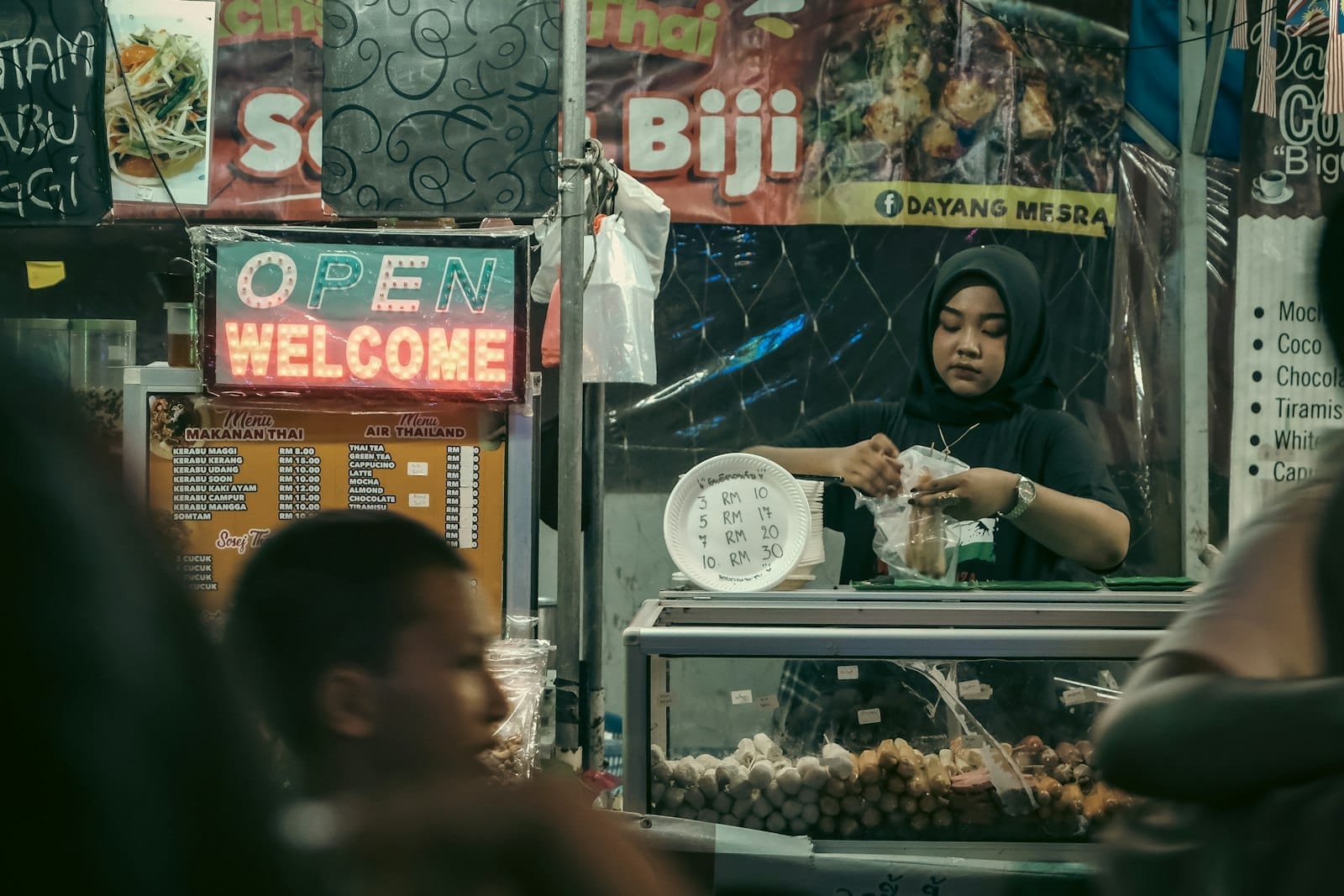
The Saturday night pasar malam and Sunday morning market are the most reliable reasons to visit on a schedule. The Saturday market stretches along Jalan Raja Muda Musa from around 5pm into the night, drawing stall after stall of grilled meats, fried snacks, traditional cakes, and fresh coconut drinks. The air is thick with smoke from satay grills and the sharp sweetness of caramelised pisang goreng. These are not markets staged for visitors — the crowd is almost entirely local Malay families, and prices reflect that.
Sunday mornings have a different energy. The most celebrated stall is Nasi Lemak Antarabangsa on Jalan Raja Muda Abdul Aziz, which has been cooking coconut rice, sambal, and anchovies since the 1970s. By 8am the queue is already forming; by 10am the best dishes sell out. Arrive before 9am if you want the full spread. The nasi lemak here is the benchmark version that Kuala Lumpur residents use when arguing about who does it best.
💡 Local tip
Sunday is the best single day to visit: the morning market is active, the streets are quieter by afternoon, and the light is good for photography before noon. Avoid arriving after 11am on Sunday if the market food is your main goal.
Tickets & tours
Hand-picked options from our booking partner. Prices are indicative; availability and final rates are confirmed when you complete your booking.
Petronas Twin Towers and Kuala Lumpur Tower observation deck tickets
From 34 €Private Taman Negara day trip from Kuala Lumpur with lunch
From 85 €Instant confirmationFree cancellationKuala Lumpur city and Batu Caves tour
From 41 €Instant confirmationFree cancellationKuala Lumpur city exploration private half-day tour
From 42 €Instant confirmationFree cancellation
Walking the Streets: What You Will See
The neighborhood's main artery is Jalan Raja Muda Musa, but the character lives in the side lanes. Timber houses built on stilts, sometimes painted pale green or cream, occasionally still have hand-painted house numbers from decades past. Small gardens overflow with papaya, pandan, and hibiscus. Cats sleep on motorbikes. The sounds are ordinary — children, the call to prayer from a nearby surau, the low hum of air conditioning units retrofitted onto old wooden facades.
Several mosques anchor the neighborhood. Masjid Jamek Kampung Baru, on Jalan Raja Alang, is the oldest and most architecturally significant, with a distinctive tiered roof and a calm courtyard that is open to respectful visitors outside prayer times. Dress modestly: covered shoulders and long pants or skirts are appropriate anywhere in this neighborhood, not just at the mosque.
The Saloma Link pedestrian bridge, which connects Kampung Baru to the KLCC area, has added a striking architectural counterpoint since opening in 2020. Its arching steel spans are visible from several points in the neighborhood and offer one of the better elevated perspectives of the city from the other direction.
If you have time after exploring Kampung Baru, the Chow Kit Market is a 15-minute walk northwest and provides an entirely different urban food experience, more chaotic and multicultural, making the two a natural pair for a single morning.
Time of Day and How It Changes the Experience
Early morning, between 7am and 9am, is when Kampung Baru is most itself. Residents collect breakfast from the roadside stalls before heading to work, the light is soft and low, and the streets carry the smell of freshly cooked rice and frying shallots. It feels genuinely unhurried, which is increasingly rare in KL.
By midday, outdoor activity drops sharply. The heat is significant, and the neighborhood quiets as people retreat indoors. If you are here between 12pm and 3pm, focus on finding shade, a cold drink, and one of the remaining lunchtime stalls. A few old-school kopitiam-style spots along the main road stay open through the afternoon.
Evening before the Saturday pasar malam is a transitional hour worth experiencing: stall operators set up their equipment while the neighbourhood muezzin calls the Maghrib prayer, and the light drops to a warm orange that turns the wooden houses gold. Even on non-market evenings, the small restaurants along Jalan Raja Alang do a steady trade for dinner.
⚠️ What to skip
During Ramadan, the character of Kampung Baru shifts substantially. The Ramadan bazaar here is one of the largest and most authentic in KL, drawing enormous crowds from late afternoon until Iftar. It is worth experiencing, but expect significant congestion from 5pm onward.
Getting There and Getting Around
Kampung Baru MRT station (Kajang Line) deposits you directly at the southern edge of the neighborhood. From the station, a short walk north along Jalan Raja Abdullah leads into the residential streets. The walk from KLCC itself is also manageable at under 20 minutes, particularly via the Saloma Link bridge, which makes for a more interesting approach than a taxi or rideshare.
Rideshare apps (Grab is the dominant service in KL) work well for getting to and from the area. For broader context on moving around the city, the getting around Kuala Lumpur guide covers transit options in detail.
The neighborhood is entirely navigable on foot. Roads are narrow and often shared with motorcycles, so stay aware on the side streets. Footpaths vary in quality — some are smooth, others broken or nonexistent. Comfortable, closed-toe shoes are practical. A basic wheelchair user would face real challenges on the uneven back lanes, though the main roads are generally accessible.
Historical Context and Why This Place Exists
The colonial administration established the Malay Agricultural Settlement in 1900, intending it as a residential and farming zone for Malay workers in the growing British administrative city. The settlement was demarcated separately from the Chinese-dominated commercial zones that would become Chinatown and the Indian precincts of Brickfields and Little India.
After independence, the settlement's protected status became a political and cultural flashpoint. Multiple redevelopment proposals have been floated since the 1980s, each generating significant public debate about Malay land rights, heritage preservation, and the pace of modernization. The result of that unresolved tension is visible in the landscape: some plots have been replaced with shophouses or small apartment blocks, but the majority of land remains in traditional form. The neighborhood exists as a living record of what central Kuala Lumpur looked like before the towers arrived.
For a broader look at KL's heritage districts, Chinatown and Merdeka Square each offer different lenses on the city's layered colonial and post-independence history.
Who Should Consider Skipping It
Kampung Baru rewards patience and genuine interest in ordinary urban life. Travelers looking for polished experiences, indoor air conditioning, or Instagram-optimized spaces will likely find it underwhelming. There is no interpretive signage, no entrance area, no curated narrative. The streets look like streets, not sets. If your time in KL is limited to two or three days and you are prioritizing iconic landmarks, Kampung Baru competes with a long list of more immediately dramatic options.
Families with very young children may also find the uneven terrain and heat challenging, particularly outside market hours. For family-friendly alternatives in the area, the KLCC Park and Aquaria KLCC offer more structured experiences nearby.
Insider Tips
- Nasi Lemak Antarabangsa on Sunday morning is the headline act, but the row of kuih stalls near the market entrance is where locals actually queue longest. Try the pulut panggang and the onde-onde.
- The Saloma Link bridge is worth walking at dusk for city views back toward the Twin Towers — it is almost always quieter than KLCC-side viewpoints and free.
- If you are visiting during a Federal public holiday, the Saturday pasar malam may shift days or expand. Check local social media or ask at your hotel the week of.
- The neighborhood has very few ATMs. Bring cash — almost all market stalls and smaller food stalls are cash-only. Small denominations work best.
- Masjid Kampung Baru welcomes respectful non-Muslim visitors outside prayer times. Remove shoes at the entrance and ask a worshipper if you are unsure when prayers are scheduled.
Who Is Kampung Baru For?
- Food travelers focused on authentic Malay street food and traditional breakfast culture
- Architecture and urban history enthusiasts interested in pre-independence KL
- Photographers looking for textured, unscripted street scenes away from tourist circuits
- Slow travelers with time to walk without an agenda
- Anyone visiting during Ramadan who wants to experience a genuine KL Ramadan bazaar
Nearby Attractions
Other things to see while in Chow Kit:
- Chow Kit Market
Chow Kit Market is Kuala Lumpur's largest and most unpolished wet market, where vendors sell everything from exotic tropical fruits and freshly slaughtered meat to dried spices and street snacks. It offers a rare window into how the city actually feeds itself, well away from tourist-polished facades.
- Saloma Link
Saloma Link is a 69-metre pedestrian bridge connecting the Kampung Baru district to the KLCC area across the Klang River. Designed with sweeping curves and a nightly light show, it is one of Kuala Lumpur's most visually distinctive pieces of urban infrastructure — and one of the few bridges in Southeast Asia built primarily for walkers.
- Titiwangsa Park
Titiwangsa Park is one of Kuala Lumpur's largest and most popular recreational green spaces, anchored by a broad lake and framed by an unlikely view of the city skyline. It draws locals far more than tourists, which is precisely what makes it worth visiting.