Rosslyn Chapel: The Stone-Carved Mystery South of Edinburgh
Founded in 1446 by Sir William St Clair, Rosslyn Chapel is one of Scotland's most ornately carved medieval buildings. Located in the village of Roslin, Midlothian, it draws visitors for its extraordinary stonework, layered history, and the legends that surround nearly every pillar and arch. A timed visit with 30–50 minutes’ travel by bus or car from Edinburgh city centre.
Quick Facts
- Location
- Chapel Loan, Roslin, Midlothian EH25 9PU — approx. 7 miles (11 km) south of Edinburgh city centre
- Getting There
- Lothian Bus service 37 from Edinburgh city centre; journey 30–50 minutes. Parking available at the visitor centre for drivers.
- Time Needed
- Allow 90 minutes inside the chapel (timed-entry slots) plus travel time; add 30–60 minutes to walk Roslin Glen nearby
- Cost
- Adult £10.00 | Concession £9.00 | Child (5–17) £3.00 | Family ticket (2 adults + up to 3 children) £27. Pre-booking recommended, especially at busy times.
- Best for
- Medieval architecture enthusiasts, history lovers, Da Vinci Code fans, families with curious older children
- Official website
- www.rosslynchapel.com
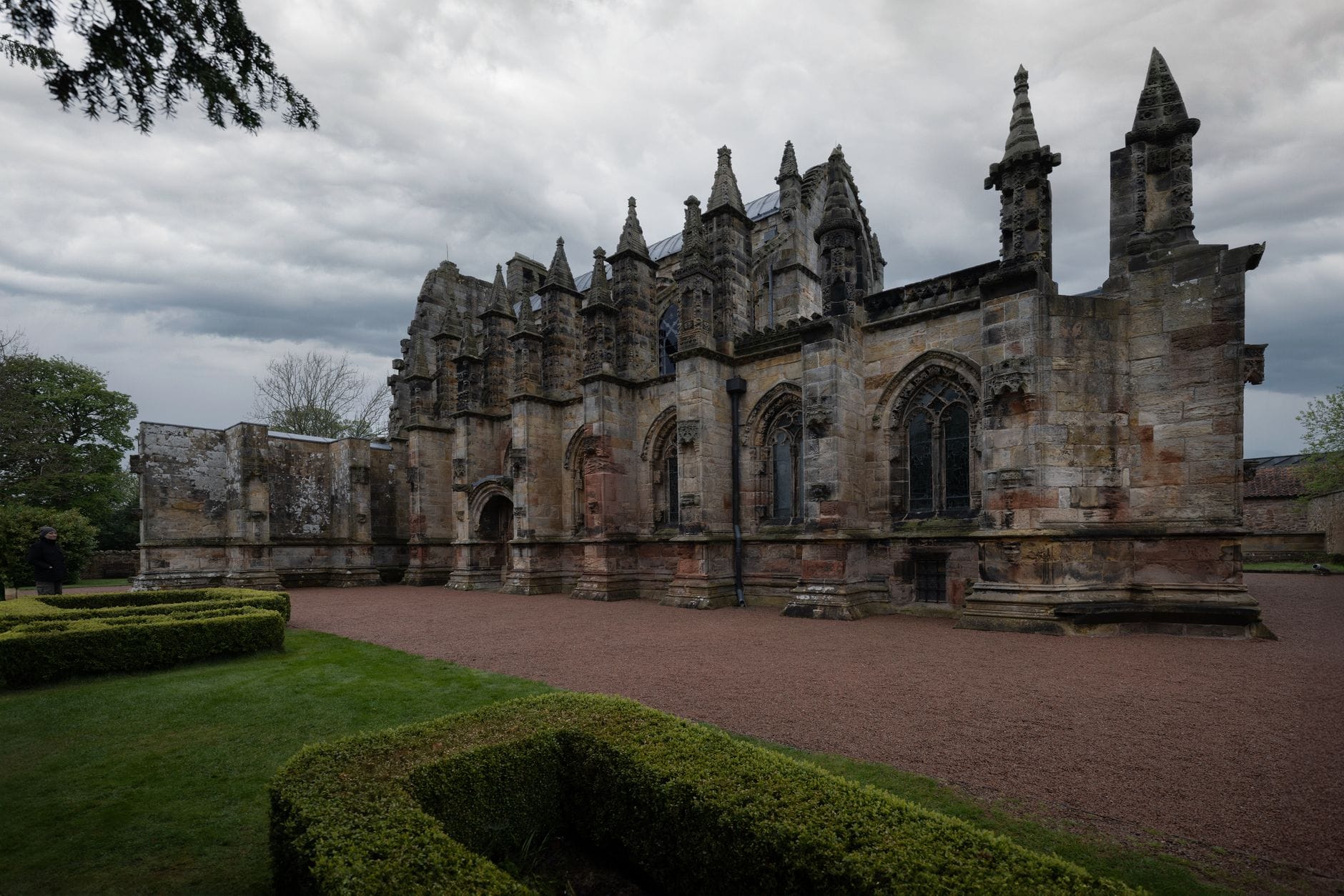
What Rosslyn Chapel Actually Is
Rosslyn Chapel, formally the Collegiate Chapel of Saint Matthew, is a 15th-century stone chapel that has outlasted its original congregation, survived religious upheaval, and become one of Scotland's most talked-about buildings. It was founded in 1446 by Sir William St Clair, 3rd Prince of Orkney, and was consecrated as a Catholic collegiate chapel around 1450. The building was never finished according to the original plans, which is part of why it looks so dense and compressed: what stands today was intended to be just the choir of a much larger church.
The chapel is still an active place of worship under the Scottish Episcopal Church, which matters when you visit. There is a quiet gravity to the space that survives the tourist traffic, and services are still held here. Visitors are welcome, but the atmosphere expects a degree of respect. Photography is not permitted inside the chapel, which is worth knowing before you arrive.
ℹ️ Good to know
Visits operate on 90-minute timed entry slots. Booking in advance via the official website is strongly recommended to guarantee entry — limited walk-up tickets may be available but cannot be relied on. Check rosslynchapel.com for current availability, especially in summer.
The Stonework: What You're Actually Looking At
Nothing in Rosslyn Chapel is plain. The interior surfaces — columns, arches, ceilings, window surrounds — are carved to a density that takes time to process. The Apprentice Pillar, near the east end of the chapel, is the carving most visitors gravitate toward. It spirals upward in bands of foliage and is technically extraordinary: achieved without power tools in the 15th century, by hand, in sandstone. The legend attached to it — that the master mason killed his apprentice out of jealousy upon seeing the finished pillar — is almost certainly invented, but it has circulated for centuries and is now inseparable from the chapel's identity.
The ceiling of the Lady Chapel at the east end is covered in carved flowers, stars, and geometric forms. Walk slowly and look up. The carvings include what some researchers describe as green men — faces with foliage growing from the mouth — along with figures that appear in Celtic, Christian, and even speculative Masonic interpretations. The chapel has attracted more symbolic analysis per square foot than almost any building in Britain, and visitors often arrive having read a particular theory and then try to locate evidence for it in the stone. The chapel contains enough detail to support almost any framework, which is part of its enduring fascination.
It is worth noting that the carvings also include plants that appear to be maize and aloe vera — species not known in Europe before the late 15th century. This detail has prompted long debate. No settled explanation exists, and the chapel's guides are refreshingly honest about that uncertainty.
Tickets & tours
Live prices and dates from our booking partner. If you book, we may earn a commission at no extra cost to you.
From Edinburgh to Rosslyn Chapel, Glenkinchie Distillery and more
From 57 €Instant confirmationFree cancellationGuided tour from Edinburgh of Rosslyn Chapel, Stirling Castle and Dunfermline Abbey
From 47 €Instant confirmationFree cancellationRosslyn Chapel and Scottish Borders small-group day tour
From 43 €Instant confirmationFree cancellationWest Highland Lochs, mountains and castles tour from Edinburgh
From 61 €Instant confirmationFree cancellation
The Da Vinci Code Effect: What Changed and What Didn't
Dan Brown's 2003 novel and the 2006 film adaptation placed Rosslyn Chapel at the center of a global audience's imagination. Visitor numbers increased sharply after the film's release, and the chapel became internationally known in a way it had not been before. The management has handled this carefully: there is no merchandise aisle dedicated to conspiracy theories, and the interpretive displays inside the visitor center are scholarly rather than sensational.
The Da Vinci Code tourism wave has largely settled into a steady baseline of curious visitors who know the chapel's name but may not know its actual history. For those visitors, the real thing tends to be more interesting than the fictional version. The building predates the novel by five and a half centuries, and its documented history — the St Clair family, the Reformation period, a long phase of neglect followed by Victorian restoration — is genuinely complex without requiring any invented additions.
If the Da Vinci Code connection is your primary interest, the chapel will still satisfy. If medieval ecclesiastical architecture is your focus, it will exceed expectations. Either way, pairing the visit with the Scotch Whisky Experience or a morning at the National Museum of Scotland makes for a well-rounded Edinburgh day.
Planning Your Visit: Timing, Transport, and the Journey Itself
Rosslyn Chapel is not in Edinburgh. This is worth stating plainly. It sits in the village of Roslin in Midlothian, about 7 miles south of the city centre. The journey by Lothian Bus service 37 from the city centre takes between 30 and 50 minutes depending on traffic and connections. The bus stops near the Rosslyn Hotel, a short walk from the chapel. The route passes through the south Edinburgh suburbs and then drops into greener, quieter countryside as it approaches Roslin, which is itself a pleasant shift if you have been based in the city centre for several days.
By car, the chapel is signposted from Edinburgh and parking is available at the visitor centre. If you are combining the visit with the nearby Roslin Glen, arriving by car gives you more flexibility, as the glen walk is best done without a fixed return bus schedule.
Opening hours are Monday to Saturday 09:30 to 17:00, and Sunday 12:00 to 17:00. The chapel is closed on Christmas Eve, Christmas Day, and New Year's Day. Early morning slots on weekdays are the least crowded and give you the interior in quieter conditions. Midday on weekends, particularly in July and August, sees the heaviest visitor concentration inside the timed slots.
💡 Local tip
Book the earliest available slot on a weekday if you want near-empty conditions inside the chapel. The stone interior holds cool air even in summer, so a light layer is useful regardless of the weather outside.
If you are building a wider day out, Roslin Glen is a short walk from the chapel and offers a completely different experience: a wooded river gorge with paths along the North Esk. It is a reasonable counterpoint to spending 90 minutes in an interior. For more structured walking options across Edinburgh and its surroundings, the Edinburgh hiking guide covers routes at different difficulty levels.
The Visitor Centre and What Surrounds the Chapel
Entry to the chapel is through a modern visitor centre that opened in 2012 following a long restoration project beginning in the 1990s. The centre contains interpretive displays on the chapel's history, the St Clair family, and the restoration work itself. It is well-designed without being distracting, and it gives context that genuinely improves what you see inside the chapel. A cafe is located within the visitor centre, and there is a small shop. The toilets are here rather than inside the chapel itself, so factor that into your arrival timing.
The grounds around the chapel include the exterior of the building, which rewards a slow circuit before you enter. The exterior stonework on the south wall is particularly detailed, and the buttresses and pinnacles are more visible from outside than many visitors realize, having gone straight indoors. The chapel sits on a slight elevation with views toward Roslin Glen, and on a clear day the setting makes more sense as a deliberate choice by the St Clair family to build on this particular piece of land.
Accessibility, Photography, and Honest Limitations
The visitor centre is accessible, and Lothian Bus service 37 operates low-floor vehicles. Detailed step-free and accessibility information for the chapel itself is available on the official website's visit section, and it is worth checking before you travel if this is a factor in your planning, as the chapel interior has some uneven stone flooring.
Photography is not allowed inside the chapel, although it is permitted in the grounds. The interior is dim — stained glass filters much of the available light — so if restrictions change, a phone camera with a reasonable low-light capability will serve you better than a basic compact. The Apprentice Pillar would photograph well from a low angle looking upward, which captures the spiral carving in full. The ceiling of the Lady Chapel is difficult to photograph satisfactorily given the angles and the light levels; taking the time to simply look at it directly will be more rewarding than trying to capture it.
A note on expectations: some visitors arrive anticipating a large cathedral-scale experience and find the chapel's actual scale surprising. It is a relatively small building. Its impact comes from density and detail rather than volume or sweep. If you are expecting something on the scale of St Giles' Cathedral on the Royal Mile, adjust your expectations downward in size but upward in intricacy.
Visitors who find Rosslyn Chapel compelling often follow it with other historic Edinburgh religious sites. St Giles' Cathedral in the Old Town is free to enter and provides a contrasting sense of ecclesiastical scale, while Greyfriars Kirkyard nearby is worth an hour for its layered history and atmosphere.
Who Will Get the Most From This Visit
Rosslyn Chapel suits visitors who are genuinely interested in medieval architecture, ecclesiastical history, or symbolic interpretation. It also works well for families with children old enough to engage with visual complexity — the hunt for specific carvings can hold a ten or twelve-year-old's attention in a way that a standard historic interior often does not. Younger children may find the 90-minute timed slot a long time in a space where touching things is not permitted.
Visitors who are primarily interested in broad Edinburgh sightseeing and have limited time should weigh the travel time carefully. The round trip from the city centre by bus adds at least an hour to the visit, and there is substantial competition for that time from attractions within walking distance of the Old Town. If you have three days in Edinburgh, Rosslyn Chapel is a strong candidate for one afternoon. If you have one day, it may displace too much.
For a one-day Edinburgh itinerary that prioritizes the city centre, the Edinburgh one-day itinerary guide helps with the decisions. For those with more time and an interest in getting beyond the standard circuit, the Edinburgh hidden gems guide covers less-trafficked options alongside Rosslyn.
Insider Tips
- Book the first slot of the day on a Monday, Tuesday, or Wednesday. These are consistently the quietest conditions inside the chapel, and the quality of attention you can give the carvings in a sparse crowd is significantly different from a Saturday afternoon.
- Walk the exterior of the building in full before entering the visitor centre. The south-facing exterior wall and the buttresses along the outside hold carvings that many visitors never see because they head straight indoors.
- The visitor centre's interpretation displays are worth reading before you enter the chapel rather than after. They provide enough context on the St Clair family and the building's construction history to make what you see inside considerably more legible.
- Roslin Glen is a 5–10 minute walk downhill from the chapel and is almost entirely missed by day-trippers. The wooded gorge path along the North Esk is free, takes about 45 minutes to walk, and provides a genuine contrast to the tight interior of the chapel.
- If you are visiting in winter, the Sunday 12:00 opening means early afternoon light through the stained glass, which can be particularly atmospheric. The chapel is also much less visited between November and February, making the timed slots easier to book at short notice.
Who Is Rosslyn Chapel For?
- Medieval and ecclesiastical architecture enthusiasts who want to study stonework in detail
- History-focused travelers with an interest in Scottish heritage and the St Clair family story
- Families with older children who respond well to visual exploration and storytelling
- Da Vinci Code readers or film viewers who want to see the real location behind the fiction
- Visitors with at least two full days in Edinburgh who can afford the travel time from the city centre
Nearby Attractions
Combine your visit with:
- Colinton Tunnel
The Colinton Tunnel is a 137-metre Victorian railway tunnel on the Water of Leith Walkway, transformed into Scotland's largest heritage mural. Inspired by Robert Louis Stevenson's poem 'From a Railway Carriage', it's free to visit, fully accessible, and open around the clock.
- Craigmillar Castle
Craigmillar Castle is a remarkably complete medieval ruin sitting on a low hill 3 miles southeast of Edinburgh's centre. Once a retreat for Mary, Queen of Scots, it rewards visitors with genuine history, sweeping city views, and crowds that are a fraction of Edinburgh Castle's.
- Cramond Beach & Island
A short bus or drive from the city centre, Cramond Beach leads to one of Edinburgh's most unusual free attractions: a tidal island in the Firth of Forth, reachable only during a narrow low-tide window. Sandy shores, wartime concrete pylons, and quiet woodland paths make this a world away from the Royal Mile.
- Edinburgh Zoo
Set across 82 acres of wooded hillside in western Edinburgh, Edinburgh Zoo is Scotland's largest wildlife attraction and home to over 2,500 animals. It holds a remarkable place in zoo history as the first zoo in the world to successfully house and breed penguins, and it remains the only UK zoo incorporated by royal charter.
Planning a trip? Discover personalized activities with the Nomado app.