Roskilde Cathedral: Scandinavia's Oldest Brick Gothic Church and Royal Mausoleum
Roskilde Cathedral (Roskilde Domkirke) is Denmark's most historically significant church: a UNESCO World Heritage Site built in the 12th and 13th centuries, the burial place of around 40 Danish kings and queens, and the structure that introduced Gothic brick architecture to northern Europe. It sits on a low hill in Roskilde, It sits on a low hill in Roskilde, just 25 minutes by train from Copenhagen Central Station..
Quick Facts
- Location
- Domkirkepladsen 3, 4000 Roskilde, Denmark
- Getting There
- 22–25 min by train from Copenhagen Central Station to Roskilde Station, then ~10 min walk
- Time Needed
- 1.5–2.5 hours including the interior and surrounding square
- Cost
- Entrance fee applies for tourist visits; free entry for church services. Check roskildedomkirke.dk for current DKK prices.
- Best for
- History enthusiasts, architecture lovers, fans of royal heritage and Scandinavian heritage sites
- Official website
- roskildedomkirke.dk/english/history
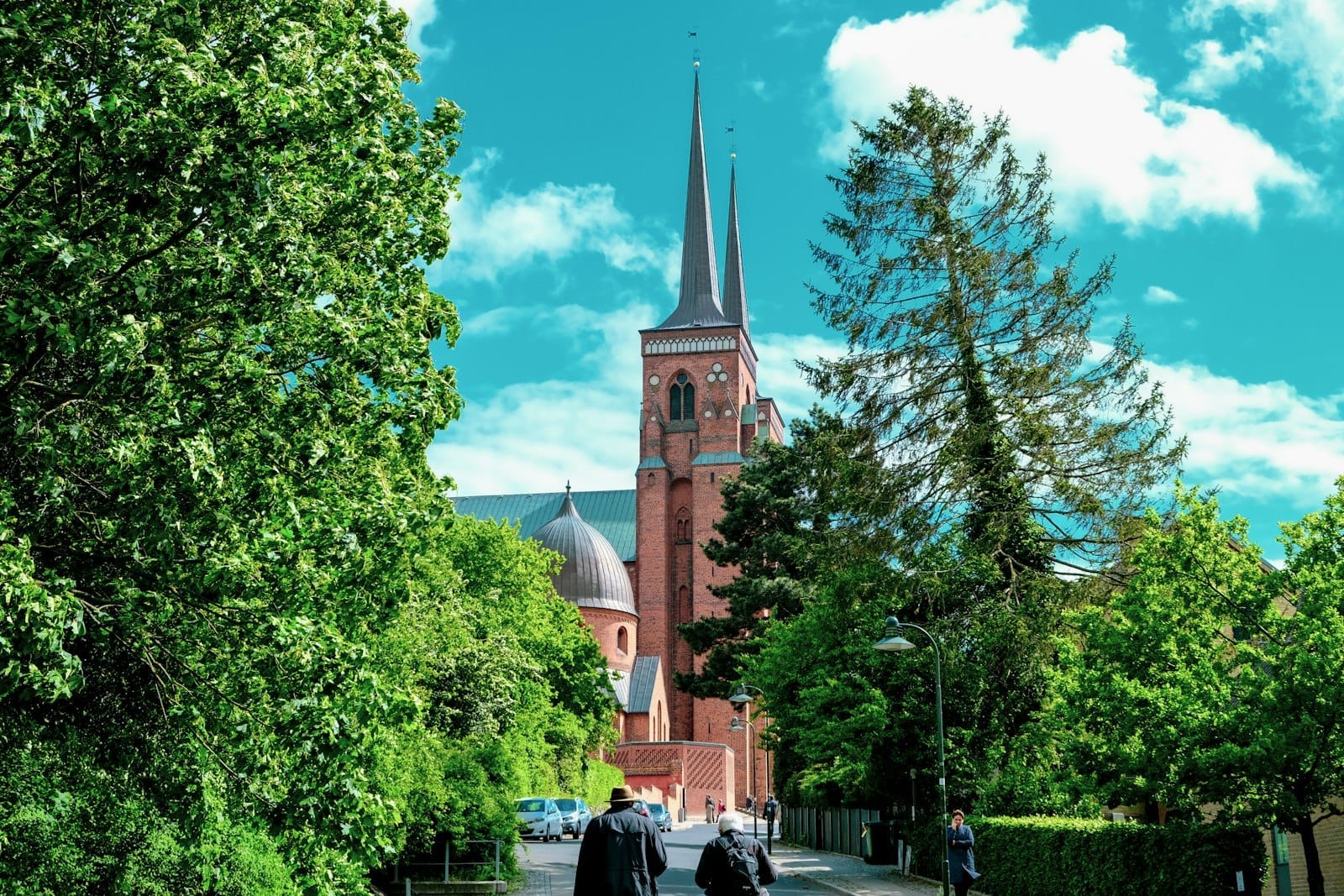
What Roskilde Cathedral Actually Is
Roskilde Cathedral, known in Danish as Roskilde Domkirke, is not simply an old church. It is the burial site of the Danish royal family stretching back centuries, a UNESCO World Heritage Site since 1995, and the structure that effectively introduced Gothic brick construction to Scandinavia. Around 40 kings and queens of Denmark rest here, from medieval monarchs to rulers of the modern era. That continuity — nearly a millennium of royal history compressed into a single building — is what separates Roskilde from other historic churches in the region.
The building sits on a low hill above Roskilde Fjord, its twin brick spires visible from much of the town. From the cathedral square (Domkirkepladsen), the scale registers immediately: this is a large, aisled Gothic basilica, and it has been dominating this skyline since the 13th century. For travelers already planning to see Copenhagen's central churches, Roskilde offers something categorically different — depth of historical significance that goes well beyond what the capital's own churches can match.
History and Architectural Significance
Construction began in the 12th century, and the main Gothic structure was substantially complete by the early 13th century. The builders used approximately 2.5 million hand-produced bricks, making Roskilde Cathedral Scandinavia's first Gothic cathedral constructed in brick. That choice of material was not incidental — it influenced ecclesiastical architecture across northern Europe, demonstrating that the French Gothic style could be adapted using locally produced brick rather than the imported stone that dominated southern European cathedrals.
The UNESCO designation, awarded in 1995, specifically cites the cathedral's role in the spread of Gothic brick construction in northern Europe and its unbroken function as a royal mausoleum. The building has been added to and modified across eight centuries — chapels were appended, the interior was decorated across different stylistic periods, and the twin spires were rebuilt after fires. The result is not a single coherent architectural statement but a layered record of Danish history in brick and stone.
If Gothic architecture and its regional variations interest you, pairing Roskilde with a visit to the Kronborg Castle in Helsingør makes for a coherent day trip covering two of Denmark's UNESCO-listed sites — though they are in opposite directions from Copenhagen.
Tickets & tours
Hand-picked options from our booking partner. Prices are indicative; availability and final rates are confirmed when you complete your booking.
1-hour boat harbour tour in Copenhagen
From 26 €Instant confirmationFree cancellationSmall group 3-hour walking tour in Copenhagen
From 45 €Instant confirmationFree cancellationCopenhagen to Malmo one-day tour
From 56 €Instant confirmationFree cancellationFull-day tour to Forest Tower and Forgotten Giants from Copenhagen
From 110 €Instant confirmationFree cancellation
Inside the Cathedral: The Royal Chapels and Tombs
The interior is where Roskilde Cathedral earns its authority. The nave is long, pale, and quietly imposing — brick walls lightened by centuries of whitewash, with the light filtering differently depending on the season and time of day. Morning visits in summer produce the most favorable interior light, with soft illumination crossing the nave from the east windows. In winter, the interior takes on a heavier, more contemplative atmosphere, which some visitors find more appropriate given the building's function.
The royal sarcophagi and funerary chapels are the primary draw. Each chapel reflects the period in which it was built: some are restrained and medieval in character, others are elaborate Baroque constructions added in the 17th and 18th centuries. The contrast between them is itself instructive, showing how different generations of the Danish royal family chose to represent themselves to posterity. Plaques, carved effigies, and painted memorials accumulate throughout the side chapels, creating an unusual density of historical information for a single building.
💡 Local tip
Plan at least 90 minutes inside. Many visitors underestimate how much time the side chapels require — each one rewards close attention. If you rush through to photograph the nave and leave, you'll miss most of what makes the cathedral worth the journey.
Roskilde Cathedral remains an active parish church. Services, concerts, and ceremonies take place regularly, and during these events, tourist access to parts of the interior may be restricted or closed entirely. Check the cathedral's official calendar before visiting, particularly on Sundays and around Danish public holidays. Attendance at a service is free and provides a different kind of experience of the space — the acoustics are remarkable, and the cathedral choir performs here regularly.
Visiting by Time of Day and Season
Weekday mornings between 10am and noon offer the quietest conditions for a tourist visit. Tour groups from Copenhagen tend to arrive mid-morning and peak around midday, so arriving at opening time gives you a window of relative solitude in the nave and chapels. Weekend afternoons, particularly in summer, are the most crowded periods — the cathedral draws significant visitor numbers between June and August, and the narrow cathedral square becomes congested when multiple groups overlap.
The exterior reads differently across the seasons. In summer, the red brick against a clear sky and the green of the surrounding square creates a photogenic contrast. In autumn and winter, the brick darkens with moisture and the low northern light catches the texture of the facade in ways that summer's flat overhead light doesn't permit. Winter visitors also benefit from fewer crowds, though they should check that the cathedral's winter opening hours accommodate their plans — hours are shorter outside peak season.
⚠️ What to skip
Opening hours vary significantly by season and are subject to change due to services, concerts, and ceremonies. Always verify current hours on the official website at roskildedomkirke.dk before making the trip.
Getting There from Copenhagen
The most practical route from Copenhagen is by regional train from Copenhagen Central Station (København H) to Roskilde Station. The journey takes approximately 22 to 25 minutes and runs frequently throughout the day. From Roskilde Station, the cathedral is around 600 metres via Algade — a straightforward walk of 8 to 10 minutes through the town centre. Buses 201A and 209 from the station also stop close to the cathedral if you prefer not to walk.
By car from Copenhagen, the drive takes approximately 30 minutes, and several car parks are available in central Roskilde near the cathedral. Bicycle parking is available on-site for those cycling. If you hold a Copenhagen Card, check current terms, as the card has historically covered train travel to Roskilde within its zone coverage — though this should be verified before travel.
Roskilde works well as a half-day trip from Copenhagen, with time remaining to explore the town's waterfront or combine with the nearby Viking Ship Museum, which is a 15-minute walk from the cathedral and houses five original Viking ships excavated from the fjord. The two sites together form one of the most substantive historical day trips available from Copenhagen.
Photography and Practical Notes
Photography is generally permitted in the interior, though flash and tripods are typically restricted or require prior arrangement. The best exterior shots of the twin spires are taken from the lower ground of the cathedral square, where the elevation of the building is most apparent. Early morning in summer, before the tour groups arrive, gives the clearest foreground in the square without crowds. The interior's pale brick and filtered light respond well to higher ISO settings — the lighting is not bright, and long exposures without a tripod produce mixed results.
Dress practically rather than formally — the interior is cool year-round, so a layer is worthwhile even in summer. The cathedral floor involves some uneven stone surfaces and steps within the chapels, which may present challenges for visitors with significant mobility limitations. Contact the cathedral directly via the information on their official website for the most current accessibility guidance, as provisions can change.
Is It Worth the Trip?
For travelers interested in European history, royal heritage, or Gothic architecture, Roskilde Cathedral is one of the most genuinely significant sites within reach of Copenhagen. The 22-minute train journey puts it closer than many visitors expect, and the combination of architectural rarity (Scandinavia's first Gothic brick cathedral), UNESCO recognition, and an unbroken tradition as a royal burial site gives it a weight that few single buildings in Denmark can match.
Travelers who find European church visits repetitive, or who are primarily interested in Copenhagen's contemporary design and food scene rather than medieval history, may find the trip less compelling. For those visitors, the city's own resources — from the Ny Carlsberg Glyptotek to SMK, the National Gallery of Denmark — may offer more relevant experiences without leaving the city.
Roskilde Cathedral is best understood not as a detour but as a destination in its own right. Anyone following a serious interest in Scandinavian history will find it more rewarding than several of Copenhagen's more prominent but less historically dense attractions. For context on planning a full day around the cathedral and the wider Roskilde area, see the day trips from Copenhagen guide.
Insider Tips
- Arrive at opening time on a weekday morning for near-solitude in the nave — tour groups from Copenhagen typically arrive from 10:30am onward, so the first 30 to 45 minutes after opening are noticeably quieter.
- The cathedral's active parish calendar means some visits coincide with services or choral rehearsals. Rather than treating this as an inconvenience, consider it an opportunity — the acoustics in the nave are exceptional, and even a brief rehearsal overheard from the entry area gives a sense of the space that photographs cannot convey.
- Combine the visit with the Viking Ship Museum (Vikingeskibsmuseet), a 15-minute walk away. The two sites are Denmark's most concentrated pairing of UNESCO-level significance and together justify a full half-day away from Copenhagen.
- The cathedral shop near the entrance stocks high-quality illustrated guides and academic publications on the building's history — better research material than most attraction shops, and worth browsing if the architecture or royal history interests you deeply.
- Check the cathedral's event calendar for organ concerts, which are held periodically and represent one of the best ways to experience the interior acoustics and scale of the space in a context beyond standard tourist access.
Who Is Roskilde Cathedral For?
- History travelers with a serious interest in Scandinavian medieval and royal heritage
- Architecture enthusiasts tracking the spread of Gothic brick construction in northern Europe
- Day-trippers from Copenhagen looking for UNESCO-level significance within 30 minutes of the city
- Visitors combining Roskilde Cathedral with the Viking Ship Museum for a full historical half-day
- Travelers who want to understand the Danish monarchy's physical and symbolic presence over centuries
Nearby Attractions
Combine your visit with:
- Amager Strandpark
Amager Strandpark (Amager Beach Park) is Copenhagen's largest beach, offering a total of 4.6 km of sandy shoreline along the city's southeastern coast. Free to enter and easily reached by metro, it combines a natural shoreline with a 2 km artificial island and sheltered lagoon opened in 2005, making it a genuine summer destination for locals and a quiet surprise for visitors expecting a landlocked Scandinavian capital.
- Arken Museum of Modern Art
Located on the Ishøj coastline south of Copenhagen, ARKEN Museum of Modern Art combines a dramatically sculptural building with a serious contemporary art program. The journey out of the city is part of the experience, and the landscape setting changes everything about how you engage with the art.
- Bakken
Dyrehavsbakken, known simply as Bakken, has been drawing visitors to the forests north of Copenhagen since 1583, making it the oldest operating amusement park on earth. Unlike polished theme parks, it mixes rickety roller coasters, carnival stalls, and open-air restaurants inside a UNESCO-recognized deer park, with free entry to the grounds.
- The Blue Planet – National Aquarium Denmark
The Blue Planet, Denmark's National Aquarium, sits in Kastrup on the Øresund coast with 7 million liters of water, 450 species, and a striking spiral building that's worth examining before you even step inside. This guide covers what to expect from the exhibits, the best times to visit, and how to get there without confusion.