Kronborg Castle: The Real Elsinore, 45 Minutes from Copenhagen
Kronborg Castle in Helsingør is one of Northern Europe's great Renaissance fortresses and the UNESCO-listed setting that inspired Shakespeare's Hamlet. Perched at the narrowest point of the Øresund strait, it commands views across to Sweden and offers one of the most atmospheric day trips from Copenhagen.
Quick Facts
- Location
- Kronborg 2C, 3000 Helsingør, Denmark — approx. 45 km north of Copenhagen
- Getting There
- DSB train from Copenhagen Central Station to Helsingør (~45–50 min), then a ~10 min walk to the castle
- Time Needed
- 2–3 hours at the castle; allow a full half-day including travel
- Cost
- Adults 135–150 DKK; under-18s free; covered by Copenhagen Card – Discover. Verify current prices at kronborg.dk
- Best for
- History enthusiasts, architecture lovers, families, literary travelers, and anyone who wants a dramatic coastal setting
- Official website
- kronborg.dk/en
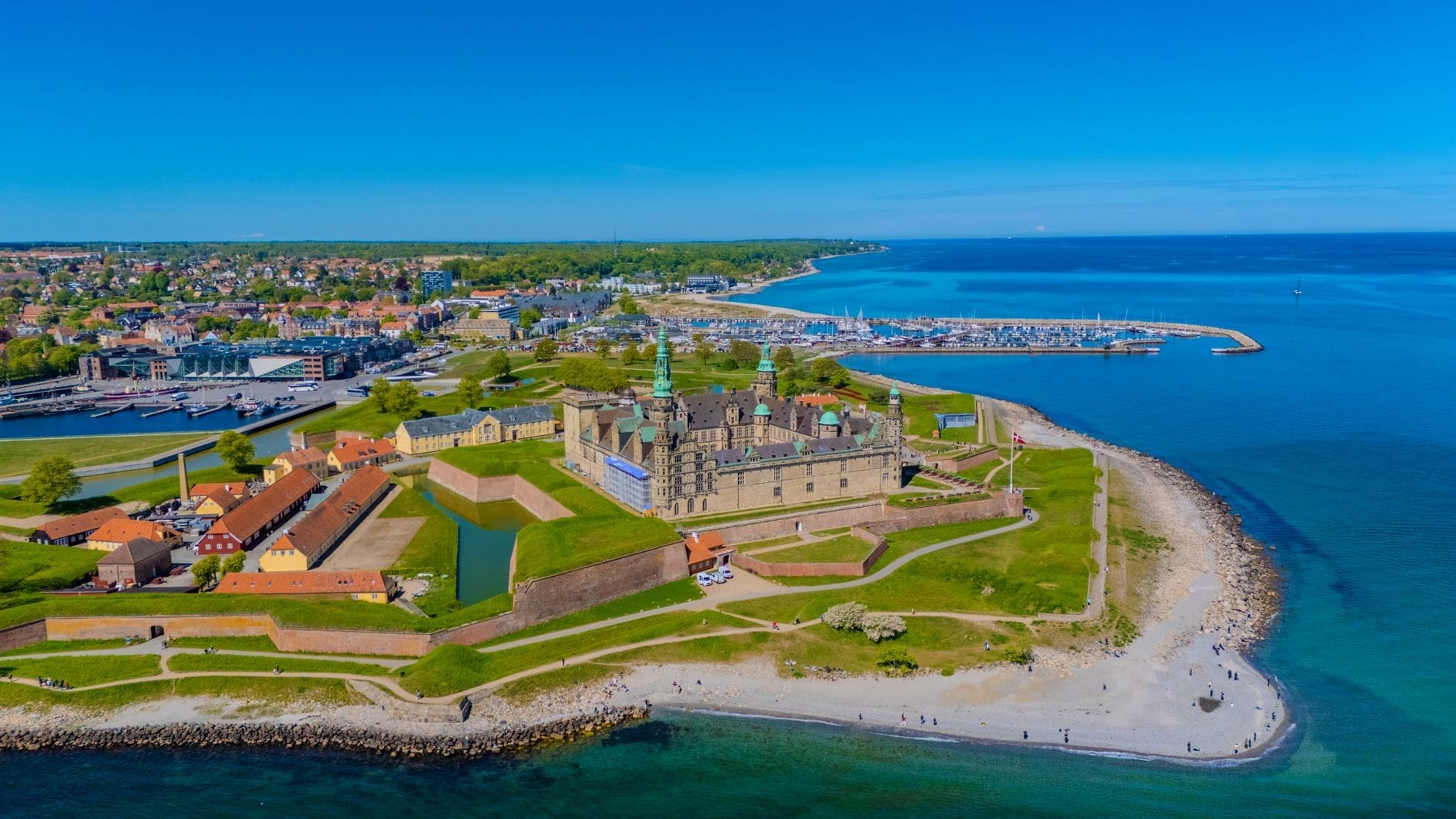
What Kronborg Castle Actually Is
Kronborg Castle — known in Danish as Kronborg Slot — is a Renaissance fortress on the northeastern tip of Zealand, positioned where the Øresund strait narrows to just four kilometers. From its ramparts, the Swedish city of Helsingborg is close enough that you can make out individual buildings across the water. That geography was never an accident: for nearly two centuries, Danish kings used Kronborg to control and tax every ship passing between the North Sea and the Baltic, making it one of the most strategically important points in Northern Europe.
The site has a longer history than the castle's Renaissance appearance suggests. A fortification called Krogen was first built here in the 1420s by Eric of Pomerania. The structure we see today took its recognizable form after a major enlargement completed in 1585, when the castle was renamed Kronborg, meaning Crown Castle. It was inscribed as a UNESCO World Heritage Site in 2000, acknowledged as one of the finest Renaissance castles in Northern Europe. Most visitors also know it as Elsinore, the setting Shakespeare used for Hamlet, though the playwright almost certainly never visited.
💡 Local tip
Typical summer opening hours are daily 10:00–18:00, but hours are seasonal and change throughout the year. Always check the official kronborg.dk website before visiting to confirm current times.
Getting There from Copenhagen
The easiest route is the DSB regional train from Copenhagen Central Station (København H) to Helsingør, which takes around 45 minutes and runs frequently. From Helsingør station, the castle is a flat, 15–20 minute walk north along the harbor — the route is well-signed and passes through the old town, so it doubles as a brief street-level introduction to Helsingør itself. If you hold a Copenhagen Card, train travel within the relevant zones may be included, which makes the journey even more straightforward. By car, the drive from central Copenhagen takes around one hour via the motorway. Visitors arriving from Sweden can take the ferry between Helsingborg and Helsingør and walk directly to the castle.
Kronborg is best treated as a dedicated half-day or full-day trip rather than a quick stop. Combined with a walk around Helsingør's old town and a meal at the harbor, the excursion fills a day comfortably. Trying to rush it in under two hours means missing the casemates and the views from the upper ramparts, which are two of the most distinctive parts of the experience.
Tickets & tours
Hand-picked options from our booking partner. Prices are indicative; availability and final rates are confirmed when you complete your booking.
Full-day trip around Copenhagen
From 108 €Instant confirmationFree cancellation48-Hour Hop-on Hop-off Copenhagen Sightseeing Bus Tour
From 39 €Instant confirmationFree cancellationCity Sightseeing Hop-On Hop-Off Bus Tour of Copenhagen
From 0 €Instant confirmationFree cancellationCity Sightseeing Hop-On Hop-Off Bus Tour of Copenhagen
From 0 €Instant confirmationFree cancellation
Arriving at the Castle: First Impressions
The approach from town sets the tone. You cross a wide dry moat via a causeway and pass through an outer gate before reaching the main courtyard. The scale registers slowly: the copper-green spires, the thick sandstone walls darkened by centuries of salt air, and the flat expanse of the Øresund just beyond the outer bastions. On clear days the light off the strait is sharp and bright, which makes the stone look almost golden in the morning. By afternoon, particularly in summer, tour groups have arrived in earnest and the courtyard fills with noise.
The exterior ramparts can be walked freely and are worth doing before you enter. The north and east bastions give unobstructed views across to Sweden and along the Danish coastline. Wind off the strait is a near-constant presence, even in summer, so a light layer is worth carrying regardless of the temperature in Copenhagen when you set out.
💡 Local tip
Arrive when the castle opens to avoid tour groups in the interior rooms. Weekday mornings in early June or late August offer notably fewer crowds than midsummer weekends.
Inside: Rooms, Casemates, and the Hamlet Mythology
The interior is split across several experiences. The royal chambers on the upper floors display period furniture, tapestries, and painted interiors that give a credible impression of Renaissance court life. The great hall is the largest of its kind in Northern Europe from the period and is genuinely impressive in scale, particularly when relatively empty. Smaller side rooms demonstrate how the castle functioned as a working administrative center as well as a royal residence.
The casemates beneath the castle are a different proposition entirely. These underground vaulted tunnels were used to garrison soldiers and store supplies, and they remain damp, low-lit, and cold regardless of the season above. The atmosphere is undeniably theatrical. In one chamber sits a large sleeping statue of Holger Danske, a legendary Danish hero said to wake and defend Denmark if the country ever faces mortal danger. The statue is a 20th-century addition, but the casemates themselves are original and their scale is striking. Visitors with limited mobility should note that the casemates involve uneven stone floors and low ceilings, and some sections require ducking. The castle as a whole has stairs and uneven surfaces throughout, with limited lift access in certain areas; consult the official website or visitor information desk for specific accessibility details.
The Shakespeare connection is more atmospheric than scholarly. There is no evidence that Shakespeare visited Kronborg, and the Hamlet story predates the castle in its current form. What the castle provides is a concrete backdrop for the play's themes: isolation, watchfulness, and the feeling of being trapped between political forces. Productions of Hamlet have been staged in the castle's courtyard since the 19th century, and the tradition continues in summer. If a performance coincides with your visit, it is worth arranging the trip around it.
How the Experience Changes by Time and Season
Kronborg behaves like two different places depending on when you visit. In midsummer, the courtyard can feel genuinely crowded by mid-morning, with school groups, coach tours, and independent travelers all converging. The interior rooms become tight around the most-photographed spots. In contrast, a visit in May, September, or October brings far fewer people and a noticeably different quality of light — lower and more directional, which makes the stone textures and the water views more photogenic.
Winter visits require checking that the castle is open, as hours shorten significantly in the off-season. But the fortress in winter, with frost on the ramparts and the strait steel-grey below, has an atmosphere that summer cannot replicate. For those planning a December trip, Kronborg occasionally features in seasonal programming — the Copenhagen Christmas period extends to some day-trip destinations, so it is worth checking what's on. Photography conditions are best in the hour after opening, before midday haze softens the light on the water.
Practical Walkthrough and What to Budget
Adult admission is currently in the range of 135–150 DKK, with children under 18 entering free. Verify current prices on the official website before visiting, as they are subject to change. The castle is covered by the Copenhagen Card – Discover, which also includes train travel within relevant zones, making it a genuinely useful card for this particular day trip.
Allow at least two hours inside the castle, plus time for the rampart walk and the casemates. Combined with the train journey and a break in Helsingør, three to four hours out of Copenhagen is a realistic plan. For travelers mapping a broader day out, Helsingør has its own old town quarter worth a brief walk, and the day trips from Copenhagen guide covers how to combine Kronborg with other destinations along the North Zealand coast, including Frederiksborg Castle in Hillerød, which is reachable on the same rail corridor.
There is a cafe inside the castle grounds for light refreshments. For a proper meal, the harbor area in Helsingør has several options within easy walking distance. Bring comfortable shoes — the cobblestone courtyard and uneven interior floors punish anything without grip. The salt air and open ramparts mean the felt temperature is often lower than the forecast, so a layer in a bag is sensible even on warm days.
Who Should Consider Skipping This
Kronborg is not for everyone. If Renaissance interiors and military history leave you cold, the 90-minute round trip by train and the admission price may feel like a significant investment for a walk around old stone rooms. Travelers with very limited time in Copenhagen would get more variety staying in the city, where Rosenborg Castle and the National Museum are walkable from the centre and cover overlapping historical territory. Visitors with serious mobility limitations should review the accessibility details carefully with the official castle team before making the journey, given the casemates' physical demands and the general lack of smooth surfaces throughout the site.
Insider Tips
- The outdoor ramparts are free to walk without purchasing a castle ticket. If the budget is tight, the exterior views across the Øresund and the moat promenade are worth the trip to Helsingør on their own.
- Shakespeare's Hamlet is performed in the castle courtyard in summer by various companies. Check the castle's events calendar at kronborg.dk before booking your trip — planning the visit around a performance adds a layer to the experience that no interior exhibit can match.
- The casemates are significantly colder than the exterior, even in July. Bring a layer specifically for the underground sections, or at least plan on a shorter visit if you run cold.
- For the best photography of the exterior, walk around the northern seaward bastions in the morning light. The combination of the copper spire, the strait, and the Swedish coast in the background is the defining image of the castle and is best captured before tour groups crowd the viewpoints.
- Combine Kronborg with Frederiksborg Castle in Hillerød on the same day — both are reachable from Copenhagen's main train network, and together they make a coherent loop through North Zealand's royal heritage without needing a car.
Who Is Kronborg Castle For?
- History and architecture travelers who want genuine depth beyond city museums
- Families with children: free admission for under-18s and the dramatic casemates hold attention well
- Literary travelers and Shakespeare enthusiasts wanting to walk the setting of Hamlet
- Photography-focused visitors, especially in spring and early autumn when light conditions and crowd levels both improve
- Day-trippers looking to combine a coastal walk, a significant historic site, and a small harbor town in one excursion
Nearby Attractions
Combine your visit with:
- Amager Strandpark
Amager Strandpark (Amager Beach Park) is Copenhagen's largest beach, offering a total of 4.6 km of sandy shoreline along the city's southeastern coast. Free to enter and easily reached by metro, it combines a natural shoreline with a 2 km artificial island and sheltered lagoon opened in 2005, making it a genuine summer destination for locals and a quiet surprise for visitors expecting a landlocked Scandinavian capital.
- Arken Museum of Modern Art
Located on the Ishøj coastline south of Copenhagen, ARKEN Museum of Modern Art combines a dramatically sculptural building with a serious contemporary art program. The journey out of the city is part of the experience, and the landscape setting changes everything about how you engage with the art.
- Bakken
Dyrehavsbakken, known simply as Bakken, has been drawing visitors to the forests north of Copenhagen since 1583, making it the oldest operating amusement park on earth. Unlike polished theme parks, it mixes rickety roller coasters, carnival stalls, and open-air restaurants inside a UNESCO-recognized deer park, with free entry to the grounds.
- The Blue Planet – National Aquarium Denmark
The Blue Planet, Denmark's National Aquarium, sits in Kastrup on the Øresund coast with 7 million liters of water, 450 species, and a striking spiral building that's worth examining before you even step inside. This guide covers what to expect from the exhibits, the best times to visit, and how to get there without confusion.