Viking Ship Museum, Roskilde: The Real Ships, the Real Story
The Viking Ship Museum in Roskilde holds five original ships raised from the Roskilde Fjord, dating back over a thousand years. This is not a reconstruction or a theme park experience. It is one of Scandinavia's most significant archaeological museums, and it rewards visitors who take their time.
Quick Facts
- Location
- Vindeboder 12, 4000 Roskilde, Denmark
- Getting There
- ~25-minute train from Copenhagen Central Station to Roskilde, then ~20–25-minute walk to the waterfront
- Time Needed
- 2.5 to 4 hours for a thorough visit
- Cost
- Paid entry; verify current prices at vikingeskibsmuseet.dk before visiting
- Best for
- History lovers, families, Scandinavian culture enthusiasts, and day-trippers from Copenhagen
- Official website
- www.vikingeskibsmuseet.dk/en
What the Viking Ship Museum Actually Is
The Viking Ship Museum (Vikingeskibsmuseet in Danish) sits at the edge of Roskilde Fjord, a short train ride west of Copenhagen. Its centerpiece is the Viking Ship Hall, opened in 1969 to house five original Viking-age vessels raised from the fjord in 1962. These are not replicas. They are the genuine, fragmented remains of ships that were deliberately sunk around 1070 CE to block a navigable channel and protect the then-important town of Roskilde from sea raids.
The five ships represent different vessel types: a large ocean-going warship, a smaller warship, a merchant trader, a ferry, and a small fishing boat. Together they tell a more complete story of Norse seafaring than any single dramatic longship could. That range is part of what makes this collection genuinely valuable to anyone curious about how Viking-age Scandinavians actually moved, traded, and defended themselves.
ℹ️ Good to know
The museum is open every day of the year. The museum is open every day of the year. Seasonal hours apply: 10:00–17:00 from 1 May to 18 October and 10:00–16:00 from 19 October to 30 April. Check vikingeskibsmuseet.dk for exact hours before you travel, as hours extend in peak season. Check vikingeskibsmuseet.dk for exact hours before you travel, as hours extend in peak season.
Inside the Viking Ship Hall
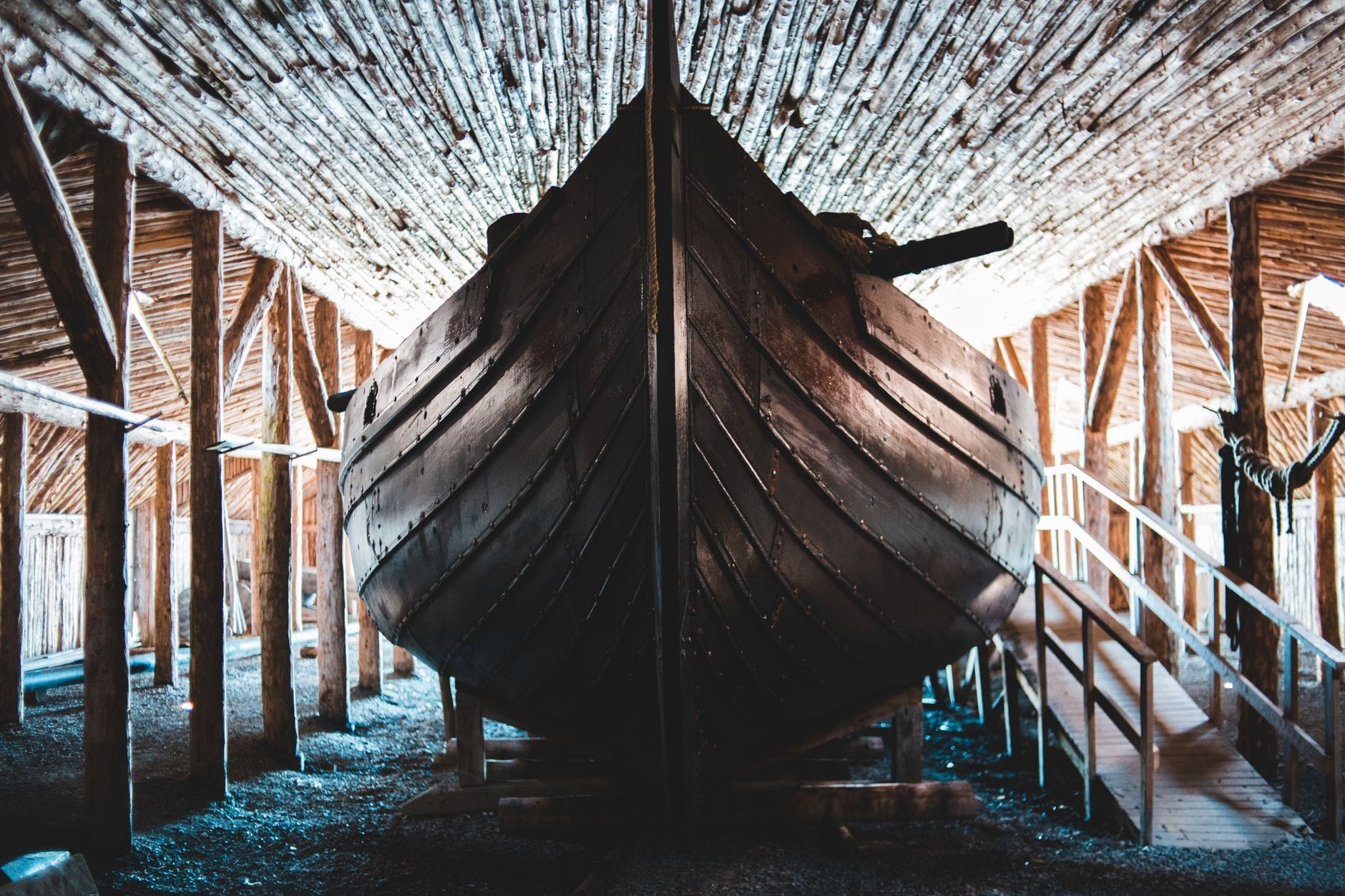
The hall itself is an architectural statement. Floor-to-ceiling glass walls face the fjord, so the ships are always framed by water and sky. In the morning, low light comes through at a flat angle and catches the preserved timbers in a way that photographs rarely capture. The wood is dark, compressed by centuries of sediment, and each fragment is mounted on a steel armature that reveals the original hull form without obscuring the gaps. You can see exactly how much survives and how much is missing.
What strikes most visitors is the scale. The large warship, Skuldelev 2, is reconstructed to its full estimated length of around 30 meters. Standing beside it at deck level makes the logistics of Viking-age seafaring feel suddenly concrete. This was not a small craft for coastal hopping. It was an ocean-capable vessel designed to carry a large crew across the North Sea or into the Baltic. Standing beside it at deck level makes the logistics of Viking-age seafaring feel suddenly concrete. This was not a small craft for coastal hopping. It was an ocean-capable vessel designed to carry a large crew across the North Sea or into the Baltic.
The display panels are well-written and translated into English throughout. They avoid the kind of vague mythology that tends to accumulate around Viking history and instead focus on archaeological evidence: tree-ring dating, timber sourcing, construction techniques, and what the cargo evidence tells us about trade routes. It is the kind of interpretive text that actually adds to the experience rather than stating the obvious.
Tickets & tours
Hand-picked options from our booking partner. Prices are indicative; availability and final rates are confirmed when you complete your booking.
1-hour boat harbour tour in Copenhagen
From 26 €Instant confirmationFree cancellationSmall group 3-hour walking tour in Copenhagen
From 45 €Instant confirmationFree cancellationCopenhagen to Malmo one-day tour
From 56 €Instant confirmationFree cancellationFull-day tour to Forest Tower and Forgotten Giants from Copenhagen
From 110 €Instant confirmationFree cancellation
The Museum Island and Working Boatyard
Outside the hall, the museum extends onto a small harbor peninsula. This is where the experience shifts from contemplative to active. The museum operates a working boatyard where craftspeople build and repair reconstructed Viking ships using traditional techniques. Depending on the time of year and what project is underway, you may see planks being shaped with hand tools, rivets being set, or a hull being assembled from scratch.
The smell of fresh-cut oak and tar is present on still days, and the sound of adze work carries across the harbor. This is not a staged demonstration. The boatyard produces vessels that are sailed, raced, and taken on open-water voyages. The boatyard produces vessels that are sailed, raced, and taken on open-water voyages. The museum also operates sailing trips on Roskilde Fjord in the warmer months.
💡 Local tip
Visit on a weekday morning for the best chance of seeing active boatyard work. Weekend afternoons bring more visitors and the craftspeople are sometimes occupied with guided groups.
In warmer months (roughly May through 30 September), the museum offers short sailing trips on replica Viking ships in the fjord. These are ticketed separately and fill up, so booking in advance via the museum website is worth doing if this is a priority for you. It is a different experience from walking the exhibits, and the fjord view back toward Roskilde Cathedral offers some context for why this waterway mattered so much historically.
How the Experience Changes by Time of Day and Season
Early mornings, especially outside high summer, are calm. The hall is quiet enough that you can hear the timber framing creak slightly in the wind. The fjord view is at its most atmospheric before the tour groups arrive around 10:30. If you take the first train from Copenhagen, you will typically have the hall largely to yourself for the first 30 to 45 minutes.
By midday in July and August, the museum is at its fullest. Families with children, school groups, and visitors doing a day trip from Copenhagen overlap significantly. The hall handles crowds reasonably well because of its volume, but the outdoor areas around the boatyard become congested. If you are visiting in summer and prefer space to think, arrive at opening or plan to spend the busy midday period in the museum's cafe, which faces the water and is a decent place to wait out the peak.
Winter visits have their own character. The fjord is often grey and still, the light is low, and the ship hall feels more solemn. The boatyard activity may be reduced, and sailing trips are not offered. Winter visits have their own character. The fjord is often grey and still, the light is low, and the ship hall feels more solemn. The boatyard activity may be reduced, and sailing trips are not offered. But the museum feels like it belongs to you in a way that high summer cannot match. and the museum feels like it belongs to you in a way that high summer cannot match.
Roskilde is worth a half-day on its own. The Roskilde Cathedral is a ten-minute walk uphill from the museum and contains the tombs of Danish royalty going back centuries. Combining the two sites makes a full and satisfying day trip from Copenhagen without feeling rushed.
Getting There from Copenhagen
Roskilde is on the main rail line running west from Copenhagen. Direct trains from København H (Copenhagen Central Station) reach Roskilde in approximately 25 minutes. Trains run frequently throughout the day. Roskilde is on the main rail line running west from Copenhagen. Direct trains from København H (Copenhagen Central Station) reach Roskilde in approximately 25 minutes. Trains run frequently throughout the day. From Roskilde station, the museum is about a 20–25-minute walk downhill toward the fjord, passing through the town centre. The route is straightforward and largely flat once you descend from the station area. The route is straightforward and largely flat once you descend from the station area.
If you hold a Copenhagen Card, check whether it covers Roskilde transport and museum entry, as the card's coverage has varied by version and year. Verify inclusions on the official card website before relying on it.
⚠️ What to skip
The walk from Roskilde station to the museum is mostly fine, but wear comfortable shoes. The final approach to the harbor is on cobblestone and uneven surfaces, which can be slippery in wet weather.
The Viking Ship Museum fits naturally into a broader day trip from Copenhagen, particularly for visitors who want history with a landscape component rather than another city museum.
Photography, Accessibility, and Practical Notes
Photography is permitted in the ship hall and throughout the outdoor areas. The low-contrast lighting inside the hall is the main challenge: the preserved ships are dark, the background through the glass is bright, and auto-exposure tends to underexpose the timber. Manual exposure or exposure compensation toward the ships gives significantly better results than letting the camera balance for the fjord light behind them.
For accessibility, the museum site links to Access Denmark for detailed specifications. The main hall is on ground level, but parts of the outdoor harbor area involve uneven surfaces. Contact the museum directly if mobility considerations are a factor in planning your visit.
Children respond well to this museum, particularly to the boatyard and the scale of the ships. The museum does not talk down to younger visitors. There are some hands-on elements and the sailing trips are genuinely exciting for kids of most ages. Families looking for a history experience that does not feel like a lecture will find this more effective than many larger national museums.
Visitors interested in the broader arc of Danish history might also consider the National Museum of Denmark in Copenhagen, which covers prehistoric and Viking-age material in depth, or Frederiksborg Castle for a different but equally substantial historical site within day-trip range.
Who Should Consider Skipping This
If your primary interest is Viking mythology, dramatic storytelling, or costumed interpretation, this museum will feel dry. It is an archaeological institution, not an experiential attraction. The ships are fragmentary. The presentation is evidence-based and fairly measured in tone. Visitors expecting the theatrical energy of a living history site may find the pace slow.
Anyone with very limited time in Copenhagen and no particular interest in Scandinavian history might use that half-day more efficiently inside the city. The round trip from Copenhagen takes the better part of an hour in transit, and you need at least two and a half hours on site to feel the visit was worthwhile. That is a significant commitment relative to other Copenhagen options.
Insider Tips
- Take the first morning train from Copenhagen Central and you will arrive at the museum close to opening time, with 30 to 45 minutes before tour groups arrive. The ship hall is at its most atmospheric in that window.
- Check the museum's sailing schedule well in advance if you want to sail on a replica Viking ship. These trips operate in warmer months only and book out, especially in July and August.
- Bring a layer even in summer. The harbor location means wind off the fjord is a constant, and the outdoor areas cool down significantly compared to the town centre.
- Walk uphill after the museum to visit Roskilde Cathedral before your return train. The cathedral is free to enter for much of the year and the views over the fjord from the churchyard are among the best in the region.
- The museum shop stocks genuinely well-researched publications on Viking-age archaeology and ship construction that are not easily found elsewhere. Worth browsing even if you are not a habitual museum shop visitor.
Who Is Viking Ship Museum, Roskilde For?
- History and archaeology enthusiasts who want primary evidence rather than dramatized reconstruction
- Families with children aged 6 and up, especially for the boatyard and sailing experiences
- Visitors doing a first trip to Scandinavia who want to understand the deep roots of Danish maritime culture
- Photographers looking for dramatic interior subjects with strong natural light and texture
- Day-trippers from Copenhagen who want a culturally substantial half-day outside the city
Nearby Attractions
Combine your visit with:
- Amager Strandpark
Amager Strandpark (Amager Beach Park) is Copenhagen's largest beach, offering a total of 4.6 km of sandy shoreline along the city's southeastern coast. Free to enter and easily reached by metro, it combines a natural shoreline with a 2 km artificial island and sheltered lagoon opened in 2005, making it a genuine summer destination for locals and a quiet surprise for visitors expecting a landlocked Scandinavian capital.
- Arken Museum of Modern Art
Located on the Ishøj coastline south of Copenhagen, ARKEN Museum of Modern Art combines a dramatically sculptural building with a serious contemporary art program. The journey out of the city is part of the experience, and the landscape setting changes everything about how you engage with the art.
- Bakken
Dyrehavsbakken, known simply as Bakken, has been drawing visitors to the forests north of Copenhagen since 1583, making it the oldest operating amusement park on earth. Unlike polished theme parks, it mixes rickety roller coasters, carnival stalls, and open-air restaurants inside a UNESCO-recognized deer park, with free entry to the grounds.
- The Blue Planet – National Aquarium Denmark
The Blue Planet, Denmark's National Aquarium, sits in Kastrup on the Øresund coast with 7 million liters of water, 450 species, and a striking spiral building that's worth examining before you even step inside. This guide covers what to expect from the exhibits, the best times to visit, and how to get there without confusion.