Roccia dell'Elefante: Sardinia's Elephant Rock and Its Ancient Tombs
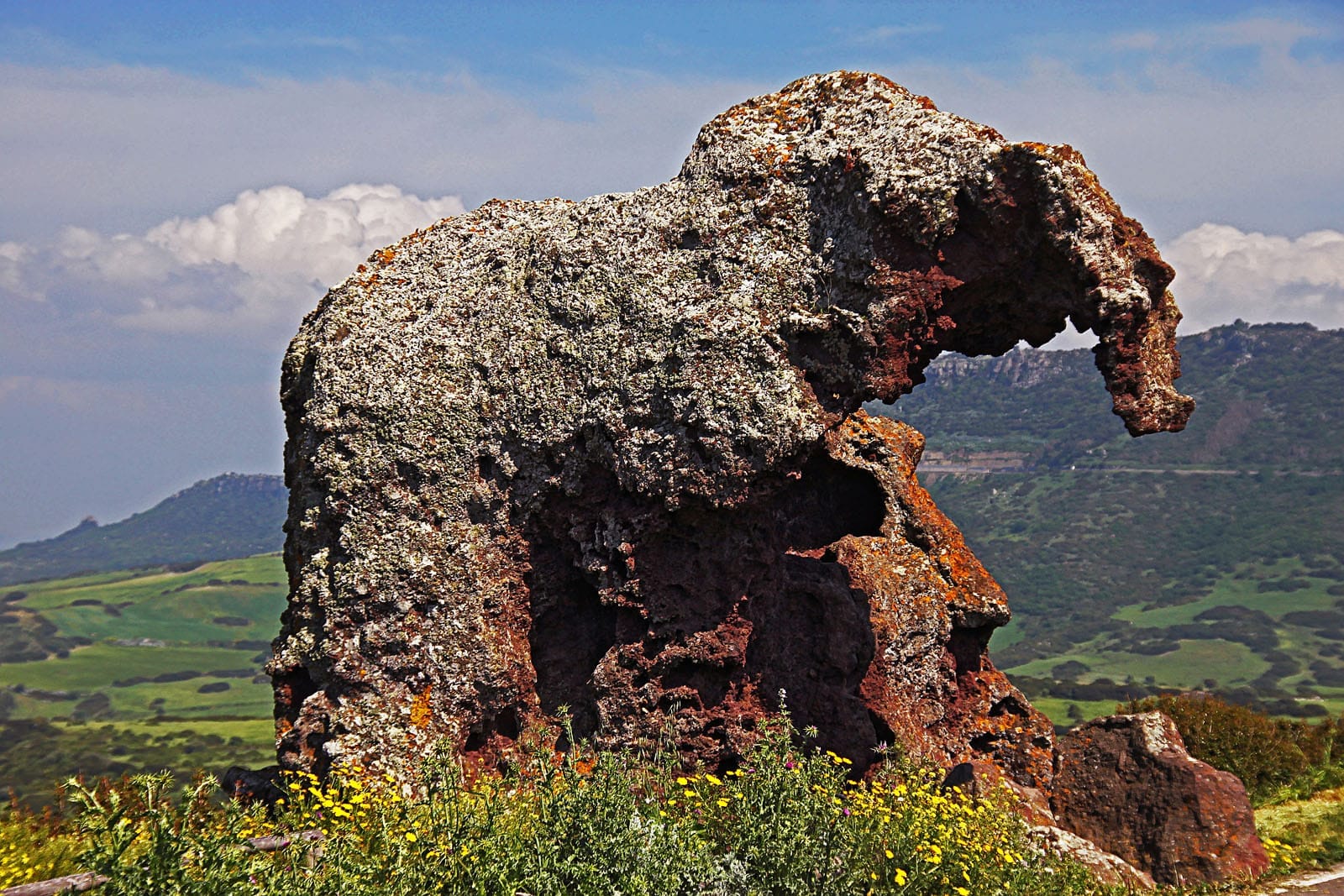
Standing beside a rural state road 4.3 km from Castelsardo, Roccia dell'Elefante is a 4-metre trachyte boulder shaped by millennia of erosion into the unmistakable profile of an elephant. Inside, two rock-cut Neolithic chamber tombs carved around 3200–2800 BCE make this one of Sardinia's most compact yet fascinating prehistoric sites. Entry is free, and the whole stop takes under an hour.
Quick Facts
- Location
- SS 134 km 4.3, locality Multeddu, Castelsardo, Province of Sassari, Sardinia
- Getting There
- Car strongly recommended; roadside pulloff on SS 134, approx. 4 km from Castelsardo towards Sedini
- Time Needed
- 20–45 minutes
- Cost
- Free (no ticket required)
- Best for
- History and archaeology enthusiasts, road-trippers, families with curious children
- Official website
- www.sardegnaturismo.it/en/explore/elephants-rock
What Is Roccia dell'Elefante?
Roccia dell'Elefante, known in Sardinian as Sa Pedra Pertunta ('the pierced stone'), is a freestanding trachyte-andesite boulder approximately 4 metres tall that rises from the scrubby macchia beside Strada Statale 134 in the municipality of Castelsardo. Detached long ago from the nearby Monte Castellazzu formation, it was sculpted by thousands of years of wind and rain erosion into a form that resembles a crouching elephant, trunk extended downward toward the road.
What makes this more than a geological curiosity is what is carved inside: two domus de janas, the rock-cut chamber tombs typical of Sardinia's final Neolithic period, dating to roughly 3200–2800 BCE. The lower and more elaborate of the two preserves multiple small interior rooms, along with carved bovine horn reliefs and architectural decorations on the walls. These details were not decorative afterthoughts. They reflect a sophisticated ritual relationship between the living and the dead, characteristic of the cultures that built such tombs across Sardinia during this period.
The name 'Roccia dell'Elefante' entered the written record after 1914, following the work of scholar Edoardo Benetti. Before that, the rock was known locally by its Sardinian name, which drew attention to the carved opening rather than to the animal profile — a reminder that the ancient tombs, not the visual trick of its shape, are the site's real significance.
ℹ️ Good to know
This is a roadside natural monument with no ticket office, no gate, and no set closing time. It is accessible during daylight hours throughout the year. There are no toilets or visitor facilities on site.
The Domus de Janas: Reading the Carved Interior
The domus de janas ('house of the fairies' in Sardinian folk tradition, though the name is entirely medieval in origin) are among the most widespread prehistoric funerary monuments on the island. Sardinia contains hundreds of them, cut into rock faces and boulders from the late Neolithic through the Copper Age. Roccia dell'Elefante is unusual because the tombs were carved into an isolated freestanding boulder rather than a cliff face, giving the monument an unusually sculptural, three-dimensional quality.
The lower tomb is the one worth examining closely. Step to the front face of the boulder and you will find a low entrance cut into the rock, with the surrounding stone worked to a degree of smooth precision that feels striking given its age. Inside, carved on the chamber walls, are the horn-shaped reliefs interpreted by archaeologists as representations of bull horns or ox horns, a recurring motif in Neolithic Sardinian funerary contexts that likely held ritual significance. For more on the broader landscape of these tombs, the Anghelu Ruju necropolis near Alghero contains some of the most elaborate examples on the island and is worth combining with a northwest Sardinia itinerary.
The upper tomb is smaller and plainer, carved higher on the boulder with a simpler chamber. Together, the two tombs confirm that this boulder was deliberately selected as a funerary site, not simply encountered by chance. Whether the elephant profile was already visible to the Neolithic communities who carved here, or whether erosion continued to sharpen the silhouette over subsequent millennia, is not known.
Tickets & tours
Hand-picked options from our booking partner. Prices are indicative; availability and final rates are confirmed when you complete your booking.
Vineyard Guided Tour and 7 Wine Tasting in Palau
From 84 €Instant confirmationFree cancellationFull-Day Sailboat Tour in La Maddalena Archipelago from Cannigione
From 112 €Instant confirmationFree cancellationHiking excursion to the Devil's Saddle
From 35 €Instant confirmationFree cancellationExcursion to the Archaeological site of Nora
From 70 €Instant confirmationFree cancellation
Visiting in Practice: What You Actually See and Do
Arriving by car on SS 134 from Castelsardo, the boulder appears on the left side of the road after about 4.3 km, unmistakable against the low scrub. There is a small roadside parking area. The walk from car to boulder takes under a minute. The whole site is open and unfenced, and there is no entry fee.
The experience is deliberately unmediated. There are no information panels of great depth, no audio guides, no barriers between you and the carved surfaces. You can walk a slow circuit around the boulder in two or three minutes, examining the elephant profile from different angles and locating the two tomb entrances. The lower entrance, at roughly knee to waist height, allows you to crouch and look inside at the carved interior. Do not attempt to climb the rock itself.
Most visitors spend 20 to 30 minutes here. Families with children who are drawn to the animal likeness often linger a little longer. Visitors with a specific interest in Sardinia's Neolithic archaeology may want 45 minutes to examine the carved details carefully and to photograph the interior reliefs. Anyone looking for a dramatic landscape experience or an extended walk will find this stop too brief and the setting too roadside-ordinary to satisfy.
💡 Local tip
Bring a small torch or use your phone flashlight. The carved interior of the lower tomb is dim, and the horn reliefs on the chamber walls are easy to miss without extra light.
Time of Day and Light Conditions
Morning light from the east catches the front face of the boulder well, making the carved entrance and surface details easier to photograph. By midday in summer, the rock sits in strong overhead light that flattens the texture and makes the interior reliefs harder to distinguish. Late afternoon produces raking shadows across the carved surfaces, which can actually help reveal the carved horn shapes and wall detailing inside the lower tomb.
Traffic on SS 134 is relatively light except during July and August peak season, when the coastal roads around Castelsardo carry considerably more vehicles. Early morning visits in summer avoid the midday heat and the occasional cluster of tour coaches that stop here on circuits between Castelsardo and Sassari. In spring and autumn, you may have the rock entirely to yourself.
The site has no shade to speak of. In July and August, when temperatures in this part of Sardinia routinely reach 30–35°C, a midday visit is uncomfortable. Wear sunscreen, bring water, and keep the stop short if visiting in high summer.
Getting There and Combining with Nearby Sights
A private car is the only practical way to reach Roccia dell'Elefante. The site sits at km 4.3 on the SS 134 state road, in the locality of Multeddu. There is no public bus stop at the boulder itself. Castelsardo, 4 km away, is served by ARST regional buses from Sassari, but the connection to the boulder requires a car or taxi from Castelsardo.
The most natural pairing is Castelsardo, the medieval hilltop town with its Doria castle, which sits just 4 km away and offers a full morning or afternoon of walking, views, and the local craft market. Combining the two into a single half-day circuit is straightforward.
Sassari, Sardinia's second city, lies roughly 30 km to the south and makes a convenient base for exploring this corner of the island. From Sassari, Monte d'Accoddi — a unique prehistoric stepped altar structure from a similar Neolithic period — is also accessible, and pairing both sites makes for a coherent day focused on northern Sardinia's ancient past.
If your interest in Sardinia's archaeology extends further, the Sardinia nuragic sites guide covers the broader landscape of prehistoric monuments across the island, including nuraghi, sacred wells, and giant tombs that span a wide geographic range.
Photography Notes
The classic photograph is taken from the road-facing side, low and slightly to one side, to capture the elephant profile in silhouette against the sky. Late afternoon light from the west produces the cleanest version of this shot. For the carved interior, a wide-angle lens or phone camera works adequately in the confined space, but you will need supplementary light to capture the horn reliefs. The texture of the trachyte stone, rough and dark grey with occasional reddish mineral staining, reads well in morning light.
The surrounding landscape is low scrub with rocky outcrops and occasional olive groves; it is not scenic in the way of Sardinia's coastal vistas, but it gives an authentic sense of the island's interior character. Including a wider environmental shot to establish context is more informative than focusing entirely on the boulder in close-up.
Accessibility and Practical Limitations
The ground around the boulder is uneven rock and compacted earth. There are no formal step-free paths, no designated accessible parking, and no facilities of any kind. Visitors with limited mobility can view the elephant profile clearly from the roadside parking area without needing to cross the rough ground, though accessing the tomb entrances requires a short walk on uneven terrain and crouching at low height.
There are no toilets, no café, and no gift shop. The nearest facilities are in Castelsardo, 4 km away. This is a roadside stop: rewarding, free, and brief, but not a destination that supports a long visit on its own.
⚠️ What to skip
Do not climb the boulder. The trachyte surface is weathered and loose in places, and the carved Neolithic tombs are fragile archaeological features. The site is protected under Italian cultural heritage law.
Insider Tips
- Bring a pocket torch or use your phone flashlight: the carved bovine horn reliefs inside the lower tomb chamber are invisible without direct illumination, and most visitors walk away without seeing the detail that makes this site interesting.
- The elephant profile is most convincing and photogenic from road level, slightly to the right when facing the rock from the SS 134. Standing close and looking straight at it reduces the illusion considerably.
- If you are driving between Sassari and Castelsardo, this adds under 10 minutes to the journey as a stop. Plan it on the outward leg so you are not rushing it when tired.
- Spring visits (April to early June) offer the best combination of mild temperatures, low crowds, and green scrubland surroundings that give the landscape some colour. By August, the vegetation is entirely parched and the heat makes lingering unpleasant.
- Combine this stop with the prehistoric altar of Monte d'Accoddi near Sassari to build a coherent half-day around northern Sardinia's Neolithic heritage rather than treating each as a brief isolated detour.
Who Is Roccia dell'Elefante For?
- Archaeology and prehistory enthusiasts who want to examine a genuine Neolithic tomb with carved interior details
- Road-trippers on the Sassari to Castelsardo route looking for a meaningful 20-minute cultural stop
- Families with children who respond well to the visual trick of the elephant shape and the adventure of peering into ancient carved chambers
- Photographers looking for an unusual geological and archaeological subject away from Sardinia's more photographed coastal scenery
- Travellers building a northern Sardinia day combining Castelsardo, Roccia dell'Elefante, and Monte d'Accoddi
Nearby Attractions
Other things to see while in Sassari:
- Basilica di San Gavino (Porto Torres)
Standing on Monte Agellu in Porto Torres, the Basilica dei Santi Gavino, Proto e Gianuario is the largest Romanesque church in Sardinia and one of the most architecturally singular in Italy. Built in the first half of the 11th century, it is the only Romanesque monument in the country originally designed with two opposing apses. For anyone tracing the island's medieval history, this is as significant as it gets.
- Bosa
Bosa sits on the north bank of the Temo River in western Sardinia, its medieval quarter tumbling down a hillside in layers of terracotta, ochre, and faded pink. It is the only town in Sardinia built along a navigable river, and that distinction shapes everything about it: the old tanneries along the water, the boat-lined banks, the slow pace that has little to do with the island's summer beach circus.
- Castello dei Doria (Castelsardo)
Perched on a volcanic promontory above the Gulf of Asinara, Castello dei Doria is a 12th-century Ligurian fortress that has shaped northern Sardinia for nearly a thousand years. Today it houses the Museo dell'Intreccio Mediterraneo, dedicated to Mediterranean basketry, while its ramparts offer some of the most commanding coastal views on the island.
- Castello Malaspina (Bosa)
Perched 81 metres above the Temo river on Serravalle hill, Castello Malaspina is the medieval landmark that defines Bosa's skyline. Inside its walls stands the Romanesque Church of Nostra Signora de Sos Regnos Altos, sheltering rare 14th-century frescoes. The climb is steep, but the views over terracotta rooftops, vineyards, and coastline are exceptional.