Remuh Synagogue & Cemetery: Kazimierz's Living Jewish Heart
Founded in 1553 on Kazimierz's Szeroka Street, the Remuh Synagogue is one of Kraków's main active Jewish houses of prayer and one of its oldest. Beside it, the 16th-century Remuh Cemetery holds some of the most significant Renaissance-era Jewish tombstones in Central Europe, including the grave of Rabbi Moses Isserles.
Quick Facts
- Location
- ul. Szeroka 40, Kazimierz, Kraków
- Getting There
- Trams 3, 8, 9, 24, 50, 69 toward Kazimierz / Jewish Quarter
- Time Needed
- 45–90 minutes
- Cost
- Entry donation PLN 10/15, cash only; bring small notes and verify before visiting
- Best for
- Jewish history, Renaissance funerary art, quiet contemplation
- Official website
- gwzkrakow.pl/en/synagogues
What the Remuh Synagogue Actually Is
The Remuh Synagogue at ul. Szeroka 40 is not a museum. That distinction matters. It is the main functioning synagogue of Kraków's Jewish community, in regular use for daily prayers and Shabbat services, which means the atmosphere inside is categorically different from the larger, more theatrical synagogues nearby that have been converted into cultural spaces. You are visiting a working religious site that happens to be over 470 years old.
The synagogue sits on the eastern side of Szeroka Street, a wide cobbled plaza that forms the historic core of Kazimierz, the former Jewish quarter of Kraków. The building is compact and unassuming from the outside, its whitewashed Renaissance facade easy to miss between the café terraces that line the street in summer. The entrance fee, payable at the gate, goes toward the ongoing restoration of both the synagogue and the adjoining cemetery.
⚠️ What to skip
The Remuh Synagogue is closed on Saturdays (Shabbat) and all Jewish holidays. Plan around this if you're visiting on a Friday afternoon or any major Jewish festival date. Check the Jewish Community of Krakow's calendar before you go.
Inside the Synagogue: Architecture and Atmosphere
The original structure was built in 1553 by Izrael ben Józef (Auerbach) in honor of his son, Rabbi Moses Isserles, known by the acronym Remuh. A fire destroyed the first building and it was rebuilt in masonry around 1556, making it the second-oldest synagogue in Kazimierz. What stands today reflects centuries of use, partial destruction during the Second World War, and careful postwar restoration.
Inside, the prayer hall is modest in scale: a single room with an Aron ha-Kodesh (the ark housing the Torah scrolls) against the eastern wall, richly decorated with Renaissance-era carved stonework. The bimah, the raised reading platform, sits at the center. The walls show Hebrew inscriptions and remnants of older decorative layers. In the morning, when light enters from the east-facing windows, the stonework catches a warm, amber tone that photographs cannot fully capture. The smell is of old stone, polished wood, and occasionally candlewax.
Men are required to cover their heads inside the synagogue. Yarmulkes are provided free of charge at the entrance, so there is no need to bring your own. Women should dress modestly; sleeveless tops are not appropriate. These are not bureaucratic rules. They reflect the fact that services are held here, and you may arrive to find a small group in prayer.
💡 Local tip
Visit on a weekday morning, ideally between 10:00 and 11:00, before tour groups arrive from the Old Town. The synagogue interior fits perhaps 60 people comfortably, and large groups make quiet contemplation difficult.
Tickets & tours
Live prices and dates from our booking partner. If you book, we may earn a commission at no extra cost to you.
Entrance ticket for the Legends of Krakow robotic show
From 9 €Instant confirmationFree cancellationWieliczka Salt Mine guided tour with hotel pickup from Krakow
From 58 €Instant confirmationFree cancellationWieliczka salt mine guided tour from Krakow
From 60 €Instant confirmationFree cancellationAuschwitz-Birkenau Spanish Guided Tour with Hotel Pick-Up
From 44 €Instant confirmation
The Remuh Cemetery: Renaissance Gravestones and a Buried History
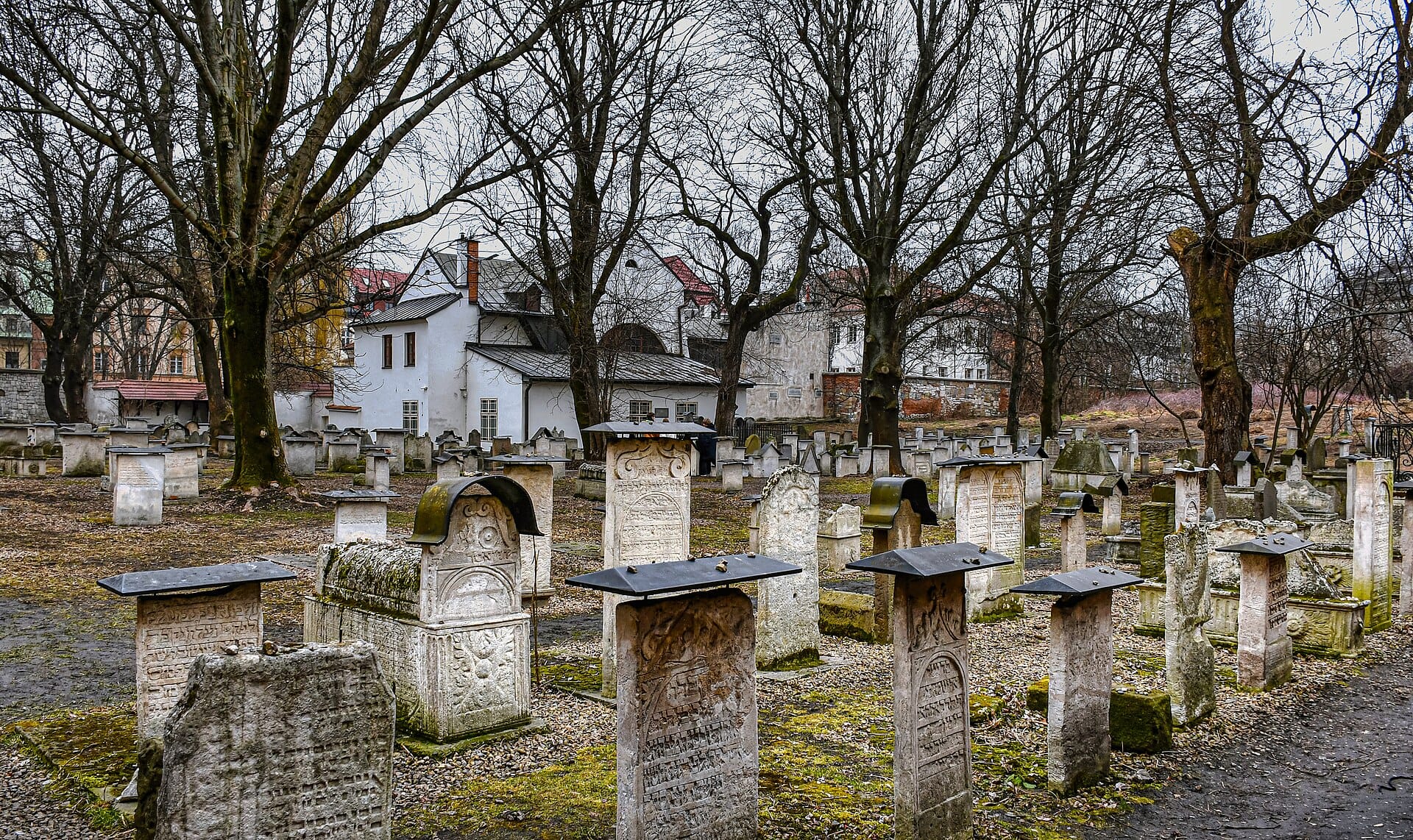
The cemetery, accessed through a gate adjacent to the synagogue, predates the building by a few years and is among the oldest surviving Jewish burial grounds in Poland. Walking into it for the first time can be affecting. The space is small, roughly the size of a large garden, but densely packed with tombstones ranging from smoothly worn 16th-century slabs to more legible 17th- and 18th-century markers.
The most important grave is that of Rabbi Moses Isserles himself, in the far corner, always identifiable by the small stones left by visitors, a Jewish mourning tradition. Isserles, who died in 1572, was one of the most influential Ashkenazi Jewish scholars of the early modern period. His commentary on the Shulchan Aruch, a core text of Jewish law, made him relevant to Jewish communities across Europe. Pilgrims visit his grave on the anniversary of his death (18 Iyar on the Hebrew calendar), and the site draws visitors from Israel, the United States, and across Europe throughout the year.
During World War II, the Nazis used the cemetery as a dumping ground and many tombstones were broken or buried. Postwar excavations uncovered hundreds of fragments, which were reassembled into a partial wall of tombstone pieces called a lapidarium along the cemetery's perimeter. The fragments that could not be matched to original graves were set into this wall rather than discarded. It is a sobering sight: row after row of carved Hebrew letters, names without graves, dates without contexts.
The cemetery's uneven ground, narrow paths between stones, and occasional raised kerbing make it difficult to navigate with a wheelchair or pushchair. If you are planning a broader visit to Kazimierz's Jewish heritage, the Old Synagogue nearby is the oldest surviving synagogue in Poland and now operates as a branch of the Historical Museum of Kraków, with wider interior access.
How the Experience Changes Through the Day
Szeroka Street operates on a distinct rhythm. By 9:00, the street is quiet, the café chairs still stacked, and the light flat and cool. This is the best time to photograph the cemetery without obstruction, and the silence feels proportionate to the space. By 11:00, the first tour groups are arriving, and by noon in summer the street is crowded, with restaurant staff distributing menus and guided walking tours clustering outside the gate.
Late afternoon brings a different quality. From roughly 16:00 onward, the tour operators thin out, the light drops lower and softer, and the cemetery takes on a more contemplative character. In summer, when opening hours run to around 18:00, the hour before closing is often the calmest of the day. Winter visits have their own appeal: the cemetery under frost or light snow is stark and quiet, and the shorter hours mean fewer visitors overall.
ℹ️ Good to know
Opening hours: approximately 9:00–18:00 (summer) and 9:00–16:00 (winter, roughly November–April). These hours are set by the Jewish Community of Krakow and are subject to change; verify directly before your visit, especially around Jewish holidays.
Getting There and Fitting It Into Your Day
The Remuh Synagogue is walkable from Kraków's Main Market Square in about 20 minutes on foot, heading south through Stradomska Street and into Kazimierz. By tram, lines 3, 8, 9, 24, 50, and 69 serve the Kazimierz area; check current stop locations on the MPK Kraków network map, as stops shift occasionally due to works.
Szeroka Street is the logical anchor for a half-day exploring Kazimierz's Jewish heritage. Within a short walk you will find the Galicia Jewish Museum, the New Jewish Cemetery on Miodowa Street, and Plac Nowy, which is the neighborhood's daily street market. A guide to Kraków's Jewish Quarter can help you structure the full half-day into a logical route.
Plan roughly 45 minutes to an hour if you want to move through at a reasonable pace: 15–20 minutes in the synagogue interior, 25–30 minutes in the cemetery. Allow more if you want to read inscriptions carefully or spend time at specific graves. The audio guide, when available, adds context that the sparse on-site labeling does not provide.
Photography, Etiquette, and Who Should Skip This
Photography is generally permitted in the cemetery. Inside the synagogue, follow any posted instructions and the guidance of on-site staff, particularly if a service is in progress or about to begin. Do not photograph worshippers without consent. The cemetery stones photograph well in overcast light, which diffuses shadows and makes the carved Hebrew lettering more legible than in direct sun.
This attraction asks something of its visitors. The Remuh Cemetery is not decorative heritage: it is a burial ground with a specific and often violent history, in a neighborhood where the entire pre-war Jewish community was destroyed. Visitors who approach it as a photo stop on a walking checklist will find it unrewarding. Those who arrive with some background knowledge, even just an hour of reading beforehand, will find it one of the most resonant places in Kraków.
If your interest in Kazimierz is primarily photographic or atmospheric rather than historical, the neighborhood still rewards a visit, but Szeroka Street's other functions, including its restaurants and the annual Jewish Culture Festival held each summer, might be more directly engaging for you than the synagogue itself.
Insider Tips
- The anniversary of Rabbi Moses Isserles' death (18 Iyar in the Hebrew calendar, falling in late April or May) draws a significant number of pilgrims. If you want the cemetery quiet, avoid this date. If you want to witness an active mourning tradition, it is worth timing your visit around it.
- The lapidarium wall of reassembled tombstone fragments along the cemetery perimeter is often overlooked by visitors focused on finding Rabbi Isserles' grave. Spend time with it: the scale of the fragment collection communicates the destruction of the site more directly than any explanatory panel.
- Szeroka Street restaurants have outdoor terraces that operate directly across from the synagogue entrance. The contrast between café noise and the cemetery quiet a few meters away can feel jarring. Consider arriving before 10:00 if you want the street to feel proportionate to what you're visiting.
- Yarmulkes are available free at the entrance, but if you prefer not to wear a shared one, bring a hat or cap. Any head covering is acceptable; it does not need to be religious in character.
- If you plan to visit multiple Kazimierz synagogues in one morning, start at Remuh, which generally opens around 9:00, and work outward from Szeroka Street. The Old Synagogue (now a museum) has different ticket arrangements and slightly more flexible hours.
Who Is Remuh Synagogue & Cemetery For?
- Visitors with an interest in Jewish history, Ashkenazi religious tradition, or pre-war Central European Jewish life
- Travelers doing a Kazimierz heritage walk who want to see a synagogue still in active religious use
- Architecture and funerary art enthusiasts interested in Renaissance stonework
- Those researching the life and legacy of Rabbi Moses Isserles and his role in Ashkenazi law
- Quiet, contemplative visitors who prefer small, serious sites over large theatrical ones
Nearby Attractions
Other things to see while in Kazimierz:
- Galicia Jewish Museum
Housed in a converted pre-war industrial building on ul. Dajwór in Kraków's Kazimierz district, the Galicia Jewish Museum presents Jewish life and culture in the former region of Galicia through documentary photography and rotating exhibitions. It is one of the most thoughtfully curated cultural institutions in southern Poland, and one that rewards visitors who come willing to slow down and read.
- Ethnographic Museum Kraków
Housed in the former Kazimierz Town Hall on Plac Wolnica, the Seweryn Udziela Ethnographic Museum of Kraków holds over 80,000 objects documenting Polish and Central European folk life. It is one of the oldest ethnographic collections in Poland, and one of the most overlooked institutions in a city full of heavyweight attractions.
- New Jewish Cemetery (Miodowa Street)
Established in 1800–1801 on the western edge of Kazimierz, the New Jewish Cemetery on Miodowa Street holds thousands of graves spanning two centuries of Kraków's Jewish life. Quiet, largely unvisited by mass tourism, and registered as a heritage monument since 1999, it offers a contemplative counterpoint to the city's busier historical sites.
- Old Synagogue
The Old Synagogue on Szeroka Street in Kraków's Kazimierz district is the oldest surviving synagogue in Poland, now home to a permanent museum dedicated to the history and culture of Kraków's Jewish community. Part of the Museum of Krakow network, it stands as one of the most historically significant buildings in Central Europe.
Planning a trip? Discover personalized activities with the Nomado app.