Old Synagogue (Stara Synagoga): A Living Record of Jewish Kraków
The Old Synagogue on Szeroka Street in Kraków's Kazimierz district is the oldest surviving synagogue in Poland, now home to a permanent museum dedicated to the history and culture of Kraków's Jewish community. Part of the Museum of Krakow network, it stands as one of the most historically significant buildings in Central Europe.
Quick Facts
- Location
- ul. Szeroka 24, Kazimierz, Kraków
- Getting There
- Walk 20 min from Old Town; tram to Kazimierz area, then short walk to Szeroka Street
- Time Needed
- 45–90 minutes
- Cost
- 22 PLN normal / 16 PLN reduced / 44 PLN family; free on Mondays
- Best for
- History enthusiasts, Jewish heritage travelers, architecture lovers
- Official website
- muzeumkrakowa.pl/en/branches/old-synagogue
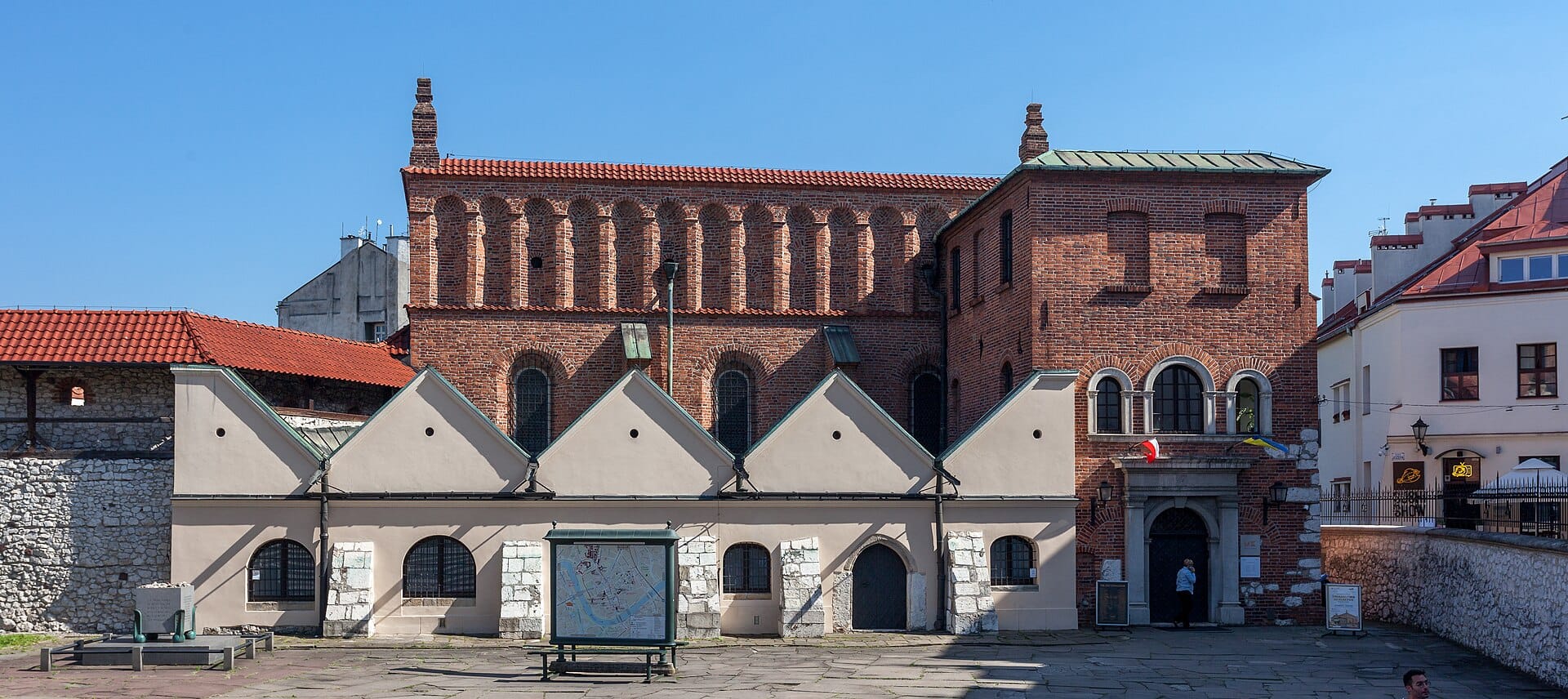
What the Old Synagogue Actually Is
The Old Synagogue, known in Polish as Stara Synagoga, sits at 24 Szeroka Street in Kazimierz and holds a distinction that no other building in Poland can claim: it is the oldest surviving synagogue in the country. The structure dates to the fifteenth century in its earliest form, though the building visible today reflects a Renaissance reconstruction carried out after a fire in 1557, likely by the Italian architect Mateo Gucci. That reconstruction gave it the characteristic late-Renaissance facade that still frames Szeroka Street today.
Since 1961, the synagogue has operated as a branch of the Museum of Krakow (Muzeum Krakowa), housing a permanent exhibition on the history, religious life, and culture of the Jewish community in Kraków. This dual identity, as both a functioning architectural monument and a dedicated museum, is what separates it from other synagogues in the neighborhood that have been restored to active religious use.
Kazimierz itself has a layered history worth understanding before you visit. Originally founded as a separate town by King Casimir III the Great in the fourteenth century, it became the center of Jewish life in Kraków for centuries before being absorbed into the city. For a full orientation to the district, the Kraków Jewish Quarter guide covers the broader context and explains how Kazimierz fits into the city's history.
What You See Inside
The interior centers on the main prayer hall, where the bimah, the raised platform from which the Torah is read, occupies the center of the room beneath a restored Renaissance vault. The space is relatively spare compared to more ornate European synagogues, which gives it a solemn, uncluttered quality. The restored ark, positioned against the eastern wall, is the dominant focal point and draws the eye immediately upon entering.
The permanent exhibition is distributed across multiple rooms and spans Jewish religious practice, festival traditions, community organization, and the lifecycle rituals of birth, marriage, and death. Objects on display include Torah scrolls, Hanukkah lamps, Passover plates, textiles, and archival photographs. The photographic material is particularly arresting: many images show Kazimierz street life and community gatherings from the late nineteenth and early twentieth centuries, giving faces and context to a community that was largely destroyed during the Second World War.
One room addresses the wartime period directly, including the Nazi occupation of Kraków and the fate of the city's Jewish population. The treatment is measured rather than graphic, but the weight of that history settles over the entire building regardless of which room you are in.
💡 Local tip
Pick up the printed room guide available at the entrance. The exhibition labeling is in Polish and English, but the printed supplement provides additional historical context that makes a significant difference to the experience, especially if you are visiting without a guide.
Tickets & tours
Live prices and dates from our booking partner. If you book, we may earn a commission at no extra cost to you.
Entrance ticket for the Legends of Krakow robotic show
From 9 €Instant confirmationFree cancellationWieliczka Salt Mine guided tour with hotel pickup from Krakow
From 58 €Instant confirmationFree cancellationWieliczka salt mine guided tour from Krakow
From 60 €Instant confirmationFree cancellationKrakow: Jewish ghetto and Schindler's Factory entrance ticket and guided tour
From 30 €Instant confirmationFree cancellation
How the Experience Changes by Time of Day
Szeroka Street is both a thoroughfare and, effectively, a square, and Stara Synagoga sits along one of its long flanks. In the morning, particularly on weekday mornings before 11:00, foot traffic is light and the entrance queue is either short or nonexistent. The light entering through the synagogue's upper windows is cleaner in the morning hours, which also makes the interior easier to photograph without artificial light competing with natural light.
By midday in summer, especially between June and August, organized tour groups arrive in waves and the main prayer hall can feel crowded enough to make quiet contemplation difficult. The photographic crowds around the bimah are particularly dense at these times. Visiting before 10:30 or after 15:30 in peak season makes a measurable difference to the atmosphere.
Monday has the added incentive of free admission, but it also comes with reduced hours: the museum closes at 15:00 on Mondays rather than the standard 17:00 on other days. Arriving by 10:00 on a Monday gives you enough time to move through the exhibition without rushing. If your schedule is flexible, a Tuesday or Wednesday morning visit combines reasonable crowd levels with the full opening hours.
ℹ️ Good to know
Opening hours: Monday 10:00–15:00, Tuesday–Sunday 9:00–17:00. Last individual entry 30 minutes before closing; groups must arrive 60 minutes before closing. Free admission on Mondays.
Architectural and Historical Context
The current structure is largely the product of the post-1557 rebuilding, which replaced the earlier Gothic synagogue with a Renaissance hall-type design more consistent with the architectural language of the period. The two-nave layout, supported by columns, is particularly notable: it is a solution commonly found in medieval Central European synagogues and reflects the religious requirement that the bimah occupy a central position in the prayer space rather than being placed near the ark.
The building survived the Second World War structurally, though the Nazis stripped its interior, used it for storage and later as a warehouse, and destroyed many of its original fittings. The postwar restoration carried out through the 1950s and into the early 1960s attempted to recover the pre-war interior arrangement, drawing on archival documentation. The result is a reconstruction rather than an untouched original, which is worth bearing in mind when viewing the bimah and ark.
For visitors interested in the broader network of Jewish heritage sites in the district, the Remuh Synagogue and Cemetery on the same street is an essential complement. The two sites together cover different dimensions of Jewish Kraków: Stara Synagoga as a historical and cultural museum, the Remuh as an active religious site with one of the oldest surviving Jewish cemeteries in Poland.
Practical Walkthrough: Before, During, and After Your Visit
The entrance to the museum is directly from Szeroka Street. There is no large courtyard or antechamber; you pass through a relatively modest doorway and purchase tickets at the desk inside. The ticket desk accepts cash in Polish złoty; card payment availability should be confirmed at the time of visit as it can vary.
The museum is compact enough that 45 to 60 minutes covers the exhibition at a normal pace. Visitors with a strong interest in the historical material, or those attending with a guide, should allow 90 minutes. There is no café inside. The building's stone floors and thick walls keep the interior noticeably cool even in summer, so a light layer is useful if you are sensitive to temperature changes.
Photography without flash is generally permitted in the main hall; follow any posted restrictions for individual display cases. The bimah and the vaulted ceiling above it are the most photographed elements. A wide-angle lens or a phone held vertically captures the full height of the vault better than a standard horizontal frame.
After visiting, Szeroka Street itself rewards a slow walk. Several other synagogues, courtyards, and the Galicia Jewish Museum are within a ten-minute walk. The Galicia Jewish Museum takes a photographic rather than object-based approach to Jewish heritage and works well as a conceptual counterpoint to the more traditional exhibition at Stara Synagoga.
If you are building a full day around Kazimierz, the Plac Nowy market is a short walk west and is the logical place for lunch. The round building at the center of the square, a former ritual slaughterhouse, serves zapiekanki (open-face baguettes) and has become one of the more recognizable informal food stops in the district.
⚠️ What to skip
The museum is closed on certain Jewish and Polish public holidays. If your visit falls around Passover, Rosh Hashanah, or national Polish holidays, check the Museum of Krakow website for current closure dates before making plans around the visit.
Who Should Temper Their Expectations
Visitors looking for a visually spectacular interior in the style of ornate Baroque synagogues in Western Europe may find Stara Synagoga understated. The space is historically significant rather than visually overwhelming, and the exhibition, while informative, is not large by the standards of major Jewish history museums in Warsaw or Berlin. The value here is context and place: standing in the oldest surviving synagogue in Poland, in the neighborhood where one of Europe's largest Jewish communities once lived, carries a weight that doesn't depend on architectural grandeur.
Visitors with limited mobility should note that the Museum of Krakow's official page does not detail step-free access or lift availability at this branch. It is advisable to contact the museum directly before visiting if accessibility is a concern.
Travelers on a tight schedule who want to see both the Old Town and Kazimierz in a single day will find this fits well into a structured walk. The Kraków walking tour guide maps out a practical route that connects Wawel, Kazimierz, and the Jewish heritage sites without backtracking.
Insider Tips
- Monday free admission is worth planning around if you are on a budget, but arrive by 10:15 at the latest since the museum closes at 15:00 and groups fill up the main hall by midday even on quieter weekdays.
- The courtyard visible from Szeroka Street just outside the synagogue is a good spot to pause and read the printed guide before going inside. Context absorbed before entry makes the exhibition considerably more rewarding.
- Szeroka Street is quieter after 16:00 when many tour groups have moved on. If you want the exterior and the surrounding street to yourself for photographs, late afternoon on a weekday is the most reliably calm window.
- Combine this visit with the Remuh Synagogue and Cemetery on the same street. The two sites together take around two and a half hours and cover Jewish religious life in Kraków from the sixteenth century through the twentieth.
- The stone floors are uneven in places, particularly in the older sections of the building. Flat-soled shoes are noticeably more comfortable than heels or sandals with thin soles.
Who Is Old Synagogue For?
- Travelers with an interest in Jewish history and heritage in Central Europe
- Architecture enthusiasts focused on Renaissance-era religious buildings
- Visitors building a Kazimierz-focused day that covers multiple Jewish sites
- Those following Second World War history in Kraków and the surrounding region
- Slow travelers who want to understand a neighborhood through its most historically rooted landmark
Nearby Attractions
Other things to see while in Kazimierz:
- Galicia Jewish Museum
Housed in a converted pre-war industrial building on ul. Dajwór in Kraków's Kazimierz district, the Galicia Jewish Museum presents Jewish life and culture in the former region of Galicia through documentary photography and rotating exhibitions. It is one of the most thoughtfully curated cultural institutions in southern Poland, and one that rewards visitors who come willing to slow down and read.
- Ethnographic Museum Kraków
Housed in the former Kazimierz Town Hall on Plac Wolnica, the Seweryn Udziela Ethnographic Museum of Kraków holds over 80,000 objects documenting Polish and Central European folk life. It is one of the oldest ethnographic collections in Poland, and one of the most overlooked institutions in a city full of heavyweight attractions.
- New Jewish Cemetery (Miodowa Street)
Established in 1800–1801 on the western edge of Kazimierz, the New Jewish Cemetery on Miodowa Street holds thousands of graves spanning two centuries of Kraków's Jewish life. Quiet, largely unvisited by mass tourism, and registered as a heritage monument since 1999, it offers a contemplative counterpoint to the city's busier historical sites.
- Plac Nowy Market, Kazimierz
Plac Nowy is Kazimierz's central market square, running from early-morning produce stalls to late-night street food. At its heart stands the Okrąglak, a 12-sided rotunda built in 1900 that once served as a kosher poultry slaughterhouse and now dishes out zapiekanki until the early hours. The square is free to enter and shifts character dramatically depending on the hour and the day of the week.
Planning a trip? Discover personalized activities with the Nomado app.