New Jewish Cemetery (Miodowa Street): Kraków's Living Memorial to a Lost Community
Established in 1800–1801 on the western edge of Kazimierz, the New Jewish Cemetery on Miodowa Street holds thousands of graves spanning two centuries of Kraków's Jewish life. Quiet, largely unvisited by mass tourism, and registered as a heritage monument since 1999, it offers a contemplative counterpoint to the city's busier historical sites.
Quick Facts
- Location
- ul. Miodowa 55, Kazimierz, Kraków
- Getting There
- 20-min walk from Kraków Old Town; tram stops on ul. Starowiślna serve the Kazimierz area
- Time Needed
- 45–90 minutes
- Cost
- Official cemetery page does not list an admission price; confirm any requested donation or fee on site
- Best for
- History seekers, those with Jewish heritage, quiet reflection
- Official website
- gwzkrakow.pl/en/cemeteries
First Impressions: Arriving at Miodowa 55
The New Jewish Cemetery on Miodowa Street announces itself with a wall of red brick and weathered iron fencing before you ever reach the gate. Walking east along ul. Miodowa from the heart of Kazimierz, you pass under a low railway bridge; the moment you emerge on the other side, the city noise drops away and the cemetery wall stretches ahead on your right. It is an abrupt transition, and an appropriate one.
The formal name in Polish is Nowy cmentarz żydowski w Krakowie. Established around 1800 on land purchased from the Augustinian order, it was created to serve Kraków's Jewish community after the older Remah Cemetery could no longer absorb new burials. When Remah closed to new interments in the mid-19th century, this cemetery on Miodowa became the primary Jewish burial ground in the city, a role it has continued into the 21st century.
ℹ️ Good to know
Opening hours vary between sources and over time. The Jewish Religious Community of Kraków currently lists Sunday–Friday, 9:30–16:30, closed Saturdays and Jewish holidays. Some older visitor guides cite different or extended hours. Check directly with the Jewish Community of Kraków (gwzkrakow.pl) before visiting, especially around religious holidays.
The Cemetery in Context: Why It Exists and What It Represents
Kazimierz was a separate town before being incorporated into Kraków in 1791, and for centuries it served as the center of Jewish life in the region. By the early 19th century, the community's original burial ground, the Remah Cemetery on ul. Szeroka, had effectively reached capacity. The Miodowa cemetery was the practical solution, but it became far more than that over the following two centuries.
The graves here cover a span of Jewish life in Kraków from the early 1800s through the Holocaust, the near-total destruction of the community during Nazi occupation, and the thin thread of Jewish life that has continued in the city since. For visitors who have already spent time at Schindler's Factory Museum or the Galicia Jewish Museum, this cemetery provides a quieter, more personal dimension to the same history. The headstones are not exhibits. They record real people: rabbis, merchants, teachers, children.
The site covers approximately 4.5 hectares, roughly 11 acres, and holds an estimated 7,000 to 10,000 graves. It was registered as a Polish heritage monument in 1999. A red-brick funeral hall (bet tahara) and a mikveh on the grounds are still operational, meaning this is not simply a preserved historic site but a functioning religious space.
Tickets & tours
Live prices and dates from our booking partner. If you book, we may earn a commission at no extra cost to you.
Krakow: Jewish ghetto and Schindler's Factory entrance ticket and guided tour
From 30 €Instant confirmationFree cancellationKrakow: Jewish quarter Kazimierz guided tour
From 15 €Instant confirmationFree cancellationKrakow Old Town, Jewish Kazimierz and Ghetto tour by electric golf cart
From 64 €Instant confirmationFree cancellationJewish ghetto guided tour in Krakow
From 10 €Instant confirmationFree cancellation
What You Actually See Inside
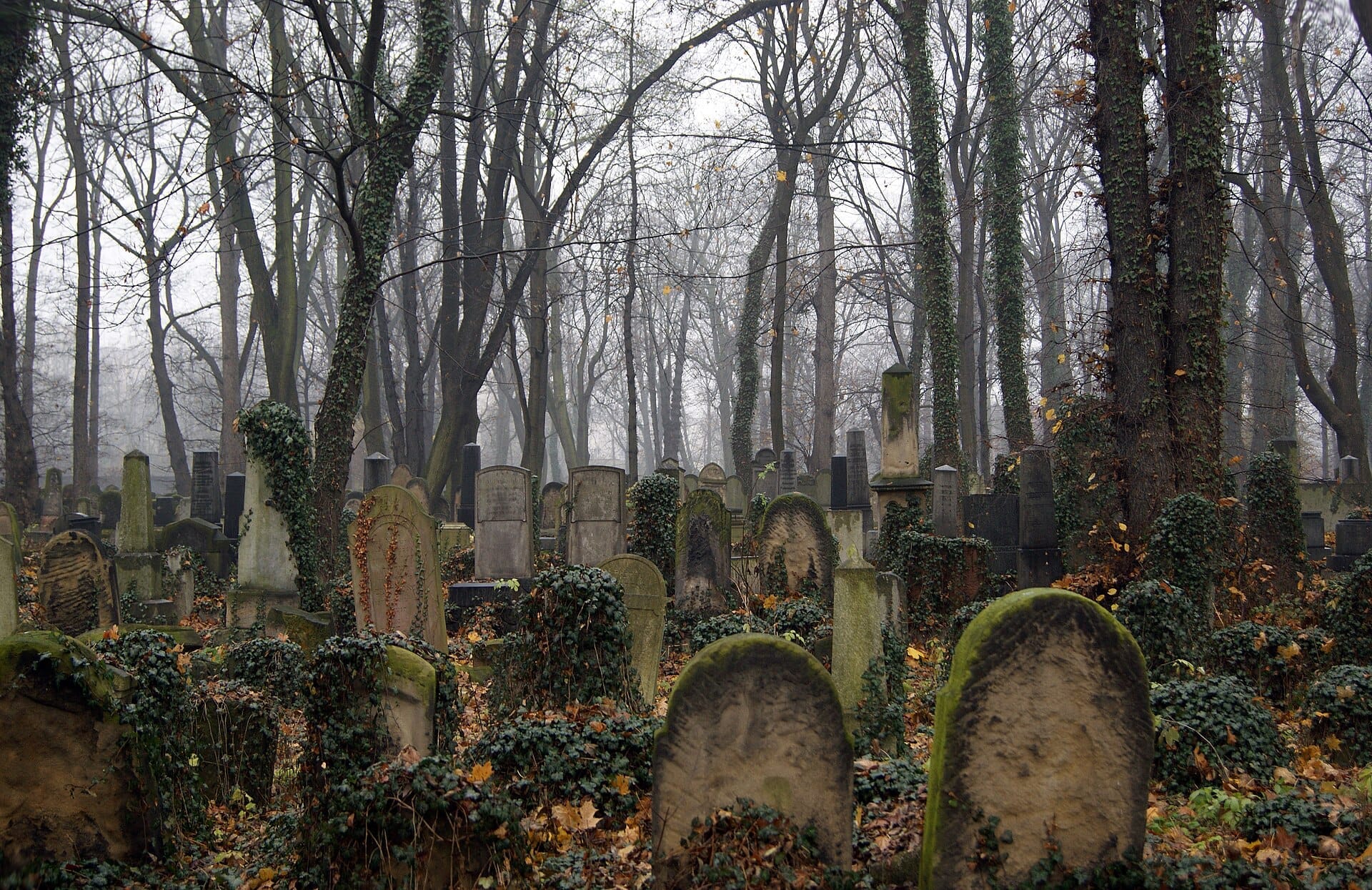
The oldest preserved tombstones date from the 1840s. Many are traditional Jewish matzevot: upright stone slabs, often with Hebrew inscriptions, carved decorative elements, and in some cases relief portraits or symbolic imagery such as hands in the priestly blessing gesture, candelabras, or broken trees indicating a life cut short. The stonework ranges from simple and worn to elaborate 19th-century funerary sculpture.
Sections of the cemetery are densely packed; in others, the ground is uneven and the stones lean at various angles, sinking slowly into the soil. Tall trees, mostly mature limes and chestnuts, create a canopy that filters the light, and in spring their roots push through the gravel paths. In wet weather, lichen spreads across the older headstones in shades of grey and pale green, making the Hebrew lettering harder to read and reinforcing the age of the site.
The tombs of several significant figures in Kraków's Jewish history are located here, including distinguished rabbis and community leaders whose names appear in the history of the city's Jewish institutions. Some graves are marked with small stones left by visitors, the traditional Jewish gesture of remembrance that requires no flowers, no inscription, only the act of placing a stone to show that someone came.
💡 Local tip
Photography is generally permitted in Jewish cemeteries in Poland unless otherwise posted, but this is a place of active religious significance. Keep your voice low, dress modestly, and if you are male, wear or bring a head covering. Small paper kippot are sometimes available near the entrance.
How the Experience Changes by Time of Day and Season
Mornings are the calmest time to visit. The light comes in low through the eastern sections of the cemetery in the early hours, casting long shadows across the headstones, and on weekday mornings you may have the entire place to yourself apart from the caretaker. By midday in summer, tour groups occasionally filter through, though the New Jewish Cemetery receives far fewer visitors than the nearby Remah Cemetery, partly because it requires a slightly longer walk and is less prominently featured in short city itineraries.
In winter, the cemetery takes on a different character. The bare trees expose more of the sky, the stone paths become slippery with frost, and the grey tones of the headstones against white or grey ground create a stark visual effect. It is worth visiting in winter if you are comfortable with cold and have appropriate footwear, though the reduced opening hours mean you need to plan more carefully.
Autumn is particularly atmospheric: fallen leaves collect against the bases of the older stones, and the smell of damp earth and decaying leaves mixes with the stone dust of the older sections. Spring brings birdsong from the tree canopy and a sense of contrast between the new growth and the age of what surrounds it. Whatever the season, the cemetery rewards slow movement.
Getting There and Practical Walkthrough
The cemetery sits on the western edge of Kazimierz, roughly 15 minutes on foot from Kraków's Old Town and around 25 minutes from Kraków Główny railway station. From the main Kazimierz area around ul. Szeroka or Plac Nowy, head west along ul. Miodowa; the walk takes about 10 minutes and passes through quieter residential streets before reaching the railway bridge. The cemetery entrance is just past the bridge on the right-hand side.
Trams running along ul. Starowiślna and ul. Dietla stop within reasonable walking distance of Kazimierz. From those stops, ul. Miodowa is a short walk south and west. Kraków has no metro system; buses and trams are the main public transport options, supplemented by taxis and ride-hailing apps including Uber and Bolt.
Wear comfortable shoes with some grip; the paths inside are gravel and uneven, and in wet or icy conditions they become slippery. The site is enclosed by brick and iron fencing, with a formal entrance gate. No specific wheelchair access information is available from official sources; visitors with mobility needs should contact the Jewish Community of Kraków directly before visiting.
⚠️ What to skip
The cemetery is closed on Saturdays (Shabbat) and Jewish holidays. If your visit to Kraków coincides with Rosh Hashanah, Yom Kippur, Passover, or other major Jewish holidays, verify access in advance through the Jewish Community of Kraków website.
Honest Assessment: Who This Is For, and Who Might Prefer to Skip It
The New Jewish Cemetery is not a site that performs for visitors. There are no explanatory panels in every language, no audio guides at the entrance, and no dramatic architecture to photograph from a distance. For travelers on a tight schedule who want to cover Kazimierz efficiently, the Remuh Synagogue and Cemetery on ul. Szeroka offers a more compact and formally interpreted experience of Jewish funerary heritage, within walking distance of Kazimierz's main synagogues and restaurants.
The Miodowa cemetery, by contrast, suits visitors who want more time, more silence, and more direct contact with the scale of what was lost. Anyone researching Jewish family history connected to Kraków should contact the Jewish Community of Kraków in advance; the community maintains records and may be able to assist with genealogical inquiries. Visitors following a broader itinerary of Jewish Kraków heritage can combine the cemetery with the Old Synagogue and the Galicia Jewish Museum, both within walking distance in Kazimierz, for a coherent half-day.
Those planning a fuller exploration of Kazimierz's history and atmosphere can find detailed context in the Kraków Jewish Quarter guide, which covers the district's synagogues, memorials, and cultural institutions in one place.
Insider Tips
- Visit on a Sunday morning if possible: the cemetery is open, traffic on Miodowa is light, and the footfall from tour groups is minimal. You are more likely to have the older sections entirely to yourself.
- Bring a printed or downloaded map of notable graves if you have specific historical interests. Signage inside is minimal, and without preparation it can be difficult to locate significant tombs in the denser sections.
- The red-brick funeral hall near the entrance is worth a closer look from the outside even if access is restricted: the 19th-century architecture reflects the functional solemnity of traditional Jewish funerary practice and is architecturally distinct from anything else in the immediate area.
- If you are visiting Kazimierz on a Friday afternoon, plan to finish at the cemetery well before Shabbat begins at sundown. The cemetery closes at that point, and you will want time to walk back through the neighborhood as it quiets down for the evening.
- The cemetery wall along ul. Miodowa contains embedded fragments of older tombstones, visible from the street. This is not accidental; it is a common practice in Jewish memorial preservation, and you can observe details of carved Hebrew lettering and decorative motifs without entering.
Who Is New Jewish Cemetery (Miodowa Street) For?
- Travelers with Jewish heritage or family connections to Kraków who want to connect with the community's history on a personal level
- History and culture visitors who have already covered the major Holocaust and Jewish heritage sites and want a quieter, less mediated experience
- Photographers interested in funerary sculpture, stonework, and the interplay of natural light with aged stone
- Anyone doing genealogical research related to Kraków's pre-war Jewish community
- Visitors who prefer contemplative, uncrowded spaces and find large tourist sites draining
Nearby Attractions
Other things to see while in Kazimierz:
- Galicia Jewish Museum
Housed in a converted pre-war industrial building on ul. Dajwór in Kraków's Kazimierz district, the Galicia Jewish Museum presents Jewish life and culture in the former region of Galicia through documentary photography and rotating exhibitions. It is one of the most thoughtfully curated cultural institutions in southern Poland, and one that rewards visitors who come willing to slow down and read.
- Ethnographic Museum Kraków
Housed in the former Kazimierz Town Hall on Plac Wolnica, the Seweryn Udziela Ethnographic Museum of Kraków holds over 80,000 objects documenting Polish and Central European folk life. It is one of the oldest ethnographic collections in Poland, and one of the most overlooked institutions in a city full of heavyweight attractions.
- Old Synagogue
The Old Synagogue on Szeroka Street in Kraków's Kazimierz district is the oldest surviving synagogue in Poland, now home to a permanent museum dedicated to the history and culture of Kraków's Jewish community. Part of the Museum of Krakow network, it stands as one of the most historically significant buildings in Central Europe.
- Plac Nowy Market, Kazimierz
Plac Nowy is Kazimierz's central market square, running from early-morning produce stalls to late-night street food. At its heart stands the Okrąglak, a 12-sided rotunda built in 1900 that once served as a kosher poultry slaughterhouse and now dishes out zapiekanki until the early hours. The square is free to enter and shifts character dramatically depending on the hour and the day of the week.
Planning a trip? Discover personalized activities with the Nomado app.