Plac Nowy Market: Kazimierz's Living Square
Plac Nowy is Kazimierz's central market square, running from early-morning produce stalls to late-night street food. At its heart stands the Okrąglak, a 12-sided rotunda built in 1900 that once served as a kosher poultry slaughterhouse and now dishes out zapiekanki until the early hours. The square is free to enter and shifts character dramatically depending on the hour and the day of the week.
Quick Facts
- Location
- Plac Nowy, pl. Nowy, 31-056 Kraków, Kazimierz district
- Getting There
- Check current tram lines to stop “Plac Wolnica” (about 2-min walk) using Kraków’s public transport planner
- Time Needed
- 30–90 min depending on market day
- Cost
- Free to enter; zapiekanki approx. 10–18 PLN
- Best for
- Food lovers, history seekers, Sunday bargain hunters
- Official website
- placnowy1.pl
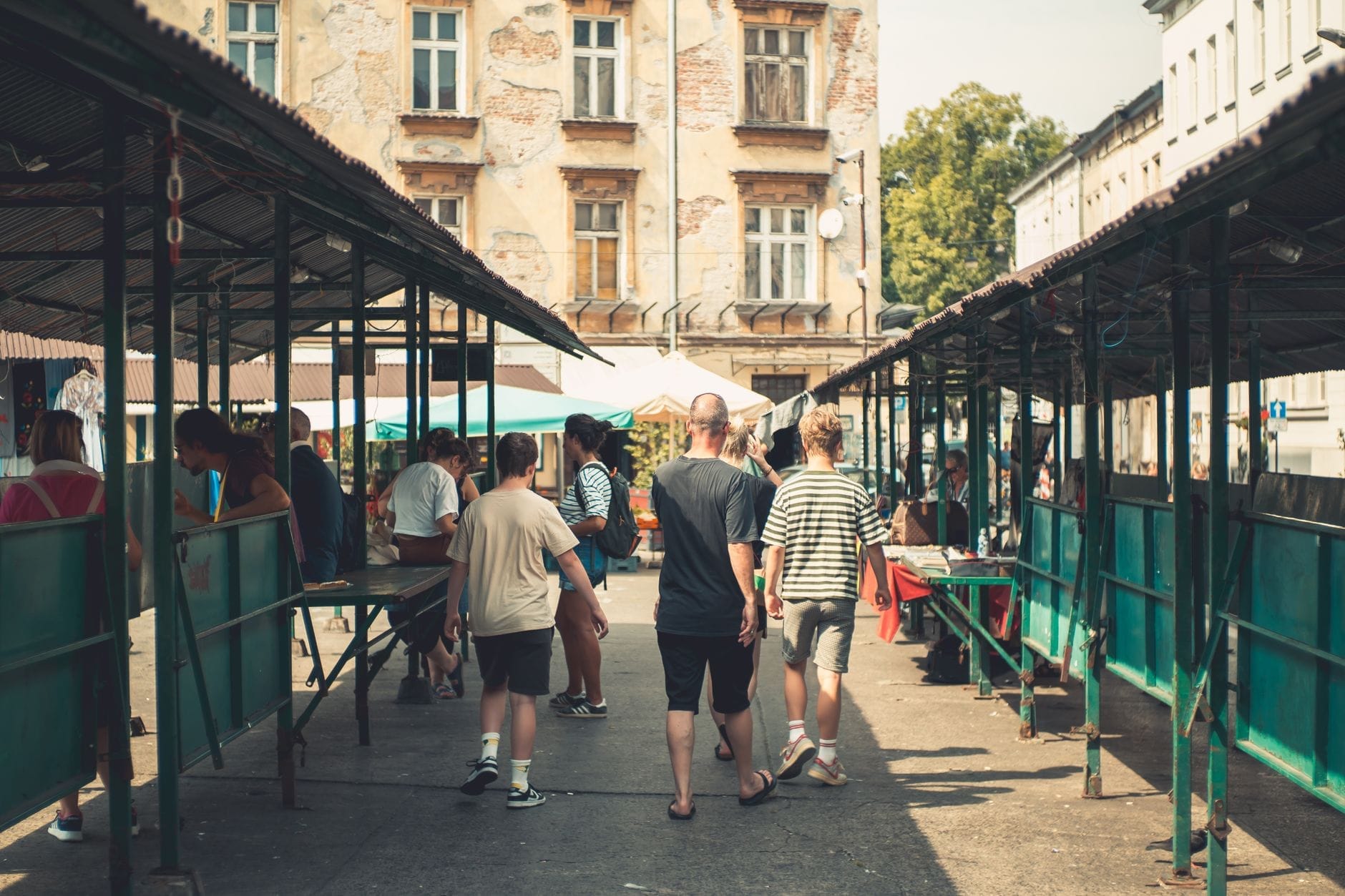
What Is Plac Nowy?
Plac Nowy, also called Nowy Square or informally the Jewish Square, sits at the social core of Kazimierz, Kraków's historic Jewish quarter. The square is compact and roughly rectangular, bordered by Nowa, Beera Meiselsa, Warszauera and Estery streets. At its exact centre stands the Okrąglak, a 12-sided, low-slung rotunda built in 1900, which gives the square its defining silhouette.
Unlike Kraków's grand Main Market Square, Plac Nowy is unashamedly neighbourhood-scale. There is no cathedral backdrop, no tourist-facing horse carriages. What you get instead is a working square that has been feeding people for over a century, layered with history that is easy to miss if you arrive without context.
💡 Local tip
The square is free to enter at any hour. Arrive before 08:00 on a Sunday to catch serious flea market sellers before they pack up the best items.
The Okrąglak: A Rotunda with a Dark Past
The Okrąglak, whose name simply means 'round building' in Polish, was constructed in 1900 and originally functioned as a kosher poultry slaughterhouse serving the Jewish community of Kazimierz. The slaughter of animals here followed religious law, and the building was a practical anchor of Jewish daily life in the district.
That function ended abruptly during the Nazi occupation of World War II. The slaughterhouse was liquidated and the building shuttered, part of the broader destruction of Jewish communal life across Kazimierz. After the war, the Okrąglak reopened in a quieter capacity as a produce market building. Today it houses a ring of small food windows, most of them selling zapiekanki, open-faced baguettes loaded with mushrooms, cheese, and toppings.
The building's exterior is plain and functional, its 12 sides giving each food stall its own arched window. It is not architecturally dramatic, but knowing its history changes how you look at it. The Galicia Jewish Museum nearby offers deeper context if this history draws you in.
Tickets & tours
Live prices and dates from our booking partner. If you book, we may earn a commission at no extra cost to you.
Entrance ticket for the Legends of Krakow robotic show
From 9 €Instant confirmationFree cancellationWieliczka Salt Mine guided tour with hotel pickup from Krakow
From 58 €Instant confirmationFree cancellationWieliczka salt mine guided tour from Krakow
From 60 €Instant confirmationFree cancellationAuschwitz-Birkenau Spanish Guided Tour with Hotel Pick-Up
From 44 €Instant confirmation
How the Square Changes by Hour and Day
Plac Nowy changes sharply depending on when you visit. Early weekday mornings, from around 07:00, the square is at its most local. Produce sellers lay out fruit, vegetables, eggs and sometimes dry goods on folding tables. The crowd at this hour is almost entirely Polish, made up of residents from Kazimierz and surrounding streets who are doing actual grocery shopping. The smell of fresh bread sometimes drifts from the surrounding streets. Conversation is in Polish. Nobody is posing for photographs.
By mid-morning on weekdays, the produce market begins to thin. A handful of stalls remain until early afternoon, but the square relaxes into a quieter in-between state. Cafes and bars around the perimeter start to fill with a mixed crowd of students, residents and visitors sitting outside with coffee.
Sundays are entirely different. The flea market draws sellers from early morning, with the best browsing typically between about 06:00 and 10:00. By late morning, many sellers with older items have usually left and what remains skews toward cheaper clothing and new goods. If you want to look for second-hand books, old postcards, coins, or Soviet-era objects, arrive early. A clothing market also operates on Sundays from around 08:00 until early to mid-afternoon.
After dark, Plac Nowy shifts character again. The Okrąglak windows stay lit, and the square becomes an informal gathering point for groups eating zapiekanki. On weekends, many rotunda windows reportedly stay open until around 02:00, serving the tail end of Kazimierz's considerable nightlife.
Zapiekanki: The Street Food You Are Here For
The zapiekanka is Kraków's defining street snack and Plac Nowy is its unofficial headquarters. The basic version is a halved baguette, toasted, spread with mushrooms and melted cheese, and finished with ketchup. Variations are now extensive: caramelised onions, jalapeños, gyros-style meat, different cheeses, smoked salmon, and more elaborate sauces. Prices start at around 10 PLN for the simplest version, rising to 18 PLN or more for loaded options, though prices should be checked on-site as they adjust over time.
Each window of the Okrąglak is operated independently. The menus overlap considerably, but regulars often have a preference for specific windows. Most people eat standing around the rotunda or perched on the low wall nearby. There is no formal seating, no tray, and no ceremony. You order, you wait two minutes, and you eat it on the street.
ℹ️ Good to know
If you are visiting in winter, zapiekanki fresh off the grill provide welcome warmth. The Okrąglak windows stay open in cold weather, and the square is noticeably less crowded than in summer months.
Getting There and Getting Around the Area
From Kraków's Old Town, Plac Nowy is around 10 to 15 minutes on foot, walking south via Grodzka or Starowiślna streets into Kazimierz. The walk itself is worthwhile, passing through the transition from the medieval centre into the quarter's narrower, more residential streets. If you prefer public transport, trams 3, 9, 19 and 24 stop at Plac Wolnica, which is about two minutes on foot from the square. For full transport options across the city, the guide to getting around Kraków covers tram routes, tickets and walking distances.
The square itself is flat and fully open. The surrounding streets in Kazimierz include both smooth pavement and older cobblestones. Visitors with mobility considerations should expect uneven surfaces on some of the side streets, though the square itself is navigable.
Plac Nowy sits within easy reach of other significant sites in Kazimierz. The Old Synagogue and the Remuh Synagogue and Cemetery are both short walks away, as is the main strip of Szeroka Street where much of Kazimierz's Jewish heritage is concentrated.
Photography and Practical Notes
The square photographs well in low light. Early Sunday mornings offer a visual contrast between the dim stalls, jumbled goods spread on the ground, and the slowly brightening sky. The Okrąglak is most photogenic at dusk, when its windows glow orange against the surrounding buildings. Midday in summer is the least interesting from a photographic standpoint, as the light is flat and the produce stalls are at their thinnest.
Weather affects the experience significantly. In heavy rain, most of the open stalls close or reduce dramatically. The Okrąglak food windows remain sheltered and open regardless. In summer, the square fills quickly by 10:00 and can feel crowded by midday on weekends. If you want the square without the tourist element, any weekday before 09:00 will give you a version of Plac Nowy that still belongs primarily to the people who live nearby.
⚠️ What to skip
Some of the surrounding streets and cafe interiors can be noisy late at night on weekends. If you are staying in Kazimierz, check whether your accommodation is immediately adjacent to the square.
Who Should Not Prioritise This Stop
Plac Nowy is not a polished attraction. There is no audio guide, no museum-quality presentation, and no dramatic architecture to anchor the visit. Travellers who prefer structured, curated experiences will likely find the square underwhelming without prior context. If your time in Kraków is limited to one or two days, this square may be secondary to sites like Wawel Castle or the Kraków Underground Museum. But if you have a half-day in Kazimierz and want to understand what this neighbourhood actually feels like on the ground, Plac Nowy is the right place to spend an hour.
Insider Tips
- Sunday flea market sellers with older or more interesting items tend to arrive before dawn and leave by 10:00. Arriving at 07:00 gives you the best access and the most space to look around before the square fills up.
- Each Okrąglak window is independently operated. If one queue looks long, walk around the rotunda before committing. The menus are similar, but wait times and freshness can vary.
- The bars and cafes on the northern edge of the square are cheaper and less overtly tourist-focused than those on Szeroka Street. If you want to sit with a coffee and watch the square without paying a premium, look for places on Ulica Nowa.
- In winter, the square is significantly quieter and the Sunday flea market is smaller. But the Okrąglak stays open late, and eating a hot zapiekanka in a half-empty square in January has its own appeal.
- The historical context of the Okrąglak as a former kosher slaughterhouse is not marked in any prominent way on the building itself. If you want to understand this layer of the square, read up beforehand or combine the visit with the Galicia Jewish Museum, a short walk away.
Who Is Plac Nowy Market, Kazimierz For?
- Food travellers who want to eat where locals eat, not where tour groups are directed
- History-focused visitors interested in Jewish Kraków and the layers of the Kazimierz district
- Early risers willing to show up before 08:00 on a Sunday for the flea market
- Budget travellers looking for a filling meal for under 20 PLN
- Photographers working in available light at dawn or dusk
Nearby Attractions
Other things to see while in Kazimierz:
- Galicia Jewish Museum
Housed in a converted pre-war industrial building on ul. Dajwór in Kraków's Kazimierz district, the Galicia Jewish Museum presents Jewish life and culture in the former region of Galicia through documentary photography and rotating exhibitions. It is one of the most thoughtfully curated cultural institutions in southern Poland, and one that rewards visitors who come willing to slow down and read.
- Ethnographic Museum Kraków
Housed in the former Kazimierz Town Hall on Plac Wolnica, the Seweryn Udziela Ethnographic Museum of Kraków holds over 80,000 objects documenting Polish and Central European folk life. It is one of the oldest ethnographic collections in Poland, and one of the most overlooked institutions in a city full of heavyweight attractions.
- New Jewish Cemetery (Miodowa Street)
Established in 1800–1801 on the western edge of Kazimierz, the New Jewish Cemetery on Miodowa Street holds thousands of graves spanning two centuries of Kraków's Jewish life. Quiet, largely unvisited by mass tourism, and registered as a heritage monument since 1999, it offers a contemplative counterpoint to the city's busier historical sites.
- Old Synagogue
The Old Synagogue on Szeroka Street in Kraków's Kazimierz district is the oldest surviving synagogue in Poland, now home to a permanent museum dedicated to the history and culture of Kraków's Jewish community. Part of the Museum of Krakow network, it stands as one of the most historically significant buildings in Central Europe.
Planning a trip? Discover personalized activities with the Nomado app.