Red Market (Mercado Vermelho): Macau's Modernist Wet Market Worth Visiting
Built in 1936 and still fully operational, the Red Market (Mercado Vermelho) is Macau's most architecturally significant municipal market. Its distinctive red brick facade and three-storey layout make it a rare intersection of heritage architecture and everyday local life on the Macau Peninsula.
Quick Facts
- Location
- Avenida do Almirante Lacerda, Macau Peninsula (corner with Avenida de Horta e Costa)
- Getting There
- Bus routes 6, 9, 9A, 23, 28C, 32 serve the market area; additional routes 17, 19, 25, 26A, and 33 stop at nearby Red Market / Almirante Lacerda / Horta e Costa stops
- Time Needed
- 20–40 minutes to browse; allow longer if you plan to buy produce or linger over the architecture
- Cost
- Free entry; it is a public municipal market
- Best for
- Architecture enthusiasts, food lovers, travelers seeking authentic local daily life
- Official website
- hpip.org/en/heritage/details/923
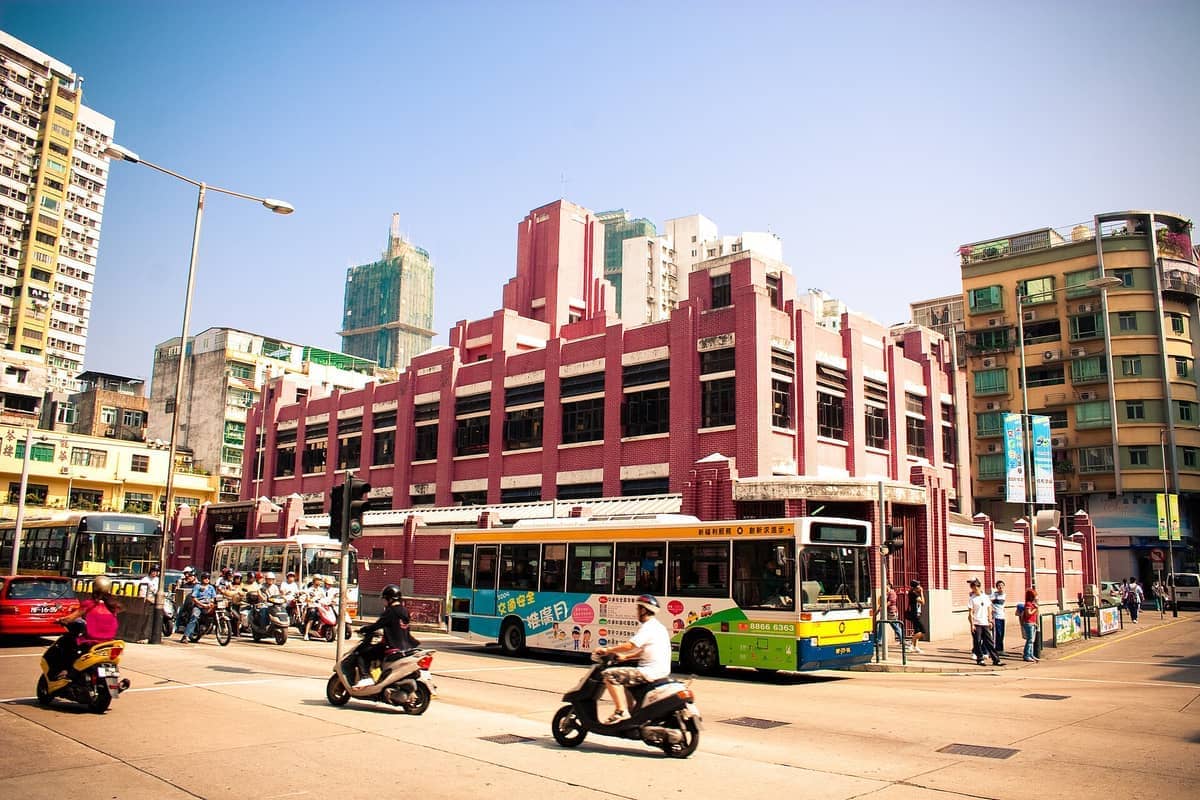
What the Red Market Actually Is
The Red Market, formally known as the Almirante Lacerda Municipal Market (紅街市大樓), is a government-classified architectural heritage site that has operated as a wet market since its completion in 1936, with temporary relocation during recent renovation works. It stands at the corner of Avenida do Almirante Lacerda and Avenida de Horta e Costa in the northern Macau Peninsula, just above the Three Lamps (Sam Pa Mun) district.
At nearly 90 years old, the building holds the distinction of being the first public amenities building in Macau to clearly follow international modernist architectural currents. The facade is unmistakable: three storeys of load-bearing red brick with clean horizontal lines and functional window openings that prioritize ventilation over ornament. There is nothing decorative about the design in the fussy colonial sense. It is austere, purposeful, and genuinely striking against the surrounding streetscape.
For travelers moving through Macau's historic core, the Red Market sits at the opposite end of the social spectrum from the polished tourist circuit of the Ruins of St. Paul and Senado Square. This is a market where local residents buy their morning fish and pork, not a curated experience designed for visitors.
💡 Local tip
Go before 09:30 if you want to see the market at full activity. By mid-morning the freshest produce is already gone, and some seafood stalls begin wrapping up.
The Architecture: Why a Market Building Earned Heritage Status
The heritage classification of the Red Market (gazetted under Macau Government Decree No. 83/92/M) is not sentimental. The building represents a specific and significant moment in the architectural history of Portuguese-administered Macau: the adoption of European modernism in a public utility context, applied without compromise to a humble everyday function.
The red brick exterior gives the market its popular name and its visual identity. Unlike the painted plaster facades common across much of the historic peninsula, the Red Market's brickwork is exposed and structural. The proportions are horizontal rather than vertical, with wide window bays on each floor that allow natural cross-ventilation, a practical necessity in subtropical heat. Standing back on Avenida do Almirante Lacerda, the building reads as a confident civic statement rather than a commercial one.
Architecturally, it pairs well as a stop with Macau's other civic heritage, such as the Leal Senado Building and the Dom Pedro V Theatre, though the Red Market's character is entirely different: utilitarian rather than ceremonial.
Inside the Market: Floor by Floor
The internal layout follows a logical three-storey hierarchy common to traditional wet markets across southern China and Hong Kong. The lower floors focus on meat, poultry, fish, and seafood, while the upper floor is dominated by vegetables, dried goods, and general produce. Expect the smells to shift decisively between floors: raw meat and blood on the ground level, the briny, tide-pool smell of fresh seafood one floor up, and the earthy, green scent of vegetables at the top.
The internal staircases are narrow and utilitarian, worn smooth by decades of foot traffic. Vendors display goods on low concrete counters under fluorescent lighting. The stalls are tight, the aisles are not wide, and at peak morning hours the space fills quickly. Vendors call out to regulars, plastic bags rustle, and the collective noise of a working market in full operation is constant but not overwhelming.
You will not find artisan produce or tourist-facing packaging here. The Red Market operates entirely for the domestic household shopping needs of the neighborhood. Prices are displayed in MOP, and most transactions are conducted in Cantonese. Basic Mandarin or pointing will get you by if you want to buy anything.
⚠️ What to skip
The building has no lifts or accessible ramps between floors. Visitors with limited mobility or those using wheelchairs will be restricted to the ground floor only.
How the Market Changes Through the Day
The Red Market opens at 07:30, and the first hour is the most active. Local shoppers arrive early, vendors are at full stock, and the sensory intensity peaks before 09:00. This is when the market justifies a visit as an experience rather than just a sightseeing stop: the combination of smells, the clatter of ice and wet surfaces, the compression of activity in a narrow space, and the contrast of all of it happening inside a protected modernist building from 1936.
By mid-morning, the pace slows and stock depletes on the seafood floor. Between roughly 10:30 and 13:00, the market is quieter and easier to walk through without the press of morning shoppers. For photography of the building's interior structure, this quieter window is actually better: you can look up at the ceiling vaults and window bays without navigating around a crowd.
Afternoons are the quietest period. Some stalls close earlier than the official 19:30 closing time, particularly the fish and meat vendors, whose products are sold to near-zero stock by early afternoon. Evening visitors may find the lower floors largely empty and the building feeling cavernous rather than alive. The facade itself, however, photographs well at any hour, particularly in the warm late-afternoon light that catches the texture of the red brick.
Getting There and Practical Details
The market sits on Avenida do Almirante Lacerda in the northern part of the Macau Peninsula. Multiple bus routes stop directly on this avenue, including routes 6, 9, 9A, 23, 28C, and 32, with additional routes 17, 19, 25, 26A, and 33 stopping at or near the Red Market. Bus fares are low, though exact amounts are subject to periodic change and should be confirmed before travel. Taxis from central Macau or the Inner Harbour area take roughly ten minutes depending on traffic.
If you are doing a walking circuit of the northern peninsula, the Red Market can anchor the start or end of a loop that takes in the surrounding neighborhood. The Lou Lim Ieoc Garden and the Camoes Grotto and Casa Garden are both within walking distance, offering a clear contrast in scale and character.
For broader context on navigating the peninsula's streets, getting around Macau by bus is straightforward once you understand the route structure, and fares remain among the cheapest in the region.
ℹ️ Good to know
The market is daily 07:30–19:30 with free entry. There is no bag check, no ticket counter, and no defined entrance sequence: just walk in from street level on Avenida do Almirante Lacerda.
Photography and What to Observe
The most photographically rewarding angle of the Red Market is the exterior corner where the two avenues meet. From here, the full height and horizontal rhythm of the red brick facade is visible, and the building's scale relative to the surrounding low-rise streetscape becomes clear. Early morning or late afternoon produces the best natural light on the brick texture.
Inside, the challenge is light: fluorescent overheads create harsh shadows and a greenish cast on produce. A wide aperture and some patience will get cleaner results. Vendors generally do not object to casual photography, but it is courteous to make eye contact or gesture before pointing a lens at a person directly. Do not block aisles while shooting, particularly during morning rush hours when shoppers are moving purposefully.
If architectural photography of Macau's historic buildings appeals to you, the Macau heritage walk covers several of the key sites across the peninsula and provides useful context for understanding how the Red Market fits into the broader built environment.
Is It Worth Your Time?
The Red Market is not a spectacle. It will not wow you the way the Ruins of St. Paul does, and it does not offer the curated charm of Taipa Village's restaurant streets. What it offers is something harder to find in a city that increasingly packages its heritage for tourism: a building of genuine architectural significance doing exactly what it was built to do, serving the people of the neighborhood it sits in, every morning, as it has since 1936.
Travelers who are genuinely interested in how cities work, who like unmediated contact with local food culture, or who care about early modernist architecture will find 30–40 minutes here quietly rewarding. Travelers looking for Instagram spectacle, air-conditioned comfort, or anything resembling a tourist amenity should manage their expectations accordingly.
The market is also, practically speaking, free. In a destination where casino lobbies can feel overwhelming and most heritage attractions have queues, the Red Market is a useful reset: a few hundred square meters of ordinary, durable, real Macau.
Insider Tips
- Arrive by 08:30 on a weekday morning to catch the market at its most active. Weekend mornings tend to be slightly less busy than weekdays for this neighborhood market.
- The exterior corner at Avenida do Almirante Lacerda and Avenida de Horta e Costa gives the best full-building view. Crossing to the opposite pavement on Lacerda provides enough distance to capture the full three-storey height.
- The vegetable floor (third level) is typically the least crowded and has more natural light reaching through the upper window bays, making it the most comfortable floor for a slow look around.
- If you want to buy produce, bring small MOP notes or coins. This is a cash-first environment and vendors may not have change for large bills early in the day.
- The surrounding Sam Pa Mun (Three Lamps) district has several traditional Macanese and local Chinese eateries within a few minutes' walk, making it easy to combine a morning market visit with breakfast in a thoroughly non-touristy setting.
Who Is Red Market (Mercado Vermelho) For?
- Architecture enthusiasts interested in early 20th-century modernism outside the European context
- Food-focused travelers who want to see where local Macau residents actually shop
- Photographers looking for texture, color, and authentic urban scenes beyond the UNESCO corridor
- Travelers on a budget who want genuine local atmosphere at zero cost
- Anyone doing a walking day across the northern Macau Peninsula
Nearby Attractions
Other things to see while in Macau Peninsula:
- A-Ma Temple (Ma Kok Miu)
A-Ma Temple, known locally as Ma Kok Miu, is the oldest temple in Macau, with origins traced to 1488. Part of the UNESCO-listed Historic Centre of Macao, this atmospheric complex blends Taoist, Buddhist, Confucian, and folk traditions across six distinct halls climbing Barra Hill. Entry is free, and the site remains an active place of worship year-round.
- Camões Grotto and Casa Garden
Tucked into the northwest of the Macau Peninsula, Camões Grotto and Casa Garden form one of the city's most layered heritage sites. The park honors Portugal's greatest poet in a setting of banyan trees and rocky outcrops, while the adjacent 18th-century mansion carries the architectural weight of colonial trade history. Both are free to enter and rarely crowded.
- Dom Pedro V Theatre
The Dom Pedro V Theatre (Teatro Dom Pedro V) is the oldest Western-style performance venue in East Asia, completed in 1860 and — though normally a working venue — temporarily closed for renovation until early October 2026. Its pale green neoclassical facade on Largo de Santo Agostinho is one of the most photogenic and historically layered corners of the Macau Peninsula, and admission is free when it is open to visitors
- Fortaleza do Monte (Mount Fortress)
Fortaleza do Monte, built between 1617 and 1626, rises above the historic centre of Macau with cannon-lined ramparts, sweeping 360-degree views, and the acclaimed Macao Museum within its walls. For the price of a cup of coffee, or nothing at all on free days, this UNESCO-listed site delivers more history per square metre than almost anywhere else in the city.