Quartiere Coppedè: Rome's Forgotten Fantasy District
A compact cluster of 26 palaces and 17 villas designed by Florentine architect Gino Coppedè between 1915 and 1927, Quartiere Coppedè is unlike anything else in Rome. Built in a freewheeling blend of Art Nouveau, Gothic, Baroque, and medieval references, it sits quietly in the Trieste neighborhood, entirely free to explore and almost always calm.
Quick Facts
- Location
- Piazza Mincio, Trieste district, Rome
- Getting There
- Trams 3 and 19 to Viale Liegi; buses to Piazza Buenos Aires or Via Po
- Time Needed
- 20–45 minutes
- Cost
- Free, no ticket required
- Best for
- Architecture lovers, photographers, travellers wanting a break from the ancient city
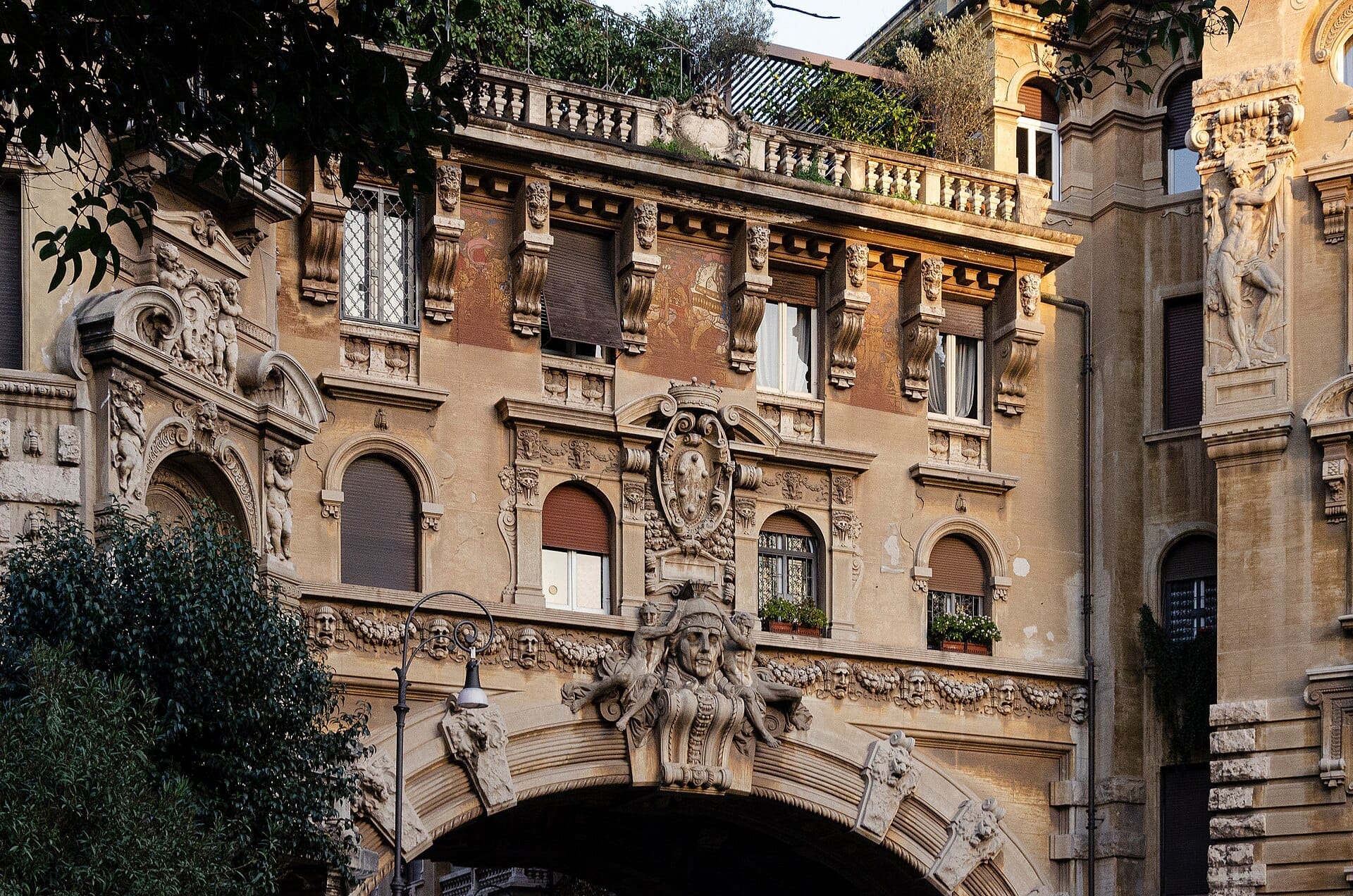
What Is Quartiere Coppedè?
Quartiere Coppedè is a small residential district in the Trieste neighborhood of northern Rome, centred on Piazza Mincio. Built between 1915 and 1927 under the direction of Florentine architect Gino Coppedè, the complex comprises 26 small palaces and 17 detached villas, all executed in a personal architectural language that borrows freely from Art Nouveau, Art Deco, Baroque, Gothic, Greek, and Roman sources. No single style dominates. The result is theatrical, slightly surreal, and almost always surprising.
The district sits roughly 2.3 km northwest of Termini Station and about 1 km behind Villa Borghese. Most visitors to Rome never come here, which is precisely what makes it worth the tram ride. The streets are quiet, the residents go about their days, and there are no entrance barriers, no ticket queues, no guided-tour groups blocking the view.
ℹ️ Good to know
Quartiere Coppedè is a living neighborhood. Residents use these streets every day. Keep noise low, avoid standing in private driveways, and treat the district with the same respect you would any residential area.
The Architecture: What You Are Actually Looking At
The entrance to the district on Via Dora stops you short. A broad archway stretches between two palazzo towers, decorated with sculpted faces, shields, and hanging lanterns. Above the arch, a large chain-link decorative frieze sits beneath a grotesque stone face. It looks like a stage set for a medieval pageant, except that it has been standing in the Roman rain for over a century.
Past the arch, the street opens into Piazza Mincio, where the Fontana delle Rane (Fountain of the Frogs) sits at the centre. The fountain features 12 sculpted frogs arranged around its basin. It is quieter and more intimate than the city's famous fountains, which is part of its appeal. Children still come to look at the frogs. Locals sit on the surrounding benches.
The surrounding buildings reward slow attention. Palazzo del Ragno (Palace of the Spider) is named for the large spider motif worked into its facade. Villino delle Fate (Villa of the Fairies) uses carved wooden elements alongside stone and plasterwork in a way that feels more northern European than Italian. Other buildings carry Masonic symbols, Egyptian motifs, heraldic animals, and Baroque cartouches, sometimes on the same facade. Coppedè was not interested in stylistic consistency. He was interested in effect.
The architectural eclecticism here has parallels in the Art Nouveau movements that swept Europe between the 1890s and 1910s, but Coppedè's work sits outside any single category. If you want to understand the range of architectural experimentation happening in Rome across different eras, the Ara Pacis and the Vittoriano monument both offer useful counterpoints, each representing a very different vision of how Rome should look and what it should say about itself.
Tickets & tours
Live prices and dates from our booking partner. If you book, we may earn a commission at no extra cost to you.
Villa Borghese, Villa Ada and Coppede District E-bike Tour
From 59 €Instant confirmationFree cancellationSt. Peter's Basilica, Vatican Museums, Sistine Chapel reserved entry
From 81 €Instant confirmationFree cancellationGuided tour of Galleria Borghese and of Villa Borghese gardens
From 69 €Instant confirmationFree cancellationVatican: Basilica, Dome and underground early bird tour
From 50 €Instant confirmationFree cancellation
How the District Changes Through the Day
Early morning, roughly 7:00 to 9:00, is the most atmospheric time to visit. The low light catches the textured stone facades at an angle, throwing the carved details into sharp relief. Residents are walking dogs, collecting post, and heading to work. The piazza is essentially empty. You can stand in the middle of it and take photographs without anyone in frame.
By late morning the trickle of tourists begins, usually in small groups of two to four people. This is still a comfortable time to visit. The district is compact enough that even a dozen visitors spread out easily across the streets. Midday in summer brings strong overhead light that flattens the facade details, so if you are here for photography, plan accordingly.
Late afternoon, from about 4:00 onwards, the golden light returns and the streets take on a softer tone. This is also when residents tend to be more present: windows open, the smell of dinner cooking drifts from upper floors, and the pace of the neighborhood slows in a way that feels true to Roman daily life. The combination of the architecture and the ordinary domestic activity happening around it is one of the more unusual experiences Rome offers.
💡 Local tip
Visit on a weekday morning for the quietest experience. Weekends can bring larger groups of Italian day-trippers, especially in spring.
Getting There and Getting Around
The most straightforward approach is by tram. Lines 3 and 19 stop on Viale Liegi, a short walk from the district entrance on Via Dora. Buses also serve the surrounding streets, including stops near Piazza Buenos Aires (also called Piazza Quadrata), Via Tagliamento, and Via Po. Coming from the city centre, the journey from Termini takes roughly 15 to 20 minutes depending on connections.
On foot, the district sits about 1 km north of Villa Borghese Gardens, making a combined visit straightforward. From the gardens' northern edge, the walk through Parioli takes about 15 minutes. This pairing works particularly well: one of Rome's best green spaces and one of its most eccentric architectural detours, with almost no overlap in the typical tourist itinerary.
The streets within the district are all pedestrian-friendly and flat. The surface is a mix of tarmac and paving stones in reasonable condition. Visitors using wheelchairs or pushchairs will find the main route from Via Dora to Piazza Mincio manageable, though some of the smaller side streets are narrower and less even.
Photography Practicalities
The district is photogenic but requires patience. Because the buildings are densely arranged and the streets relatively narrow, wide-angle lenses capture the cramped relationship between facades well, but it can be difficult to get full building elevation shots without stepping back into adjoining roads. Early morning gives you empty streets and side-lit textures. Overcast days actually work well here: the diffuse light brings out the colour in the stone and the painted details without harsh shadows.
The Fontana delle Rane in Piazza Mincio is best shot from the eastern edge of the piazza, which frames the fountain against the palazzo facades behind it. The entrance arch on Via Dora is most effective from a position about 20 to 30 metres down the street, looking back toward the arch from inside the district, so that the surrounding buildings provide context.
⚠️ What to skip
Many of the buildings are private residences. Do not attempt to enter courtyards, doorways, or private gardens, even if they appear open. The district is public space, but individual properties are not.
How This Fits Into a Broader Rome Itinerary
Quartiere Coppedè is not a half-day attraction. The district covers a very small area and can be seen thoroughly in 30 to 45 minutes. Its value is as a diversion from the main tourist circuit rather than a centrepiece. It works well as an add-on to a morning in Villa Borghese, a visit to the Galleria Borghese, or an afternoon exploring the Trieste and Parioli neighborhoods, which offer some of Rome's better café options away from tourist pricing.
For travellers who feel that Rome's ancient monuments are beginning to repeat themselves on a longer trip, this district represents something genuinely different: early 20th-century Rome, built not for the state or the church but for wealthy private clients who wanted something spectacular. If that kind of architectural digression appeals, the lesser-known corners of Rome reward exactly this kind of curiosity.
Who should not bother: travellers on a strict two-day schedule focused on ancient Rome and the Vatican will find the detour hard to justify. The district adds no major historical context to the Roman story and requires a tram ride from the central sights. It is also not suitable as the centrepiece of a day out for families with young children unless the children are specifically interested in architecture or the fountain's frog sculptures, which are, admittedly, quite good.
Insider Tips
- Walk through the entrance arch on Via Dora and then immediately turn around to look back at it. The view of the arch framed by the street behind you is more dramatic than the approach from outside, and it gives a better sense of the scale of the decorative programme.
- The side streets off Piazza Mincio, including Via Brenta and Via Dora itself, have buildings that most visitors miss by heading directly to the fountain. Take a full loop rather than going straight to the piazza and back.
- If you visit in late spring or summer, the upper balconies of several buildings are covered in climbing plants and flowers. This softens the stone facades considerably and adds to the slightly otherworldly atmosphere that Coppedè seems to have intended.
- Pair the visit with coffee at one of the cafés along Viale Liegi or Via Po. These are neighborhood bars with local pricing, a noticeable difference from the centro storico.
- Gino Coppedè died in 1927, the year the district was completed. The project was carried through by other hands during its final years, and sources indicate he may not have directly overseen completion. The project was carried through by other hands during its final years. This context gives the whole complex a slightly elegiac quality when you know it.
Who Is Quartiere Coppedè For?
- Architecture enthusiasts who want to see early 20th-century Rome beyond the Fascist-era buildings
- Photographers looking for textured, uncrowded subjects in good morning light
- Repeat visitors to Rome who have covered the main sights and want something genuinely different
- Travellers combining the visit with Villa Borghese Gardens or the Galleria Borghese
- Anyone who wants to spend 30 minutes in a quiet residential Rome neighborhood with something remarkable to look at
Nearby Attractions
Other things to see while in Centro Storico:
- Ara Pacis
Commissioned in 13 BC to celebrate Augustus's campaigns in Gaul and Spain, the Ara Pacis Augustae is one of the best-preserved monuments of ancient Rome. Today it sits inside a striking modern pavilion on the Tiber's east bank, offering an unusually intimate encounter with imperial-era marble carving at near eye level.
- Campo de' Fiori
Campo de' Fiori is one of Rome's most recognizable piazzas, running a daily produce and flower market Monday through Saturday before reinventing itself as a lively social square after dark. Its paving stones have witnessed public executions, papal power, and centuries of commerce.
- Capitoline Hill
Capitoline Hill sits at the symbolic center of Rome, where Michelangelo's perfectly proportioned piazza crowns a site inhabited since the Bronze Age. Today it holds the world's oldest public museums, Rome's city hall, and some of the most striking views over the Roman Forum in the city.
- Capitoline Museums
Perched atop Capitoline Hill overlooking the Roman Forum, the Musei Capitolini hold some of antiquity's greatest sculptures and paintings across three interconnected palaces. Founded in 1471, they predate the Louvre by more than three centuries and reward visitors with both iconic works and panoramic views that few Rome attractions can match.
Planning a trip? Discover personalized activities with the Nomado app.