Puu-Käpylä Wooden House Area: Helsinki's Living 1920s Garden Suburb
Puu-Käpylä is a protected residential district in northern Helsinki built in the early 1920s to house the city's working class. Its low-rise wooden villas, colorful painted facades, and shared garden courtyards make it one of the most visually distinctive neighborhoods in Finland. Entry is free, and the streets are open at all hours.
Quick Facts
- Location
- Pohjolankatu, 00610 Helsinki (Käpylä district, northern Helsinki)
- Getting There
- Tram 1 to Pohjolanaukio or Käpylänaukio; buses 56 and 69 to Käpylän paloasema
- Time Needed
- 45 minutes to 1.5 hours for a self-guided walk
- Cost
- Free (public streets, open 24 hours)
- Best for
- Architecture lovers, photography, quiet walks, history enthusiasts
What Puu-Käpylä Actually Is
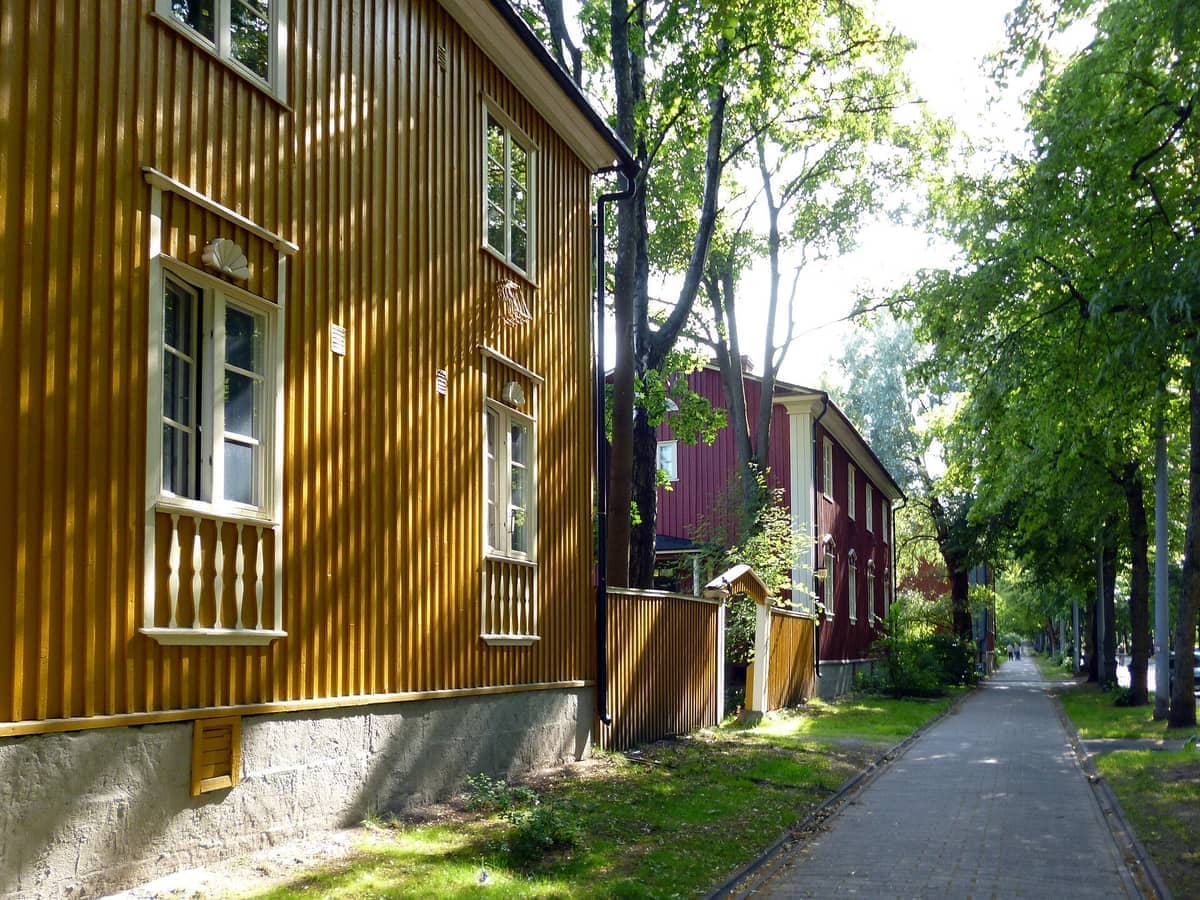
Puu-Käpylä, often referred to as the Puu-Käpylä Wooden House Area, is a protected residential neighborhood in the Käpylä district of northern Helsinki. Built in the early 1920s, it was designed specifically to provide affordable rental housing for the city's manual workers at a time when Helsinki was rapidly industrializing. The result is one of the most coherent examples of garden city planning in Finland: low, symmetrical wooden villas arranged around shared courtyards, with fruit trees, lilac bushes, and vegetable plots filling the spaces between buildings.
The district is listed as nationally significant built cultural heritage under Finland's RKY classification, and it carries formal conservation status in the city plan. That protection matters: Puu-Käpylä genuinely looks today much as it did a century ago. The houses are occupied, well maintained, and privately owned, so this is not a museum or an open-air exhibit. You are walking through a real neighborhood where people live, garden, and hang laundry. That distinction shapes the experience entirely.
ℹ️ Good to know
Puu-Käpylä is a living residential area. The streets and paths are public, but the gardens and courtyards belong to residents. Walk quietly, do not enter private property, and avoid lingering directly outside windows.
The Architecture and Its Origins
Many of the villas in Puu-Käpylä follow a recognizable template: in the smallest buildings, four apartments share a structure, each with its own private entrance opening directly onto a communal garden rather than a shared corridor. This arrangement reflected garden city ideals imported from Britain and Germany: the belief that working people deserved not just shelter but access to green space, light, and a sense of individual dignity within a collective setting.
Construction was fast by design. Buildings could be set up in as little as about two weeks per structure, using standardized timber frames and simple detailing. Speed was necessary: the housing shortage in early-1920s Helsinki was acute. Yet the efficiency did not produce a uniform or bleak streetscape. The facades vary in color from pale ochre to deep terracotta to sage green, and the pitched roofs, small porches, and decorative window surrounds give each block a distinct character within a coherent whole.
The street plan itself is worth reading. Pohjolankatu, the main axis, runs through the area with secondary lanes branching off at right angles. Blocks are loosely organized rather than tightly packed, with generous gaps between buildings that allow daylight to reach the gardens and create views across the neighborhood. Walking the grid takes less than an hour, but the spatial rhythm is slow and pleasantly repetitive, like reading a well-structured sentence over and over.
Tickets & tours
Hand-picked options from our booking partner. Prices are indicative; availability and final rates are confirmed when you complete your booking.
Helsinki Beautiful Canal Route, archipelago cruise
From 26 €Instant confirmationFree cancellationHelsinki Panorama Sightseeing Bus Tour With Audio Guide
From 35 €Instant confirmationFree cancellationHelsinki Pasila Street art district tour with a local
From 99 €Instant confirmationFree cancellationSurvival suit floating experience
From 125 €Instant confirmationFree cancellation
How the District Changes Through the Day
In the early morning, Puu-Käpylä is nearly silent. The streets are empty, the gardens are still, and the low wooden houses glow in the flat northern light. This is the best time for photography: the facades are evenly lit, there are no parked cars crowding the foreground, and the color contrasts between the painted timber and the surrounding green are sharpest. Bring a camera or a phone with a good wide-angle lens.
By mid-morning on weekends, a few residents emerge to tend their plots, and the courtyards take on a gentle, domestic quality. Children appear. Bicycles lean against fences. The smell of freshly cut grass mixes with the faint scent of timber and old paint that the buildings seem to exhale when the sun warms them. It is not a dramatic sensory experience, but it is a specific and recognizable one.
Midday and early afternoon bring the most foot traffic, including the occasional tourist group or architecture walk. The streets handle this well because they are wide enough and the neighborhood is large enough that visitors disperse quickly. By late afternoon on summer days, the gardens fill with residents, and the atmosphere shifts from quiet to quietly sociable. Winter visits are atmospheric in a different way: snow on the rooftops and frost on the wooden shutters push the aesthetic close to the visual shorthand for Finnish winter postcards.
💡 Local tip
For the best photographs, visit on a clear morning in late spring or early autumn when the light is low and golden and the trees have color without obscuring the facades.
Getting There and Walking the Area
Tram line 1 is the most straightforward connection from central Helsinki. Ride it to either Pohjolanaukio or Käpylänaukio and you arrive within a short walk of Pohjolankatu, the main street of Puu-Käpylä. The tram journey from the city center takes roughly 20 to 30 minutes. Bus lines 56 and 69 serve the nearby Käpylän paloasema stop and are useful if you are coming from elsewhere in the city.
The area pairs well with a broader exploration of northern Helsinki. If you are already visiting the Sibelius Monument or Töölönlahti Bay, Puu-Käpylä is a reasonable extension, though the tram is faster than walking the full distance between these points.
The self-guided walk is simple. Start at the Pohjolanaukio end of Pohjolankatu and walk its length, turning onto side streets as they catch your attention. The blocks between Pohjolankatu, Metsolantie, and Väinölänkatu contain the densest concentration of original houses. Budget 45 minutes for a focused walk, or 90 minutes if you want to linger in courtyards, read building details, and double back on streets that deserve a second look.
Wear comfortable shoes. The streets are paved but uneven in places, and the most interesting views often require stepping off the main road onto slightly rougher paths between buildings. In winter, pavements can be icy; traction-soled footwear matters.
Photography and Practical Notes
Puu-Käpylä rewards careful framing more than wide-angle vistas. The scale of the architecture is intimate: two-story buildings, low garden fences, narrow lanes. The most compelling shots tend to be straight-on facade views, details of painted timber surrounds, or mid-ground compositions with a blooming fruit tree or fence post in the foreground. Avoid shooting directly into private courtyards where residents are present.
If you are building a broader walking itinerary through Helsinki's architectural highlights, this area connects logically to a visit to the Museum of Finnish Architecture, which provides useful historical context for understanding Finland's distinct approach to urban housing design. Our Helsinki walking tour guide also outlines routes that can be adapted to include Puu-Käpylä.
The district has very few cafes, shops, or public toilets within the immediate area. There are small commercial options, including a local cafe, along Pohjolankatu near the main tram stops, and Käpylä's broader neighborhood has a few local cafes within a few minutes' walk. Do not plan for a long stay without refreshments if you need them, particularly on weekdays when some businesses may be closed.
Seasonal Conditions and When to Visit
Puu-Käpylä is worth visiting in any season, but the character shifts significantly. Summer brings the fullest version: lush gardens, painted facades against green foliage, and the gentle activity of residents outdoors. Late May and early June are particularly striking as the apple and cherry trees in the courtyards blossom. Autumn turns the surrounding trees orange and red, creating strong color contrasts with the painted timber. Winter strips the area back to its structural essentials: snow-covered rooftops, bare branches, and a silence that feels almost total. For a broader sense of how Helsinki changes seasonally, the best time to visit Helsinki guide covers this in more detail.
Rain does not ruin a visit here, but it does change it. Wet timber and overcast light flatten the facade colors considerably. If you arrive on a grey drizzly day, focus on close-up architectural details rather than panoramic street views, which tend to look washed out in those conditions.
Occasionally, guided walking tours are organized through Puu-Käpylä, including free events during Open House Helsinki. These tours require pre-registration and have limited capacity. Check the Open House Helsinki website in advance if you want a structured introduction rather than a self-guided walk.
Is Puu-Käpylä Worth the Journey?
Honest answer: it depends on what you are looking for. Puu-Käpylä is not a dramatic attraction. There is no single landmark, no viewpoint, no exhibition. What it offers is coherence: a neighborhood that has survived largely intact, that reads clearly as a social and architectural statement from a specific historical moment, and that rewards slow, attentive walking.
Visitors who find genuine pleasure in urban fabric, residential architecture, and the texture of everyday life in a foreign city will consider it one of the better hours spent in Helsinki. Visitors who prefer concentrated, legible attractions, such as the Suomenlinna sea fortress or the Temppeliaukio rock church, may find Puu-Käpylä underwhelming. It is a neighborhood, not a spectacle, and there is no shame in deciding that is not your preference.
For those with limited time in Helsinki, it is an honest trade-off. The journey from the city center takes 20 to 25 minutes each way, and the visit itself runs 45 to 90 minutes. That is a meaningful slice of a short trip. If architectural history and quiet residential walks sit high on your priorities, the time is justified. If they do not, the city center has enough to fill a short visit without venturing this far north.
Insider Tips
- The side streets east of Pohjolankatu, particularly around Väinölänkatu, are less frequently walked by visitors and contain some of the best-preserved original details including unpainted timber on older outbuildings.
- If you visit during Open House Helsinki (typically held in late summer or early autumn), free guided tours of Puu-Käpylä are sometimes on the program. Spots fill quickly and pre-registration is required.
- The fruit trees in the communal courtyards are at their most photogenic during early June blossom season. This window lasts only a week or two, so timing matters if this is the specific image you want.
- Tram line 1 follows Mannerheimintie through the city centre before reaching Käpylä, making a one-way tram journey a useful way to see the city's changing urban character from working-class residential to grand boulevard architecture.
- There are no facilities inside the district itself. The closest reliable cafe options are on Pohjolankatu near the tram stops at the southern end of the neighborhood, a short walk from the main streets.
Who Is Puu-Käpylä Wooden House Area For?
- Architecture enthusiasts interested in early 20th-century Nordic residential planning
- Photographers looking for quiet, colorful streetscapes away from central Helsinki crowds
- Travelers who enjoy slow, observational walking in lived-in neighborhoods
- Visitors with a particular interest in Finnish social history and working-class housing
- Anyone on a longer Helsinki stay who has covered the central attractions and wants to explore further
Nearby Attractions
Combine your visit with:
- Aurinkolahti Beach
Aurinkolahti Beach is Helsinki's most expansive public sandy beach, located in the Vuosaari district in eastern Helsinki. Free to enter year-round, it draws swimmers and sunbathers in summer and winter walkers when the ice rolls in. A café, outdoor gym, SUP rentals, and lifeguard supervision from June through early August make it the city's most complete beach destination.
- Nuuksio National Park
Nuuksio National Park sits just 30 kilometres west of Helsinki in Espoo, offering 53 square kilometres of old-growth boreal forest, lichen-draped granite outcrops, and clear glacial lakes. Entry is free, trails range from flat boardwalks to demanding ridge hikes, and the park is genuinely accessible by public transport. It is one of the few places in Europe where you can step off a city commuter train and be surrounded by undisturbed nature within the hour.
- Porvoo Old Town
Vanha Porvoo (Old Porvoo) is a rare example of a near-intact Finnish medieval town centre, with cobblestone lanes, ochre-painted 18th-century wooden houses, and a riverside setting that has changed little in centuries. Entry to the public streets and squares is free, and the town sits just 50 km east of Helsinki, making it the most popular day trip from the Finnish capital.