Puerta de Alcalá: Madrid's Triumphal Arch and Its Best-Kept Secrets
Standing at the heart of Plaza de la Independencia since 1778, the Puerta de Alcalá is one of Madrid's most recognizable monuments. Designed by Francesco Sabatini for King Carlos III, this neoclassical gate marks the eastern edge of the old city and frames the entrance to the Retiro district. Entry is free and the arch is accessible at any hour.
Quick Facts
- Location
- Plaza de la Independencia, Retiro, Madrid
- Getting There
- Retiro (Line 2) or Banco de España (Line 2)
- Time Needed
- 15–30 minutes to see the arch; pair with Retiro Park for 2+ hours
- Cost
- Free — outdoor public monument, no ticket required
- Best for
- Photography, architecture lovers, evening strolls
- Official website
- www.esmadrid.com/informacion-turistica/puerta-de-alcala
What Is the Puerta de Alcalá?
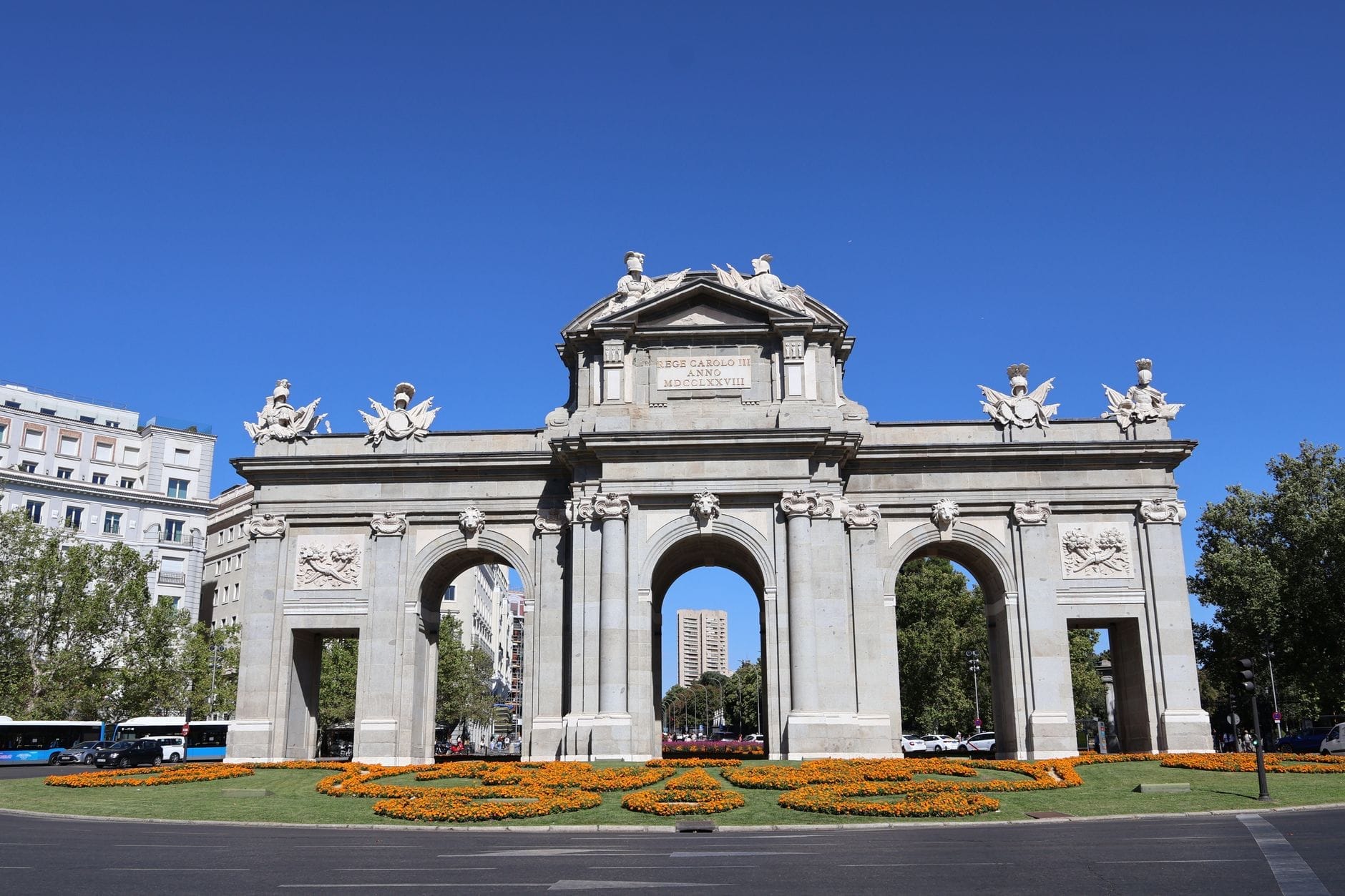
The Puerta de Alcalá is a neoclassical triumphal arch completed in 1778, built on the orders of King Carlos III and designed by Italian architect Francesco Sabatini. It rises from the center of Plaza de la Independencia, at the intersection of Calle de Alcalá, Calle Alfonso XII, and Calle de Serrano. Constructed from granite, the gate stands roughly 19 meters tall and spans five openings — three central arches with rounded tops flanked by two rectangular side passages, a configuration that sets it apart from the more conventional three-arch formula used in comparable European monuments.
It replaced an earlier, more modest gate dating from the 16th century that once marked the eastern boundary of the city and served as the formal entry point for travelers arriving from the town of Alcalá de Henares. Under Carlos III, Madrid was undergoing an ambitious urban modernization program, and the new gate was conceived as a statement of Bourbon ambition — a monument that could hold its own against the great civic architecture of Paris or Rome.
ℹ️ Good to know
The Puerta de Alcalá was one of the first large-scale neoclassical monuments in Spain and is widely considered a defining example of 18th-century Spanish civic architecture.
The Arch Up Close: What You Actually See
Standing in front of it for the first time, the scale takes a moment to register. The granite has an almost pewter quality in overcast light, cool and slightly rough to the touch if you approach the base. Look up at the attic level above the central arch and you will find carved lion heads and decorative garlands in stone, the kind of detail that photographs do not convey. The inscriptions on the frieze record the reign of Carlos III and the date of completion.
The arch sits on a large circular roundabout, which means you can walk nearly all the way around it. The southern face, which faces toward the Retiro park side, tends to be slightly less photographed and often less crowded. The stone base shows some surface weathering and patina from two and a half centuries of Madrid air, which adds texture rather than detracting from it.
One small detail worth noticing: a small plaque commemorates the arch's role during the Peninsular War. The monument has witnessed several centuries of Spanish history played out in the plaza around it.
Tickets & tours
Hand-picked options from our booking partner. Prices are indicative; availability and final rates are confirmed when you complete your booking.
Madrid Christmas lights tour by private Eco Tuk Tuk
From 89 €Instant confirmationFree cancellationImperial Madrid walking tour
From 16 €Instant confirmationFree cancellationAlcala de Henares tour with entrance to the Cervantes Birthplace Museum
From 47 €Instant confirmationFree cancellationTapas and history tour through old Madrid
From 75 €Instant confirmationFree cancellation
How Light and Time of Day Change Everything
Photographers should note that the arch faces roughly east-to-west along Calle de Alcalá. In the morning, sunlight hits the western face directly, which is the side you see when walking toward Retiro. By mid-afternoon the light flattens out and the granite appears washed. The best window for photos from the western approach is between 8 and 10 in the morning, when the low-angle light emphasizes the carved relief and the stone takes on a warm golden tone.
At dusk and after dark, the arch is illuminated and the effect is quite different from the daytime version. The floodlights cast upward from the base, throwing the carved detailing into sharp relief against a deep blue or black sky. Friday and Saturday evenings bring a constant flow of people to the plaza — couples, groups heading toward Retiro park, cyclists — and the area has an unhurried, sociable atmosphere. On weeknights it is quieter, and you can often have a clean sightline for a few minutes at a time.
💡 Local tip
For the clearest photos of the illuminated arch, arrive after 9:30 PM in summer (when the sky finally darkens) or around 7:30–8 PM in winter. Position yourself on the wide pavement along Calle de Alcalá, west of the roundabout, for a straight-on perspective.
Getting There and Moving Through the Area
The most direct metro connection is Retiro station on Line 2, a three-minute walk from the arch via Calle de Alcalá. Banco de España station on the same line is about a ten-minute walk in the opposite direction, along the broad Paseo del Prado. If you are visiting the Parque del Retiro in the same outing, the Retiro station exit deposits you almost exactly between the two. The arch and the park gate on Puerta de Alcalá street are separated by less than 200 meters.
The Puerta de Alcalá sits at a natural crossroads between several of Madrid's more worthwhile walking routes. To the north, Calle de Serrano leads into the Barrio de Salamanca, Madrid's most polished residential and shopping district. To the south, Calle Alfonso XII runs along the western edge of Retiro park toward the Real Jardín Botánico and the museum triangle. The arch is therefore well positioned as a waypoint on a longer urban walk rather than a standalone destination.
💡 Local tip
Buses stop near Plaza de la Independencia. The bus is useful if you are coming from the Gran Vía corridor or the Atocha end of Paseo del Prado.
Historical and Cultural Context
Carlos III is sometimes called the best mayor Madrid never had, a reference to his sweeping urban reforms during the 1760s and 1770s that produced the Prado promenade, the Botanic Garden, and several new institutional buildings. The Puerta de Alcalá was the centerpiece of this civic vision. The road through the gate was the main route connecting Madrid to the University of Alcalá de Henares. It was the road by which the royal family departed for summer stays in Aranjuez and by which ambassadors, church officials, and soldiers entered the capital.
Sabatini, who was born in Palermo and trained in Naples, had already worked extensively for the Spanish Crown before this commission. His approach here drew from Roman triumphal arches while incorporating Spanish decorative sensibilities in the sculptural program. The choice of granite over the more typical limestone or marble gives the Madrid gate a solidity that reads differently from, say, the stucco-finished arches of central Paris. It was built to last, and it has.
The arch fits naturally into a broader exploration of Madrid's 18th-century urban layer. If this period of the city interests you, the nearby Palacio Real and the Real Jardín Botánico were products of the same Bourbon building campaign. A focused half-day could connect several of these sites along a logical walking route.
Photography, Accessibility, and Practical Notes
The arch is surrounded by a traffic roundabout. There are pedestrian crossings at several points around the plaza, and the pavement on the Calle de Alcalá side is wide enough to step back and compose longer shots. There is no dedicated viewpoint or elevated vantage, so all photography is at street level. The roundabout can be noisy during peak traffic hours, roughly 8 to 10 AM and 5 to 8 PM on weekdays, but this rarely affects the viewing experience significantly.
Accessibility is straightforward for most visitors. The plaza is flat, paved, and step-free. There are no barriers to approaching the monument, and the surrounding streets have standard kerb cuts. The monument is viewable without entering any enclosed space, which makes it fully accessible for wheelchair users and families with prams.
On weekends in spring and autumn, the adjacent park entrance sees significant foot traffic, and the area around the arch becomes part of Madrid's broader open-air social life. If you are visiting during a major city event, consult the Madrid visitor guide in advance, as Plaza de la Independencia occasionally serves as a staging area for city-wide celebrations and protests that can affect pedestrian flow.
⚠️ What to skip
The arch sits on a busy roundabout. Do not attempt to access the central island or stand in traffic lanes for photos. All worthwhile angles are achievable from the surrounding pavements.
Is It Worth Your Time?
Taken on its own, the Puerta de Alcalá is a five-minute stop. It does not have an interior to enter, there is no exhibition, and the monument tells its story quickly. What makes it rewarding is its position as a pivot between several of Madrid's most enjoyable areas. A visit to the arch works best when it is the start or end of a longer route: into Retiro park, down toward the Prado corridor, or north into Salamanca for lunch.
Those expecting the kind of immersive experience offered by a major museum will find this underwhelming as a standalone destination. But as a piece of civic infrastructure that has stood for nearly 250 years, that has been photographed by millions, and that still functions as a genuine landmark orienting people across one of Europe's major cities, it delivers exactly what a great urban monument should: a clear, confident sense of place.
Insider Tips
- Walk to the south face of the arch — the side closest to Retiro park — for a less cluttered composition. The Calle Alfonso XII pavement there is quieter and the arch reads cleanly against the sky.
- The arch appears in Francisco de Goya's painting 'The Meadow of San Isidro' (1788), identifiable in the background skyline. Seeing it in person after viewing the painting in the Prado gives both works an extra dimension.
- If you visit in late afternoon in spring, the light along Calle de Alcalá turns amber around 6 to 7 PM, and the stone of the arch picks up a warmth that is almost entirely absent at midday.
- The plaza is one of the few open spaces in this part of the city where you can see the arc of the Retiro treeline, the arch, and Calle de Alcalá all in one view. It is worth pausing to orient yourself before heading in either direction.
- Combine the arch with the Estanque Grande lake inside Retiro park, a five-minute walk away, for an afternoon that covers two very different but complementary Madrid landmarks without doubling back.
Who Is Puerta de Alcalá For?
- Architecture and urban history enthusiasts exploring Madrid's Bourbon-era city-building
- Photographers looking for a landmark that rewards both dawn and night shooting
- Visitors using Retiro park as the anchor of an afternoon and wanting cultural context along the way
- Walkers connecting the Salamanca district to the museum corridor along Paseo del Prado
- Travelers on a budget who want landmark sightseeing without admission costs
Nearby Attractions
Other things to see while in Retiro:
- CaixaForum Madrid
CaixaForum Madrid is a striking cultural centre on Paseo del Prado, housed in a converted early-20th-century power station redesigned by Herzog & de Meuron. Alongside rotating international exhibitions, it features a celebrated vertical garden by botanist Patrick Blanc and sits within walking distance of the city's three great art museums.
- Estanque Grande del Retiro
The Estanque Grande del Retiro is a vast artificial lake at the center of Parque del Retiro, created in the 17th century for royal festivities and now open to everyone for free. Rent a rowboat, watch street performers, or simply sit on the surrounding promenade as the Alfonso XII monument reflects in the water.
- Museo Nacional del Prado
The Museo Nacional del Prado holds one of the most important collections of European art in the world, with around 7,000–8,000 paintings spanning five centuries of Western painting. Located on the Paseo del Prado in the Retiro district, it is the cultural centerpiece of Madrid and the reason many visitors come to the city at all.
- Museo Nacional Centro de Arte Reina Sofía
The Museo Nacional Centro de Arte Reina Sofía is Spain's national museum of 20th-century art, housed in a converted 18th-century hospital near Atocha station. Its permanent collection includes Picasso's Guernica and major works by Dalí and Miró, making it one of the most significant modern art institutions in Europe.