Porto Giunco Beach, Villasimius: Flamingos, Turquoise Water, and a Spanish Watchtower
Porto Giunco is approximately 2 kilometres of fine white sand on Sardinia's southeast tip, framed by a flamingo lagoon on one side and the Capo Carbonara Marine Protected Area on the other. It combines exceptional natural scenery with easy access from Cagliari, making it one of the most rewarding beach days in the south of the island.
Quick Facts
- Location
- Località Giunco – Stagno di Notteri, 09049 Villasimius (SU), Sardinia
- Getting There
- ARST bus 101 from Cagliari to Villasimius (about 1.5 hrs, around €5–6 one way), then local shuttle to beach (~€2 one way). By car: SS125 toward Villasimius, follow signs south past the Notteri pond. Nearest airport: Cagliari Elmas (CAG), ~50 km / about 1 hour’s drive.
- Time Needed
- Half day minimum; a full day is more realistic if you plan to walk to the tower or swim in different coves
- Cost
- Beach access free. Parking approximately €5/day (capacity ~800 cars). Sun lounger and umbrella hire available via the beach club (verify current rates on-site).
- Best for
- Families, snorkellers, nature lovers, photographers chasing flamingo sightings
- Official website
- www.sardegnaturismo.it/en/explore/porto-giunco
What Porto Giunco Actually Is
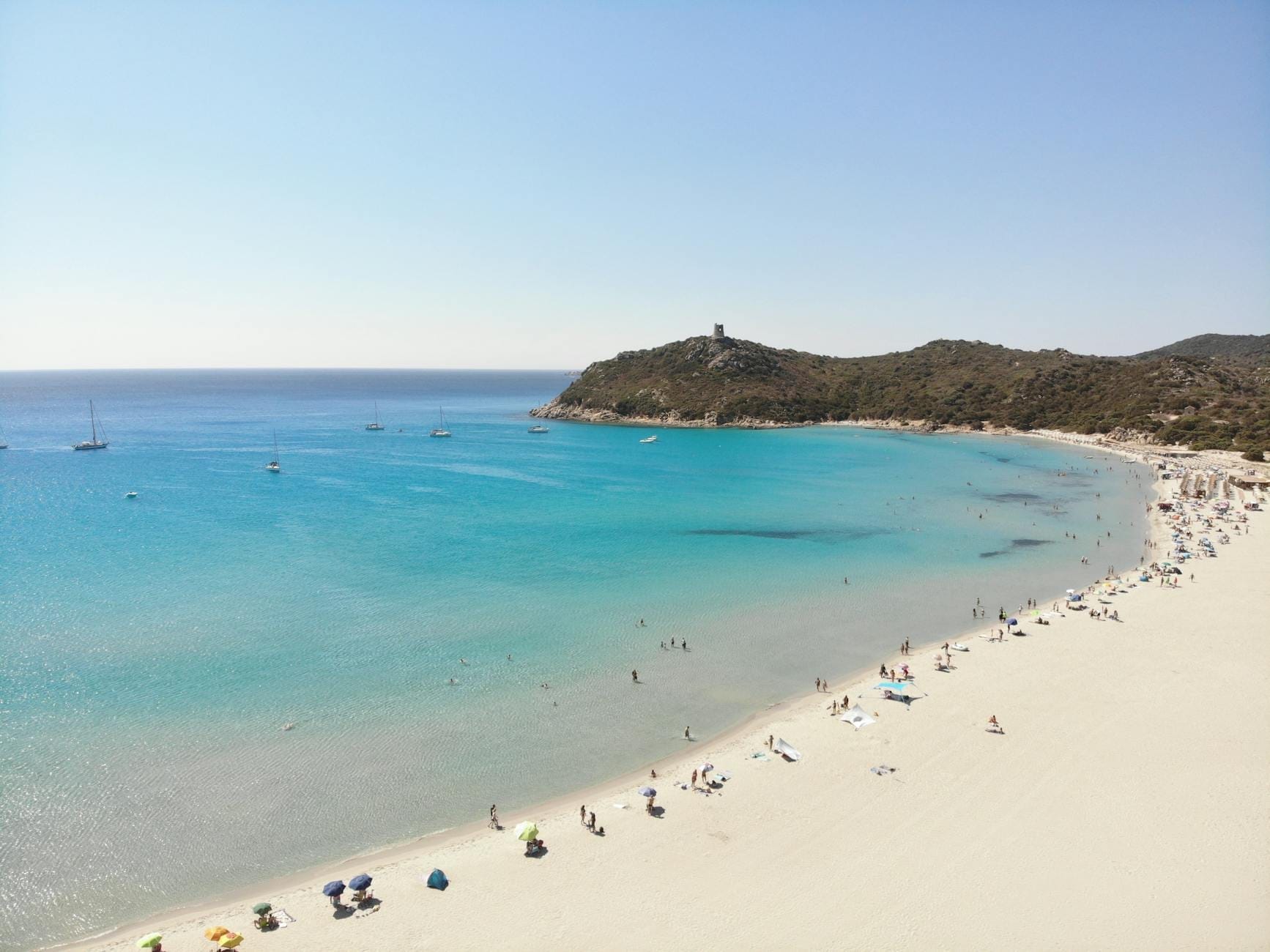
Porto Giunco Beach, officially known in Italian as Spiaggia di Porto Giunco or Spiaggia del Giunco o Notteri, is a public beach on Sardinia's far southeastern coast within the municipality of Villasimius. It sits inside the Capo Carbonara Marine Protected Area, a designation that has kept the water unusually clear and the seabed largely undisturbed by anchoring and development pressure.
The beach itself is roughly 2 kilometres long, shaped into a gentle arc of fine white-to-cream sand. What sets it apart from other long beaches in Sardinia is its dual landscape: to the south, the open sea in shades of pale turquoise and deep cobalt; to the north, the Stagno di Notteri, a shallow brackish lagoon that regularly hosts greater flamingos (Phoenicopterus roseus), grey herons, and various wading birds. This contrast, sand and sea on one face, a protected wetland on the other, is not common anywhere in the Mediterranean.
ℹ️ Good to know
The beach is public and free to access at any time. There are no entry gates or tickets. A paid parking area near the beach costs approximately €5 per day in summer and holds around 800 vehicles.
How It Feels to Be There: Time of Day and Crowds
Arriving before 9 am in July or August means you will likely have the walk through the eucalyptus grove to yourself. The scent of eucalyptus in the early morning air, mixed with salt carried by a light sea breeze, is one of those details that stays with you. The sand at that hour is still cool underfoot, and the water, though it is often around 24–26°C in high summer, feels refreshing rather than tepid. The flamingos in the lagoon tend to be most active and visible in the early morning, feeding near the shallow edges of the Notteri pond.
From around 10:30 am onward through peak season (late June through August), the beach fills steadily. By noon on a Saturday in August, the main central stretch is dense with sun loungers and umbrellas, both from the stabilimento (beach club) and free-standing setups from day visitors. The car park reaches capacity by mid-morning on busy weekends, and the road approach can back up. If you are driving, arriving by 8:30 am or after 5 pm resolves most of that friction.
Late afternoon transforms the place. As the angle of the sun drops toward the west, the water takes on a deeper, more saturated turquoise. Families with young children start packing up, and the beach thins out noticeably after 5 pm. The hour before sunset is photogenic: the 16th-century Spanish watchtower on the headland catches orange light, and the lagoon surface turns reflective. If the flamingos are present, this is the moment to photograph them.
⚠️ What to skip
In July and August, the car park often fills by 9:30 am on weekends. Arriving late and finding no parking means a long walk on an exposed road. Plan accordingly, or use the seasonal shuttle from Villasimius centre.
Tickets & tours
Hand-picked options from our booking partner. Prices are indicative; availability and final rates are confirmed when you complete your booking.
4x4 full-day tour to Villasimius and beaches from Cagliari
From 84 €Instant confirmationFree cancellationBalai Bay snorkeling experience from Porto Torres
From 42 €Instant confirmationFree cancellationAsinara island e-bike rental from Porto Torres
From 48 €Instant confirmationFree cancellationBoat Tour of Porto Cervo's beaches from Porto Rotondo
From 84 €Instant confirmationFree cancellation
The Lagoon and the Flamingos
The Stagno di Notteri is a coastal lagoon separated from the sea by the strip of sand that forms the beach. It is a protected natural habitat and home to greater flamingos year-round, though numbers and visibility vary by season. The birds are typically more numerous in autumn and winter, when migratory individuals join resident populations, but sightings are common throughout the year. You do not need to hike to find them; from the beach path or the parking area edge, you can often see pink shapes wading in the shallow water on the lagoon side of the road.
Do not cross any fencing or approach the lagoon edge on foot. The area is ecologically sensitive, and disturbing the birds is both harmful and prohibited within the marine protected area's regulations. Binoculars or a camera with a long lens are the right tools here. The viewing requires patience rather than proximity.
Porto Giunco is one of the more accessible spots in southern Sardinia for combining a beach day with genuine wildlife observation. For broader context on Sardinia's protected coastal wetlands and the bird life they support, the Parco Molentargius Saline near Cagliari is another significant flamingo habitat worth knowing about.
The Torre di Porto Giunco: History Above the Beach
On the headland at the southern end of the beach, approximately 40 metres above sea level, stands the Torre di Porto Giunco. It is a 16th-century watchtower built under Spanish rule, part of a coastal defence network that Sardinia's Habsburg administrators constructed to monitor North African pirate activity along the island's shores. Towers like this one were spaced so that each was visible to its neighbours, allowing fire-and-smoke signals to relay warnings quickly along the coast.
The tower is reachable on foot via a path that climbs from the beach. The ascent is moderate and takes around 20 to 30 minutes at a steady pace. The view from the top encompasses the full length of Porto Giunco beach, the Notteri lagoon, the open sea toward Capo Carbonara, and on clear days, the outline of the island of Serpentara offshore. It is worth the effort in the early morning or late afternoon; at midday in summer, the exposed path offers no shade and the heat makes the climb unpleasant.
💡 Local tip
Wear closed shoes with grip for the tower path. The last section involves uneven rocky ground, and flip-flops or sandals without ankle support make it slippery and tiring.
Swimming, Snorkelling, and the Marine Reserve
The main beach has a long, shallow sandy entry that deepens gradually. This makes it particularly suitable for children and for less confident swimmers. The water is calm on most days because the bay's orientation provides natural shelter from prevailing winds, though the Mistral from the northwest can occasionally create choppier conditions toward the open end of the bay.
Snorkellers will find more interest at the rocky headlands flanking the main beach, particularly around the Capo Carbonara promontory, where the marine reserve status means fish populations are noticeably denser than in unprotected waters. Posidonia oceanica seagrass meadows, which are a key indicator of water quality and support a wide range of marine life, are present in the waters offshore. For those wanting to explore deeper and further, Sardinia's snorkelling and diving guide covers the best sites across the island and explains the permit rules within marine protected areas.
The smaller cove of Cala Porto Giunco, tucked on the eastern side of the headland, offers a more sheltered and rockier environment. Reaching it requires scrambling over rocks and is not possible for those with limited mobility. The water there is typically calmer and very clear, but there are no facilities.
Getting There and Practical Logistics
The most straightforward approach from Cagliari is by car along the SS125 state road. The drive takes approximately one hour in light traffic, and the final section from Villasimius town to the beach follows a clearly signposted road that passes the northern edge of the Notteri lagoon. Parking costs approximately €5 per day in the main paid area. The capacity is around 800 vehicles, which sounds generous but fills up on peak summer weekends well before mid-morning.
Without a car, take ARST bus 101 from Cagliari's main bus terminal to Villasimius (approximately 1.5 hours, around €5–6 one way). From Villasimius centre, the beach is 3 to 4 kilometres away. A seasonal local shuttle connects the town to the beach area for approximately €2 one way or €5 for a day pass, running roughly hourly during the summer months (verify the current schedule locally or at the tourist office in Villasimius, as timetables change between seasons). Walking the 3-4 km on the road is possible but exposed, with no pavement for much of it. For broader planning of car-free travel in Sardinia, the guide to getting around Sardinia explains the regional bus network in useful detail.
Accessibility: the footpath from the parking area to the beach passes through low scrub and eucalyptus trees. Regional sources do not confirm wheelchair-adapted or step-free pathways to the waterline. The main sandy beach area is flat once you reach it, but the approach path itself may not be suitable for wheelchairs or pushchairs with limited clearance. The tower path and the Cala Porto Giunco cove are not accessible for anyone with reduced mobility.
When to Go and Who Should Reconsider
Porto Giunco is at its best in late May, June, and September. The water is warm enough for comfortable swimming (the sea off southern Sardinia is generally swimmable from May through October), the sand is not packed, and the light for photography is better without the harsh midday glare of peak summer. The September in Sardinia guide makes a case for this shoulder month more broadly, and Porto Giunco is one of the places that benefits most from the quieter conditions.
July and August are viable but require accepting the trade-offs: significant crowds, a car park that fills early, and a beach that loses its spacious character by 11 am. If you are travelling with young children who need shallow water and tolerate busy beach environments well, the peak season is still workable, and the beach's gentle slope into the sea makes it family-friendly in terms of swimming safety.
Travellers who find crowded beaches frustrating, who want a quieter or more isolated experience, or who are hoping for solitude at the waterline should either visit in shoulder months or consider some of Sardinia's less-accessible coastal spots. Porto Giunco is well-known and easy to reach, and in peak season, those two facts are reflected in how many people are there. If that is a dealbreaker, adjust expectations or timing accordingly.
For context on the broader Villasimius area and what else is reachable nearby, see the Villasimius and Costa Rei destination guide.
Insider Tips
- Park on the road shoulder near the lagoon viewing point before the main pay car park, if you arrive early enough. You get an immediate view of the flamingos without paying the €5 parking fee, and the walk to the beach is short. This is a common local approach on busy mornings.
- The eucalyptus grove path to the beach offers the only reliable shade of the day. If you are visiting with young children or anyone sensitive to direct sun, time your walks to and from the beach through the grove rather than across the open sand.
- Bring your own snorkelling kit. Equipment hire is available at the beach club but tends to run out or become limited on peak days. The clearest snorkelling, with the most fish, is at the rocky outcrops at the north and south ends of the bay rather than in the central sandy section.
- The tower walk is best saved for the final 90 minutes before sunset. The light is better for photos, the heat is far less punishing, and you are walking away from the beach as most visitors are leaving, so the path is clear.
- If the main beach car park is full, Villasimius town centre has parking and the shuttle runs from there. Do not attempt to turn large vehicles around on the narrow beach access road during busy periods; there is limited space to manoeuvre.
Who Is Porto Giunco Beach (Villasimius) For?
- Families with young children: the long, shallow sandy entry makes swimming safe and comfortable for small kids
- Wildlife watchers: the Notteri lagoon flamingo colony is one of the most accessible in southern Sardinia
- Snorkellers: the marine protected area status translates into measurably richer underwater life at the bay's rocky margins
- Photographers: the combination of a Spanish watchtower, pink flamingos, and turquoise water in one frame is rare
- Day-trippers from Cagliari: the 52 km distance and direct bus route make this a realistic and rewarding full-day trip without a rental car
Nearby Attractions
Other things to see while in Villasimius & Costa Rei:
- Spiaggia di Costa Rei
Spiaggia di Costa Rei is a sweeping arc of fine white sand along Sardinia's southeastern coast, running roughly 8 to 10 kilometres through the locality of Costa Rei, a seaside fraction of the municipality of Muravera. The water is shallow, clear, and calm, making it one of the most family-accessible beaches on the island. Unlike the heavily marketed northern coasts, this stretch rewards visitors who make the hour-long drive from Cagliari with space, quiet, and impressive scenery.
- Spiaggia di Simius (Villasimius)
Spiaggia di Simius (Simius Beach) sits just southeast of Villasimius in Sardinia's sun-drenched southeast corner, stretching more than a kilometre of fine white sand along shallow turquoise water. Free to access and open year-round, it rewards visitors who plan around the crowds with some of the clearest Mediterranean swimming on the island.
- Spiaggia di Punta Molentis
Punta Molentis is a compact, semi-wild beach inside the Capo Carbonara Marine Protected Area near Villasimius. Surrounded by juniper scrub and the ruins of an old granite quarry, it draws visitors who want clear water without the resort infrastructure. The catch: access is limited by a daily cap, parking can be booked in advance, and the last stretch is on foot along a dirt path.