Spiaggia di Costa Rei: Sardinia's Long White Shore
Spiaggia di Costa Rei is a sweeping arc of fine white sand along Sardinia's southeastern coast, running roughly 8 to 10 kilometres through the locality of Costa Rei, a seaside fraction of the municipality of Muravera. The water is shallow, clear, and calm, making it one of the most family-accessible beaches on the island. Unlike the heavily marketed northern coasts, this stretch rewards visitors who make the hour-long drive from Cagliari with space, quiet, and impressive scenery.
Quick Facts
- Location
- Costa Rei, Muravera (SU), southeastern Sardinia
- Getting There
- By car from Cagliari via SS125, approx. 1 hour. No direct public bus service to the beach itself — a rental car is strongly recommended.
- Time Needed
- Half day minimum; most visitors stay a full day
- Cost
- Free (open access). Optional sunbed and umbrella hire from private lidos; parking fees vary by operator.
- Best for
- Families with young children, couples seeking long walks on sand, snorkellers, and anyone wanting Sardinia-quality beaches without peak-season crowds
- Official website
- www.sardegnaturismo.it/en/places/sud/costa-rei
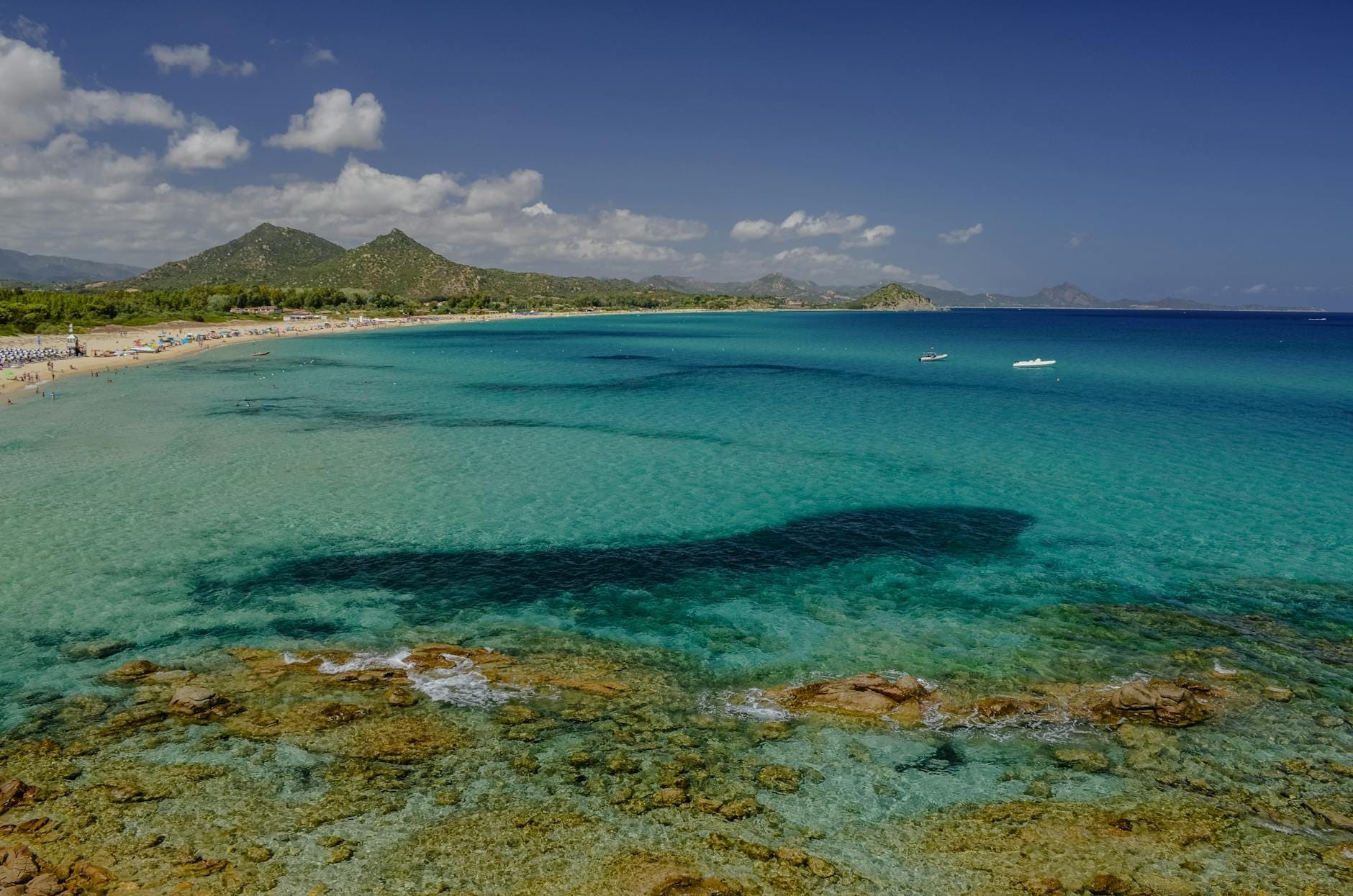
What Costa Rei Actually Looks Like
Spiaggia di Costa Rei is one of those beaches that takes a moment to process. From the access road, you catch glimpses of colour between the umbrella pines — a particular shade of shallow turquoise that sits between teal and green — and then the full scale of the place opens up. Roughly eight to ten kilometres of unbroken white sand stretch in a gently curving line from the northern inlet at Porto Pirastu down toward Cala Sinzias in the south. The sand is fine and pale, the kind that squeaks faintly underfoot when dry, and it slopes so gradually into the water that shallow depths extend a long way offshore.
The beach faces southeast, which means it catches morning light from the left flank and afternoon sun dead-on. By midday in summer the glare off the water is intense — polarised sunglasses are not optional, they are necessary. In the early morning, before 9am, the light is golden and low, and the water colour shifts from flat grey to that vivid blue-green within minutes of sunrise. This is when the beach is at its most photogenic and its least crowded.
The backdrop is low Sardinian scrubland and dune vegetation rather than dramatic cliffs, which gives Costa Rei a more open, relaxed character than the gorge beaches of the Golfo di Orosei further north. The horizon is wide and uninterrupted. On clear days you can see the outline of Capo Ferrato to the north, which marks the northern edge of the Costa Rei shoreline.
💡 Local tip
Arrive before 9am in July and August to secure a good position on the free beach sections. By 10:30am, the most accessible stretches near the main access points fill with sun loungers and the parking areas become congested.
The Water: Why Shallow Matters
The defining characteristic of Costa Rei's sea is its depth profile. The seabed shelves away from the shore very gradually, meaning that adults can walk thirty or forty metres from the waterline and still be standing waist-deep. For families with small children this changes the experience entirely: children can play freely in the shallows without the abrupt drop-offs that make parents anxious at steeper beaches. There are no rocks at the waterline along most of the main beach — entry is on clean sand.
The water clarity is high, particularly at either end of the beach where facilities thin out and foot traffic is lower. The colour in mid-water is a genuine turquoise, not the murky blue-green of busier Mediterranean shores — the sandy seabed reflects light upward and keeps visibility good even after a busy day. Snorkellers will find the best conditions in the calmer water near the northern access point around Monte Nai, where the bottom transitions from sand to occasional patches of posidonia seagrass.
ℹ️ Good to know
Sea bathing at Costa Rei is generally comfortable from late May through October. July and August bring the warmest sea temperatures but also the strongest afternoon winds, which can create choppy conditions by 2–3pm. Early morning and late afternoon swims are consistently calmer.
Tickets & tours
Hand-picked options from our booking partner. Prices are indicative; availability and final rates are confirmed when you complete your booking.
Sightseeing tour of Costa Smeralda
From 130 €Instant confirmationDolphin-watching experience from Pittulongu with a marine biologist
From 35 €Instant confirmationFree cancellationDolphin watching and snorkeling near Figarolo Island
From 79 €Instant confirmationFree cancellationVineyard Guided Tour and 7 Wine Tasting in Palau
From 84 €Instant confirmationFree cancellation
How the Beach Changes Through the Day
The first hour after dawn is different from any other part of the day. The beach bars are closed, the sunbed attendants have not yet arrived, and the only sounds are the low wash of waves and occasional birdsong from the macchia behind the dunes. Walkers — mostly older Italian and German visitors staying in the nearby villas — take their morning stroll along the waterline. The sand still holds the coolness of the night.
From around 9am, the rhythm shifts. Families arrive with bags, umbrellas, and inflatable toys. The equipped lidos — beach clubs operating seasonal concessions — begin setting out their rows of sunbeds, which in the central sections of the beach form dense corridors of striped fabric. By noon in peak season the atmosphere is unambiguously Italian summer: football on the sand, children shrieking in the shallows, the smell of sunscreen mixing with the faint brine of the sea. It is lively rather than frantic, and the sheer length of the beach means crowding is never as suffocating as at more famous Sardinian beaches.
The late afternoon, from around 5pm onward, is when Costa Rei rewards patience. Day-trippers begin leaving. The light turns amber and elongates shadows across the wet sand. The water, warmed by a full day of sun, is at its most inviting. Walking the length of the beach in this light, southward toward Cala Sinzias, is one of the finer simple pleasures in this part of Sardinia.
Getting There and Getting Oriented
Costa Rei sits about 60 kilometres northeast of Cagliari. The drive on the SS125 takes roughly an hour and is straightforward, though the final approach through the scrubland and pinewood is on a narrower two-lane road that can become slow-moving in August. A rental car is, in practice, the only realistic way to reach the beach from Cagliari — there is limited seasonal bus service to the locality but not to all beachfront access points, and the area is not served by train. This is worth stating plainly: if you do not have a car, Costa Rei is difficult to reach.
The Costa Rei locality extends roughly 10 kilometres of coastline. The main beach — what most visitors mean when they say Spiaggia di Costa Rei — runs through the central section near the resort village, with the main access points around Monte Nai and Piscina Rei. If you are planning a longer stay and want to explore the wider stretch of coast, including quieter coves at either end, the Villasimius and Costa Rei area offers several other beaches within a short drive, each with slightly different character.
Parking is available at various points along the beach road. Some spots are free and unpaved; others are operated by private attendants and charge a seasonal fee. In July and August these fill early. The best strategy is to park at the northern or southern ends of the beach and walk inward, which also takes you away from the densest concentration of sun loungers.
⚠️ What to skip
Costa Rei is largely a purpose-built summer resort with limited infrastructure outside the June–September season. If you visit in April, May, October, or November, expect many bars, shops, and facilities to be closed or operating reduced hours. The beach itself is open and free year-round.
Practical Beach Details: What to Bring and Know
The beach has no shade from natural sources along most of its length — the dune vegetation sits behind the sand and the water faces southeast, so there is no cliff or tree cover over the main sunbathing area. Bring your own umbrella or rent from one of the lidos if you plan to spend a full day. Hiring from a beach club usually includes two sunbeds and an umbrella; prices vary by operator and season and should be checked locally, as they are set by private businesses.
Fresh water rinse-off showers exist at the main lido areas during the season. The beach bars serve coffee, cold drinks, and basic food from around 8am through the early evening in high season. There are public toilets associated with the larger beach concessions, though coverage thins out significantly at the quieter ends of the beach. If you are walking far south toward Cala Sinzias, carry water.
- Footwear for the parking area: the access paths can be hot on bare feet by noon in summer
- Polarised sunglasses: the glare off shallow white-sand water is intense
- Sun protection rated high: the southeast-facing aspect means full exposure from morning onward
- Cash: some smaller parking operators and beach vendors do not accept cards
- A snorkel if you plan to explore the seagrass patches near Monte Nai
Context: Costa Rei and the Sarrabus Region
Costa Rei is a seaside frazione of Muravera, a town in the historic region of Sarrabus in southeastern Sardinia. The area developed as a resort zone relatively recently by European standards, with tourism infrastructure concentrated in the postwar decades. Unlike the Costa Smeralda to the north, which was purpose-designed for luxury tourism in the 1960s, Costa Rei developed more organically and at a lower price point — it remains primarily a destination for Italian domestic tourists and a growing number of northern European families, rather than a showcase for high-end spending. That understated character is, for many visitors, a point in its favour. For context on how the island's beach tourism compares across different areas, the guide to Sardinia's best beaches gives a useful regional overview.
The town of Muravera itself, about 10 kilometres inland from the coast, has a small historic centre and local market but is not typically a visitor destination in its own right. For those extending a trip beyond the beach, the broader southeast coast is worth exploring: nearby Villasimius, about 30 kilometres to the southwest along the coastal road, has its own strong beach offer and a more developed tourist infrastructure. The Villasimius beach and the protected lagoon at Porto Giunco are both within reasonable driving range.
Who Should Reconsider This Beach
Costa Rei is excellent for what it does, but it is not the right beach for everyone. Visitors looking for dramatic scenery — vertical cliffs, sea caves, or the kind of cove that requires a boat or a long hike to reach — will find the flat, open expanse of Costa Rei underwhelming. The landscape is pleasant but not spectacular by Sardinian standards. For that kind of experience, the Golfo di Orosei, further north on the eastern coast, is a different world.
Travellers without a car will struggle to reach Costa Rei from Cagliari and should plan accordingly — either by arranging a rental or by choosing a beach in the Cagliari area that is served by public transport, such as Poetto beach, which is accessible directly from the city centre. And if the goal is genuine solitude, Costa Rei in July and August is not the answer — the central sections fill steadily through the morning and remain busy until late afternoon.
Insider Tips
- Walk south from the main access point toward Cala Sinzias in the late afternoon. The beach narrows and the facilities drop away, and within twenty minutes you will be on near-empty sand with the same quality of water.
- The northern end of the beach, near Monte Nai, has slightly more interesting underwater terrain for snorkelling — look for the patches of posidonia seagrass where fish congregate. Avoid the central lido sections for this.
- A dog-friendly beach zone is periodically designated within the wider Costa Rei area — check locally for the current dedicated stretch and rules, as these can shift seasonally. The main beach prohibits dogs during summer.
- September is the most practical month to visit: water temperatures are at their peak after a full summer of warming, crowds drop sharply after the Italian school term restarts, and the beach bar services are still running.
- If you are self-catering nearby, the morning fish market in Muravera town (roughly 10 kilometres inland) is worth an early detour — the Sarrabus coast has a small but active fishing tradition and the freshness of what is on offer reflects it.
Who Is Spiaggia di Costa Rei For?
- Families with toddlers and young children who need predictably shallow, calm entry water
- Couples looking for long sunset walks on an uninterrupted sandy shore
- Italian domestic tourists seeking reliable, well-serviced beach infrastructure without north Sardinia prices
- Snorkellers who want clear water over a sandy and seagrass seabed
- Visitors combining a week in the southeast with cultural day trips to Cagliari
Nearby Attractions
Other things to see while in Villasimius & Costa Rei:
- Porto Giunco Beach (Villasimius)
Porto Giunco is approximately 2 kilometres of fine white sand on Sardinia's southeast tip, framed by a flamingo lagoon on one side and the Capo Carbonara Marine Protected Area on the other. It combines exceptional natural scenery with easy access from Cagliari, making it one of the most rewarding beach days in the south of the island.
- Spiaggia di Simius (Villasimius)
Spiaggia di Simius (Simius Beach) sits just southeast of Villasimius in Sardinia's sun-drenched southeast corner, stretching more than a kilometre of fine white sand along shallow turquoise water. Free to access and open year-round, it rewards visitors who plan around the crowds with some of the clearest Mediterranean swimming on the island.
- Spiaggia di Punta Molentis
Punta Molentis is a compact, semi-wild beach inside the Capo Carbonara Marine Protected Area near Villasimius. Surrounded by juniper scrub and the ruins of an old granite quarry, it draws visitors who want clear water without the resort infrastructure. The catch: access is limited by a daily cap, parking can be booked in advance, and the last stretch is on foot along a dirt path.