Spiaggia di Simius: Villasimius's Finest White Sand Beach
Spiaggia di Simius (Simius Beach) sits just southeast of Villasimius in Sardinia's sun-drenched southeast corner, stretching more than a kilometre of fine white sand along shallow turquoise water. Free to access and open year-round, it rewards visitors who plan around the crowds with some of the clearest Mediterranean swimming on the island.
Quick Facts
- Location
- Simius, Villasimius, southeastern Sardinia
- Getting There
- Private vehicle recommended; follow signs from Villasimius town centre toward Cala Giunco
- Time Needed
- Half day to full day
- Cost
- Free (beach access); sun lounger rental available at additional cost
- Best for
- Families, swimmers, snorkellers, sunset walkers
- Official website
- www.sardegnaturismo.it/it/esplora/simius
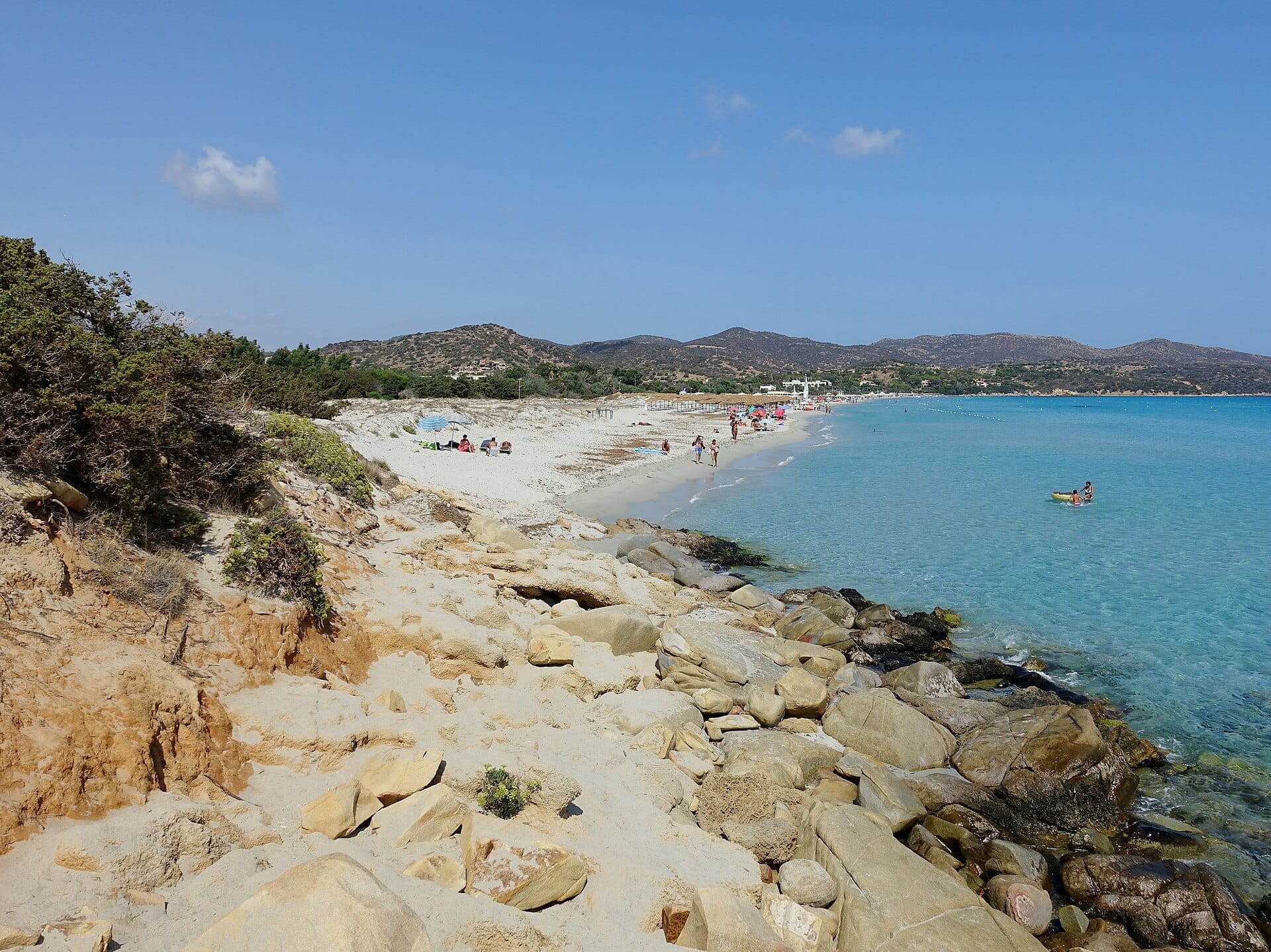
What Spiaggia di Simius Actually Looks Like
Spiaggia di Simius is a broad, gently curved arc of sand over a kilometre long, sitting just southeast of Villasimius, immediately southeast of Villasimius. The sand is fine and pale, close to white when dry, with a powdery texture underfoot that makes the midday sun feel even more intense. The water graduates from near-transparent at the shoreline through layers of turquoise and pale green before deepening to blue further out, and because the seabed stays shallow for some distance, the colour shifts are unusually vivid.
The beach faces roughly south. Behind the sand, low Mediterranean scrub and dune vegetation provide a natural buffer, keeping the feeling open without being exposed. There are no dramatic cliffs or rock formations framing this beach, unlike some of the more theatrical spots further north along the Golfo di Orosei. The appeal here is quieter: scale, soft sand, and the quality of the water itself.
💡 Local tip
Arrive before 9:00 in July and August to secure a spot near the water without the dense midday crowds. By 11:00 on a peak summer day, the beach fills significantly and parking can become difficult.
How the Experience Changes by Time of Day
Early mornings at Spiaggia di Simius have a different character entirely from the high-noon scene. The light is low and golden, the sea often completely flat, and the only sounds are small waves lapping and the occasional call of seabirds over the lagoon system nearby. Walkers and local joggers use the beach at this hour, and the water, warmed by the previous day's sun, can feel surprisingly inviting for an early swim.
By mid-morning in peak season, families arrive in volume, sun lounger concessions set up along the central section, and the sound landscape shifts to children, conversation, and the thwack of paddle balls. The water remains calm enough for easy swimming through the morning. Midday in July or August brings the full weight of the Sardinian sun: temperatures regularly exceed 30°C and can push toward 35°C or higher. If you are sensitive to heat, the two hours around noon require shade, sunscreen reapplication, and hydration.
Late afternoon is when the light becomes exceptional for photography. The sun moves behind the low hills to the west, softening the harshness, and the water takes on a deeper, more saturated tone. Crowds thin noticeably after 17:00 as families with young children leave. Staying until near sunset rewards patient visitors with colour on the water and cooler air drifting in from the sea.
Tickets & tours
Hand-picked options from our booking partner. Prices are indicative; availability and final rates are confirmed when you complete your booking.
4x4 full-day tour to Villasimius and beaches from Cagliari
From 84 €Instant confirmationFree cancellationGuided dinghy tour from Villasimius with snorkelling
From 51 €Instant confirmationFree cancellationVineyard Guided Tour and 7 Wine Tasting in Palau
From 84 €Instant confirmationFree cancellationFull-Day Sailboat Tour in La Maddalena Archipelago from Cannigione
From 112 €Instant confirmationFree cancellation
The Water: Clarity, Depth, and Swimming Conditions
The water quality at Simius Beach is excellent, a part of the island that already benefits from low industrial activity and strong coastal protection around the Capo Carbonara marine protected area. The shallows are shallow: wading out 20 or 30 metres from the shore you may still be knee-deep, which makes this one of the more forgiving beaches on the island for young children or nervous swimmers.
Snorkelling along the edges where sand gives way to seagrass patches is worthwhile; small fish, sea urchins, and the occasional cuttlefish are visible without any specialist equipment. The absence of strong currents on calm days makes this a relaxed environment for swimming, though like any open beach, conditions can change when the Mistral or Scirocco winds pick up. During the main season from late June through early September, the sea temperature typically ranges from around 24°C to 27°C.
For more serious underwater exploration around Villasimius, including the deeper sites in the marine reserve, the broader Sardinia snorkelling and diving guide covers what the area offers beyond the beach itself.
Practical Walkthrough: Parking, Facilities, and Layout
Access to Spiaggia di Simius is via a road leading south from Villasimius toward Cala Giunco. The beach is free to access with no admission charge. In peak season a paid parking area operates near the beach; spaces fill quickly on weekends and in August, so arriving before 09:00 is sensible if you are driving. There is no meaningful public transport option to the beach itself, making a car, scooter, or bicycle the practical choices for most visitors.
The beach has concession areas offering sun lounger and umbrella rental, as well as a beach bar. Toilet and shower facilities are available near the main access point, though at peak times queues form. The outer sections of the beach away from the concessions are free, and those sections tend to attract visitors who prefer to set up with their own equipment.
Villasimius town is a short drive away and has a good range of restaurants, a supermarket, and a pharmacy. If you plan to spend a full day at the beach, bringing sufficient water is strongly advisable: the sun is relentless between June and September, and the beach bar, while present, gets busy.
⚠️ What to skip
Do not leave valuables visible in parked cars. Opportunistic theft from vehicles near popular Sardinian beaches is a real risk, particularly in summer. Use a small waterproof pouch for essentials and leave everything else at your accommodation.
When to Visit: Season and Shoulder Periods
The sea is swimmable from around late May through October, with the water at its warmest in August and September. July and August bring the heaviest visitor numbers: Italian families dominate the beach in August in particular, and the combination of full parking, full concessions, and dense crowds on the sand is real. If you visit in this window, manage expectations about solitude.
June and September offer a noticeably better ratio of good conditions to manageable crowds. The water is warm, the sun is strong, and the beach is not at capacity. May and early October can be rewarding for those who do not mind that the water is cooler (around 20°C) and that some facilities may not yet be fully open or may have already closed for the season. For a broader picture of what each month offers across the island, the best time to visit Sardinia guide is worth consulting before you book.
Weather matters significantly here. The beach is pleasant in sunshine and miserable in heavy cloud or rain, which is uncommon from June to September but not impossible. The Mistral wind, which blows down from the northwest, can create choppy conditions and a persistent onshore breeze that makes the heat bearable but kicks up light sand. Check local forecasts the evening before you plan to visit.
Photography, Accessibility, and the Surrounding Area
For photography, the best light falls in the first two hours after sunrise and in the last 90 minutes before sunset. The mid-morning and early evening shots of the water, with its layered colour gradient, are what circulate most widely from this beach. A polarising filter dramatically reduces glare on the water and reveals the seabed texture. Wide-angle lenses suit the horizontal sweep of the beach; telephoto lenses pick out the colour transitions offshore.
The fine, level sand makes the beach relatively easy to navigate for visitors using wheelchairs or with mobility constraints, though the soft dry sand further from the water line requires more effort. No formal beach wheelchair service has been documented at this location, so visitors with specific accessibility needs should verify current facilities directly before visiting.
Simius Beach sits close to the Stagno di Notteri, a coastal lagoon that is part of the wider wetland system around Villasimius. Flamingos are a genuine and unhyped feature of this area, often visible from the road between the town and the beach. The southeast corner of Sardinia, centred on Villasimius and Costa Rei, rewards visitors who explore beyond the beach itself: the Capo Carbonara headland, the marine reserve, and the string of beaches along Costa Rei each add a different dimension to a stay.
Who Should Think Twice
Spiaggia di Simius is a wide, flat, service-oriented beach. Visitors seeking dramatic scenery, total seclusion, or a raw, undeveloped coastline will find it underwhelming compared to beaches along the Golfo di Orosei further north. Those who specifically want to avoid resort infrastructure, sunbeds, and beach bars should look elsewhere. In peak August, the beach is crowded in a way that removes any sense of discovery.
If dramatic coastal landscapes are the priority, the Cala Goloritzé and Cala Mariolu in the Golfo di Orosei represent a fundamentally different kind of Sardinian beach experience, though they require considerably more effort to reach.
Insider Tips
- The northern end of the beach, furthest from the main parking and concession area, stays quieter throughout the day and has the same sand and water quality. Walk five minutes past the umbrellas and you will find it significantly less dense.
- The road between Villasimius and Simius Beach passes alongside the Stagno di Notteri lagoon. Pull over at the low bridge section in the early morning or late afternoon and you will almost certainly see flamingos feeding in the shallow water, no guided tour required.
- Bringing a beach tent or large parasol is worth the effort in July and August. The concession umbrellas rent out fast and are concentrated in the central section. Your own shade gives you freedom to position anywhere on the beach.
- For the clearest water and fewest people, visit on a weekday in the first week of June or the last week of September. Conditions are still excellent and the contrast with peak August is significant.
- Villasimius town has a good outdoor market and several good local restaurants serving fresh fish. Eating dinner there after a beach day, rather than at hotel restaurants, gives a better sense of the place and tends to be better value.
Who Is Spiaggia di Simius (Villasimius) For?
- Families with young children, thanks to the shallow water and level sand
- Swimmers and snorkellers who want clear, warm water with easy entry
- Visitors combining a beach day with the surrounding marine reserve and lagoon wildlife
- Photographers looking for Sardinia's signature turquoise water without a boat trip
- First-time visitors to Sardinia who want a representative example of the island's southeast coastline
Nearby Attractions
Other things to see while in Villasimius & Costa Rei:
- Porto Giunco Beach (Villasimius)
Porto Giunco is approximately 2 kilometres of fine white sand on Sardinia's southeast tip, framed by a flamingo lagoon on one side and the Capo Carbonara Marine Protected Area on the other. It combines exceptional natural scenery with easy access from Cagliari, making it one of the most rewarding beach days in the south of the island.
- Spiaggia di Costa Rei
Spiaggia di Costa Rei is a sweeping arc of fine white sand along Sardinia's southeastern coast, running roughly 8 to 10 kilometres through the locality of Costa Rei, a seaside fraction of the municipality of Muravera. The water is shallow, clear, and calm, making it one of the most family-accessible beaches on the island. Unlike the heavily marketed northern coasts, this stretch rewards visitors who make the hour-long drive from Cagliari with space, quiet, and impressive scenery.
- Spiaggia di Punta Molentis
Punta Molentis is a compact, semi-wild beach inside the Capo Carbonara Marine Protected Area near Villasimius. Surrounded by juniper scrub and the ruins of an old granite quarry, it draws visitors who want clear water without the resort infrastructure. The catch: access is limited by a daily cap, parking can be booked in advance, and the last stretch is on foot along a dirt path.