Spiaggia di Punta Molentis: Villasimius's Most Carefully Guarded Beach
Punta Molentis is a compact, semi-wild beach inside the Capo Carbonara Marine Protected Area near Villasimius. Surrounded by juniper scrub and the ruins of an old granite quarry, it draws visitors who want clear water without the resort infrastructure. The catch: access is limited by a daily cap, parking can be booked in advance, and the last stretch is on foot along a dirt path.
Quick Facts
- Location
- Municipality of Villasimius, southeast Sardinia, inside the Capo Carbonara Marine Protected Area
- Getting There
- Car recommended. Take the coastal road from Villasimius toward Costa Rei, then follow signs to the paid parking area. Final stretch on foot along an unpaved path from the parking area. Boat excursions from Villasimius harbour also possible.
- Time Needed
- Half day minimum. Most visitors spend 3–5 hours.
- Cost
- A per-person entry fee and paid parking are required; amounts vary by season and management and should be checked before visiting. Fees subject to change — verify at villasimiusturismo.it before visiting.
- Best for
- Snorkellers, couples, photographers, nature lovers who value protected water over beach amenities
- Official website
- www.villasimiusturismo.it/la-spiaggia-di-punta-is-molentis
What Makes Punta Molentis Different
Most Sardinian beaches that earn a reputation eventually pay for it in crowds and sunlounger rental rows. Spiaggia di Punta Molentis has avoided that fate, at least partly, because it sits inside a formally protected area and the municipality of Villasimius actively manages how many people enter each day. A daily cap on visitor numbers means the beach never reaches the kind of density that turns Mediterranean sand into something more like a car park.
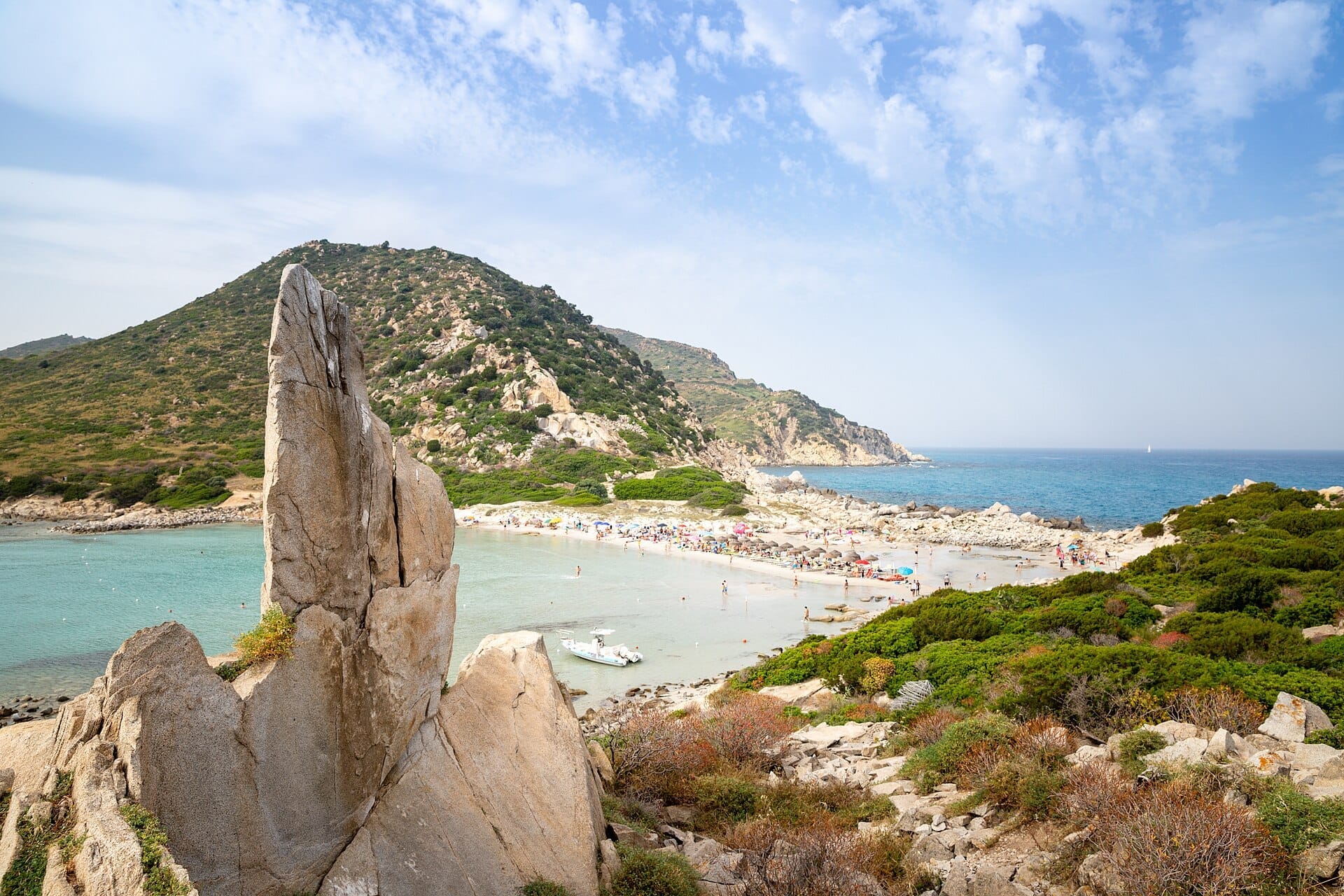
The beach itself is small by Sardinian standards: roughly 100 metres of medium-fine pale sand, curved slightly between two granite headlands. The promontory to the north, the actual Punta Molentis, gives the place its shape and its shelter. On the landward side, low Mediterranean scrub — juniper, cistus, mastic — keeps the backdrop looking raw and uncultivated. There are no hotel towers visible from the waterline.
The name Punta Molentis comes from the Sardinian "su molenti," meaning donkey. Donkeys once hauled granite down from the small quarry at the tip of the promontory, and the quarry's cut stone and rusted fittings are still visible for anyone who walks the headland path. It is a minor historical detail, but it gives the place a layer of character that purely scenic beaches tend to lack.
⚠️ What to skip
Parking can be booked online in advance during summer through the Villasimius municipal booking portal, and access is regulated by a daily quota. Turning up without a reservation on a July or August morning frequently means being turned away. Book at least a week ahead in peak season.
The Water and the Seabed
The bay sits inside the Capo Carbonara Marine Protected Area, which is also part of the Natura 2000 network under the designation "Isola dei Cavoli, Serpentara, Punta Molentis e Campulongu." That status has real practical consequences for the water quality. Motorised boats are regulated within the area, there is no heavy maritime traffic nearby, and the seabed retains patches of Posidonia oceanica seagrass meadows, which are a reliable indicator of healthy coastal water.
The shallow entry is gentle enough for children and confident enough for snorkellers. The seabed transitions from pale sand to rock and seagrass within a short swim, and visibility on a calm morning can stretch several metres down. The colour of the water shifts from near-white in the shallows to a deep turquoise further out, a gradient that has made this bay popular with photographers who shoot from the headland above.
For anyone planning to combine beach days with underwater exploration, Punta Molentis pairs well with the broader snorkelling and diving options along the Sardinian coast. The protected marine zone here is one of the more accessible entry points into that world without specialist equipment.
Tickets & tours
Hand-picked options from our booking partner. Prices are indicative; availability and final rates are confirmed when you complete your booking.
Vineyard Guided Tour and 7 Wine Tasting in Palau
From 84 €Instant confirmationFree cancellationFull-Day Sailboat Tour in La Maddalena Archipelago from Cannigione
From 112 €Instant confirmationFree cancellationHiking excursion to the Devil's Saddle
From 35 €Instant confirmationFree cancellationExcursion to the Archaeological site of Nora
From 70 €Instant confirmationFree cancellation
How the Experience Changes Through the Day
Early morning, before 9am, is when Punta Molentis is at its most atmospheric. The light comes in low from the east and catches the granite outcrops in warm tones. The parking area is quiet, the path through the scrub smells of cistus and dried grass, and the beach itself holds only a fraction of the day's capacity. The water at this hour is often glassy, the surface unmarked by wind or boat wash.
By late morning the atmosphere shifts. Families arrive with cool boxes and beach tents. The small refreshment point and restaurant that operate in season start serving, and the sound of the sea competes with conversation. It does not feel overrun the way an unregulated beach might, but the solitude is gone. Midday in July and August brings real heat — temperatures regularly exceed 30°C in this southeastern corner of Sardinia — and the beach fills to close to its permitted limit.
Late afternoon, after around 4pm, is a second window worth knowing about. Day-trippers with children tend to leave first. The light improves again for photography, the wind sometimes picks up slightly to take the edge off the heat, and the water has been warming all day, making it comfortable for swimming well into the evening. Access to the managed beach services is generally limited to daytime hours; rules on evening access and closing times should be checked locally before visiting.
💡 Local tip
The headland walk around Punta Molentis takes 20–30 minutes and gives clear views down onto the bay and out to the islands of Cavoli and Serpentara. Go in the morning while the light favours the water. Wear closed shoes — the granite surface is uneven and some sections are steep.
Getting There and the Last Kilometre
Punta Molentis is reached via the scenic coastal road that runs between Villasimius and Costa Rei, one of the more attractive drives in southeastern Sardinia. The road passes several viewpoints overlooking the protected marine area before a signed turn leads to the large paid parking area. Cars, motorbikes, and bicycles all have separate fees; the parking area is functional rather than scenic, a cleared gravel space in the scrub.
From the parking area, the beach is reached on foot along a dirt track. The surface is uneven and there is no shade for most of the route. In July and August, that walk in full midday sun with a loaded beach bag is a genuine exertion. Wear shoes rather than flip-flops, carry water, and keep this in mind before bringing very young children or anyone with mobility limitations. The track is not accessible for wheelchairs or pushchairs in any practical sense, and there is no official accessible alternative route. Visitors with specific mobility needs should contact the Villasimius tourism office directly.
The alternative is arriving by boat. Boat excursions from Villasimius harbour operate in the marine protected area and some itineraries include a stop at Punta Molentis among other beaches. This avoids the parking and walking logistics entirely and adds a different perspective on the bay, though it also means surrendering some control over timing and duration.
Villasimius itself, about 5–6km by road, is worth factoring into your day. It is a small resort town with good restaurants and a relaxed pace. See the full area overview in the Villasimius and Costa Rei travel guide for context on where to eat, stay, and what else to combine with a visit.
The Protected Area Context
Understanding why Punta Molentis looks the way it does requires some background on the Capo Carbonara Marine Protected Area. Established to protect the marine and coastal ecosystems of the southeastern tip of Sardinia, the area encompasses the rocky headland of Capo Carbonara, the islands of Cavoli and Serpentara, and the coastal strip that includes Punta Molentis. The Natura 2000 designation adds a layer of European-level habitat protection.
The visitor cap and the use of advance booking systems are direct outcomes of that protected status and related management choices. They exist not as administrative inconveniences but as active conservation measures. The beach's condition — the clarity of the water, the intact Posidonia meadows, the absence of permanent commercial structures crowding the shoreline — is not accidental. It is the result of managed access over time. This is worth keeping in mind when the booking system feels frustrating.
The broader southeast Sardinian coastline, including the beaches at Porto Giunco and the stretch toward Costa Rei, operates within a similar logic of protected coastal land meeting tourist demand. Each beach has its own rules and character.
Photography, Conditions, and Practical Details
The most photographed view of Punta Molentis is from the headland above the beach, looking back across the bay with the islands of Cavoli and Serpentara in the background. Achieving this requires the headland walk mentioned above. The best light for this shot falls in the morning, when the sun is behind the photographer and the water colour is at its most saturated. Early June and late September offer this light with fewer people in the frame.
Conditions for photography and swimming are most reliable from late May through early October. The sea is generally calm inside the bay, though the levante wind from the east can occasionally roughen the surface in the afternoon. Autumn storms do occasionally arrive from October onward, and outside of the managed summer season the beach reverts to a wilder state with no services operating.
Facilities on the beach in season are deliberately limited: a refreshment kiosk, a small restaurant, basic toilets. There are no sunlounger rental operations on the scale found at commercial Sardinian beaches. Visitors bring their own equipment. The beach is divided into a free section and an area with paid service concessions in season; verify the current setup via the official Villasimius tourism site before visiting, as these arrangements can change year to year.
ℹ️ Good to know
The shoulder months of May, early June, and September offer the best combination of decent swimming temperatures, manageable crowds, and lower parking and accommodation costs. The mandatory visitor cap means the beach is never technically empty in summer, but September mornings come close to the quiet experience that peak-season visitors are chasing.
Who This Beach Is Not For
Punta Molentis asks more of visitors than most Italian beach destinations. The planning required, the advance booking, the parking fees, the one-kilometre walk on an uneven path, and the limited onsite services all add friction. Travelers who want to turn up spontaneously, rent sunloungers directly from a beach attendant, and access a full beach bar will find that experience at other Villasimius beaches without the logistical overhead.
The same southeastern coastline offers easier options. Spiaggia di Villasimius is more accessible and has fuller services. Costa Rei beach has the long open expanse that suits families who need space to spread out. Punta Molentis makes most sense for visitors who have done their research, booked ahead, and specifically want the combination of protected water and low-key surroundings.
Insider Tips
- Book your parking slot through the official Villasimius municipal portal and check current instructions there about any linked access or quota systems before you go.
- Arrive as early in the morning as possible if you are visiting in August. The walk from the parking area takes around 15–20 minutes, and the beach fills toward its 500-person cap faster than most visitors expect on a clear high-season day.
- The headland path that circles Punta Molentis itself is separate from the main beach access. You can walk part of the promontory without officially entering the beach zone, which is useful if you arrive and the cap is already reached. The views from above are arguably better than from the sand.
- Bring all your own shade and food. The onsite refreshment facilities are basic and lines form quickly in high season. A good cool box, a beach umbrella, and your own lunch makes the day significantly more comfortable.
- The boat approach from Villasimius harbour gives you a view of both Punta Molentis and the islands of Cavoli and Serpentara in a single outing. If you are visiting for the first time and the logistics of driving and parking feel complicated, a guided boat excursion is a reasonable first experience of the area.
Who Is Spiaggia di Punta Molentis For?
- Snorkellers and swimmers who want clear, protected water over convenience
- Couples looking for a scenic, lower-density beach without mass-tourism infrastructure
- Photographers who want the headland viewpoint and early morning light
- Travelers willing to plan ahead in exchange for a more intact natural setting
- Day-trippers from Villasimius combining a beach morning with lunch in town
Nearby Attractions
Other things to see while in Villasimius & Costa Rei:
- Porto Giunco Beach (Villasimius)
Porto Giunco is approximately 2 kilometres of fine white sand on Sardinia's southeast tip, framed by a flamingo lagoon on one side and the Capo Carbonara Marine Protected Area on the other. It combines exceptional natural scenery with easy access from Cagliari, making it one of the most rewarding beach days in the south of the island.
- Spiaggia di Costa Rei
Spiaggia di Costa Rei is a sweeping arc of fine white sand along Sardinia's southeastern coast, running roughly 8 to 10 kilometres through the locality of Costa Rei, a seaside fraction of the municipality of Muravera. The water is shallow, clear, and calm, making it one of the most family-accessible beaches on the island. Unlike the heavily marketed northern coasts, this stretch rewards visitors who make the hour-long drive from Cagliari with space, quiet, and impressive scenery.
- Spiaggia di Simius (Villasimius)
Spiaggia di Simius (Simius Beach) sits just southeast of Villasimius in Sardinia's sun-drenched southeast corner, stretching more than a kilometre of fine white sand along shallow turquoise water. Free to access and open year-round, it rewards visitors who plan around the crowds with some of the clearest Mediterranean swimming on the island.