Porto City Hall (Câmara Municipal do Porto): The Monument at the Top of Aliados
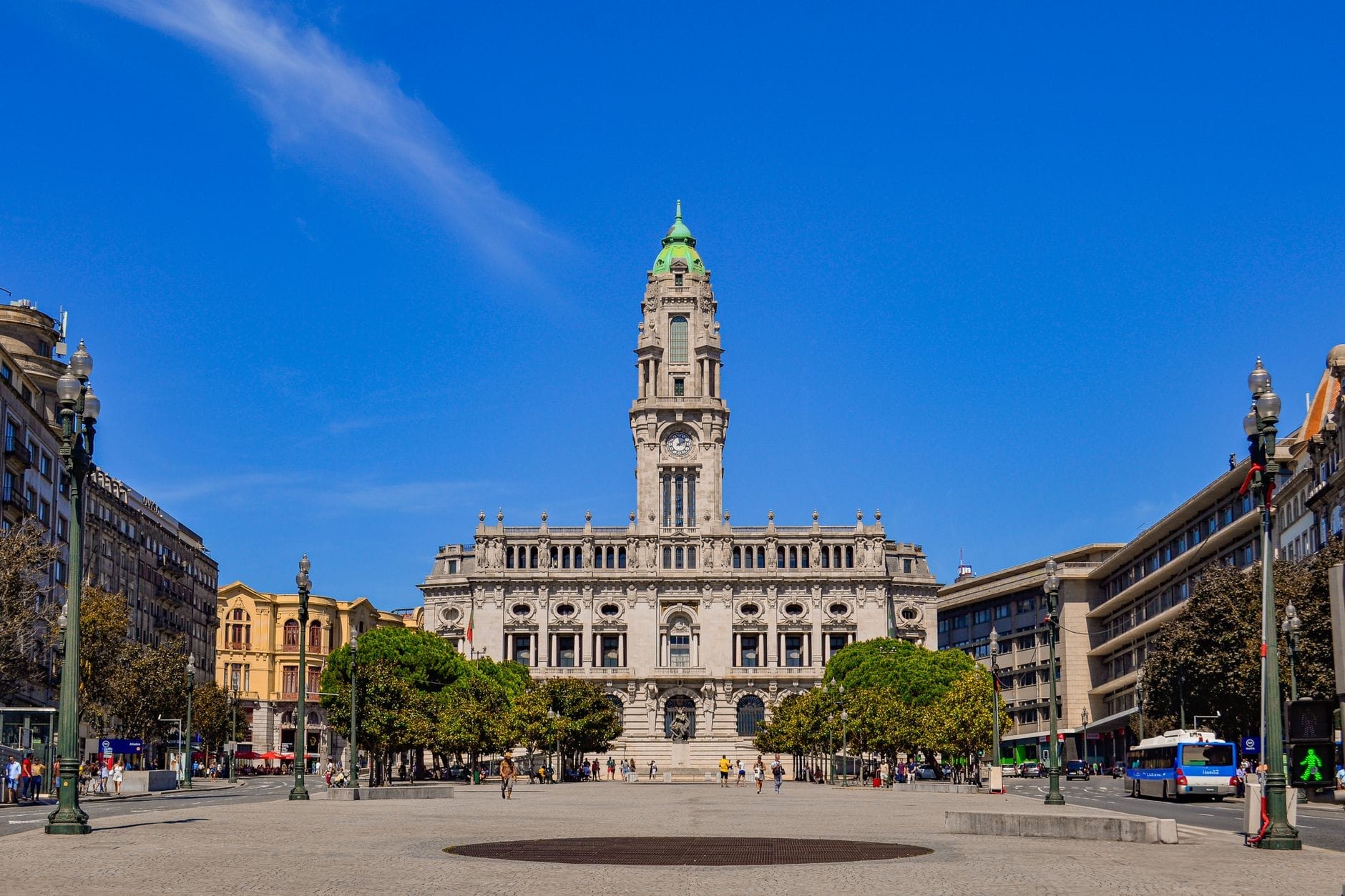
Porto City Hall, officially the Câmara Municipal do Porto or Paços do Concelho, anchors the northern end of Avenida dos Aliados with its imposing Beaux-Arts facade and 70-metre clock tower. Construction ran from 1920 to 1957, and today the building serves as both an active seat of local government and one of Porto's most photographed landmarks.
Quick Facts
- Location
- Praça General Humberto Delgado, 4000-407 Porto — top of Avenida dos Aliados, Baixa
- Getting There
- Metro: Aliados station (Line D, yellow line) — directly on the avenue; Trindade interchange a short walk north
- Time Needed
- 15–30 min for exterior and square; longer if attending an event or organized guided visit
- Cost
- Free to view from outside; interior access is limited to civic services, events, or organized tours — verify current conditions at cm-porto.pt
- Best for
- Architecture photography, understanding Porto's civic identity, orientation walks through central Baixa
- Official website
- www.cm-porto.pt
What Porto City Hall Actually Is
The Câmara Municipal do Porto, known in English as Porto City Hall or the Porto Municipal Chamber, is the seat of Porto's elected local government. It is not a museum, not a palace open to the public on regular schedules, and not a viewpoint tower you can climb. What it is, unambiguously, is one of the most architecturally significant civic buildings in Portugal, and the visual full stop at the northern end of Porto's grandest boulevard.
The building dominates Praça General Humberto Delgado, the broad square where Avenida dos Aliados terminates. Its Beaux-Arts stone facade, symmetrical wings, and approximately 70-metre central clock tower create an unmistakable silhouette that anchors the entire urban composition of central Porto. Tourists who wander up the avenue almost always arrive here, often without having planned to — which says a great deal about the building's gravitational pull on the city's layout.
ℹ️ Good to know
Interior access: Porto City Hall is a functioning municipal building. Public entry is generally limited to civic business, organized guided tours, or special civic events. Do not rely on walking in to explore the interior — confirm any visit options directly at cm-porto.pt before you arrive.
A Building Decades in the Making: The Architecture and History
Construction of the current building began in 1920, designed by architect António Correia da Silva. The project was ambitious in scale and slow in execution: the building was not fully completed until 1957, meaning it took 37 years from groundbreaking to finished state. That span crosses some of the most turbulent decades in Portuguese history, including the First Republic, the transition to the Estado Novo, and the mid-century period of national reconstruction. The finished building reflects a formal, monumental classicism that was common to major civic institutions of that era across southern Europe.
The clock tower, rising roughly 70 metres from street level, is the defining element. Its bells are considered a civic symbol by Porto residents — the kind of sound that Portuenses associate with the rhythms of daily life in the city centre. The tower's scale is best appreciated from the middle of Avenida dos Aliados itself, where the entire avenue acts as a framing device, drawing the eye upward to the belfry against the sky.
Standing in front of the main entrance, at ground level in the square, is a statue of the poet and playwright Almeida Garrett (1799–1854), a 1954 work by sculptor Barata Feyo. Garrett is one of the towering figures of Portuguese Romanticism, born in Porto, and his presence here is a deliberate civic statement connecting the city's identity to its literary heritage. If you walk down Avenida dos Aliados from the City Hall steps, you pass through what was designed as one unified monumental composition, with symmetrical banking palaces and institutional buildings lining both sides of the central promenade.
Tickets & tours
Hand-picked options from our booking partner. Prices are indicative; availability and final rates are confirmed when you complete your booking.
Escape Tour self-guided, interactive city challenge in Porto
From 50 €Instant confirmationEscape Tour self-guided, interactive city challenge in Porto
From 30 €Instant confirmationEscape Tour self-guided, interactive city challenge in Porto
From 50 €Instant confirmationPeneda Geres park full-day tour from Porto
From 100 €Instant confirmationFree cancellation
The Square at Different Times of Day
The square in front of Porto City Hall reads very differently depending on the hour. Early in the morning, before 9 am, the pavement is largely empty and the stone facade catches whatever light is coming in from the east. The contrast between the pale limestone-coloured exterior and a blue Porto sky — when the weather cooperates — makes this the best moment for photography. The reflections on the polished granite paving slabs, still damp from overnight moisture in the wetter months, add an extra layer of depth to wide-angle shots.
By mid-morning and through the lunch hour, the square fills with commuters connecting between metro lines, office workers from the surrounding financial district, and tourists who have followed the avenue uphill from Aliados station. Street vendors sometimes operate on the fringes. The fountain in the square becomes a meeting point. The noise level is significant: tram sounds, metro escalators, and the general soundtrack of central Porto commerce fill the air. If you want a quiet moment with the building, mornings before 9 am or evenings after 7 pm are the most rewarding.
On weekends and during Porto's civic festivals, the square transforms into the city's de facto gathering point. The São João Festival, Porto's major midsummer celebration every June, uses this square and the length of the avenue as a primary gathering zone. Porto City Hall itself is sometimes illuminated for national holidays and civic events, and the clock tower takes on a different, more theatrical quality when lit at night.
💡 Local tip
Best photography angle: Stand at the southern end of the central promenade on Avenida dos Aliados and shoot northward. The symmetry of the avenue's flanking buildings draws the eye straight to the clock tower. A wide-angle lens or phone in landscape mode captures the full composition. For close facade detail, walk directly to the square and shoot upward from the base of the Almeida Garrett statue.
Getting There and the Surrounding Area
Porto City Hall sits at the top of Avenida dos Aliados in the Baixa district, Porto's central downtown. The Aliados metro station (Line D, yellow) deposits you directly onto the avenue a short walk south of the square. The Trindade station, a major interchange for multiple lines, is a few minutes' walk north. If you are arriving by bus or on foot from São Bento Railway Station, the City Hall is a direct uphill walk of under ten minutes through the heart of Baixa.
The immediate neighbourhood around the City Hall is Porto's most institutional quarter: banks, government offices, and formal commercial premises occupy the ground floors of the buildings lining the avenue. A few blocks to the east, Mercado do Bolhão offers a completely different register — noisy, sensory, and market-chaotic. A few blocks to the west, you reach the shopping stretch of Rua de Santa Catarina, Porto's main pedestrian retail street.
What You Can Realistically Experience as a Visitor
To be direct: Porto City Hall is primarily an exterior attraction for tourists. The building is an active municipal seat, and drop-in interior tourism is not the standard mode of visiting. The civic rooms inside, which include formal reception halls decorated to a level appropriate to the building's institutional status, are not on a standard public tour circuit in the way that a palace or museum would be. Occasional guided visits are organized, but these need to be confirmed with the municipality in advance.
This does not diminish the experience. The facade itself, the clock tower, the square, and the relationship to the broader Aliados composition together constitute a genuinely impressive piece of urban architecture. Most visitors spend 15 to 30 minutes here: walking the perimeter of the building, examining the main entrance portal, standing in front of the Almeida Garrett statue, and taking in the view back down the avenue. That is enough to understand why this building matters to the city.
⚠️ What to skip
Who might be disappointed: If you are expecting to walk inside and explore decorated civic halls or climb the clock tower, you will likely find the experience falls short of expectations. Interior access is not guaranteed for casual visitors. This is better understood as an architecture and public space destination than an interior attraction.
Porto City Hall in the Context of the City's Identity
Porto carries the ceremonial official style "Ancient, Very Noble, Ever Loyal and Undefeated City of Porto," and the City Hall is perhaps the single building that most concretely embodies that civic self-image. While churches like the Clérigos Church and the Porto Cathedral represent the city's religious heritage, the Câmara Municipal represents its secular, civic ambition: the conviction, expressed in stone and height and formal symmetry, that Porto is a serious, self-governing city with its own character distinct from Lisbon.
That sense of civic pride runs through the urban fabric of Baixa as a whole. The Aliados avenue was conceived as Porto's answer to the grand European boulevard, and the City Hall was always intended to be its terminus and focal point. Understanding this helps make sense of the Baixa district more broadly: it is not a historic quarter in the organic, medieval sense of Ribeira, but a designed civic statement from the early 20th century, meant to project modernity and institutional weight.
The 35-year construction gap between 1920 and 1955 is itself a piece of history. The Portugal that started the building and the Portugal that finished it were very different countries. The final completed form, with its restrained formal classicism, reflects mid-century Portuguese official taste rather than the early republican ambitions that launched the project. Standing in front of it, knowing that detail, adds a layer to what is otherwise easy to read as simply a grand government building.
Insider Tips
- The very best time to photograph the facade is on a clear morning between 8 and 9 am, when the light falls directly on the stone and the square is nearly empty. By 10 am, tour groups and commuters fill the frame.
- Stand at the midpoint of the Avenida dos Aliados promenade — not at the square itself — to see the full composition: the clock tower anchoring the avenue's perspective line is the intended view, and it only works from a distance.
- Check the municipality's website (cm-porto.pt) before your trip if you want any chance of an interior visit. Organized civic tours are occasionally offered, but they are not walk-in and availability changes.
- The square doubles as Porto's main civic gathering space during public events. If you are visiting during the São João Festival in June, expect the entire area around City Hall to be at the centre of the celebrations — atmospheric, but extremely crowded.
- The Almeida Garrett statue at the base of the building is easy to walk past without noticing who it represents. Garrett was born in Porto and is considered one of the founders of Portuguese Romanticism in literature and theatre — worth a moment of acknowledgment.
Who Is Porto City Hall For?
- Architecture enthusiasts who want to understand Porto's 20th-century civic ambitions in stone
- Photographers looking for the classic Aliados composition with the clock tower as the focal point
- First-time visitors using the building as a visual orientation anchor for exploring central Porto
- Travelers interested in civic and political history who want to locate Porto's institutional centre
- Anyone in Porto during a public holiday or the São João Festival, when the square becomes the city's main gathering stage
Nearby Attractions
Other things to see while in Baixa:
- Avenida dos Aliados
Avenida dos Aliados is the ceremonial spine of central Porto, a wide early-20th-century boulevard stretching from Praça da Liberdade to Porto City Hall. Free to visit at any hour, it serves as Porto's civic stage, commercial main street, and the most direct introduction to the city's architectural ambitions.
- Capela das Almas
Standing on Porto's main shopping street, the Capela das Almas is one of the most photographed facades in the city. Its nearly 16,000 hand-painted blue-and-white azulejo tiles tell stories of saints across 360 square metres of exterior wall. Entry is free, and it takes less than 30 minutes to absorb properly.
- Clérigos Church
Rising 75 metres above the rooftops of Baixa, Clérigos Tower is the defining silhouette of the Porto skyline. The complex combines a beautifully preserved Baroque church, a small museum, and one of the city's most rewarding panoramic viewpoints, all within a few minutes' walk of the city's main commercial streets.
- Clérigos Tower
Standing 75 metres above Porto's rooftops, the Torre dos Clérigos is the tallest campanile in Portugal and the city's most instantly recognisable silhouette. Built between 1754 and 1763 to a design by Italian-born architect Nicolau Nasoni, it rewards those willing to climb its 200-plus steps with a panorama that stretches from the Douro river to the Atlantic. This page covers what the experience actually delivers, how crowds behave at different times of day, and everything you need to plan your visit.