Porto Bridge Climb: Walking the Arch of the Arrábida Bridge
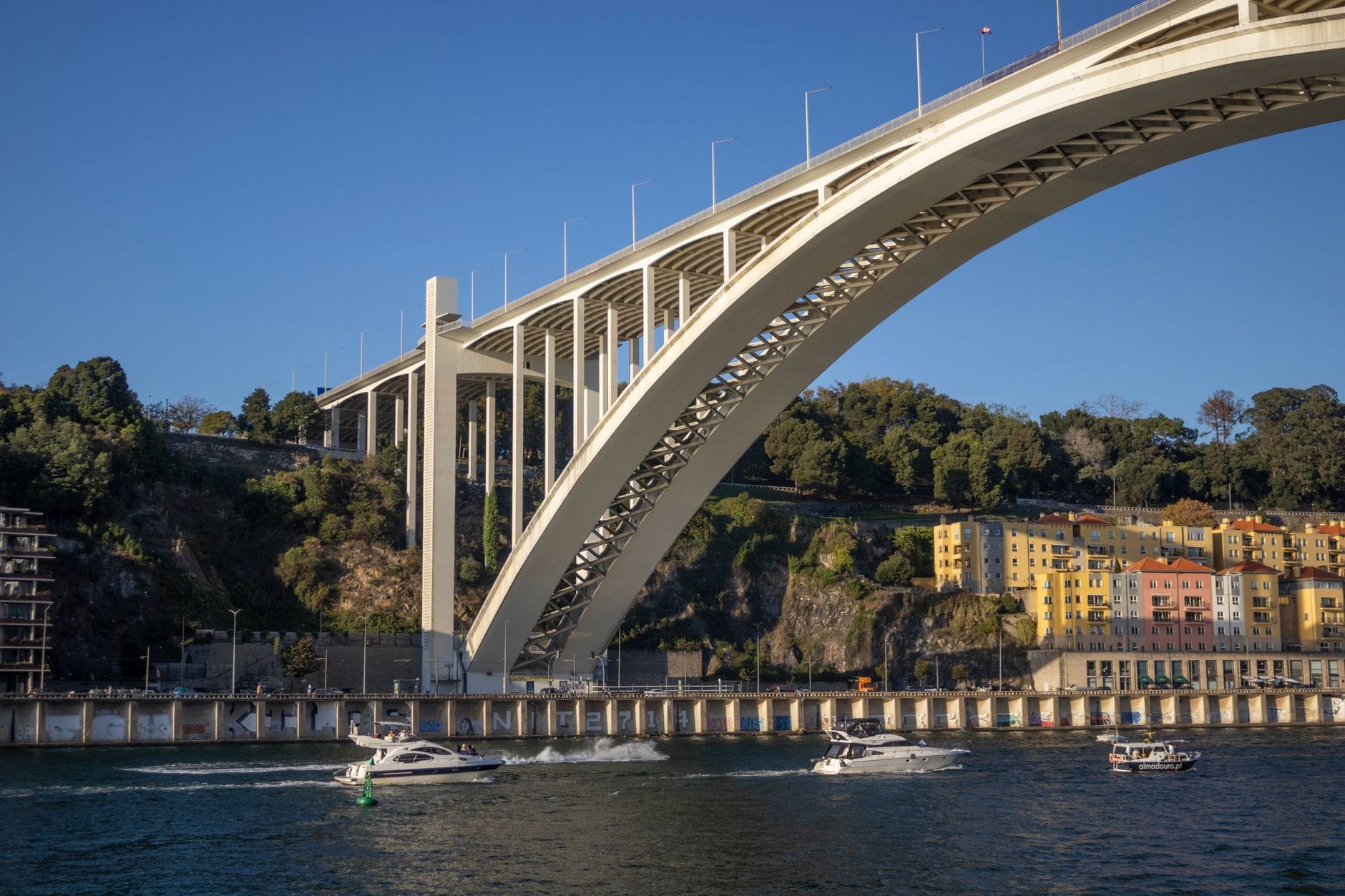
The Porto Bridge Climb takes you along the concrete arch of the Ponte da Arrábida, 65 metres above the Douro River. Once the world's largest concrete arch when it opened in 1963, the structure now offers one of the most unusual vantage points in northern Portugal. This guide covers everything you need to know before booking.
Quick Facts
- Location
- Rua do Ouro 680, Porto — north bank of the Douro, ~50m west of the Arrábida Bridge
- Getting There
- Tram line 1 and Bus 500 — both stop at 'Ponte Arrábida'; ~25 min walk from Ribeira
- Time Needed
- 1–1.5 hours including check-in, safety briefing, and the climb itself
- Cost
- Around €20 standard / €14 for Portuguese residents (verify current prices at portobridgeclimb.com)
- Best for
- Heights enthusiasts, architecture lovers, and anyone who wants an aerial perspective of the Douro valley
- Official website
- www.portobridgeclimb.com
What the Porto Bridge Climb Actually Is
The Porto Bridge Climb is a guided walk along the outer arch of the Ponte da Arrábida, the graceful concrete bridge that spans the Douro River at the western edge of the city. You are not on the road deck. You ascend via 262 steps on the interior of the arch itself, emerging onto an 8-metre-wide walkway that curves over the river at roughly 65 metres above the water. Every participant is clipped to a continuous lifeline for the duration of the tour.
This is not a passive observation deck. The approach is active: you climb, you move along a curved surface with the wind off the Atlantic in your face, and the Douro spreads out in every direction below you. The experience is closer in spirit to a bridge climb in Sydney or Auckland than to a conventional miradouro.
ℹ️ Good to know
Minimum age is 12 years. Groups are capped at 13 participants plus one guide, so slots fill up, especially on weekends. Book online in advance and pay on arrival at the reception.
The Arrábida Bridge: Engineering History Worth Knowing
The Ponte da Arrábida was inaugurated in 1963 and designed by engineer Edgar Cardoso. At its opening, it held the record for the largest concrete arch in the world, a title that made it a landmark of mid-20th-century engineering ambition. The arch spans the Douro at a point where the river is broad and the banks are high, which is precisely what makes the views from the top so far-reaching.
For decades after its inauguration, the arch was inaccessible to the public. Porto Bridge Climb opened the route to visitors in 2016, converting the interior of the arch into a safe, guided attraction without altering the bridge's historic structure. Walking on it today, you are moving through a piece of civil engineering that was genuinely groundbreaking in its era, not just a scenic add-on.
The Arrábida is one of several bridges that define Porto's skyline. For a ground-level overview of all of them, the Porto bridges guide covers each crossing in context, from the iconic Dom Luís I to the modern Infante bridge further upstream.
Tickets & tours
Hand-picked options from our booking partner. Prices are indicative; availability and final rates are confirmed when you complete your booking.
Porto's six bridges speedboat tour along the Douro River
From 45 €Instant confirmationFree cancellationPorto sightseeing by tuk-tuk and six bridges cruise on the Douro River
From 51 €Instant confirmationPorto pass for Six Bridges Cruise and city museums
From 64 €Instant confirmation516 Arouca Bridge and Paiva Walkways Day Trip from Porto
From 120 €Instant confirmationFree cancellation
The Climb: Step by Step
You arrive at a granite staircase on the Porto bank of the Douro, roughly 50 metres west of the bridge. After checking in at the reception building, the guide runs a safety briefing and fits everyone with a harness. The lifeline is a clip-on system that runs continuously along a fixed rail, so you are always attached without having to think about it.
The 262-step ascent runs inside the arch, protected from wind and with handrails throughout. Once you reach the crown, you walk along the top of the arch on the open-air walkway. The surface is concrete, the width is generous enough that it does not feel precarious, but the drop is real and visible. At 65 metres above the river, the Douro looks slow and glittering below, and on a clear day you can see the river mouth at Foz and the Atlantic beyond it.
The guide narrates the bridge's history and points out landmarks during the top section. The descent uses the same internal staircase. The full experience, from briefing to exit, typically runs between one hour and ninety minutes depending on group size and pace.
💡 Local tip
Wear closed-toe shoes with a firm sole. Sandals and flip-flops are not suitable for the staircase. Bring a light layer: the arch top is exposed to Atlantic wind regardless of what the temperature is at street level.
Views from the Top: What You Can See
The panorama from the Arrábida arch is structurally different from Porto's hilltop viewpoints. From the miradouros in Vitória or Bonfim, you look across the city's rooftops toward the river. From the bridge, you look along the river itself, with the city rising on both banks above you and the Atlantic horizon visible to the west.
To the east, on a clear day, you can trace the Douro gorge inland, where the valley narrows and the landscape shifts toward the wine country of the Douro valley. To the west, the river opens into the estuary and the beaches of Foz come into view. Below, rabelo boats are sometimes visible on the water, and the Gaia bank shows its familiar run of port wine lodges on the hillside opposite.
If you are planning to explore the Gaia side after your climb, the area around the Cais de Gaia is a short drive east along the river and pairs well with a port wine lodge visit in the afternoon.
Best Time to Visit and How Weather Affects the Experience
Tours run most days of the year, closing on 24 and 25 December and 1 January. Exact time slots vary by season and are published only through the online booking platform, so checking availability before you plan your day is essential. The experience is weather-dependent in a meaningful way: on overcast days, visibility drops and the Atlantic horizon disappears. On rainy or very windy days, tours may be cancelled for safety reasons.
The clearest, calmest conditions in Porto tend to fall between May and early October. Morning slots in summer offer the sharpest light and the lowest wind, while late afternoon in September gives a warmer glow over the river. Avoid planning the climb as a non-negotiable activity if you are visiting in November or December, when Porto's oceanic climate delivers frequent overcast and rainy days.
For a fuller picture of when to come to the city, the best time to visit Porto guide breaks down weather patterns and crowd levels month by month.
⚠️ What to skip
Tours can be cancelled at short notice due to wind or rain. If you have a tight itinerary, do not schedule the climb as your only activity for a morning. Have a backup plan in the same area.
Getting There
The departure point is at Rua do Ouro 680, on the Porto bank of the Douro. From Ribeira, it is a flat, 25-minute walk west along the river road. The route passes through a quieter residential stretch, and the bridge comes into view well before you reach the access staircase.
By public transport, tram lines 1 and 18 and bus 500 all stop at 'Ponte Arrábida'. Tram Line 1 runs along the river and is a pleasant way to approach from the Ribeira direction. See the Porto Tram Line 1 page for route and frequency details. Tourist buses operated by Blue Bus (Helitours), Red Bus (Massarelos), and Yellow Bus (TramCar Museum) also stop nearby, with a five-minute walk to the entrance.
By car, parking on the riverside road can be limited during busy periods. Ride-hailing via Uber or Bolt is a practical option and drops you directly at the address. From Foz do Douro, the walk along the river takes around 32 minutes heading east.
Photography on the Arch
Cameras and phones are permitted during the climb. The top of the arch gives you a vantage point that no miradouro in Porto replicates: a central position over the river with clear sightlines in four directions. Wide-angle lenses or smartphone wide modes work well for capturing the curve of the arch itself and the scale of the drop below.
The challenge is wind. At 65 metres, even a modest breeze can shake a long lens or make it difficult to steady your hands. A lens strap and a firm two-handed grip are advisable. In bright midday light, the concrete surface reflects glare; morning or late afternoon slots tend to produce more usable light for landscape shots. Selfie sticks are not recommended given the harness setup and the wind conditions.
Accessibility and Who Should Skip This
The climb is not accessible to wheelchair users. The entry route requires an outdoor granite staircase, and no step-free alternative is offered. The minimum age is 12 years. There is no published upper age limit, but the 262-step ascent requires reasonable physical mobility, and participants with severe fear of heights, heart conditions, or limited mobility should consult the official FAQ before booking.
If you are visiting Porto primarily for its historic architecture, azulejo tiles, and riverfront atmosphere rather than adventure activities, this climb may not be the best use of two hours. The city's hilltop viewpoints offer Douro panoramas without the physical and financial commitment. That said, the engineering story of the Arrábida Bridge is genuinely interesting, and the perspective from the arch cannot be replicated from the ground.
For a quieter, free alternative with strong Douro views, the Miradouro da Vitória in the historic centre is a good comparison point.
Insider Tips
- Book your slot at least a day or two ahead during summer weekends. The group cap of 13 people means popular morning slots sell out faster than you might expect.
- Check the weather forecast the evening before. If Porto is forecasting strong coastal winds or sustained rain, contact Porto Bridge Climb directly to confirm whether your tour is likely to run rather than waiting to find out on the morning.
- The reception building is easy to miss on your first pass. Look for the granite staircase on the riverside, about 50 metres west of the bridge itself. If you reach the bridge pylons, you have gone slightly too far east.
- Portuguese residents qualify for a discounted rate. If you are visiting from elsewhere in Portugal, bring proof of address, as the discount is verified at the desk.
- Combine the climb with a walk along the Douro river road rather than heading straight back into central Porto. The stretch between Arrábida and Ribeira is flat, relatively uncrowded, and gives you a ground-level view of the riverbank that contrasts well with what you have just seen from 65 metres up.
Who Is Porto Bridge Climb For?
- Travellers with a specific interest in structural engineering or 20th-century architecture
- Outdoor and adventure-minded visitors who want something more physical than museum-hopping
- Photographers looking for an aerial river perspective that differs from standard Porto viewpoints
- Groups of friends or families with participants aged 12 and above who want a shared activity
- Return visitors to Porto who have already covered the city's main cultural sites and want a different angle on the landscape
Nearby Attractions
Other things to see while in Ribeira:
- Cais da Ribeira
Cais da Ribeira is Porto's historic riverside promenade along the north bank of the Douro, part of the UNESCO World Heritage-listed centre. Free to walk, lined with colourful buildings and boat tour kiosks, it is one of Portugal's most recognisable urban waterfronts.
- Casa do Infante
Casa do Infante stands on Rua da Alfândega in the heart of Porto's Ribeira district, occupying a site that has been central to the city's life since the Roman period. Built as a royal customs house in 1325 and later named for Prince Henry the Navigator, traditionally regarded as having been born here in 1394, it now operates as a unit of the Museu do Porto, housing archaeological remains and centuries of civic records beneath one roof.
- Dom Luís I Bridge
The Ponte Dom Luís I is a double-deck iron arch bridge spanning the Douro River between Porto's Ribeira quarter and Vila Nova de Gaia. Open 24 hours a day and free to cross on foot, it rewards visitors with sweeping river views from both its road-level walkway and its elevated metro deck, 45 metres above the water.
- Douro River Cruise
A Douro River cruise transforms Porto's skyline into a living panorama of medieval towers, port wine lodges, and six iron bridges. Whether you take a 50-minute sightseeing loop or a multi-day voyage into the Alto Douro Wine Region, the river gives you a perspective on Porto and its surroundings that no viewpoint on land can match.