Portal de los Dulces: Cartagena's Sweet Arcade Inside the Walled City
Portal de los Dulces is a colonial-era arcaded walkway beside Plaza de los Coches where women in traditional dress sell handmade Caribbean sweets from wooden trays. Free to enter and central to the historic district, it offers one of the most sensory and culturally grounded stops in Cartagena de Indias.
Quick Facts
- Location
- Cra. 5 #33-15, Centro Histórico, Cartagena de Indias, Bolívar, Colombia. Adjacent to Plaza de los Coches and steps from Torre del Reloj.
- Getting There
- Walk from Torre del Reloj (main city gate), a 2-minute stroll. Taxis and ride-hailing services drop at the gate. No metro in Cartagena; Transcaribe buses serve the broader center.
- Time Needed
- 20 to 45 minutes to browse and taste. Longer if you linger over coffee or pair it with Plaza de los Coches.
- Cost
- Free entry. Individual sweets typically cost less than 2 USD per piece. Budget 10,000–20,000 COP for a small selection.
- Best for
- Food lovers, families, first-time visitors to Cartagena, photographers, and anyone wanting a genuinely local cultural moment.
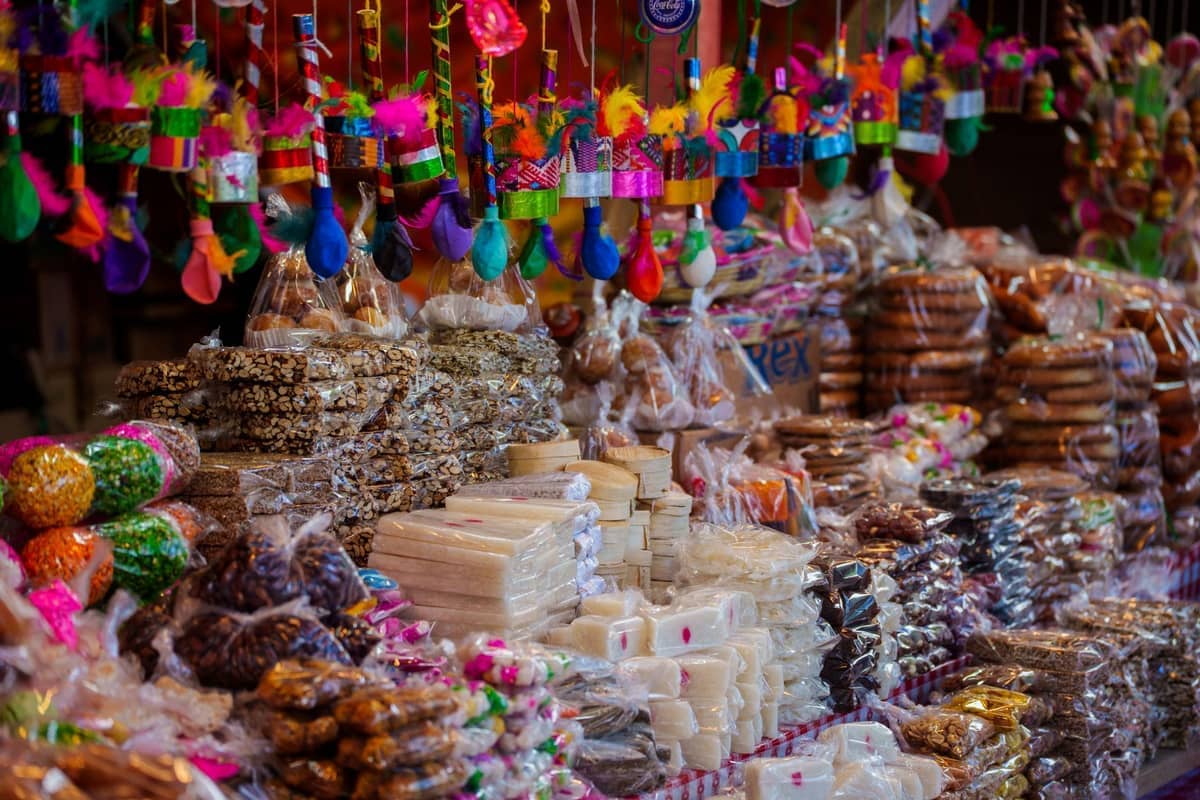
What Is Portal de los Dulces?
Portal de los Dulces is a covered arcade running along the inner face of the colonial portico that frames the western edge of Plaza de los Coches, in the heart of Cartagena's Centro Histórico. For generations, women known as palenqueras and traditional vendors have occupied the arched stalls here, selling handmade Caribbean sweets from wooden trays, wicker baskets, and glass cases lined with bright paper.
The arcade is not a shop or a museum. It is a public walkway lined with small, semi-permanent stalls, each run by an individual vendor who sets her own hours and stock. There is no entrance gate, no ticket, and no single authority governing the space. This informality is part of what makes it feel genuinely alive rather than staged for tourism.
What you find under the arches is a concentrated cross-section of coastal Colombian confectionery: cocadas in white, brown, and pink (shredded coconut bound with panela sugar), alegrías made from popped amaranth, caballitos crafted from tamarind paste, enyucados, mazamorras, and more. The sweets are made to recipes that predate independence, drawing on African, Indigenous, and Spanish culinary traditions layered across centuries of Caribbean trade.
💡 Local tip
Vendors welcome tasting before buying. It is entirely normal to try two or three pieces before committing. Point, smile, and hold up a finger — vendors are accustomed to language barriers and will respond in kind.
The Arcade Through the Day: How the Experience Shifts by Hour
The Portal changes character significantly depending on when you arrive. Early morning, before 9:00, the stalls are still being set up. Vendors arrange pyramids of coconut sweets on cloth-covered tables, the stone floor is cool, and the square behind you is quiet except for pigeons and the occasional street sweeper. The smell at this hour is clean and faintly sweet, like dried sugar and coconut oil warming in the Caribbean morning.
By mid-morning, roughly 10:00 to 12:00, the arcade reaches its most pleasant state. Stalls are fully stocked, vendors are relaxed, the light angles under the arches at a flattering angle, and foot traffic is manageable. This is the best window for unhurried browsing and photography. The chatter of negotiations, the clatter of Plaza de los Coches behind you, and the occasional call from a vendor competing for attention create a layered, ambient soundtrack that is distinctly Cartagena.
Afternoons between 14:00 and 17:00 bring tour groups and cruise-ship visitors, and the arcade becomes noticeably more crowded. Vendors are attentive but less patient during peak periods. The heat under the stone arches in the dry season (December through April) can feel intense after midday, with temperatures regularly reaching 30–32°C and humidity adding weight to the air. If you visit then, plan for shade and water nearby.
By early evening, around 18:00, many stalls begin closing. The sweet smell gives way to the savory aromas drifting from nearby food carts in Plaza de los Coches. The square lights up, the atmosphere shifts toward the social evening tempo of the old city, and Portal de los Dulces becomes more of a backdrop than a focal point. If your priority is the sweets, come before 17:00.
Tickets & tours
Hand-picked options from our booking partner. Prices are indicative; availability and final rates are confirmed when you complete your booking.
Totumo Volcano and lunch at a VIP hotel from Cartagena
From 34 €Instant confirmationFree cancellationCity tour of Cartagena with entry to San Felipe castle
From 25 €Instant confirmationFree cancellationSan Andres Islands pontoon tour through the inner bay
From 26 €Instant confirmationFree cancellationGlass-bottom boat tour to San Andres aquarium and mangroves
From 21 €Instant confirmationFree cancellation
Historical and Cultural Context
The arcade that houses Portal de los Dulces is part of the colonial portico system that defines several of Cartagena's main squares. Plaza de los Coches, the square immediately in front, was historically a major slave market within Cartagena’s role as a principal entry point for the transatlantic slave trade in the 16th and 17th centuries. The sweet-making traditions sold under these arches today are directly descended from culinary practices brought by enslaved Africans, many of whom came through the nearby port.
The connection between these sweets and Afro-Colombian heritage runs deep. Coconut-based confections, tamarind preparations, and panela-sweetened treats are all rooted in West and Central African food traditions that were adapted using Caribbean ingredients. For a fuller understanding of this cultural lineage, the Afro-Colombian culture guide for Cartagena provides essential context that elevates a casual tasting stop into something historically meaningful.
The arcade's architectural setting, stone arches built under Spanish colonial urban planning principles, dates broadly to the 17th and 18th centuries. The columns, worn smooth by centuries of touch, support vaulted ceilings that keep the vendors shaded and the sweets from melting in direct sun. The pairing of colonial infrastructure with Indigenous and African food culture is not incidental. It is a condensed version of Cartagena's entire history.
Practical Walkthrough: Navigating the Stalls
Portal de los Dulces runs roughly east to west along the arcaded wall adjacent to Plaza de los Coches. The square itself is framed by the iconic Torre del Reloj, Cartagena's main clock tower gate, which sits at the south end of the square and is the most common pedestrian entry point into the walled city. From the Torre del Reloj, the arcade is a two-minute walk straight ahead and left along the portico.
The stalls are arranged in a single row under the arches. Each vendor occupies a small, defined space and specializes in a particular set of products, though there is significant overlap in basic items like cocadas. Prices are typically quoted per piece or per small bag. Bargaining is not standard, but vendors will often offer a slight reduction if you buy in larger quantities. Prices for individual pieces generally fall well under 1,000 COP, making this one of the most affordable sensory experiences in the city.
The stall surfaces are stone or wood, stacked high with sweets and often decorated with hand-lettered signs in Spanish. Most vendors do not speak significant English, but transactions are simple enough that pointing and gesturing work well. Having small bills in Colombian pesos (COP) is useful, as vendors rarely have change for large denominations.
⚠️ What to skip
The stone paving under the arcade is uneven in places, original colonial stonework that has shifted over centuries. Wear closed-toe shoes or flat sandals with grip. High heels are genuinely impractical throughout the Centro Histórico, and this arcade is no exception.
Photography: What to Capture and When
Portal de los Dulces is one of the more photogenic spots in the walled city, but it rewards patience over wide-angle shots of the whole arcade. The real visual interest is at close range: the geometric arrangements of multicolored sweets on cloth-draped tables, the hands of a vendor portioning cocadas, the textures of tamarind paste against bright packaging, the deep shadows of the arches framing a woman in traditional dress.
Morning light from the east enters the arcade at a low angle between roughly 8:00 and 10:00, casting warm shadows across the stalls and illuminating the colors of the sweets without the harsh contrast of midday. For portrait photography, always ask permission first. Most vendors are willing, and some will pose deliberately once they understand what you want, though this may prompt a polite request for a small purchase. A single cocada in exchange for a portrait is a fair and respectful arrangement.
What to Pair With This Visit
Portal de los Dulces sits at the natural starting point for exploring the entire walled city. The Palacio de la Inquisición is a short walk east, and the Catedral Santa Catalina de Alejandría is visible from Plaza de Bolívar just beyond. Together, these three stops form a compact half-morning route that covers Cartagena's colonial-era commercial, judicial, and religious history within a walkable triangle.
If the sweets open an appetite for broader food culture, the Cartagena street food guide maps out vendors and markets across the city, from arepas de choclo near Getsemaní to fried fish at La Boquilla. Portal de los Dulces is a natural first chapter in that story, not the whole book.
Visitors who find the arcade too tourist-oriented, or who want a more local version of the same experience, should note that women carrying trays of the same traditional sweets circulate throughout the walled city and into Getsemaní throughout the day. The portal formalizes a trade that also happens spontaneously on nearly every corner of the old center.
Practical Assessment: What This Is and Is Not
Portal de los Dulces is not a destination you need to plan your day around. It takes twenty minutes to walk the full length of the arcade, sample a few sweets, and understand the range of what is sold. It will not absorb an afternoon. What it offers instead is a genuine sensory and cultural moment that is free, accessible, and located at the front door of the walled city.
Travelers who expect a food market in the European sense, with dozens of producers and artisan products, will find the Portal modest in scale. The same basic sweets appear at most stalls. The cultural value lies less in variety than in continuity: this trade has happened under these arches for generations, and the women selling here are carrying forward a craft with deep roots in the city's history.
People who are not interested in sweets, confectionery, or food culture may find twenty minutes here sufficient before moving on. That is entirely reasonable. It is not a landmark that demands extended time, and there is no pressure to buy. It is, however, one of the few places in the Centro Histórico where an everyday commercial exchange connects directly to the city's longer story.
Insider Tips
- Go on a weekday morning before 11:00. Tour groups from cruise ships typically reach the walled city between midday and 15:00, which is when the arcade gets crowded and vendors become less inclined to chat or offer tastings.
- Cocadas come in three standard varieties: white (plain coconut and sugar), brown (made with panela, Colombia's unrefined cane sugar), and pink (tinted with food coloring). The brown panela version has the most complex flavor and is the closest to the original recipe.
- Carry exact change or small bills in COP. Vendors do not always have change for 50,000 or 20,000 COP notes, especially early in the day before they have built up a cash float.
- The women in traditional dress selling sweets from head trays throughout the walled city are called palenqueras, from the Afro-Colombian community of San Basilio de Palenque. They typically sell the same products as the Portal stalls. Buying from a palenquera walking the streets supports that community directly.
- After buying sweets, step into Plaza de los Coches and look back at the arcade from the square. The full colonial portico with vendors under the arches is the image most often associated with the Portal in photography. You cannot get this angle from inside the arcade itself.
Who Is Portal de los Dulces For?
- First-time visitors to Cartagena who want a sensory introduction to the city's food culture within the first hour of arrival
- Families with children who respond well to colorful, sweet, affordable food experiences
- Photographers looking for close-range texture and portrait opportunities in natural colonial light
- Travelers with an interest in Afro-Colombian heritage and food traditions
- Anyone on a tight schedule who wants a culturally meaningful stop that takes under 30 minutes
Nearby Attractions
Other things to see while in Centro Histórico (Ciudad Amurallada):
- Cartagena City Walls (Murallas)
The Murallas de Cartagena de Indias are the best-preserved colonial defensive walls in the Americas, ringing the historic center with roughly 3 kilometers of coral-stone ramparts, cannons, and Caribbean sea views within an 11-kilometer defensive system overall. Entry is free, the walk takes 1 to 3 hours depending on your pace, and the experience changes dramatically depending on the time of day you show up.
- Catedral Santa Catalina de Alejandría
Standing at the east corner of Parque de Bolívar in Cartagena de Indias, the Catedral Basílica Metropolitana de Santa Catalina de Alejandría is one of the oldest episcopal sees in the Americas. Construction began in the 16th century, and the building remains the seat of the Archbishop of Cartagena de Indias today. Entry is free, the doors open daily, and the surrounding plaza makes this one of the most rewarding stops in the entire Centro Histórico.
- Iglesia de Santo Domingo
The Iglesia de Santo Domingo is widely considered the oldest surviving church in Cartagena de Indias, anchoring a plaza that doubles as one of the historic center's most lively gathering points. The building itself rewards close inspection, while the square around it offers a completely different experience depending on the hour you arrive.
- India Catalina Statue
Standing at the entrance to Cartagena de Indias, the bronze India Catalina Statue has marked the city's identity since 1974. Free, open around the clock, and loaded with historical weight, it is the first landmark many visitors encounter and the last symbol they remember.