Pontocho Alley: Kyoto's Lantern-Lit Dining Street
Pontocho Alley (先斗町通) is a 500-meter pedestrian lane running between Shijo-dori and Sanjo-dori, one block west of the Kamo River. By day it's a quiet corridor of wooden facades and paper lanterns. By night it becomes Kyoto's most concentrated dining experience, with restaurants, bars, and the occasional glimpse of a geiko slipping between doorways.
Quick Facts
- Location
- Pontocho-dori, Nakagyo-ku, Kyoto — between Shijo-dori and Sanjo-dori, one block west of the Kamo River
- Getting There
- Hankyu Kawaramachi Station (about 3 min walk) or Keihan Gion-Shijo Station (about 9–10 min walk)
- Time Needed
- 30 min to walk through; 2–3 hours if dining or exploring side lanes
- Cost
- Free to walk; dining costs vary widely by venue
- Best for
- Evening dining, atmosphere walks, Japanese food culture, couples, night photography
- Official website
- http://www.ponto-chou.com/
What Pontocho Alley Actually Is
Pontocho Alley, written in Japanese as 先斗町通 (Ponto-cho Dori), is a public pedestrian street in Nakagyo-ku, the central ward of Kyoto. It runs roughly 500 meters north to south, connecting Shijo-dori at its southern end to Sanjo-dori at its northern end, pressed between the commercial grid of downtown Kyoto and the western bank of the Kamo River. There is no gate, no ticket booth, no entrance ceremony. You simply turn off a main street and you are in it.
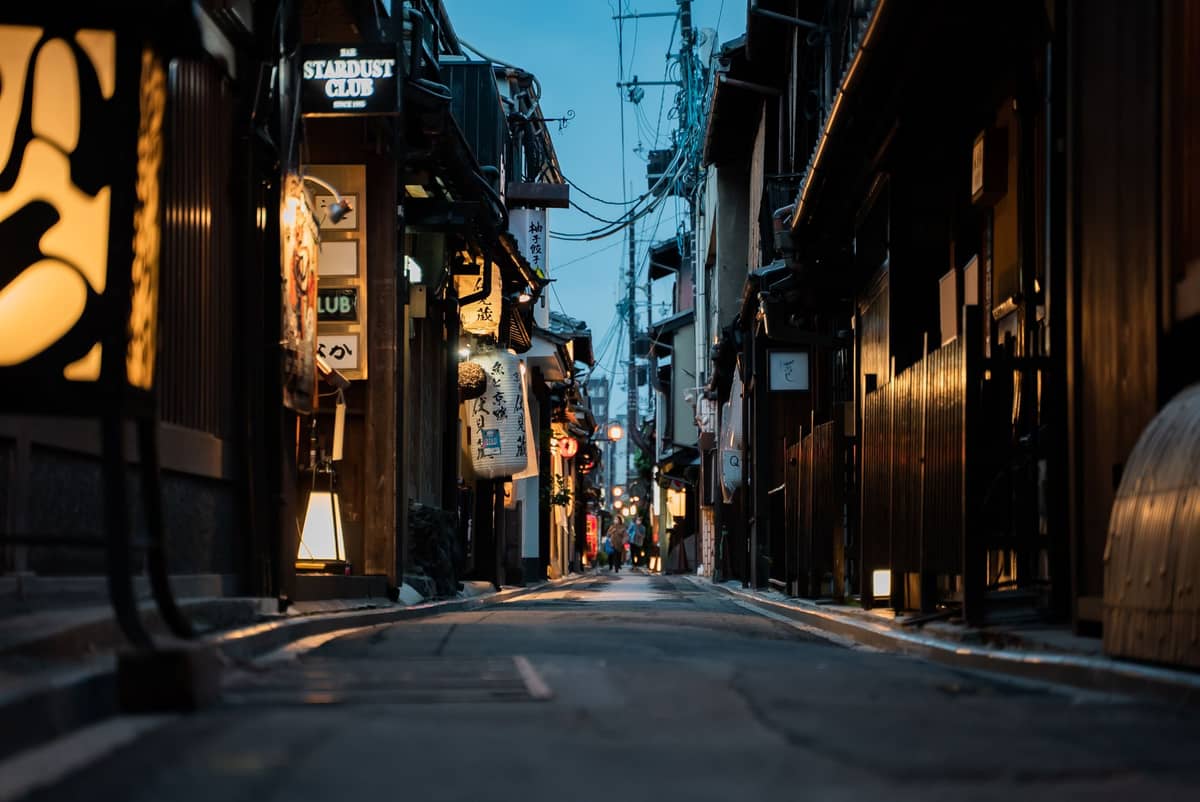
The alley itself is barely wide enough for four people to walk abreast comfortably. On both sides, two- and three-story wooden buildings rise with little setback, creating a corridor effect that concentrates sound, smell, and light. Paper lanterns hang at irregular intervals. Restaurant menus are displayed in glass cases or handwritten on wooden boards. On warm evenings, the smell of grilling fish and charcoal drifts through the lane in waves. This is not a reconstructed heritage zone — these are working restaurants and bars operating in buildings that have stood for generations.
ℹ️ Good to know
The alley is open 24 hours as a public street. Most restaurants and bars open around 17:00 and close around 23:00, though hours vary by establishment. Arriving before 18:00 gives you the best balance of atmosphere and table availability.
The Experience by Time of Day
During daylight hours, Pontocho is surprisingly understated. The wooden storefronts are shuttered or barely open, the lanterns are unlit, and the alley feels more functional than atmospheric — delivery workers, kitchen staff, and the occasional curious tourist share the narrow path. The architecture itself is the reward at this hour: the tight rows of machiya-style buildings, the precise placement of stone lanterns at doorsteps, the absence of modern signage compared to the commercial chaos of nearby Shijo-dori. If you want to photograph the alley without crowds obscuring the lines of the lane, early afternoon is the time.
The transformation begins around dusk. By 18:00, the lanterns glow amber and orange, restaurant doors open to release warmth and sound, and the density of pedestrians increases sharply. On weekends and during peak travel seasons — late March through early May and mid-October through late November — the alley can feel genuinely crowded, with foot traffic slowing to a shuffle near the busier mid-section. Even so, the crowd rarely feels as overwhelming as nearby tourist corridors, partly because the narrowness of the lane naturally limits how many people can be present at once.
Late at night, after 21:30, the character shifts again. The dinner crowds thin, the more casual bars take over, and the lane acquires a quieter, more local feel. If your goal is atmosphere over activity, the window between 19:00 and 21:00 on a weeknight offers the best combination.
Tickets & tours
Hand-picked options from our booking partner. Prices are indicative; availability and final rates are confirmed when you complete your booking.
Evening food tour in Kyoto Pontocho
From 130 €Instant confirmationFree cancellationKyoto Coast, Amanohashidate and Ine Bay 1-Day Trip from Osaka or Kyoto
From 46 €Instant confirmationFree cancellationKyoto Sanzen-in, Arashiyama and Bamboo Grove Full Day Tour
From 47 €Instant confirmationFree cancellationKyoto Arashiyama insider walking tour
From 66 €Instant confirmationFree cancellation
Historical and Cultural Context
Pontocho is one of Kyoto's designated hanamachi, the formal entertainment districts where geiko (Kyoto's term for geisha) and maiko (apprentice geiko) have trained and worked for centuries. The district developed along the Kamo River as a place of riverside entertainment during the Edo period, and its geography, wedged between the river and the commercial city, shaped its identity as a place slightly apart from ordinary urban life.
The district remains an active hanamachi today. Geiko and maiko do still move through Pontocho in the evenings on their way to ochaya (teahouses), and sightings are genuinely possible — though not guaranteed, and not something visitors should attempt to photograph intrusively. The behavior expectations around geiko interactions have become increasingly firm across all of Kyoto's hanamachi, and Pontocho is no exception. For a deeper look at this culture and how to engage with it respectfully, theKyoto geisha guide covers the context in detail.
The origin of the name Pontocho is debated. One common explanation links it to the Portuguese word 'ponto' (point or tip), possibly referencing the shape of the sandbar where the district sits between the Kamo and Takase rivers. Another ties it to a local family name. Neither etymology is definitively settled, but the Portuguese theory reflects the historical presence of foreign merchants in this part of Kyoto during the 16th and 17th centuries.
The Kawadoko Terraces: Riverside Dining in Summer
From roughly May 1 through September 30 each year, many Pontocho restaurants extend wooden platforms out over the Kamo River on their eastern sides. These are called kawadoko (or noryo-yuka), and they are one of Kyoto's most distinctive seasonal dining experiences. You sit a few meters above the water, with a direct view of the river and, on the far bank, the forested hills of Higashiyama in the distance.
The practical reality of kawadoko dining is worth knowing before you arrive. Reservations are often essential, particularly for the better-regarded establishments, and prices reflect the experience: expect to pay significantly more for a kawadoko seat than for indoor dining at a comparable restaurant. The platforms are also only accessible via stairs from the restaurant interior, making them unsuitable for visitors with significant mobility limitations. That said, the experience of eating above the river on a warm Kyoto evening, with lantern light reflecting off the water below and the sound of the current underneath, is genuinely distinct.
⚠️ What to skip
Kawadoko dining is not cheap. Budget-conscious visitors should research specific restaurants carefully before assuming riverside seating is accessible at all price points. Reservations for popular spots can be fully booked weeks in advance during peak summer evenings.
Practical Walkthrough: Getting There and Moving Around
Pontocho is straightforward to reach from central Kyoto. From Hankyu Kawaramachi Station, the southern entrance of the alley is a short 3–5 minute walk east along Shijo-dori toward the Kamo River, then north into the lane. From Keihan Gion-Shijo Station, cross the Kamo River on Shijo-dori and walk west; the alley entrance is on your right after a few minutes. Buses on routes 17 and 205 from Kyoto Station stop at Shijo Kawaramachi, adding roughly 5 minutes of walking.
The alley runs flat the entire length with no steps on the main path, which makes it manageable for most visitors including those with strollers. Vehicles and bicycles are prohibited. Side lanes branch off east toward the river at various points — these are worth exploring, as some lead to quieter restaurant entrances and views of the Kamo River. The area connects naturally to the broaderdowntown Kyotogrid, and pairing a Pontocho evening with a walk along the Kamo River or through theGion Shirakawa canal district makes for a full evening without needing transit.
There are no public restrooms within Pontocho itself. The nearest options are at Shijo-Kawaramachi Station or in the department stores along Shijo-dori. Plan accordingly before entering. There is also no dedicated parking for the area; visitors arriving by car will need to use coin parking facilities in the surrounding blocks, which are plentiful in central Kyoto but can fill quickly on weekend evenings.
What to Eat, Drink, and Expect
The cuisine along Pontocho spans an unusually broad range for a single 500-meter corridor. Traditional Kyoto cuisine (kyo-ryori), including kaiseki multi-course meals, is available at the high end. Alongside these, you will find izakayas, yakitori counters, ramen shops, and Western-style bars. The quality is broadly reliable because the location demands it — poorly regarded restaurants in this district tend not to survive. That said, the most tourist-facing storefronts near the Shijo-dori entrance can be generic; walking further north into the alley toward Sanjo-dori tends to find less tourist-optimized options.
Kyoto's food culture runs deep, and Pontocho is one of the most concentrated expressions of it. If you are approaching the city's dining culture for the first time, theKyoto food guideprovides useful orientation on what to look for and where different cuisines sit in the city's hierarchy. For visitors interested in the tea ceremony tradition that underlies much of Kyoto's formal dining culture, theKyoto tea ceremony guide adds helpful context.
Photography, Weather, and Who Should Skip It
Pontocho photographs well in the evening, particularly on rainy nights when the lantern light reflects off wet stone and the narrowness of the lane creates natural depth in a frame. A wide-angle lens works better than a telephoto in this space. The challenge is crowd management: popular sections of the alley are frequently filled with pedestrians in both directions, and patience is required for clear shots. Early evening on a weeknight in the shoulder seasons — late September to early October, or early April — offers the best conditions.
Kyoto's summers are genuinely punishing: temperatures regularly reach 32–33°C in July and August with high humidity, and Pontocho's enclosed lane traps heat. The kawadoko terraces provide some relief from river breezes, but the alley itself can feel airless on hot evenings. Winter evenings, by contrast, are cold and quiet; the atmosphere is different but genuinely appealing if you are dressed for it. Spring and autumn remain the most comfortable seasons for an evening walk.
Who will not enjoy Pontocho: travelers seeking budget street food will find it an expensive corridor. Anyone hoping for a quiet, uncrowded evening on a Saturday in cherry blossom or autumn foliage season will be disappointed. The lane is also not the place for a spontaneous kaiseki meal — the better restaurants require reservations. If your priority is authentic local nightlife away from tourist infrastructure, areas further north and west in Kyoto will suit you better.
Insider Tips
- The northern half of the alley, from mid-lane to the Sanjo-dori end, is noticeably less crowded than the southern section near Shijo-dori. Walking the full length and choosing a restaurant from the northern third rather than the first block in will typically mean quieter surroundings and slightly less tourist-oriented menus.
- If you want to see geiko or maiko in the alley, the window between 18:00 and 19:30 is most likely. They move purposefully and quickly; do not follow, block their path, or attempt to photograph without distance. A brief, respectful sighting is memorable precisely because it is unplanned.
- Several restaurants in Pontocho have eastern-facing exits that open directly onto small lanes running to the Kamo River. These riverside paths are quiet at night and offer excellent views of the river and the Higashiyama hills — worth finding after dinner rather than exiting back through the main alley.
- For kawadoko reservations, contact restaurants directly and well in advance — several weeks for peak summer weekends. Many establishments have English-language contact options or booking forms on their websites.
- Rainy evenings in Pontocho are underrated. The crowds thin slightly, the lantern reflections on wet stone are photogenic, and the enclosed alley provides partial shelter. Pack a compact umbrella and do not avoid the alley on a drizzly evening.
Who Is Pontocho Alley For?
- Couples looking for a genuine Kyoto evening atmosphere without needing to organize a formal cultural program
- Food-focused travelers who want variety and quality in a small area — from izakaya counter seats to multi-course kaiseki
- Photographers drawn to lantern-lit urban nightscapes and traditional wooden architecture
- Visitors spending two or more nights in Kyoto who want a relaxed evening anchor near the city center
- Anyone combining a dinner outing with a walk along the Kamo River or an evening in the Gion district
Nearby Attractions
Other things to see while in Downtown Kyoto (Kawaramachi & Shijo):
- Kamo River (Kamogawa)
The Kamo River runs north to south through central Kyoto, serving as the city's most democratic public space. Free to access at any hour, the riverbanks draw joggers at dawn, couples at dusk, and everyone in between. This is not a ticketed sight — it is the living backdrop of Kyoto daily life.
- Kyoto Gyoen National Garden
Kyoto Gyoen National Garden is a 65-hectare public park wrapped around the Kyoto Imperial Palace, free to enter year-round. Once the residential precinct of Heian-era court nobles, it is now one of the few places in central Kyoto where you can walk for an hour without being asked to buy a ticket.
- Kyoto Imperial Palace
Kyoto Imperial Palace, known in Japanese as 京都御所 (Kyōto Gosho), served as the seat of Japan's imperial family until the capital transferred to Tokyo in the late 19th century. Set within the broad, park-like grounds of Kyoto Gyoen National Garden, the palace complex is free to enter and open to the public year-round, making it one of downtown Kyoto's most accessible historic sites. That said, 'accessible' doesn't mean 'spectacular' in the conventional sense — this is a place of restraint, not grandeur, and knowing what to expect shapes the experience entirely.
- Kyoto International Manga Museum
Housed in a beautifully repurposed elementary school in central Kyoto, the Kyoto International Manga Museum holds roughly 300,000 manga-related items spanning over a century of the medium. It is part library, part archive, part cultural institution, and one of the few places in Japan where you can pull a vintage manga off a wall-to-ceiling shelf and read it on the grass.