Plimoth Patuxet Museums: A Living History Day Trip From Boston
Plimoth Patuxet Museums in Plymouth, Massachusetts brings the 1620 Pilgrim settlement and the Indigenous Patuxet homeland vividly to life through costumed interpreters, a full-scale Mayflower replica, and working historical structures. It is one of the most richly layered living history experiences on the East Coast, and one of the most rewarding day trips from Boston for travelers who want depth rather than a quick overview.
Quick Facts
- Location
- 137 Warren Avenue, Plymouth, MA 02360 — approx. 38–40 miles south of Boston
- Getting There
- MBTA Kingston/Plymouth Commuter Rail to Kingston Station, then rideshare; or Plymouth & Brockton Bus to Plymouth Park and Ride, then rideshare
- Time Needed
- 4–6 hours for a thorough visit; budget a full day if including Plymouth town
- Cost
- General admission from approx. US$35 for adults; discounts and community pricing available. Verify current prices at plimoth.org before visiting.
- Best for
- History enthusiasts, families with school-age children, travelers interested in Indigenous history and colonial America
- Official website
- plimoth.org
What Plimoth Patuxet Museums Actually Is
Plimoth Patuxet Museums is not a standard museum with exhibit halls and display cases. It is an outdoor living history complex spread across several sites in and around Plymouth, Massachusetts, where trained interpreters inhabit the roles of specific historical individuals from the 1620s, speaking in period dialect and staying fully in character. The experience is closer to time travel than to a conventional museum visit, and that distinction matters enormously when deciding whether to make the roughly 40-mile drive south from Boston.
The institution was founded in 1947 under the name Plimoth Plantation. In 2020, it was renamed Plimoth Patuxet Museums, a change that reflects a deliberate shift toward representing the full story of the place: not only the English Pilgrim settlement but also the Wampanoag people whose homeland, Patuxet, occupied that same territory. The name change was accompanied by a sustained effort to center Indigenous perspectives as equal parts of the narrative, rather than as backdrop or footnote to the colonial story.
The complex encompasses four main sites: the 17th-Century English Village, the Historic Patuxet Homesite, Mayflower II (a full-scale replica of the original ship, docked in Plymouth Harbor), and the Plimoth Grist Mill. Tickets cover multiple sites, and visitors should confirm the current combination and pricing at the official site before arriving.
ℹ️ Good to know
Season note: Plimoth Patuxet Museums is typically open 7 days a week, 9:00 a.m. to 5:00 p.m., from the start of the season through the Sunday following Thanksgiving, and closed during winter months. Always confirm dates at plimoth.org before planning your trip.
The 17th-Century English Village: Immersion in the Pilgrim Settlement
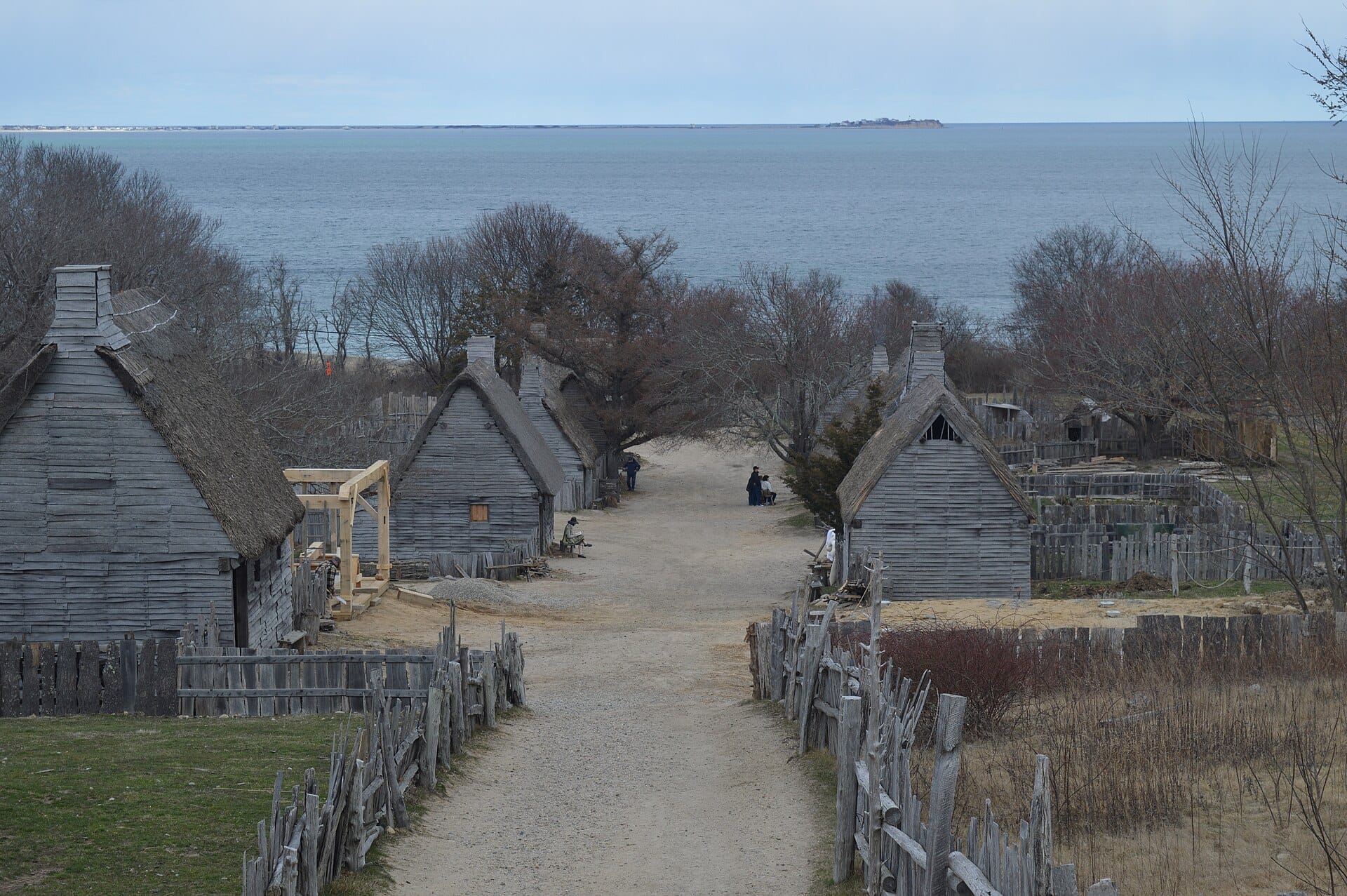
The English Village is the heart of the complex: a reconstructed 1627 settlement of thatched-roof timber houses, vegetable gardens, livestock pens, and muddy footpaths that smell distinctly of wood smoke and damp earth. The sensory quality of the place sets it apart from almost any other historical site in New England. Interpreters, each portraying a documented resident of the colony, engage visitors in conversation as if the year were 1627 — discussing crop yields, religious disputes, and the difficulties of the crossing, without breaking character.
Early in the morning, when the site first opens, the village has a quieter, more intimate atmosphere. You can walk into houses where interpreters are lighting fires or preparing food, and conversations flow naturally. By midday in summer, the crowds thicken considerably and the experience shifts toward a more performative register. If depth of engagement matters to you, arriving close to the 9:00 a.m. opening on a weekday — particularly in May, June, or September — is the most reliable way to avoid the school-group rush that peaks between 10:00 a.m. and noon.
The physical layout of the village follows archaeological and documentary evidence. The houses are small, dark inside, and deliberately uncomfortable by modern standards. That discomfort is part of the point. Visitors who expect a romanticized colonial tableau often leave with a more complicated picture of what the settlement actually involved.
Tickets & tours
Hand-picked options from our booking partner. Prices are indicative; availability and final rates are confirmed when you complete your booking.
Boston Tea Party Ships and Museum tickets
From 27 €Instant confirmationFree cancellationGo City | Boston All-Inclusive Pass
From 67 €Instant confirmationFree cancellationBoston Summer Night Trolley Tour and River Cruise
From 27 €Instant confirmationFree cancellationLEGOLAND Discovery Center Boston tickets
From 26 €Instant confirmationFree cancellation
The Historic Patuxet Homesite: The Indigenous Side of the Story
Adjacent to the English Village, the Historic Patuxet Homesite presents the Wampanoag perspective with a fundamentally different interpretive approach. Unlike the English Village, where interpreters remain in 17th-century character, the Wampanoag cultural educators at the Patuxet Homesite are contemporary Native people who speak in their own voices, as themselves, about their history, their culture, and their community today. This is a deliberate and important distinction.
The homesite includes a nushwetu (a traditional dome-shaped structure), a weetu (a larger longhouse-style dwelling), and demonstrations of traditional crafts, fishing techniques, and agricultural practices. The educators explain the Wampanoag relationship to the land, the impact of English colonization, and the ongoing presence of Wampanoag people in the region. This is not a frozen, ethnographic display — it is an active, often pointed conversation about history and its consequences.
For many visitors, the Patuxet Homesite is the most intellectually significant part of the experience, particularly because it pushes back against the simplified Thanksgiving narrative that dominates popular American understanding of this period. Children often respond to the hands-on demonstrations with particular engagement; adults frequently find the conversations with educators to be among the most memorable interactions of the visit.
💡 Local tip
Take time at the Patuxet Homesite even if it feels unfamiliar or off your planned route through the complex. The conversations with Wampanoag cultural educators are unscripted and substantive — they cannot be replicated by any exhibit panel or audioguide.
Mayflower II: Boarding the Replica Ship in Plymouth Harbor
Mayflower II is docked at Plymouth's State Pier, a short distance from the main museum campus. The ship is a full-scale working replica of the original Mayflower, built in England in the 1950s and sailed across the Atlantic in 1957 to Plymouth, Massachusetts. It is, by any measure, a remarkable object: 106 feet long, with towering wooden masts, cramped below-deck quarters, and a scale that simultaneously impresses and unsettles when you try to imagine 102 passengers and a crew crossing the North Atlantic in it in 1620.
Costumed interpreters aboard the ship portray specific crew members and Pilgrim passengers, and the narrow below-deck space — where passengers would have lived for 66 days at sea — is shocking to stand inside. The smell of tar and old wood, the low overhead clearance, and the way the ship moves gently in the harbor all contribute to an experience that photographs cannot convey. Mayflower II opens for the season in spring; exact opening dates vary by year.
Plymouth Rock, the famous glacial erratic traditionally associated with the Pilgrims' landing, is a short walk from the State Pier. It is worth seeing, though travelers should approach it with realistic expectations: it is a modest-sized boulder in a granite portico. Its significance is symbolic and historical rather than visually dramatic. The surrounding waterfront area is pleasant to walk, and Plymouth town itself has several good restaurants worth a stop after the museum visit.
Visitors with a strong interest in maritime history may also want to consider pairing this day trip with a visit to the Charlestown Navy Yard in Boston, which includes USS Constitution, the oldest commissioned warship afloat in the U.S. Navy.
Getting There From Boston: Transit and Driving
Plimoth Patuxet Museums sits in Plymouth, Massachusetts, roughly 38–40 miles south of downtown Boston. By car via Route 3 South, the drive typically takes 45 minutes to an hour depending on traffic — expect longer on summer weekends, particularly Friday afternoons and Sunday returns. Parking is available in Plymouth, and the museum itself has on-site parking.
By public transit, the most practical route is the MBTA Kingston Line Commuter Rail from South Station in Boston to Kingston Station. From Kingston Station, a rideshare (Uber or Lyft) covers the remaining distance to the museum. Alternatively, the Plymouth & Brockton Bus operates from Boston's South Station Bus Terminal to Plymouth's Park and Ride, from which another rideshare connects to the museum campus. Transit travel times are substantially longer than driving — plan for 90 minutes or more each way — so this option suits travelers who prefer not to rent a car rather than those optimizing for efficiency.
⚠️ What to skip
There is no direct public transit stop at the museum entrance. If you are traveling without a car, budget extra time and money for rideshare connections from Kingston Station or Plymouth Park and Ride. Check MBTA schedules in advance at mbta.com, as commuter rail frequency on this line is limited, especially on weekends.
For broader guidance on navigating the region by transit and car, the getting around Boston guide covers MBTA options and day-trip logistics in detail.
Practical Details: What to Wear, Accessibility, and Photography
The visit involves approximately half a mile of walking over uneven terrain — gravel paths, grass, and in some areas, historically accurate unpaved surfaces. Comfortable, supportive footwear is not optional; the paths are legitimately rough, and heels or minimalist sandals will make the experience actively unpleasant. In summer, sunscreen and a hat are worth carrying, as sections of the English Village offer limited shade.
Weather affects the experience meaningfully. On gray or rainy days, the village atmosphere can feel authentically bleak in the best possible way — wool-clad interpreters continuing their routines in drizzle adds a layer of historical reality that a sunny day does not. That said, heavy rain makes the uneven paths slippery, and some outdoor demonstrations move inside or are curtailed. Early fall visits, typically September and October, tend to offer the most reliable combination of comfortable temperatures, lower crowds, and good light for photography.
For seasonal context on visiting the greater Boston region, the Boston in fall guide covers why autumn is particularly strong for day trips and outdoor attractions.
Photography is permitted throughout the museum and encouraged. The English Village offers rich compositional material: fire-lit interiors visible through low doorways, costumed figures against thatch and timber, and garden plots in various states of growth. The Mayflower II rigging photographs well in morning light before the crowds arrive. The museum's policy on photographing Wampanoag cultural educators and ceremonies is worth asking about directly on arrival, as consent and cultural protocols apply.
Visitors with mobility limitations should contact the museum directly before visiting to confirm current physical accessibility provisions. The uneven terrain presents genuine barriers, and the museum's commitment to access is stated, but the physical reality of an outdoor living history site means some areas are inherently more challenging than others.
Is Plimoth Patuxet Worth the Trip From Boston?
For travelers with a genuine interest in early American history, Indigenous culture, or the mechanics of how historical interpretation works, Plimoth Patuxet Museums is one of the most substantive day trips available from Boston. The combination of the English Village, Patuxet Homesite, and Mayflower II covers the same historical period from distinctly different perspectives, and the quality of the interpretive staff is high.
Families with school-age children tend to respond particularly well, especially to the hands-on elements and the novelty of talking to people in historical costume who will not break character. Children old enough to sustain curiosity for several hours — roughly ages 7 and up — typically get the most from the visit.
Travelers who prefer urban experiences, who find living history museums slow-paced, or who are primarily interested in visual spectacle rather than conversation-based history will likely find the investment of time and money out of proportion to their enjoyment. The museum is not designed for quick walkthroughs — if you cannot commit three to four hours minimum, the experience will feel incomplete.
Those planning a broader historical itinerary in Boston itself should also consider the Freedom Trail, which covers sixteen significant Revolutionary War sites across 2.5 miles of downtown Boston, and can be done on the same trip or as a separate outing. The Boston history guide provides useful context for understanding how Plymouth Colony fits into the broader arc of New England colonial history.
Insider Tips
- Arrive at the English Village within the first 30 minutes of opening. The interpreters are more conversational before the school groups arrive, and you can often step inside working buildings and ask detailed questions without competing for attention.
- The 'Ways to Save' page on the official website lists a local 'America's Hometown' admission option (recently around $5–$10) for Plymouth-area residents, plus other discount programs. Check this page before buying tickets — standard admission pricing is not the only option.
- If you are driving from Boston, avoid Friday afternoons and Sunday returns in July and August. Route 3 South is heavily congested during these windows, and the 40-mile drive can easily take 90 minutes or more.
- Combine the museum visit with a walk to Plymouth Rock and the Plymouth waterfront, which is free and adds about 45 minutes. The State Pier area where Mayflower II is docked is walkable from the town center, and there are several good seafood restaurants along the harbor.
- Bring a physical notebook or bookmark specific questions about Wampanoag history before visiting the Patuxet Homesite. The cultural educators engage most deeply with visitors who arrive with genuine curiosity and specific questions rather than general interest.
Who Is Plimoth Patuxet Museums For?
- History enthusiasts who want interpretive depth rather than a quick overview of colonial America
- Families with school-age children (ages 7 and up) who engage with hands-on and character-based learning
- Travelers interested in Indigenous history and Wampanoag culture as a contemporary, living subject
- First-time visitors to New England who want to understand the Pilgrim-era origins of the region before exploring Boston's Revolutionary history
- Educators and researchers interested in how living history museums approach contested or complex historical narratives
Nearby Attractions
Combine your visit with:
- Arnold Arboretum
Founded in 1872, the Arnold Arboretum is the oldest public arboretum in North America — a free, 281-acre landscape in Jamaica Plain managed by Harvard University. With over 15,000 accessioned plants and sweeping hillside views, it draws botanists, dog walkers, and curious visitors in equal measure across all four seasons.
- Blue Hills Reservation
Ten miles south of downtown Boston, Blue Hills Reservation spreads across more than 7,000 acres of forested hills, rocky ridgelines, and glacial wetlands. Free to enter and open year-round from dawn to dusk, it offers 125 miles of trails ranging from easy pond-side loops to a genuine summit climb at 635-foot Great Blue Hill.
- Boston Duck Tours
Boston Duck Tours puts you aboard a replica World War II DUKW amphibious vehicle for an 80-minute circuit of the city's most historic landmarks, finishing with a splash into the Charles River. Running seasonally from late March through late November, it's one of the few tours in Boston that covers both street-level sights and a Charles River perspective in a single trip.
- Boston Harbor Islands
Boston Harbor Islands National and State Park puts 34 islands and peninsulas within easy ferry reach of downtown Boston. From Civil War earthworks on Georges Island to the oldest lighthouse station in the United States on Little Brewster, the park rewards visitors who are willing to trade the city's brick sidewalks for salt air and open water.