Musée Picasso Paris: A Complete Guide to the National Picasso Museum
Housed in the grand Hôtel Salé in Le Marais, the Musée national Picasso-Paris holds one of the world's most comprehensive collections of Picasso's work, spanning nearly eight decades of creativity. With over 5,000 works and 200,000 archival documents, it is the most authoritative single-artist museum in Paris.
Quick Facts
- Location
- 5 rue de Thorigny, 75003 Paris (Le Marais, 3rd arrondissement)
- Getting There
- Saint-Sébastien–Froissart (line 8) or Chemin Vert (lines 8 & 9), ~7–10 min walk
- Time Needed
- 1.5 to 2.5 hours for permanent collection; 3 hours if a major temporary exhibition is on
- Cost
- Regular: €17; Family rate: €12 per adult (with a child); Free on the 1st Sunday of each month
- Best for
- Art lovers, architecture enthusiasts, Le Marais walkers, and those wanting depth over spectacle
- Official website
- www.museepicassoparis.fr
Why the Picasso Museum Stands Apart
Most major art museums accumulate their Picasso works through auction, donation, or diplomatic purchase — a canvas here, a print there. The Musée national Picasso-Paris is different. Its collection was formed primarily through a legal mechanism unique to French inheritance law: in lieu of paying death duties after Picasso's death in 1973, his estate transferred an extraordinary tranche of works directly to the French state. What arrived was not a curated best-of, but Picasso's own holdings: the pieces he kept, the experiments he never sold, the works he made for himself. The result is a collection of unusual intimacy and depth, spanning 1895 to 1972, covering the full arc of his creative life.
The museum holds over 5,000 works including paintings, sculptures, ceramics, drawings, prints, and collages, plus roughly 200,000 archival documents. If you are already familiar with Picasso through the grand canvases in New York's MoMA or Barcelona's Museu Picasso, a visit here will reframe your understanding of the man's output. If you are new to him entirely, this is a better starting point than anywhere else. For broader context on Paris's exceptional museum landscape, see our guide to the best museums in Paris.
💡 Local tip
The museum is free on the first Sunday of every month (no reservation required for free entry, but expect higher visitor numbers than usual). If your travel window includes one of these Sundays, plan to arrive at or before 9:30 a.m.
The Building: Hôtel Salé and Its Architecture
The Picasso Museum occupies the Hôtel Salé, a 17th-century private mansion built between 1656 and 1659 for Pierre Aubert de Fontenay, a tax farmer who collected the salt tax on behalf of the Crown — hence the nickname 'Salé' (salted). The building was classified as a historic monument in 1968, and underwent a comprehensive renovation between 1979 and 1985 before the museum opened to the public in 1985. Architect Roland Simounet oversaw the interior transformation, designing display spaces that respect the mansion's baroque bones while allowing the works to breathe.
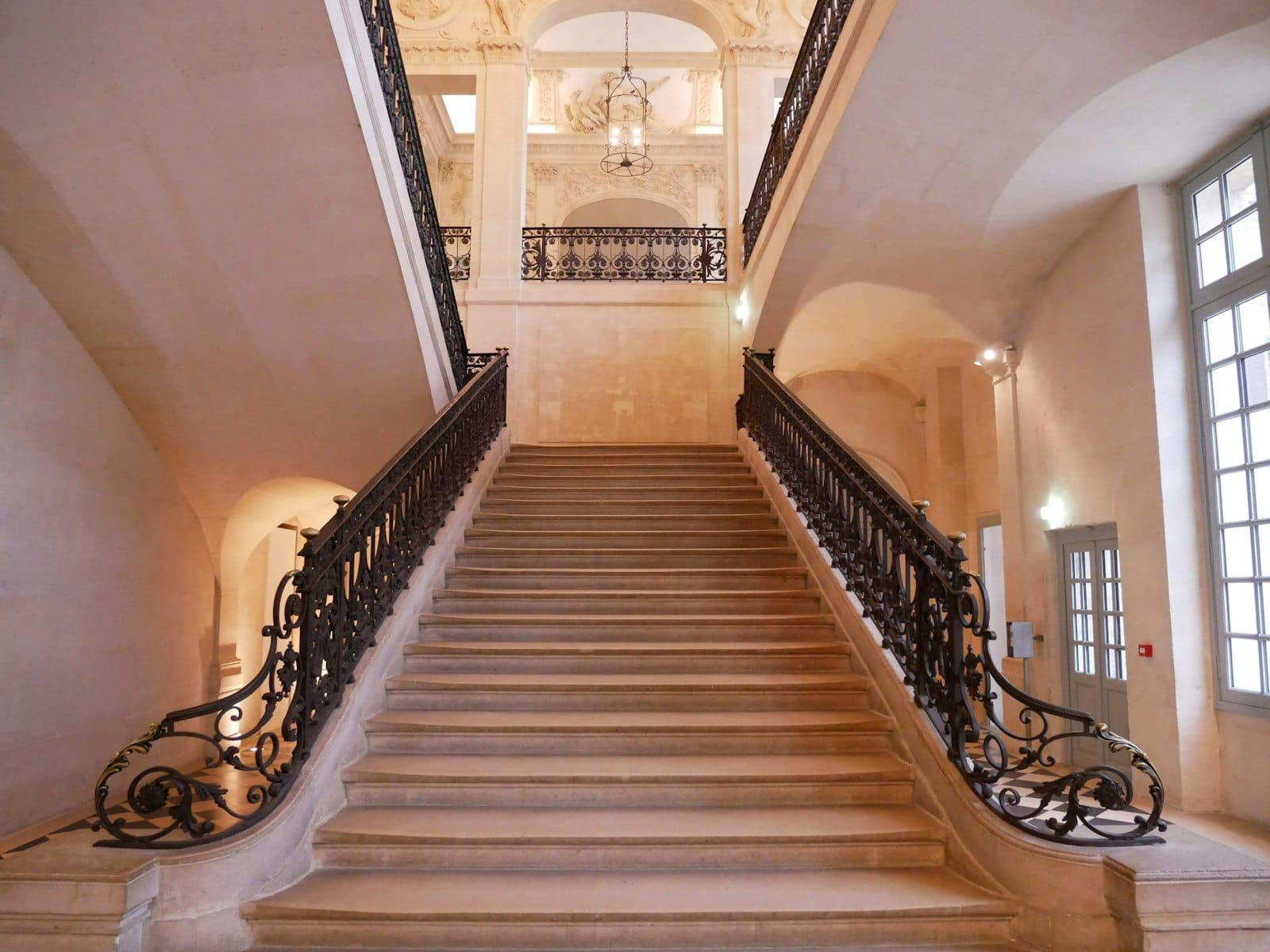
From the street, the Hôtel Salé presents a formal courtyard facade of pale stone, with a projecting central bay and sculpted keystones above the windows. This formality shifts inside, where the grand staircase — decorated with lead figures attributed to Martin Desjardins — becomes one of the most photographed non-artwork elements in any Paris museum. The museum's stone floors, paneled rooms, and garden create a domestic scale that suits Picasso's work far better than a white-cube gallery would. It feels less like viewing objects in a showcase and more like visiting a very large, very well-organized studio.
The Hôtel Salé sits in the heart of Le Marais, a district that still holds the highest concentration of pre-Revolutionary private mansions in Paris. Walking the surrounding streets — particularly rue de Thorigny and rue des Coutures-Saint-Gervais — gives you a sense of what 17th-century aristocratic Paris looked and felt like at ground level.
Tickets & tours
Hand-picked options from our booking partner. Prices are indicative; availability and final rates are confirmed when you complete your booking.
Paris Essential dinner cruise at 6.15pm
From 99 €Instant confirmationFree cancellationBest of Paris city tour with Eiffel Tower lunch and Seine cruise
From 144 €Instant confirmationFree cancellationBest of Paris guided bike tour
From 45 €Instant confirmationFree cancellationSeine cruise tickets with return transportation from Disneyland Paris
From 75 €Instant confirmationFree cancellation
The Permanent Collection: How to Navigate It
The permanent collection is arranged broadly chronologically across two main floors, moving from Picasso's early academic training in Barcelona and Madrid through the Blue and Rose Periods, Cubism, Neoclassicism, Surrealism, and his late work. The journey from a precise charcoal study of 1895 to the raw, large-format canvases of the 1960s is genuinely startling when experienced in sequence rather than cherry-picked from a highlight reel.
Key works to seek out include the Self-Portrait of 1907 (painted during the same period as Les Demoiselles d'Avignon, though that canvas is in New York); the series of portraits of his partners and companions, which together read as a visual autobiography; and the sculptural holdings, which are exceptional. Picasso's three-dimensional work is often underrepresented in survey exhibitions, but here you will find constructions, assemblages, and modeled pieces that demonstrate how thoroughly he rethought form in every medium he touched.
Audio guides are available for rent at the entrance and add real value if you want contextual explanation without joining a guided tour. The museum's printed room guides are clear and well-translated into English. Allow at least 90 minutes for the permanent collection alone; if a major temporary exhibition is running in the dedicated ground-floor and upper-gallery spaces, add another 45 to 60 minutes.
ℹ️ Good to know
The museum ticket covers both the permanent collection and all current temporary exhibitions — you are not paying extra to see what is showing alongside the permanent works. Check the museum's website before your visit to see what temporary show is on.
Best Time to Visit and How Crowds Behave
Tuesday through Thursday mornings are the quietest periods. The museum opens at 9:30 a.m., and arriving at opening time on a weekday gives you a chance to walk the first two rooms before tour groups arrive, which typically happens around 10:30 a.m. Weekend afternoons are the most congested, particularly during school holidays and the summer months of July and August.
The first Sunday of the month, when admission is free, attracts a noticeably larger crowd than a typical Sunday. If you use that free-entry date, come early. Conversely, rainy weekday mornings in autumn or winter produce some of the thinnest crowds you will find at any major Paris museum. The interior spaces are well lit year-round, so there is no seasonal lighting advantage to time your visit around.
Photography without flash is permitted throughout the permanent collection, which makes the Hôtel Salé's architectural details as rewarding to document as the artworks themselves. For tips on composing Paris museum shots, see our guide to the best photo spots in Paris.
⚠️ What to skip
The museum is closed every Monday, as well as January 1, May 1, and December 25. Last admission is at 5:15 p.m., which is 45 minutes before closing. Do not underestimate this — security staff begin circulating through the galleries around 5:30 p.m.
Getting There and Practical Logistics
The museum is at 5 rue de Thorigny, in the 3rd arrondissement. The closest Metro station is Saint-Sébastien–Froissart on line 8, a walk of roughly seven minutes north through Le Marais. Chemin Vert (also line 8) is a comparable distance in the opposite direction and is slightly easier to navigate if you are coming from the eastern side of the city. Bus line 29 stops close by and is a useful option if you are arriving from the Right Bank near the Louvre.
Advance online booking is strongly recommended. The museum website at museepicassoparis.fr allows you to select a timed entry slot, which guarantees priority access in the half-hour window following your chosen time. Walk-in tickets are available at the on-site ticket desk, but during busy periods you may wait 20 to 30 minutes to enter. The museum is included in the Paris Museum Pass, which covers entry without the need to queue at the ticket desk — a genuine time-saver if you are visiting multiple museums in a short window.
The museum has a cloakroom for bags and coats, and a gift shop on the ground floor with a strong selection of art books, prints, and design objects. The garden, visible from the upper floors, is accessible in fine weather and offers a quiet pause between floors. There is no dedicated café inside the museum, so plan to eat before or after rather than expecting a sit-down break on site.
Situating It in Le Marais: Before and After Your Visit
The Picasso Museum is most rewarding when treated as one part of a longer exploration of Le Marais rather than a standalone destination. The Musée Carnavalet — Paris's dedicated museum of city history — is a 10-minute walk south on rue de Sévigné and is free to enter. It is a natural companion visit, particularly if you want to deepen your sense of the architectural and social world that produced buildings like the Hôtel Salé.
The Place des Vosges is about 12 minutes on foot to the southeast, and its arcaded galleries house several small art dealers and galleries that make for an interesting coda to a morning of Picasso. The surrounding streets of Le Marais — particularly rue de Bretagne and the Marché des Enfants Rouges nearby — are among the better places in central Paris to find an informal lunch after a museum morning.
If you are building a broader art itinerary for your trip, the best museums in Paris guide covers how to sequence visits across the city's major collections without burning out on gallery fatigue. First-time visitors may also want to consult the Paris for first-timers guide to understand how the Picasso Museum fits into a broader itinerary.
Who Should Skip This Museum
The Picasso Museum is not the place for an introduction to Western art in general — its scope is deliberately narrow, and visitors who have no prior interest in Picasso or early 20th-century modernism may find two hours in a single-artist collection exhausting. Children under ten typically struggle unless they have some appetite for sculpture and unusual shapes. The admission cost of €16 is high relative to some Paris institutions, and families paying for multiple adults should weigh it against the free Musée Carnavalet or the lower ticket price at other Marais museums. If your priority is the most spectacular or immediately recognizable art in Paris, the Musée d'Orsay or the Louvre will deliver more familiar landmarks per hour.
Insider Tips
- Book a timed-entry slot online before you go, even on weekdays. The priority access window is genuinely enforced, and walk-in queues can form quickly once tour groups arrive around mid-morning.
- The grand staircase with its 17th-century lead sculptures is as worth your attention as many of the paintings. Slow down at the landing before heading to the upper-floor galleries.
- The garden on the ground-floor level is easy to miss if you follow the main visitor flow straight upstairs. In mild weather, it is a quiet place to pause and genuinely less frequented than the interior rooms.
- If you are visiting on a free first-Sunday, head directly to the sculpture rooms on arrival — they tend to clear faster than the painting galleries as general visitors gravitate toward the canvases.
- The museum bookshop carries several out-of-print or museum-exclusive catalogues not available elsewhere in Paris. If you are a serious Picasso reader, leave budget and bag space for the book section.
Who Is Picasso Museum Paris For?
- Art lovers who want to see Picasso's full creative arc in one building, not just his greatest hits
- Architecture and design enthusiasts drawn to the Hôtel Salé's baroque interiors as much as the collection
- Repeat Paris visitors who have already covered the Louvre and Musée d'Orsay and want depth over breadth
- Photography-focused travelers who want layered subjects: art, architecture, and a 17th-century Marais courtyard
- Travelers on a Le Marais day who want a substantive cultural anchor before exploring the neighborhood's streets and markets
Nearby Attractions
Other things to see while in Le Marais:
- La Promenade Plantée
Long before New York's High Line existed, Paris had this: 4.7 kilometres of gardens, rose trellises, and bamboo groves built atop a disused 19th-century railway viaduct. The Promenade Plantée, officially the Coulée verte René-Dumont, runs east from Bastille through the 12th arrondissement to the edge of the Bois de Vincennes, free of charge.
- Musée Carnavalet
Spread across two connected 16th-century Marais mansions, the Musée Carnavalet – Histoire de Paris holds over 640,000 objects tracing the city from prehistoric river settlements to the 20th century. Entry to the permanent collection is free, making it one of the most rewarding and underused museums in Paris.
- Musée des Arts et Métiers
Tucked into a converted medieval abbey on the edge of Le Marais, the Musée des Arts et Métiers holds nearly 80,000 objects charting the full arc of human invention, from 17th-century scientific instruments to Foucault's Pendulum swinging beneath Gothic vaults. It is one of the oldest science and technology museums in the world, and consistently one of the most underrated rooms in Paris.
- Place des Vosges
Built under Henri IV and inaugurated in 1612, Place des Vosges is the oldest planned square in Paris. Its 36 symmetrical red-brick pavilions frame a formal garden where locals read, children play, and visitors slow down. Admission to the square is free.