Place des Vosges: Inside Paris's Oldest and Most Beautiful Square
Built under Henri IV and inaugurated in 1612, Place des Vosges is the oldest planned square in Paris. Its 36 symmetrical red-brick pavilions frame a formal garden where locals read, children play, and visitors slow down. Admission to the square is free.
Quick Facts
- Location
- Place des Vosges, 75004 Paris (Le Marais, 3rd & 4th arrondissements)
- Getting There
- Bastille (lines 1, 5, 8) or Saint-Paul (line 1), ~5 min walk
- Time Needed
- 45 min to 2 hours (longer if visiting Maison Victor Hugo)
- Cost
- Free (square and garden); Maison Victor Hugo permanent collection free, fees for temporary exhibitions
- Best for
- Architecture lovers, history enthusiasts, afternoon strolls, photography
- Official website
- www.paris.fr/lieux/place-des-vosges-10866
What Place des Vosges Actually Is
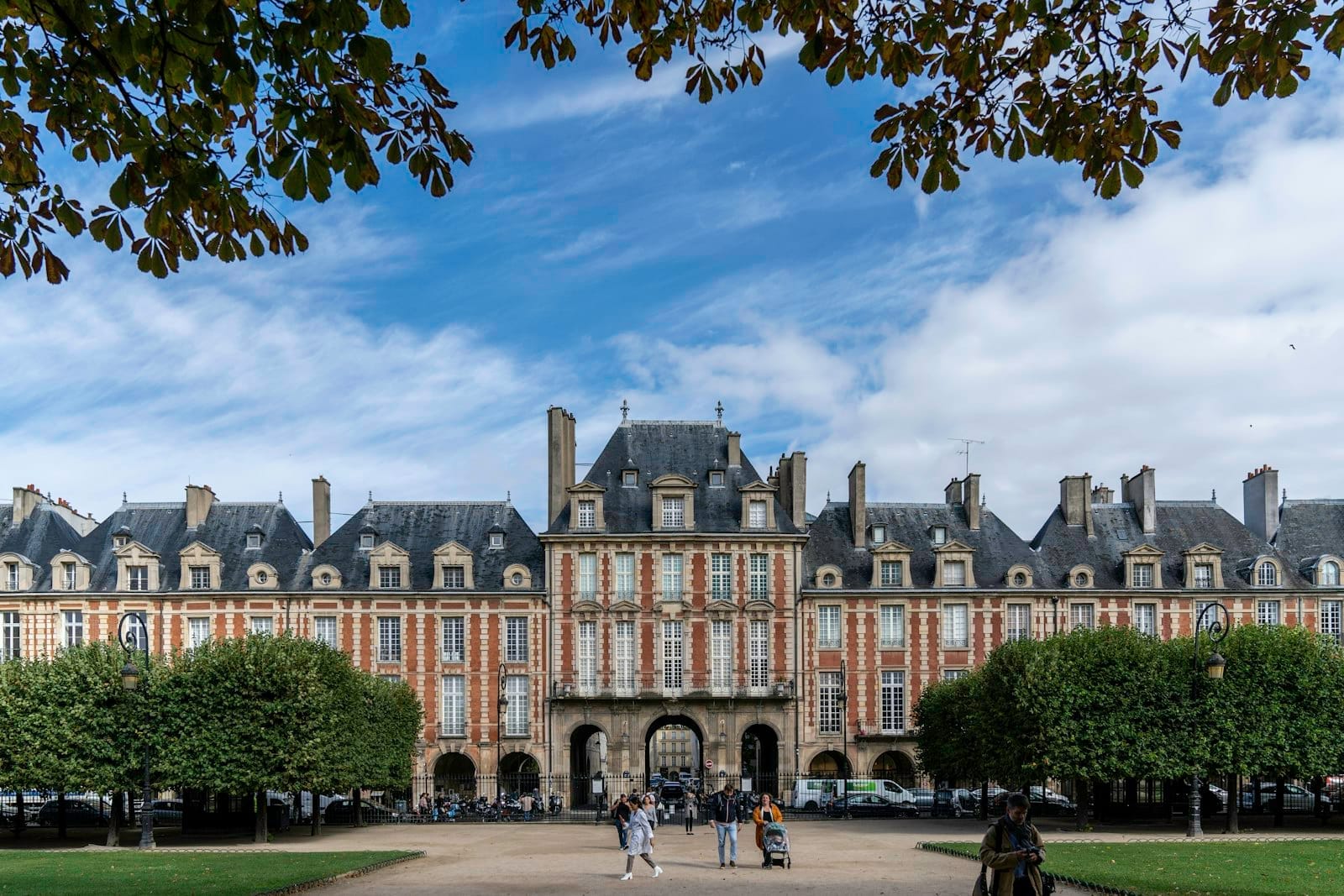
Place des Vosges is the oldest planned square in Paris, a perfectly proportioned rectangle of 140 metres by 140 metres enclosed by 36 identical pavilions of red brick and pale stone under slate-grey roofs. It sits in the Marais district, straddling the 3rd and 4th arrondissements, and has served as royal ceremonial ground, fashionable address, and everyday public garden for over four centuries. Where many of Paris's celebrated landmarks demand ticket queues and hushed reverence, this square simply exists: open, free, and still very much in use by the people who live around it.
The square anchors one of the most culturally dense corners of Le Marais. The Picasso Museum is a few blocks north, and Musée Carnavalet, Paris's dedicated museum of city history, sits immediately adjacent. Neither requires a visit to appreciate Place des Vosges itself, but together they form one of the most concentrated pockets of cultural weight anywhere in the city.
💡 Local tip
The arcaded galleries (vaulted stone walkways running beneath the pavilions on all four sides) are the best refuge during a rain shower and a good place to browse the small galleries, cafés, and antique dealers installed in the arches. Entry is free; generally open daily from early morning to late evening.
Four Centuries of History Compressed into One Square
Construction began in 1605 on the orders of King Henri IV, who envisioned a harmonious royal square to anchor the emerging Marais neighbourhood. He did not live to see its completion: Henri IV was assassinated in 1610, and the square was inaugurated in 1612 during a three-day celebration of the betrothal of Louis XIII. For most of the 17th century it was known as Place Royale and served as the social centre of Parisian aristocratic life. Cardinal Richelieu kept a residence here. The address carried immense social cachet.
After the Revolution, the royal name was stripped from the square. In 1800, Napoleon renamed it Place des Vosges in honour of the Vosges department in northeast France, which had been the first department to pay the taxes imposed by the Revolutionary government. The square was classified as a Historic Monument on 26 October 1954, cementing its protected status. The pavilions, remarkably, have retained their original appearance: the brick facades, the steep slate roofs, the uniform arcades.
Victor Hugo lived at number 6 from 1832 to 1848, during some of the most productive years of his literary career. That address is now the Maison Victor Hugo, a free municipal museum where his reconstructed apartments, drawings, and personal effects are on permanent display. It is one of the quieter museums in Paris and frequently overlooked, which makes it worth the detour.
Tickets & tours
Hand-picked options from our booking partner. Prices are indicative; availability and final rates are confirmed when you complete your booking.
Pastry and chocolate tour in Saint-Germain-des-Pres neighborhood
From 109 €Instant confirmationFree cancellationWalking tour of Saint-Germain-des-Pres neighborhood
From 104 €Instant confirmationFree cancellationGuided tour of Les Invalides with Tomb of Napoleon
From 89 €Instant confirmationGluten-free and organic dessert cooking class
From 129 €Instant confirmationFree cancellation
What You See When You Walk In
The square is entered through one of nine arched passages, the most dramatic being the central openings on the north and south sides beneath the slightly taller Pavillon de la Reine (Queen's Pavilion) and Pavillon du Roi (King's Pavilion). These two pavilions, both now privately occupied, break the otherwise rigid symmetry of the arcade with an extra storey and more elaborate stone detailing. The visual rhythm of the whole ensemble, 36 facades each three storeys of red brick above a vaulted stone ground floor, produces a coherence that is rare in any European city.
Inside, a formal garden occupies the centre: four lawns separated by gravel paths, a fountain at each intersection, and mature linden trees providing shade in summer. The garden is enclosed by a low iron fence and dogs are not permitted inside, which keeps it noticeably calm. The arcaded perimeter, by contrast, is open to foot traffic at all times and functions as a covered outdoor corridor connecting cafés, galleries, and restaurants.
ℹ️ Good to know
Maison Victor Hugo (6 Place des Vosges) is open Wednesday to Monday, 10:00–18:00 (closed Tuesdays). The permanent collection is free. Temporary exhibitions carry an admission fee. No advance booking is required for the permanent collection.
How the Square Changes Through the Day
Early morning, before 9:00, the square belongs to locals: dog walkers circling the perimeter, the occasional jogger, a few residents on benches outside the garden fence. The quality of light in spring and autumn, when it falls at a low angle across the brick facades, is worth arriving for on its own. The warm terracotta tones deepen against the pale stone trim, and the reflections in the central fountains shift with every cloud.
By mid-morning on weekdays the cafés under the arcades open and the lunch crowd begins to form. Weekend afternoons are the square's busiest period: families use the garden, visitors photograph the facades, and the restaurant terraces fill early. If crowds matter to you, a Tuesday or Wednesday morning between 9:00 and 11:00 gives you the closest thing to solitude. Winter strips the lindens bare and empties the gravel paths, but the combination of slate rooftops and warm brick makes it one of the better photographic subjects in the city on a clear grey day.
💡 Local tip
For the best facade photographs, position yourself at the centre of the square in the mid-morning (roughly 9:30–11:00) when the sun illuminates the south-facing pavilions. In summer, late afternoon light works equally well on the north side. Avoid midday in high summer when direct overhead light flattens the brick texture.
Getting There and Moving Through the Neighbourhood
The most convenient Metro station is Bastille (lines 1, 5, and 8), roughly a 5-minute walk west along rue Saint-Antoine and then north. Chemin Vert (line 8) deposits you closer to the northern entry of the square. For a more rewarding approach, walk from the Hôtel de Ville area through the medieval street grid of Le Marais, which gives you context for just how old the surrounding urban fabric actually is.
The square itself is pedestrianised and flat, making it accessible for pushchairs and wheelchair users at ground level. The arcaded galleries are step-free along their full perimeter. The fenced garden interior has compacted gravel paths, which can be uneven in places. The Maison Victor Hugo has a lift to upper floors.
A natural half-day combines Place des Vosges with the Musée Carnavalet and Picasso Museum, then a late lunch in the arcades. Alternatively, head south toward the Opéra Bastille or consult our guide to things to do in Paris to build a wider itinerary around the area.
Honest Assessment: Is It Worth Your Time?
Place des Vosges is not a single-spectacle attraction. There is no one moment that takes your breath away. What it offers is architectural coherence, historical depth, and the rare sense that a 400-year-old space is still serving its original purpose: gathering, strolling, and sitting in public. Travellers expecting constant stimulus may find it underwhelming after 20 minutes, particularly if they arrive at the crowded midday window.
Those who appreciate proportional design, who want a pause between major museums, or who are curious about how Paris grew from its medieval core will find it one of the most satisfying stops in the city. It pairs naturally with a long lunch at one of the arcade restaurants, after which the square looks entirely different.
Insider Tips
- The arcade restaurants on the south side (under the Pavillon du Roi) enjoy prime sun for lunch from spring to early autumn, but their prominence means they charge a premium. The cafés on the north arcade are slightly cheaper and equally good for people-watching.
- To enter the square from the south, use the passage that cuts through from rue Saint-Antoine via the Hôtel de Sully courtyard: one of Paris's finest Renaissance courtyards and free to walk through.
- The Maison Victor Hugo is rarely busy even in peak season. Arrive at opening time (10:00) and you will likely have the reconstructed apartments largely to yourself.
- The square straddles the 3rd and 4th arrondissements: the northern row of pavilions is technically in the 3rd, the southern row in the 4th. A minor detail, but useful if you are navigating by arrondissement.
- In summer, the garden's central area is shaded by the linden trees by mid-afternoon. The benches just outside the iron fence are not shaded, so bring water if you plan to sit for any length of time.
Who Is Place des Vosges For?
- Architecture and design enthusiasts interested in 17th-century French urban planning
- Literary travellers following Victor Hugo or the broader history of Parisian intellectual life
- Families looking for a contained outdoor space in central Paris with a children's area inside the garden
- Photographers working in the early morning or late afternoon when the brick facades catch directional light
- Anyone who wants a free, unhurried pause between museum visits in Le Marais
Nearby Attractions
Other things to see while in Le Marais:
- La Promenade Plantée
Long before New York's High Line existed, Paris had this: 4.7 kilometres of gardens, rose trellises, and bamboo groves built atop a disused 19th-century railway viaduct. The Promenade Plantée, officially the Coulée verte René-Dumont, runs east from Bastille through the 12th arrondissement to the edge of the Bois de Vincennes, free of charge.
- Musée Carnavalet
Spread across two connected 16th-century Marais mansions, the Musée Carnavalet – Histoire de Paris holds over 640,000 objects tracing the city from prehistoric river settlements to the 20th century. Entry to the permanent collection is free, making it one of the most rewarding and underused museums in Paris.
- Musée des Arts et Métiers
Tucked into a converted medieval abbey on the edge of Le Marais, the Musée des Arts et Métiers holds nearly 80,000 objects charting the full arc of human invention, from 17th-century scientific instruments to Foucault's Pendulum swinging beneath Gothic vaults. It is one of the oldest science and technology museums in the world, and consistently one of the most underrated rooms in Paris.
- Picasso Museum Paris
Housed in the grand Hôtel Salé in Le Marais, the Musée national Picasso-Paris holds one of the world's most comprehensive collections of Picasso's work, spanning nearly eight decades of creativity. With over 5,000 works and 200,000 archival documents, it is the most authoritative single-artist museum in Paris.