Piazza d'Italia, Sassari: The Civic Heart of Northern Sardinia
Piazza d'Italia is the principal public square of Sassari, Sardinia's second-largest city. A rectangle of about 100 metres per side, framed by Neoclassical palaces and anchored by a 19th-century royal statue, it is where political ceremony, daily life, and urban history converge. Entry is free, and it is open at all hours.
Quick Facts
- Location
- Piazza d'Italia, 07100 Sassari SS, Sardinia, Italy. At the upper end of Corso Vittorio Emanuele II, on the edge of the historic centre.
- Getting There
- Walkable from Sassari railway station (roughly 10–15 minutes on foot) or reachable by local city bus or taxi to the historic centre. Sassari also has a light metro-tram line (Metrotranvia di Sassari), though its existing stops are outside the immediate historic centre.
- Time Needed
- 20–40 minutes to absorb the square itself; allow 2–3 hours if you combine it with surrounding streets and the Palazzo della Provincia.
- Cost
- Free. No ticket required — Piazza d'Italia is a public urban space accessible at all times.
- Best for
- Architecture enthusiasts, history travellers, photographers, and anyone wanting to understand Sassari as a living city rather than a beach stopover.
What Piazza d'Italia Actually Is
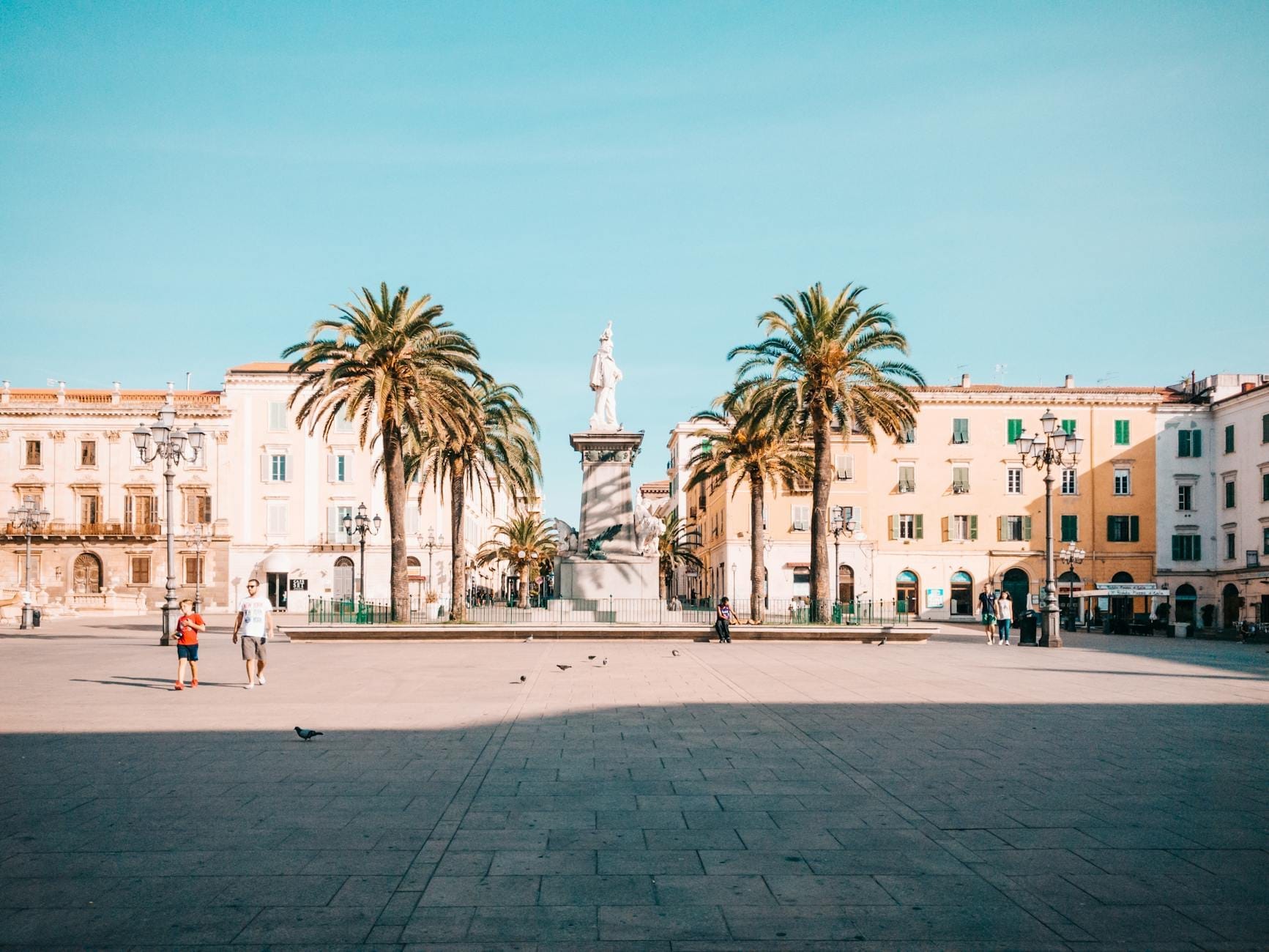
Piazza d'Italia is the main civic square of Sassari, and it operates as both an architectural statement and a working public space. At roughly 100 metres on each side, covering about one hectare, it is the largest piazza in the city and one of the most formally composed public spaces in Sardinia. Unlike the island's beach resorts or archaeological sites, this is a square built entirely to project civic identity, and understanding that ambition makes the visit considerably more interesting.
The square sits just outside the line of the medieval city walls, on the edge of Sassari's historic centre, near the top of Corso Vittorio Emanuele II, a principal thoroughfare that still links the old town to the newer districts. This position, neither inside the tangle of the medieval streets nor fully in the modern city, is deliberate. The square was conceived as a threshold, a place where the unified Italian nation announced itself in stone to Sardinia's second-largest city.
ℹ️ Good to know
The square is open 24 hours, free to enter, and has no gates or ticketed sections. The best approach on foot is along Corso Vittorio Emanuele II from the historic centre, which gives you a natural sense of arrival.
History and Architecture: Why It Was Built This Way
The ambition for a grand new square in Sassari predates the square itself by several decades. The first project for the new square dates to the beginning of the 19th century as part of a broader urban expansion plan for the city. But it was the political rupture of Italian unification that gave the project its urgency and its character. Levelling and construction work began in 1872, and what emerged was a rigidly formal rectangle framed by Neoclassical buildings designed to communicate stability, order, and belonging to the new Italian state.
The most prominent building on the square is the Palazzo della Provincia di Sassari, which today houses the Prefettura, the state’s territorial government office established soon after Italian unification, built between 1872 and 1880 in a restrained Neoclassical style. Its long facade, with arched ground-floor porticos and a rhythm of tall windows above, sets the formal tone for the entire space. The other surrounding buildings follow broadly compatible architectural registers, giving the square a coherence that many Italian piazze, assembled across centuries, cannot claim.
At the centre of the square stands the bronze equestrian statue of King Vittorio Emanuele II, the first king of unified Italy. Sculpted by Giuseppe Sartorio, the statue was inaugurated in 1899 in the presence of the royal family. The inauguration was no ordinary ceremony: according to regional tourism sources, it coincided with the first edition of the Cavalcata Sarda, the Sardinian horse parade that has since become one of the island's most celebrated traditional festivals, held in Sassari each May. The layering of political symbolism and Sardinian cultural pageantry in that single 1899 afternoon says something precise about how Sassari has always negotiated its relationship with mainland Italian identity.
For context on how Sassari fits into Sardinia's broader urban and cultural landscape, see the Sassari destination guide.
Tickets & tours
Hand-picked options from our booking partner. Prices are indicative; availability and final rates are confirmed when you complete your booking.
Sassari Historic Center Guided Tour
From 54 €Instant confirmationFree cancellationVineyard Guided Tour and 7 Wine Tasting in Palau
From 84 €Instant confirmationFree cancellationFull-Day Sailboat Tour in La Maddalena Archipelago from Cannigione
From 112 €Instant confirmationFree cancellationHiking excursion to the Devil's Saddle
From 35 €Instant confirmationFree cancellation
What It Feels Like to Be There: Morning, Afternoon, and Evening
Early morning is the most rewarding time to study the architecture. Before 9am, the square belongs mostly to dog walkers, a few commuters crossing on foot, and delivery vehicles supplying the bars on the perimeter. The stone paving, which catches the low Sardinian sun at an angle that flattens later in the day, shows its texture clearly. The Palazzo della Provincia's facade reads with particular sharpness in the raking morning light, and the statue of Vittorio Emanuele II casts a long shadow toward the southeast.
By mid-morning the square fills with a more purposeful crowd: office workers arriving at the provincial government buildings, students from nearby schools, and residents stopping at the cafes that line the porticos. This is when the square functions as it was intended, not as a tourist attraction but as the administrative and civic core of a working city. You can sit at one of the outdoor tables with a coffee and watch Sassari organise itself.
Midday in summer can be hot in the open centre of the square. The paving radiates heat and there is limited shade away from the building arcades. Most locals clear the open space and retreat under the porticos or leave for lunch entirely. If you are visiting in July or August, plan to be at the square before 10am or after 5pm.
Evenings transform it. The square is lit at night, the statue given a golden wash that the daylight never produces. Sassari residents use the square for the traditional passeggiata, the evening stroll that is still a genuine social ritual in smaller Italian cities. Groups of teenagers, older couples, and families with young children all share the same paved rectangle in a way that feels entirely unrehearsed. The cafes and bars around the edges stay busy until late. This is the version of the square that most rewards simply sitting still.
Practical Walkthrough: Navigating the Square
The square is flat and paved throughout, which makes it accessible for visitors using wheelchairs or pushchairs without notable difficulty. Specific accessible toilet facilities and reserved parking are not documented on the official tourism pages, so visitors with particular accessibility needs should confirm arrangements locally in advance.
There are no official ticket offices, information kiosks, or formal entrances to find. You simply walk in from any of the streets that feed into the corners and edges of the square. The most photographed angle is from the Corso Vittorio Emanuele II approach, looking across the paving toward the Palazzo della Provincia with the statue in the middle distance.
Photography is straightforward in the morning and evening. Midday light in summer is flat and harsh. The statue reads best from ground level in low-angle light, when the patina on the bronze becomes visible. The Palazzo della Provincia facade photographs well from the opposite side of the square, which gives enough distance to take in the full width of the building.
💡 Local tip
If you want a clear shot of the statue without other visitors in frame, arrive before 8:30am on a weekday. By 9am, office workers and school groups start cutting across the square regularly.
Getting There and Around
Sassari's railway station connects the city to Cagliari, Olbia, and other points on the Trenitalia network, as well as ARST services. From the station, Piazza d'Italia is roughly a 10 to 15-minute walk through the historic centre, following Corso Vittorio Emanuele II uphill. City buses and taxis serve the centre, and Sassari's Metrotranvia light rail has stops in the urban core, though the walk from the station is pleasant and passes several points of interest in the old town.
Sassari is served by Alghero-Fertilia Airport (IATA: AHO), approximately 35 kilometres to the southwest, which has ARST bus connections to the city. Olbia Costa Smeralda Airport (OLB) is further, roughly 100 kilometres to the east, but is the main northeast Sardinian entry point if you are combining this visit with the Costa Smeralda or Gallura region.
If you are planning a wider trip through northern Sardinia, the guide to getting around Sardinia covers transport options across the island in detail.
What to Combine It With
Piazza d'Italia alone will occupy perhaps 30 minutes, even for a careful visitor. The square is best treated as the centrepiece of a longer walk through Sassari's historic centre rather than a standalone destination. Corso Vittorio Emanuele II, which leads directly into the square, passes through the oldest part of the city and connects to the Duomo di San Nicola and a network of narrow streets that retain their medieval street plan.
The Museo Nazionale Giovanni Antonio Sanna, Sassari's principal archaeological museum, is within walking distance and gives essential context for understanding Sardinia's pre-Roman and Nuragic past. Combining the piazza with the museum makes for a coherent half-day programme focused on the city.
For broader northern Sardinia context, including the Nuragic sites accessible as day trips, see the guide to Sardinia's Nuragic sites. Alghero, about 35 kilometres southwest, is also worth pairing with a Sassari visit; the Alghero destination overview covers what to expect there.
⚠️ What to skip
If you are visiting Sassari primarily to reach Piazza d'Italia and have no other interest in the city, the square alone may not justify a long detour. It rewards travellers who want to understand Sardinian civic and architectural history, not those looking for a dramatic landscape or beach experience.
Insider Tips
- The first edition of the Cavalcata Sarda, Sardinia's most famous traditional parade, was held in 1899 to coincide with the inauguration of the Vittorio Emanuele II statue. If you visit Sassari in May during the Cavalcata, the square is the ceremonial focal point and takes on a completely different atmosphere from its everyday self.
- Walk the full perimeter of the square rather than just crossing through the centre. The side streets that open off the corners give a quick sense of how abruptly the formal Neoclassical grid gives way to the dense medieval street pattern of the old city.
- The bars under the porticos of the Palazzo della Provincia serve coffee to the office workers who staff the building. These are not tourist cafes; the prices and pace reflect local use rather than visitor markup.
- Evening light in autumn and spring, when the sun sets at a lower angle than in summer, produces the most interesting photographic conditions on the square. The warm stone and bronze statue both respond well to the orange-hour light.
- Sassari has a notable tradition of street markets and local commerce along Corso Vittorio Emanuele II. If you arrive on a weekday morning, the lower section of the Corso below the square often has informal traders and small shops that give a more honest picture of the city's everyday character than the formal square itself.
Who Is Piazza d'Italia (Sassari) For?
- Architecture and urban history enthusiasts who want to understand how post-unification Italy expressed itself in Sardinian cities
- Photographers seeking formal Neoclassical compositions with minimal crowds in the early morning
- Travellers passing through Sassari who want a one-hour orientation to the city's public life and civic character
- Anyone attending the Cavalcata Sarda in May, for whom the square is an essential ceremonial location
- Visitors combining Sassari with nearby Alghero or Nuragic sites who want a city anchor for a day in the north
Nearby Attractions
Other things to see while in Sassari:
- Basilica di San Gavino (Porto Torres)
Standing on Monte Agellu in Porto Torres, the Basilica dei Santi Gavino, Proto e Gianuario is the largest Romanesque church in Sardinia and one of the most architecturally singular in Italy. Built in the first half of the 11th century, it is the only Romanesque monument in the country originally designed with two opposing apses. For anyone tracing the island's medieval history, this is as significant as it gets.
- Bosa
Bosa sits on the north bank of the Temo River in western Sardinia, its medieval quarter tumbling down a hillside in layers of terracotta, ochre, and faded pink. It is the only town in Sardinia built along a navigable river, and that distinction shapes everything about it: the old tanneries along the water, the boat-lined banks, the slow pace that has little to do with the island's summer beach circus.
- Castello dei Doria (Castelsardo)
Perched on a volcanic promontory above the Gulf of Asinara, Castello dei Doria is a 12th-century Ligurian fortress that has shaped northern Sardinia for nearly a thousand years. Today it houses the Museo dell'Intreccio Mediterraneo, dedicated to Mediterranean basketry, while its ramparts offer some of the most commanding coastal views on the island.
- Castello Malaspina (Bosa)
Perched 81 metres above the Temo river on Serravalle hill, Castello Malaspina is the medieval landmark that defines Bosa's skyline. Inside its walls stands the Romanesque Church of Nostra Signora de Sos Regnos Altos, sheltering rare 14th-century frescoes. The climb is steep, but the views over terracotta rooftops, vineyards, and coastline are exceptional.