People's Square Shanghai: The City's Civic Core Explained
People's Square sits at the geographic and cultural center of Shanghai, a free public plaza open around the clock, surrounded by major museums, city government buildings, and some of the best-connected metro infrastructure in China. It rewards visitors who look beyond the open space itself.
Quick Facts
- Location
- 120 Renmin Avenue, Huangpu District, Shanghai
- Getting There
- People's Square Station (Lines 1, 2, 8)
- Time Needed
- 1–3 hours for the square; add 2–3 hours per museum
- Cost
- Free (square and park); individual museums charge separately
- Best for
- Architecture lovers, museum-goers, morning walkers, transit-based itineraries
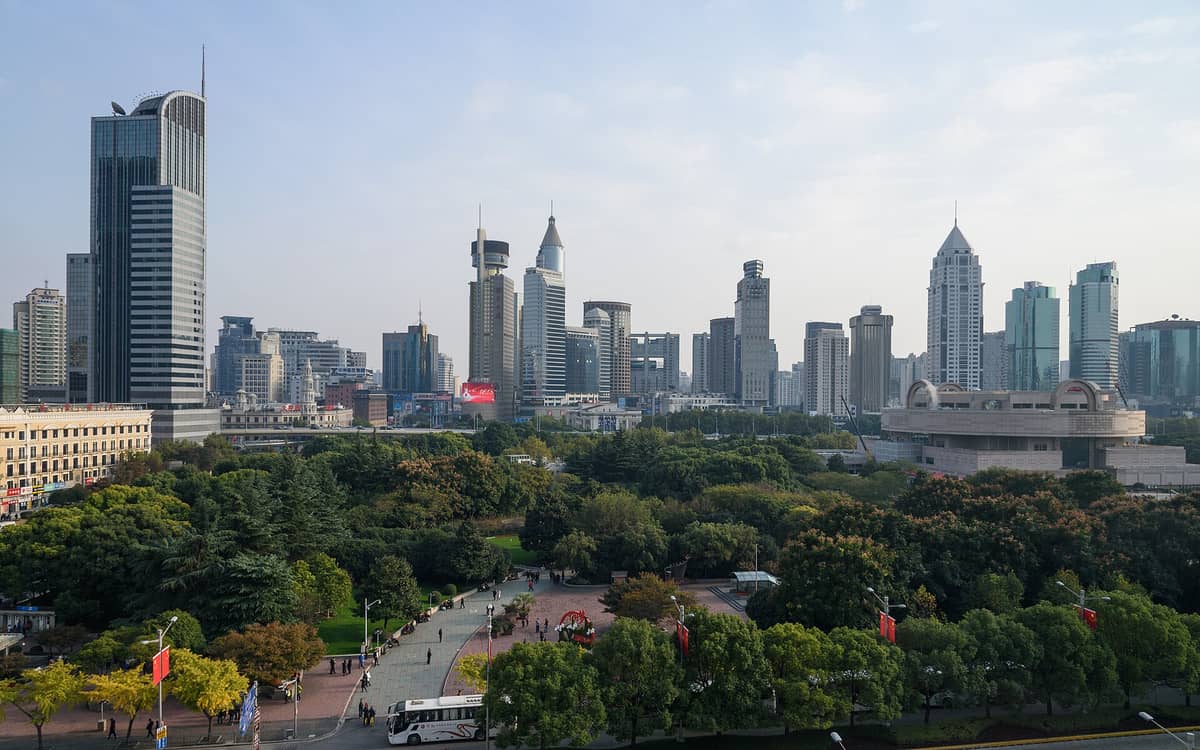
What People's Square Actually Is
People's Square (人民广场, Rénmín Guǎngchǎng) is Shanghai's central civic plaza, sitting in Huangpu District at the intersection of three metro lines and within walking distance of the Bund. It is not a theme park or ticketed attraction. The square itself is free to enter at any hour, which makes it more useful than most destinations in this price bracket: it functions simultaneously as a transport hub, a public park, a political symbol, and the forecourt of three major cultural institutions.
The ground beneath and around the square tells its own story. Before 1949, this entire site was the Shanghai Racecourse, one of the largest in Asia during the colonial era. After the founding of the People's Republic of China, the racecourse was demolished and replaced with a civic square and, later, parkland. Today the Shanghai municipal government headquarters stands on the northern edge of the site, and the square is formally recognized as the point from which highway distances across the municipality are measured.
ℹ️ Good to know
People's Square is both a park and a transit node. Metro exits emerge directly into the square, the underground shopping mall, and the museum precinct. If you arrive by Line 2 from Pudong Airport, you will pass through People's Square Station as part of your journey into central Shanghai — it is worth surfacing here.
The Square at Different Hours
The experience changes noticeably depending on when you arrive. In early morning, before 8am, the park section north of Renmin Avenue fills with older residents doing tai chi, ballroom dancing, and group exercises. The sounds at this hour are particular: a mix of recorded music floating across the gravel paths, the shuffle of rubber soles, occasional birdsong from the planted trees. The air carries the faint smell of damp earth and, near the fountain plaza, a hint of chlorine.
By mid-morning the museum queues form at the Shanghai Museum's south entrance on Renmin Avenue and at the Urban Planning Exhibition Hall. School groups arrive in clusters, and the square becomes noticeably louder. The central fountain runs on a schedule rather than continuously — check locally for current operation times, as it varies by season. Midday in summer is genuinely harsh here: the open plaza offers very little shade and the granite surfaces reflect heat aggressively. Temperatures regularly exceed 32°C from June through August, and humidity compounds the effect.
Late afternoon and early evening are when the square is at its most photogenic. The Grand Theatre on the western edge catches low western light on its curved glass facade, and the government building at the north is softened by dusk. Families return with small children, street food vendors position themselves near the metro exits, and the pace slows considerably. On clear evenings, the illuminated skyline visible from the park's elevated areas gives a sense of the city's density without requiring a tower ticket.
⚠️ What to skip
Avoid the plaza between 11am and 3pm in July and August. The open concrete offers almost no shade, temperatures can feel extreme, and the tourist volume peaks during these hours. If you must visit midday, use the underground mall beneath the square as a cool transit route between attractions.
Tickets & tours
Hand-picked options from our booking partner. Prices are indicative; availability and final rates are confirmed when you complete your booking.
Shanghai city and Zhujiajiao water town private tour with lunch
From 371 €Instant confirmationFree cancellationShanghai private tour with iconic landmarks of the old and new city
From 284 €Instant confirmationFree cancellationShangai Yuyuan Garden entrance tickets
From 9 €Instant confirmationFree cancellation
The Institutions That Make It Worth the Journey
People's Square on its own is pleasant but not a destination. The cultural institutions clustered around it are what justify the trip, and they are among the best in the city.
The Shanghai Museum occupies the southern edge of the square on Renmin Avenue. Its permanent collection of ancient Chinese art, ceramics, bronzes, and calligraphy is genuinely world-class and free to enter for permanent galleries (temporary exhibitions may require tickets and advance reservation — verify before visiting). The building itself, a circular structure referencing a Chinese bronze ding vessel set on a rectangular base, is a deliberate architectural statement about cultural continuity. Allow at least two hours if you intend to move through more than one department seriously.
The Shanghai Urban Planning Exhibition Hall sits just east of the square on People's Avenue. Its centerpiece is a scale model of Shanghai's entire urban area occupying a full floor — the kind of exhibit that makes you recalibrate the city's actual size. The exhibition documents the transformation of the metropolis from 1949 to the present, with a particular focus on the Pudong development. Entry is charged (verify current price before visiting); closed Wednesdays except national holidays, open 09:00–17:00 with last ticket sales at 16:00.
On the western edge of the square, the Shanghai Grand Theatre is one of the city's premier performing arts venues. It is not a visitor attraction in the conventional sense — you need a ticket to a performance to enter the main halls — but the exterior is architecturally striking. The sweeping glass arc of its roof, designed by French architect Jean-Marie Charpentier and completed in 1998, became one of the defining images of 1990s Shanghai. If you are interested in Shanghai's modern architectural development, the Shanghai architecture guide covers the planning context in detail.
Getting There and Moving Around
People's Square Station sits at the intersection of Metro Lines 1, 2, and 8, making it one of the most connected stops in the entire Shanghai Metro system. Line 2 connects directly to Pudong International Airport (approximately 60–75 minutes, roughly ¥7–10) and to Lujiazui in Pudong. Line 1 runs north-south through the city center. Line 8 connects to the Old Town area and Yaohua Road. There are multiple exits from the station; the most useful for the square itself are Exits 1 and 3, which bring you up directly into the plaza and toward the Shanghai Museum respectively.
Several city bus routes serve the square, including lines 46, 49, 123, 145, 312, and 451, as well as sightseeing bus routes. The square is also a natural walking distance from Nanjing Road Pedestrian Street to the northeast and from the Bund waterfront, roughly 20–25 minutes on foot through the commercial district. Taxis and Didi drop-offs are convenient along the perimeter roads but the square's central position means the metro is almost always the faster option.
💡 Local tip
If you are arriving from Pudong Airport and heading to central Shanghai for the first time, surfacing at People's Square Station on Line 2 gives you an immediate geographic anchor. The square is the city's zero-kilometer reference point — everything radiates from here.
Photography and Practical Logistics
The square's open layout is straightforward to photograph but the results can be flat without specific timing. The best compositional opportunities are at dusk, when the Grand Theatre's glass facade reflects the remaining sky, and at night, when the government building is illuminated and the fountain area clears of crowds. For broader Shanghai skyline photography, the square itself is not the strongest vantage point — the elevated terraces along the Bund waterfront or the viewing decks in Pudong are more rewarding. The best photo spots in Shanghai guide covers these options in detail.
The square is flat, open, and directly connected to metro infrastructure with level access at multiple points, making it broadly accessible for visitors with limited mobility. The Shanghai Museum has elevator access and level paths from the Renmin Avenue entrance. For detailed, venue-specific accessibility information, check each institution's current visitor guide before your trip.
Photography of the square and park is unrestricted for personal use. Photography inside the Shanghai Museum is generally permitted in permanent galleries without flash; restrictions apply in some temporary exhibition spaces. The Urban Planning Exhibition Hall permits photography of most exhibits including the scale model.
Honest Assessment: Managing Expectations
People's Square is not a place most travelers would find memorable on its own. The plaza is large, well-maintained, and historically significant, but the visual drama that defines other Shanghai landmarks is largely absent from the open ground itself. What makes the square worth your time is its function as a civic cluster: the museums are excellent, the transit connections are unmatched, and the surrounding architecture represents one of the clearest examples of how Shanghai layered modernist civic design over colonial-era infrastructure.
Visitors looking for atmospheric street life or the texture of older Shanghai neighborhoods will find more satisfaction in Tianzifang or along Wukang Road. Visitors primarily interested in the art and history museums will find People's Square one of the most productive half-days in the city. Families with children may want to note that the park area is genuinely child-friendly in the morning hours — open space, fountains when operating, and multiple food options near the metro exits.
In winter (December through February), the park can feel cold and exposed, with daily means around 4–7°C and frequent damp air. The museums become more appealing in these conditions since they are warm and uncrowded on weekday mornings. Spring and autumn visits, particularly April to May and October to November, offer the most comfortable outdoor conditions at the square itself.
Insider Tips
- The underground level of People's Square Station connects to a sprawling shopping mall. On hot summer days or rainy afternoons, you can walk between the Shanghai Museum, the Urban Planning Exhibition Hall, and the metro entirely underground without surfacing.
- The Shanghai Museum's permanent collection galleries are free, but popular temporary exhibitions fill up quickly and may require advance booking. Check the museum's official site before your visit if you have a specific exhibition in mind.
- The park section north of Renmin Avenue is significantly quieter and greener than the southern plaza. If you want to sit and observe Shanghai residents in their morning routines, enter from the northern metro exits and walk toward the small lake and tree canopy.
- People's Square is the zero-kilometer marker for highway distances in Shanghai Municipality — a small geographic footnote that makes it the literal center of the city as officially defined.
- Weekday mornings between 9am and 11am are the least crowded window for the museums. Saturday and Sunday afternoons can see significant queues at the Shanghai Museum's entrance, particularly during school holidays.
Who Is People's Square For?
- Museum-focused travelers who want to cover Shanghai's history and urban planning in a single precinct
- First-time visitors using the metro who want a central orientation point before exploring other districts
- Architecture enthusiasts interested in the contrast between 1990s civic design and the surrounding commercial skyline
- Families with young children visiting in the morning, when the park is calm and the open space gives children room to move
- Travelers connecting between Nanjing Road and the Bund who want a logical midpoint with cultural options
Nearby Attractions
Combine your visit with:
- Chongming Island
Chongming Island sits at the mouth of the Yangtze River, a vast alluvial island that functions as Shanghai's rural counterweight. Wetland reserves, a national forest park, cycling paths through farmland, and virtually no high-rises make it a genuinely different Shanghai experience.
- ERA Acrobatics Show
Running nightly at Shanghai Circus World in Jing'an District, ERA2 – Spirit of Shanghai is the city's flagship acrobatics production. Expect gravity-defying stunts, dramatic lighting, and a 60-to-100-minute show that needs no translation. Here is everything you need to know before buying a ticket.
- Jade Buddha Temple
The Jade Buddha Temple (玉佛禅寺, Yùfó Chán Sì) is one of Shanghai's most significant active Buddhist monasteries, housing two exceptional jade Buddha statues brought from Burma in the late 19th century. Unlike many temples that have become purely ceremonial attractions, this one functions as a working monastery, with monks in residence and daily rituals that visitors can witness firsthand.
- Jinshan City Beach
Jinshan City Beach (金山城市沙滩景区) is a man-made coastal resort on Hangzhou Bay, about 60 km south of central Shanghai. It is the closest thing to a genuine beach day the city offers, with designated swimming zones, a long promenade, and seasonal facilities. This guide covers what to realistically expect, when to go, and how to get there.