Palazzo Davanzati: A 14th-Century Merchant Palace Frozen in Time
Palazzo Davanzati is one of Florence's most underappreciated museums: a genuine medieval merchant house on Via Porta Rossa where you can walk through furnished rooms, examine original frescoes, and understand daily life in 14th-century Florence. Unlike the city's grand art galleries, this is a domestic space, intimate in scale and startling in detail.
Quick Facts
- Location
- Via Porta Rossa 13, Historic Centre (Centro Storico), Florence
- Getting There
- 10-minute walk from Santa Maria Novella station; 5 minutes on foot from Piazza della Signoria
- Time Needed
- 1 to 1.5 hours
- Cost
- €8 standard; combined Bargello Musei passes available; free on first Sunday of the month and select public holidays
- Best for
- History lovers, architecture enthusiasts, anyone wanting to escape the major museum crowds
- Official website
- bargellomusei.it/en/museum/palazzo-davanzati
What Palazzo Davanzati Actually Is
The Museo di Palazzo Davanzati, formally known as the Museo dell'Antica Casa Fiorentina (Museum of the Ancient Florentine House), is a medieval tower-house turned state museum at Via Porta Rossa 13 in Florence's historic centre. Unlike the Uffizi or the Accademia, this is not a gallery. It is a house, and that distinction changes everything about the experience.
The building itself was constructed in the mid-14th century for the Davizzi family, wealthy merchant-bankers who assembled it by consolidating several older tower structures on the same block. In 1578, the Davanzati family purchased it, made changes to the facade, and added their coat of arms. It opened to the public in 1910 as one of Italy's first house-museums, was acquired by the Italian state in 1951, and reopened in its current form in 1995.
What you find inside is a rare thing: a Florentine domestic interior that retains its original room structure, period furniture, frescoed walls, and household objects across multiple floors. The experience is closer to walking through a well-preserved family home than touring an art exhibition.
💡 Local tip
Floors two and three are accessible only when accompanied by museum staff and require a same-day reservation made at the entrance desk. Visiting groups are capped at 15 people plus one guide, so arrive early if you want guaranteed access to the upper levels.
The Facade: Reading a Medieval Merchant's Status
Before you enter, stand back and study the exterior from the small Piazza Davanzati. The facade is an object lesson in how medieval Florentine merchants communicated power. It is built in grey pietra forte stone, the material of serious money in 14th-century Florence. The lower floors have iron rings and brackets projecting from the stone, used to hang textiles and cage birds. The loggia crowning the top floor was a later addition, giving the building a lighter, more open skyline than the fortress-like tower-houses it replaced.
The ground floor was commercial space, not domestic. Shops opened directly onto the street, which you can still perceive in the proportions of the arched openings. The family lived above the trade, in an arrangement typical of wealthy Florentine merchants who kept work and private life in the same building but on carefully separated levels.
Tickets & tours
Live prices and dates from our booking partner. If you book, we may earn a commission at no extra cost to you.
Entrance ticket to the Palazzo Davanzati Museum in Florence
From 13 €Instant confirmationMedici series tour in Palazzo Medici Riccardi
From 90 €Instant confirmationFree cancellationPalazzo Vecchio secret passages tour with lunch or gelato tasting
From 47 €Instant confirmationFree cancellationPalazzo Vecchio and Salone dei Cinquecento guided tour
From 65 €Instant confirmationFree cancellation
Inside the Palace: Room by Room
Once inside, the ground floor introduces the courtyard, a loggia-ringed space with a well at its centre. The well shaft connects all floors of the building, a practical feature that allowed water to be drawn up to each level without descending to street level, a genuine logistical achievement for a 14th-century urban house.
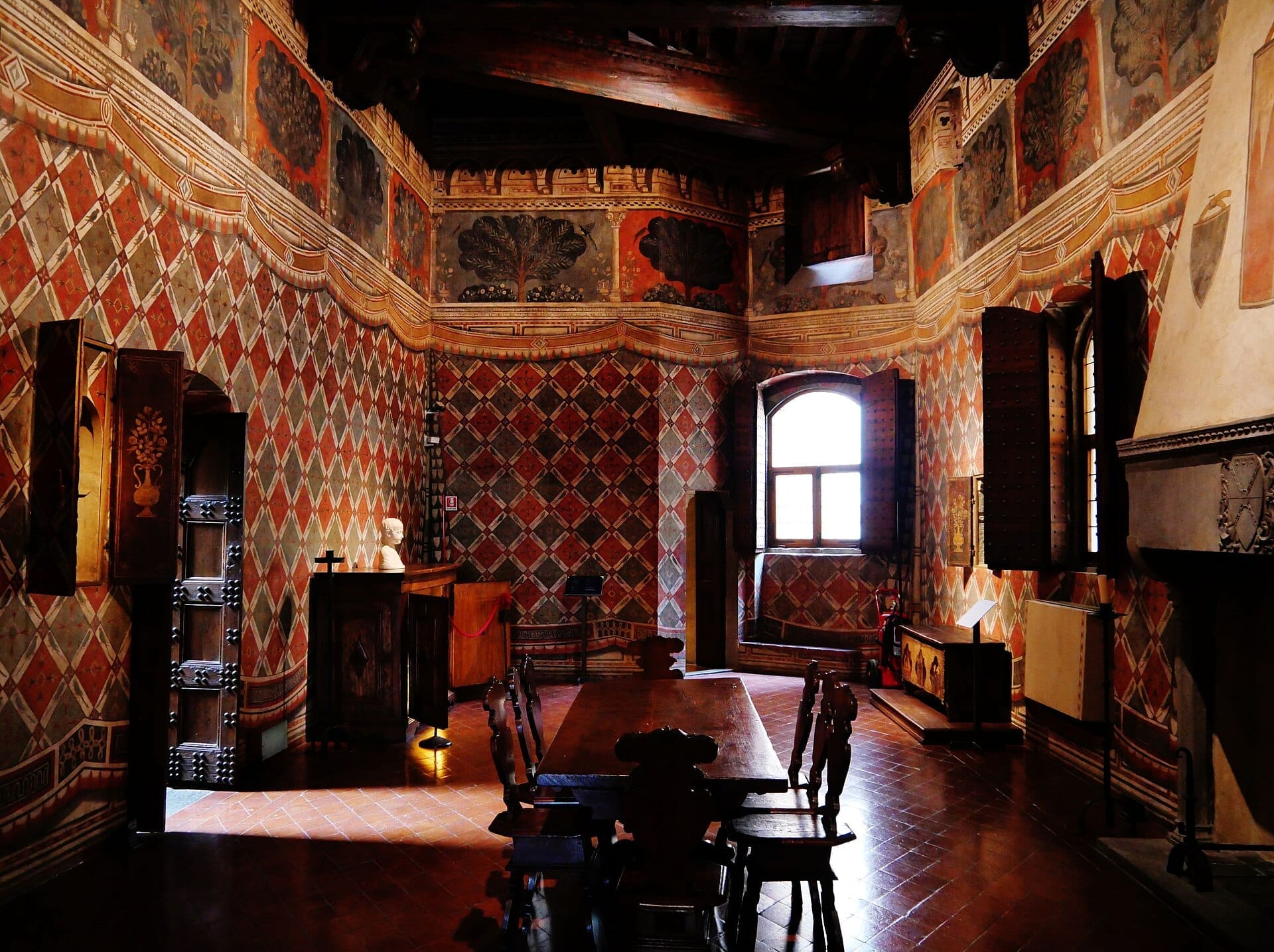
The first floor holds the reception and dining rooms. The Sala Madornale, the great hall, is the grandest space in the building. Its walls are decorated with painted false drapery in red, green and cream, a fresco technique designed to simulate expensive woven hangings. Look at the floors: the terracotta tiles have the warm, uneven tone of genuinely old ceramics, not the uniform surface of modern reproductions. The furniture, a mix of period pieces and careful reconstructions, includes heavy wooden chests that served simultaneously as storage, seating and display.
Higher floors become more intimate. The bedroom chambers contain canopied beds and small devotional objects, and the walls in some rooms retain narrative fresco cycles, including the celebrated Sala dei Pappagalli (Room of the Parrots), whose painted parrots and heraldic shields still carry distinct colour. One room on an upper floor contains fragments of what scholars believe to be illustrations from the French romance cycle of the Chatelaine de Vergy, a rare secular narrative subject for a private interior of this period.
The kitchen occupies the uppermost occupied floor, positioned there partly to reduce fire risk to the rest of the building and partly for ventilation. The collection of domestic objects here, ceramic vessels, iron implements, a large fireplace with its original hood, is among the most evocative parts of the museum. If you want to understand how preindustrial domestic life in Florence actually functioned, this room delivers more than almost any other space in the city. For further context on the surrounding neighbourhood, see our guide to theCentro Storico.
Crowds, Timing, and What to Expect by Hour
Palazzo Davanzati is open Tuesday through Sunday, 08:15 to 18:50, with the last admission 40 minutes before closing. It is closed on Mondays. Note that on Sundays the museum closes between 12:20 and 13:30 for a weekly religious service, so plan around that gap if visiting on a Sunday.
The museum attracts a fraction of the visitors that queue at the Uffizi or Accademia. In practical terms, this means that even on a busy Saturday in high season, you are unlikely to find more than a few dozen people inside at any given time. The upper floors in particular feel genuinely quiet. Morning visits, around 09:00 to 10:30, tend to be the calmest. Midday sees a slight uptick from tourists moving through the central historic core between major sites.
The interior is lit by natural light through the courtyard and windows, so the atmosphere shifts noticeably through the day. Morning light falls across the painted walls in ways that afternoon back-lighting can flatten. For photography, an overcast morning produces the most even results in the darker frescoed rooms.
ℹ️ Good to know
Free admission applies on the first Sunday of each month and on 25 April, 2 June, and 4 November. On these days, standard reservations are generally suspended. If you visit on a free Sunday, arrive when the museum opens at 08:15 to avoid the modest but noticeable increase in visitors these dates attract.
Historical and Cultural Context
Palazzo Davanzati sits in the same historic core that gave rise to the buildings aroundPiazza della Signoriaand the major civic monuments of 14th and 15th-century Florence. What makes it unusual is that it represents the domestic, private side of that same social world. The palaces around the Signoria were built to project civic and institutional power. Palazzo Davanzati was built to be lived in by a specific family, to house their wealth, raise their children, and conduct their trade.
The Davizzi who built it were neither noble nor artisan. They were merchant-bankers, the social class that financed the Florentine Republic and, eventually, underwrote the Medici. Understanding how that class organised their domestic space, what they displayed, how they allocated rooms by function and by status, adds a layer of texture to Florence that the great art collections alone cannot supply.
The building's history also reflects Florence's general arc: built at the height of mercantile prosperity in the 1300s, passing through multiple owners as fortunes shifted over the centuries, and eventually absorbed into the state museum network in the 20th century. For a broader picture of this world, theMuseo del Bargellonearby offers complementary medieval and Renaissance context, with its collection of sculpture from the same era.
Practical Walkthrough: Getting There and Navigating the Visit
The museum is located on Via Porta Rossa 13, a pedestrianised street in the heart of Florence's historic centre. From Piazza della Repubblica it is about a 3-minute walk heading south-west. From Piazza della Signoria, walk north-west and you will reach it in roughly 5 minutes. From Santa Maria Novella station, the walk takes around 10 to 12 minutes through the historic core.
Tickets cost €8 for standard admission. A reservation fee of around €4 applies if you book in advance. Combined Bargello Musei passes cover entry to multiple properties, including the Bargello itself and the Medici Chapels, and are worth considering if you plan to visit several sites across two or three days.
Upper floors require staff-accompanied access, which you arrange at the entrance on the day. Groups are capped at 15 visitors, so there may be a short wait during busier periods. The ground floor and first floor are generally self-guided. There is no café inside the museum. For a coffee or lunch break, the streets around Via Porta Rossa connect directly to the broaderCentro Storico, with options across all price ranges within a few minutes' walk.
⚠️ What to skip
Visitors with mobility requirements should contact the museum directly before visiting. Specific information about step-free access and lift availability is not published on the museum's website. Phone: +39 055 238 8610. Email: museo.davanzati@polomuseale.firenze.it.
Who Should Skip It
Palazzo Davanzati will not satisfy visitors whose primary interest is canonical Renaissance painting or monumental sculpture. The collection here is almost entirely decorative and domestic: furniture, textiles, ceramics, frescoed rooms, household objects. If you have limited time and need to choose between this and the Uffizi, the Accademia, or the Duomo complex, those will deliver a broader range of major works.
Very young children may find the interior less engaging than more visually spectacular sites. Families visiting Florence with children might instead prioritise more interactive or visually immediate experiences. For family-oriented planning, see our guide onFlorence with kids.
The upper floors also involve a guided, timed visit with a group cap of 15, which some independent travellers find limiting. If you prefer to move through spaces at your own pace and linger where you choose, factor that constraint into your decision.
Insider Tips
- Arrive at opening (08:15) and immediately ask at the desk about the next available accompanied visit to floors two and three. These fill quietly but steadily, and if you wait until you have finished the ground floor, you may find the next slot is over an hour away.
- The Sala dei Pappagalli on the upper floors contains some of the best-preserved secular fresco work in any Florentine domestic interior. Do not leave without seeing it, and bring a small torch if you have one: the painted parrots are in a corner that the overhead light does not always reach clearly.
- The free-admission first Sundays bring a noticeable influx but still nothing like the queues at the Uffizi. The 12:20 to 13:30 Sunday closure for religious services is often forgotten by visitors who arrive at midday and find the doors shut, so check your timing.
- The current combined Bargello Musei passes can be good value if you plan to visit the Bargello sculpture museum and the Medici Chapels in the same trip. Palazzo Davanzati alone at €7 is straightforward, but the combined ticket rewards a deeper dive into Florence's medieval and early Renaissance history.
- Photography is generally permitted in the public areas without flash. The courtyard well, shot from the ground floor looking upward toward the open loggia at the top, is one of the more architecturally compelling interior views in the building.
Who Is Palazzo Davanzati For?
- History and social history enthusiasts who want to understand how medieval Florentine merchants actually lived
- Architecture lovers interested in the transition from defensive tower-house to domestic palazzo
- Repeat visitors to Florence who have already covered the major galleries and want something more specific and less crowded
- Travellers with a particular interest in medieval decorative arts, textiles, ceramics, and domestic objects
- Anyone looking for a quieter, more contemplative museum experience away from the main tourist flow
Nearby Attractions
Other things to see while in Centro Storico (Historic Center):
- Arno River Walk (Lungarni)
The Lungarni are the named embankment streets running along both banks of the Arno River through central Florence. Free to walk at any hour, they offer the city's best unmediated views of the Ponte Vecchio, the surrounding hills, and the slow rhythm of Florentine daily life. No ticket, no queue, no reservation required.
- Brunelleschi's Dome Climb
The climb inside Brunelleschi's Dome is one of the most physically rewarding experiences in Florence. 463 steps through narrow brick passages deliver you to a panoramic terrace above the city's rooftops, with views that no other vantage point in the historic centre can match. Here is everything a traveler needs to plan it well.
- Florence Baptistery
The Florence Baptistery, officially the Battistero di San Giovanni, is one of the oldest and most significant religious buildings in Italy. Standing directly in front of Florence Cathedral, it is famous for Ghiberti's gilded bronze 'Gates of Paradise' and a breathtaking interior ceiling covered in Byzantine mosaics. This guide covers what to expect, when to visit, and how to make the most of your time here.
- Florence Cathedral (Duomo di Firenze)
The Cattedrale Metropolitana di Santa Maria del Fiore is the geographic and spiritual heart of Florence. Free to enter, extraordinary to stand inside, and far more layered than its famous exterior suggests. Here is everything you need to plan a worthwhile visit.
Planning a trip? Discover personalized activities with the Nomado app.