Palazzo Contarini del Bovolo: Venice's Spiral Staircase Palace
Tucked behind Campo Manin in the San Marco district, Palazzo Contarini del Bovolo hides one of Venice's most photographed architectural details: a five-storey external spiral staircase wrapped in loggias and Gothic arches. Small, with standard admission currently €9, and typically less busy than the city's headline sights, it rewards visitors who seek out the quieter corners of the city.
Quick Facts
- Location
- S. Marco 4303, near Campo Manin, San Marco, Venice
- Getting There
- On foot from Santa Lucia station (~25 min, follow Rialto signs then Calle Cavalli); or walk 10 min from Rialto Bridge
- Time Needed
- 45–75 minutes is plenty for most visitors
- Cost
- €9 standard admission (verify current prices before visiting)
- Best for
- Architecture lovers, photographers, and anyone wanting to escape the Piazza San Marco crowds
- Official website
- www.scalacontarinidelbovolo.com
What Is Palazzo Contarini del Bovolo?
Palazzo Contarini del Bovolo is a late-Gothic palace in Venice's San Marco sestiere, with its famous external staircase added in the late 15th century for the noble Contarini family. It is not famous for its interior rooms or its art collection. It is famous for one thing: the Scala Contarini del Bovolo, an external spiral staircase that climbs five storeys of the palace's rear courtyard, its open loggias and pointed arches multiplying upward in progressively lighter tiers. The word 'bovolo' means snail shell in the Venetian dialect, and the name is exactly right.
The staircase is attributed to Venetian architect Giovanni Candi and stands around 26 meters tall with roughly 80 steps. The design blends Gothic arches with early Renaissance loggia work, a combination that was fashionable in Venice at the turn of the 15th century. What makes it unusual, even by Venetian standards, is that this kind of ornamental external staircase is almost nowhere else to be found in the city. The closest visual parallel is not a Venetian building at all.
💡 Local tip
The palace sits at the end of a narrow calle just off Campo Manin. There is no large sign at the street entrance. Look for the archway at Calle della Vida (S. Marco 4303) and follow it through to the courtyard. First-time visitors frequently walk past it.
The site is operated under the Gioielli Nascosti di Venezia (Hidden Jewels of Venice) cultural initiative, which also manages several other lesser-known palaces. If you are planning to visit multiple smaller palaces in the city, it is worth checking the operator's current combined ticket options. For context on how the palace fits into the broader San Marco experience, see the San Marco neighborhood guide.
The Experience: Arriving and First Impressions
Getting to the palace is itself a lesson in how Venice hides things. Campo Manin is not a dramatic piazza. It is a mid-sized square with a central monument to Daniele Manin, the 19th-century Venetian revolutionary, a water fountain, and some benches. The foot traffic here is almost entirely local: residents cutting through toward the Rialto, workers on lunch break. The palazzo's entrance is signposted discreetly.
You pass through a narrow archway into a courtyard that feels immediately quieter than the streets outside. The staircase reveals itself all at once: the full height of it visible from the moment you step in, the stacked loggias drawing the eye upward, each tier slightly lighter and more open than the one below. On a sunny morning the stone catches the light and turns a warm amber. On an overcast afternoon the whole structure reads in softer grey tones. Both are worth seeing.
The courtyard itself is small enough that you are never more than ten or fifteen meters from the staircase. There are a few garden elements at ground level, benches, and informational panels explaining the history of the palace and the Contarini family. The smell is of old stone and, depending on the season, faint damp from the canal just beyond the walls. You can hear the canal traffic and the ambient noise of the city, muffled by the buildings around you.
Tickets & tours
Hand-picked options from our booking partner. Prices are indicative; availability and final rates are confirmed when you complete your booking.
Scala Contarini del Bovolo Entrance Tickets
From 9 €Instant confirmationScala Contarini del Bovolo Entrance Tickets
From 7 €Instant confirmationVenetian Villas of Riviera del Brenta Guided Tour from Venice
From 140 €Instant confirmationFree cancellationDoge's Palace skip-the-line tour
From 67 €Instant confirmationFree cancellation
Climbing the Staircase: What to Expect
The staircase is the main event, and it is open to visitors during standard admission. The steps are stone, worn smooth in the center from centuries of use, and the handrail is a simple iron rod. The climb is not strenuous for most visitors, but the steps are uneven and the loggias on each level have low stone balustrades. People with limited mobility or a strong fear of heights should be aware that there is no enclosed section: the staircase is open to the courtyard on every level.
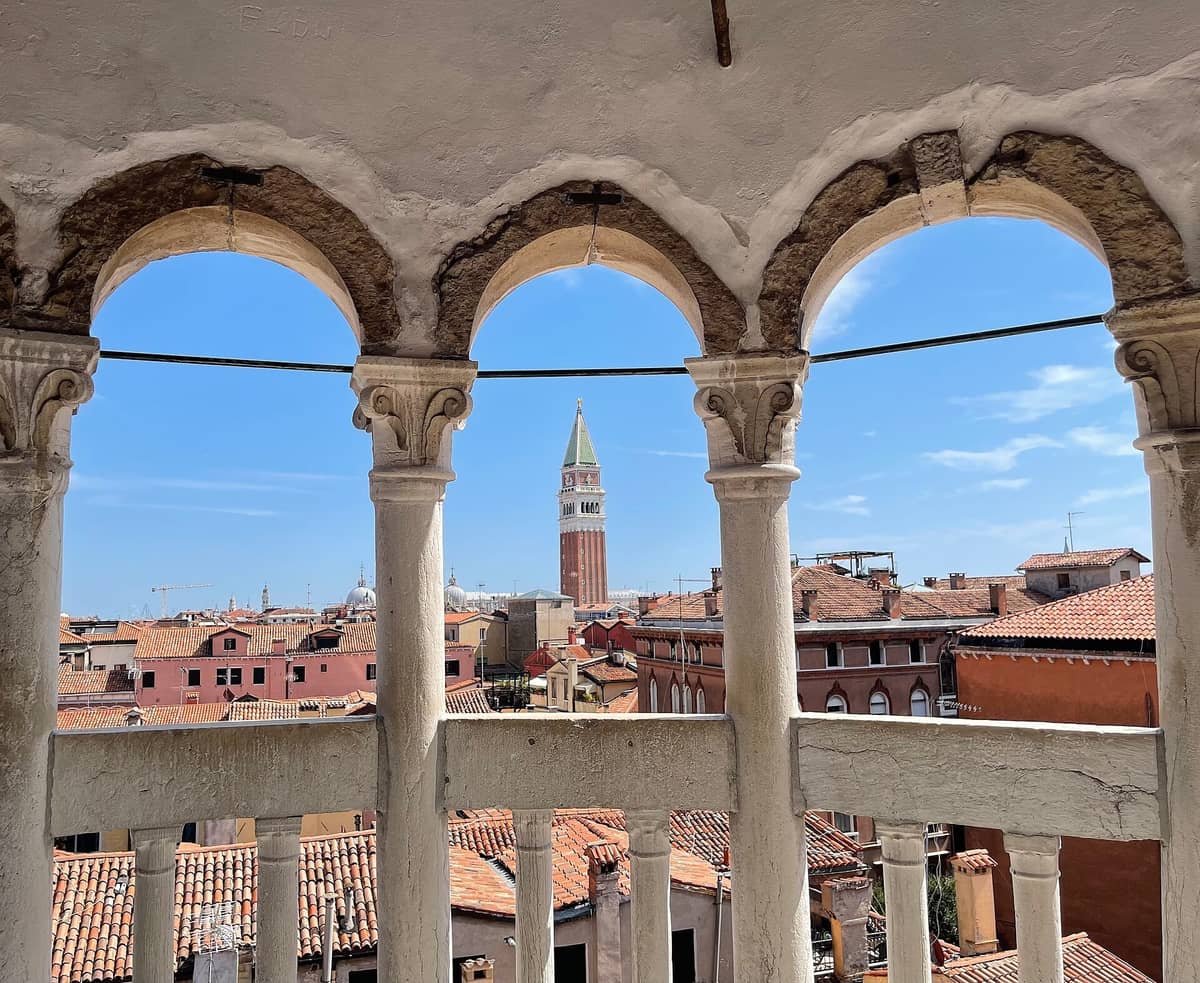
From the upper levels, the view is not Venice-wide in the way that the top of the Campanile in Piazza San Marco is. Instead you get intimate rooftop views: terracotta tiles, chimney pots, the backs of palaces, a small slice of canal. It is the kind of view that feels private, like something you were not supposed to see. The top of the staircase opens onto a loggia with a direct sightline back down the courtyard and across the rooflines of San Marco.
⚠️ What to skip
The stairs are original stone and can be slippery when damp, which happens frequently in Venice's autumn and winter months. Wear shoes with some grip. Sandals with smooth soles are not ideal.
Best Time to Visit and How Crowds Work Here
The palace does not draw the same volume of visitors as the Doge's Palace or St. Mark's Basilica, which is part of its appeal. The courtyard is small enough that even a few tour groups arriving at the same time can make it feel congested, but this is rare. Mid-morning on a weekday, roughly 10:00 to 11:30, tends to be the quietest window. Late afternoon, from around 16:00 onward, can bring a second wave of visitors finishing nearby sights.
Summer afternoons can be warm in the enclosed courtyard with limited shade. Spring and autumn offer more comfortable conditions, and the lower-angle light in October and November is particularly good for photography of the staircase facade. Winter visits are quieter and the city overall is less crowded, though the shorter daylight hours mean you will want to arrive before 14:00 to get good light in the courtyard.
Venice's autumn season also brings the possibility of acqua alta, high-water flooding. The palace itself is in a slightly elevated part of the San Marco sestiere and is not the most flood-prone location, but surrounding streets can be affected. The acqua alta guide explains what to expect and how to prepare if you are visiting between October and February.
Historical and Architectural Context
The Contarini family were one of Venice's most powerful patrician clans, responsible for eight doges over the Republic's long history. The exact patronage commission for this particular palace is not as well documented as the building's fame might suggest, but the staircase is generally dated to 1499 and credited to Giovanni Candi, a Venetian architect active during the transitional period between Gothic and Renaissance styles.
The loggia staircase form has roots in Venetian civic and domestic architecture but the Scala Contarini del Bovolo takes the concept further than almost any other surviving example in the city. Each loggia is supported by columns with delicately carved capitals, and the arches shift between Gothic pointed and rounded Romanesque forms as they ascend, creating a visual rhythm that rewards close study. Restoration work carried out in recent years has stabilized the stonework significantly; the staircase was in poor condition for several decades before its careful rehabilitation.
For comparison, the grandest Gothic facades in Venice face outward onto the Grand Canal. The palazzo's staircase faces inward, a private gesture hidden from canal traffic. It sits in an entirely different register from the monumental Gothic of the Doge's Palace just a fifteen-minute walk away.
Getting There: Practical Navigation
There is no vaporetto stop immediately adjacent to the palace. The most straightforward approach on foot from the Santa Lucia train station takes approximately 25 minutes: follow the main signs toward Rialto as far as Campo San Bartolomio, then turn south toward Campo Manin. From the Rialto Bridge the walk is around 10 minutes heading south along the main pedestrian corridors.
The nearest vaporetto stop is broadly Rialto (lines 1 and 2 on the Grand Canal), from which the palace is a 10-minute walk. Alternatively, the Sant'Angelo stop on the Grand Canal (line 1) places you slightly closer from the west side. The area around Campo Manin has good signage, but the final approach to the palace entrance on the narrow calle is easy to miss on a first visit.
ℹ️ Good to know
Opening hours: 27 Oct 2025 to 22 Feb 2026, daily 9:30 to 17:30, last admission 17:00. 23 Feb 2026 to 25 Oct 2026, daily 10:00 to 18:00, last admission 17:30. Closed 25 and 26 December. Verify current hours before visiting as seasonal schedules apply.
Photography: Making the Most of the Staircase
The staircase is highly photogenic but the small courtyard creates real compositional challenges. A wide-angle lens (or a wide setting on a phone) is almost essential to capture the full height of the structure from ground level. Standing at the far end of the courtyard and pointing the camera upward gives the most dramatic perspective, with the loggias converging toward the top. Midday direct sunlight can create harsh shadows between the arches; softer morning or late-afternoon light makes the stonework read more evenly.
From the upper loggia levels, the view downward into the courtyard is a strong secondary shot, showing the spiral form and the geometric repetition of the arches from above. The palace also photographs well from the outside at street level if you can find the right angle through the archway entrance, giving a framed view of the staircase beyond.
If architectural photography is central to your Venice visit, the palace pairs well with other nearby examples of Gothic and early Renaissance detailing, including the Ca' d'Oro on the Grand Canal, and the remarkably intact Santa Maria dei Miracoli in Cannaregio.
Worth It?
At €9 and under an hour of your time, Palazzo Contarini del Bovolo is one of the better-value architectural experiences in Venice. It is not a museum with collections to browse; the experience is essentially the courtyard and the staircase climb. If you are hoping for sweeping lagoon panoramas or a rich interior, this is the wrong stop. If you find ornamental Gothic stonework genuinely interesting, or if you simply want a quiet ten minutes away from the crowds around Piazza San Marco, it delivers.
Visitors who prefer large-scale, landmark experiences, or who have very limited time in Venice and need to prioritize, may find this a lower priority than the city's headline attractions. It is also not suitable for visitors with significant mobility limitations, given the irregular stone steps and open-sided staircase structure.
Insider Tips
- The entrance calle is easy to miss: look for the arch marked Calle della Vida off the southern side of Campo Manin. Walk through the passage and the courtyard opens in front of you.
- Arrive within the first 30 minutes of opening on a weekday. The courtyard holds only a modest number of people comfortably, and early morning light on the staircase from the east is especially warm.
- The palace is a five-minute walk from Campo Santo Stefano, which has several good cafes. A coffee before or after makes a natural addition to the visit without adding extra navigation.
- The informational panels in the courtyard are in Italian and English and give genuinely useful detail about the Contarini family and the restoration history. They are worth reading, not just passing.
- If you visit in late October or November, the lower sun angle means the staircase catches long horizontal light from the west in the late afternoon, creating strong shadows across the loggias that photograph very well.
Who Is Palazzo Contarini del Bovolo For?
- Architecture and design enthusiasts who want to study Gothic-Renaissance detailing up close
- Photographers looking for a contained, manageable subject away from crowd-heavy locations
- Travelers on a second or third Venice visit who have already covered the headline sights
- Anyone with €9 and an hour to spare who wants to understand why Venice still surprises people
- Visitors following a broader San Marco walking route who want to add a low-key but genuinely interesting stop
Nearby Attractions
Other things to see while in San Marco:
- Bridge of Sighs (Ponte dei Sospiri)
The Ponte dei Sospiri is one of Venice's most photographed structures, an enclosed white limestone bridge linking the Doge's Palace to the New Prisons over the narrow Rio di Palazzo canal. You can see it for free from the Ponte della Paglia, or cross it from the inside as part of a Doge's Palace ticket. Here is everything you need to visit it well.
- Doge's Palace (Palazzo Ducale)
Doge's Palace is the Gothic heart of Venice's political history, rising at the edge of Piazza San Marco with a facade unlike anything else in Italy. This guide covers what you'll actually experience inside, when to visit for smaller crowds, and how to make the most of one of Europe's most significant civic buildings.
- Grand Canal (Canal Grande)
The Canal Grande is the main artery of Venice, a reverse-S shaped waterway stretching 3.8 km through the heart of the city and lined with more than 170 palaces spanning six centuries of Venetian architecture. Free to view at any hour, it rewards visitors who know when and how to travel it.
- Museo Correr
Occupying the grand Napoleonic Wing and part of the Procuratie Nuove above Piazza San Marco, the Museo Correr holds centuries of Venetian civic history, Renaissance painting, and lavishly decorated royal apartments. It rewards visitors who take their time, and it's consistently overlooked by crowds fixated on the Doge's Palace next door.