Oscar Wilde Memorial Sculpture, Merrion Square: A Close Look at Dublin's Most Theatrical Monument
Unveiled in 1997, the Oscar Wilde Memorial Sculpture in Merrion Square Park is one of Dublin's most distinctive public artworks. Made from nephrite jade, thulite, and a 35-tonne quartz boulder, it sits directly opposite Wilde's childhood home — and it's completely free to visit.
Quick Facts
- Location
- North-west corner, Merrion Square Park, Dublin 2 — opposite 1 Merrion Square (Wilde's childhood home)
- Getting There
- Short walk from the city centre; served by Dublin Bus routes nearby along Nassau Street and Merrion Square
- Time Needed
- 15–30 minutes to examine the sculpture and read the inscriptions; longer if you combine with a walk around the park
- Cost
- Free — no admission required; Merrion Square Park is a public city park
- Best for
- Literature lovers, architecture fans, photography, and anyone who appreciates craftsmanship in public art
- Official website
- http://www.talkingstatuesdublin.ie/statues/oscar
What You're Looking At: The Sculpture in Detail
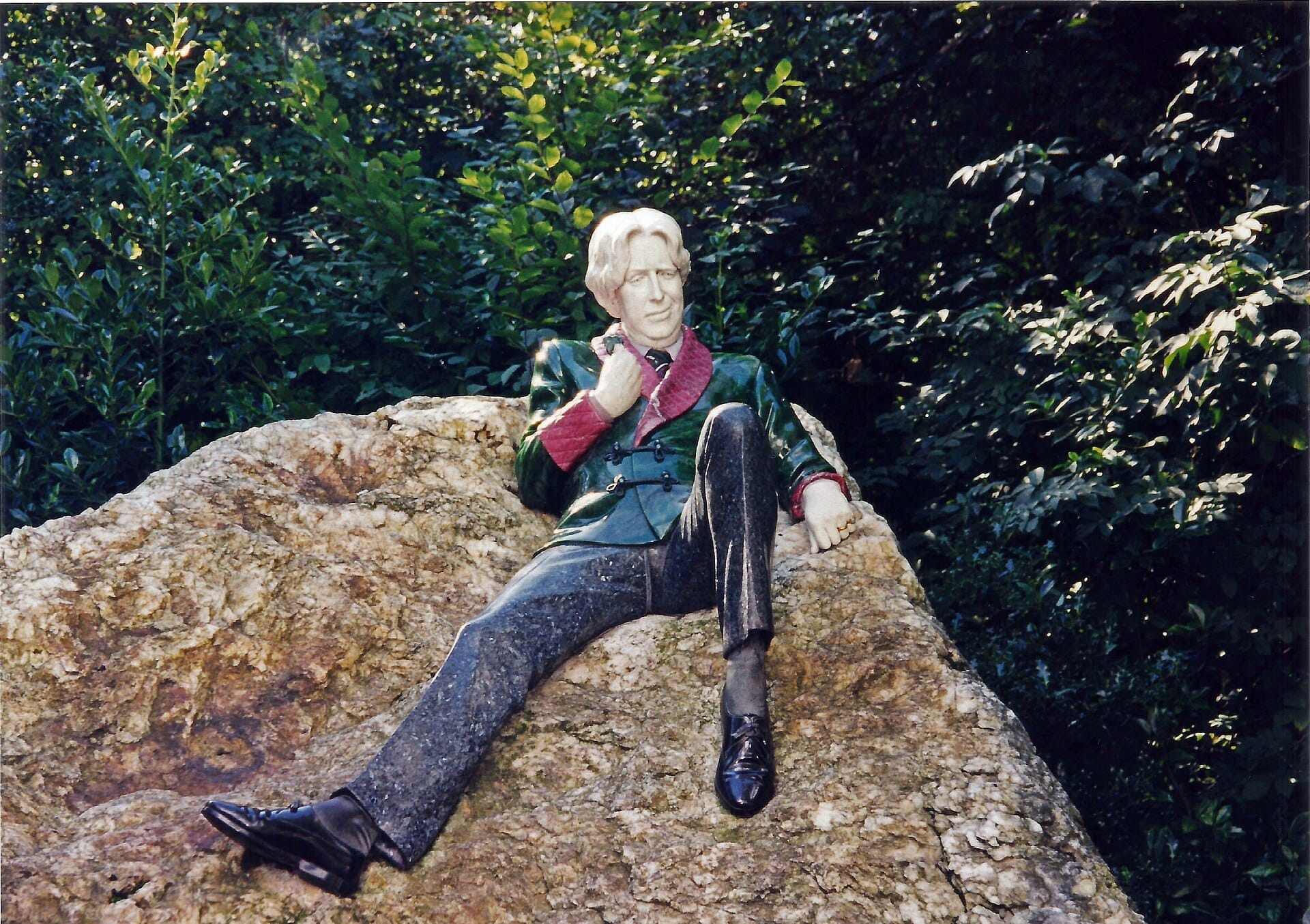
The Oscar Wilde Memorial Sculpture is not your standard civic monument. Where most public statues plant their subjects upright on a pedestal, this one sprawls. Wilde reclines across a 35-tonne quartz boulder in the north-west corner of Merrion Square Park, one leg crossed, head tilted, wearing the expression of a man who finds the world mildly amusing. The pose is deliberate: it captures the playwright's studied nonchalance more effectively than any formal stance could.
Sculptor Danny Osborne completed the work in 1997, choosing materials with the same care Wilde brought to his own wardrobe. The smoking jacket is carved from nephrite jade — a deep, waxy green. Pink thulite forms the collar and cuffs. The face and hands are rendered in a pale stone that catches light differently depending on the time of day and the direction of the sun. Up close, the surface textures are extraordinary: the jacket has a convincing softness to it, while the quartz boulder beneath him is rough and warm-toned, almost volcanic.
💡 Local tip
Walk around all three parts of the monument. Beyond the reclining figure, two pillars carry inscriptions and imagery — including a depiction of Wilde's wife, Constance, on one pillar, and a male torso representing his lover Lord Alfred Douglas on the other. Most visitors photograph the main figure and miss the rest.
The monument as a whole makes more sense once you know it has three distinct components: the reclining Wilde, plus two freestanding pillars. Together they reference the central relationships and contradictions of his life. The inscriptions include excerpts from his writing, and readers who spend time with them will find lines that land differently given the biographical context.
The Location Is the Point: Merrion Square and 1 Merrion Square
The placement of the sculpture is not incidental. It faces directly across the road toward 1 Merrion Square, the Georgian townhouse where Oscar Wilde grew up. His father, Sir William Wilde — a prominent surgeon — lived there, and the family home placed young Oscar at the centre of Dublin's intellectual and social life from an early age. The building still stands, now marked with a plaque, and looking from the statue toward that facade gives the whole memorial a quiet biographical weight.
Merrion Square itself is one of Dublin's finest Georgian spaces, and the sculpture benefits from that setting. The surrounding Merrion Square Park is well-maintained, with open lawns, mature trees, and benches that make it a popular lunchtime destination for office workers from the nearby government buildings. On weekday mornings it is relatively quiet; by midday the park fills with people eating sandwiches and walking dogs, which creates an oddly domestic backdrop for a literary landmark.
On weekend mornings, particularly in summer, the northwest corner near the statue tends to have a steady flow of visitors, but rarely feels crowded. The open park setting means there are no queues, no timed entries, and no barriers between you and the work. You can stand inches from the jade jacket and examine the carving in detail, which is something most museum exhibits do not permit.
Tickets & tours
Hand-picked options from our booking partner. Prices are indicative; availability and final rates are confirmed when you complete your booking.
Giant's Causeway, Dark Hedges, and Belfast Tour from Dublin
From 85 €Instant confirmationFree cancellationDublin self-guided audio tour
From 10 €Instant confirmationBird of Prey, Cliffs of Moher and Aillwee Cave from Dublin
From 201 €Instant confirmationFree cancellationGame of Thrones Studio tour with return transfer from Dublin
From 63 €Instant confirmationFree cancellation
How the Light Changes the Experience
The sculpture behaves differently at different hours. In the morning, when the sun comes from the east and strikes the park at a low angle, the nephrite jade jacket reads as a deep, almost grey-green, and the boulder's quartz crystals catch the light in small, bright points. This is arguably the most photogenic time: the shadows are long, the contrast is high, and the park is quiet enough that you can compose a shot without other tourists walking into frame.
In afternoon light, particularly on clear days in late spring and summer, the jade warms to a richer green and the thulite collar takes on a rosy tone that photographs well with a long lens from across the path. Overcast days are equally interesting — the even light removes the shadows that can obscure the carving's finer details, and the stone colours become more saturated rather than less.
ℹ️ Good to know
For photography: a morning visit on a weekday, roughly between 9am and 11am, gives you the best combination of good light, low crowds, and an uncluttered background. The park's trees provide a natural frame from the south side of the path.
Wilde in Dublin: Why This Memorial Matters
Oscar Wilde was born in Dublin in 1854 and left for Oxford at 17, after which his life — his writing, his trials, his imprisonment, and his death in Paris in 1900 — unfolded far from Ireland. Dublin's relationship with Wilde was historically ambivalent: the city celebrated his wit but was slower to acknowledge his sexuality and the circumstances of his prosecution under Victorian obscenity laws. The 1997 memorial, unveiled nearly a century after his death, was partly an act of cultural reclamation.
The choice of Merrion Square was intentional: it roots Wilde's legacy in his Dublin origins rather than in London or Paris, where his literary career peaked. Visitors with a deeper interest in Wilde's life in the city can follow the Dublin Literary Trail, which takes in a number of locations associated with writers who grew up in or were shaped by the city.
It is worth noting that the monument was unveiled on 28 October 1997, which would have been Wilde's 143rd birthday. The date was not chosen casually. The sculpture was funded through private and public contributions. The result is one of the few public monuments in Dublin that manages to be genuinely expressive rather than merely commemorative.
Combining the Visit with the Surrounding Area
The statue sits within easy walking distance of several significant attractions. The National Gallery of Ireland is at the western edge of Merrion Square and makes a natural pairing — particularly on a rainy day when lingering in the park becomes less appealing. Entry to the permanent collection is free.
A few minutes south brings you to the National Museum of Ireland – Archaeology on Kildare Street, also free. The combined weight of these institutions makes Merrion Square one of the more culturally concentrated blocks in the city, and a morning here can cover the Wilde statue, a full gallery visit, and coffee in a neighbourhood that is quieter and less commercially pressured than the Grafton Street and St Stephen's Green area just to the west.
The park itself has a weekend art market along its railings, where local artists sell paintings and prints. If you are visiting on a Saturday or Sunday, the route from the Wilde statue along the park's perimeter is worth walking for that alone.
Practical Notes: Access, Accessibility, and Honest Caveats
Merrion Square Park is a public city park with free access during opening hours, which are managed by Dublin City Council and change seasonally. The Wilde statue requires no separate ticket or booking. There are no audio guides or interpretation panels on site beyond the inscriptions on the monument itself, so visitors who want deeper context are better served by reading about the work in advance.
The park paths are paved and level, making the sculpture accessible to wheelchair users and those with pushchairs. The sculpture sits on a raised boulder and is not designed for climbing. Viewing from the surrounding path gives a clear sightline to the full figure and the two companion pillars.
⚠️ What to skip
The park's opening and closing times change seasonally and are set by Dublin City Council. Check current hours before planning an early morning or late evening visit, particularly in winter when the park may close earlier.
A word of honest appraisal: if you are expecting a large, imposing monument, the Wilde statue may surprise you with its scale. It is not small, but the reclining pose means it reads differently from a distance than a standing figure would. Some visitors walk past the park corner without noticing it immediately. The reward is in getting close and spending time with the materials and the details — which are genuinely exceptional — rather than in a dramatic first impression from the street.
Insider Tips
- The two companion pillars are frequently overlooked. Stand in front of each one separately and read the inscriptions — the pillar depicting Constance Wilde includes a quote that adds considerable irony given the circumstances of their marriage.
- If you visit on a weekday lunchtime, the park benches nearest the statue fill with people from the nearby government offices and Georgian offices around the square. The contrast between office workers eating lunch and tourists photographing an elaborate literary memorial gives the spot an oddly grounded, un-touristic atmosphere.
- The jade jacket and thulite collar photograph best in soft, overcast light rather than direct sun. On bright days, the quartz boulder can blow out highlights in photos; position yourself so the figure is against the park's green background rather than the open sky.
- 1 Merrion Square — Wilde's childhood home across the road — bears a commemorative plaque. It takes about 20 seconds to cross and read it, and doing so before looking back at the statue helps you understand why the sculpture faces the direction it does.
- The Talking Statues Dublin project has an audio recording accessible via QR code or the project's website that lets Wilde 'speak' at this location. It is worth queuing up before you arrive — it adds a layer of context that no physical panel could provide.
Who Is Oscar Wilde Statue, Merrion Square For?
- Literary travellers with an interest in Wilde, Victorian literature, or Irish cultural history
- Photographers looking for a sculptural subject with unusual materials and varied lighting conditions
- Visitors combining a free morning itinerary around Merrion Square's galleries and museums
- Families with older children who have encountered Wilde's work at school and want a real-world anchor
- Architecture and urban design enthusiasts interested in how public monuments interact with Georgian streetscapes
Nearby Attractions
Other things to see while in St Stephen's Green & Grafton Street:
- George's Street Arcade
Built in 1881 as Ireland's first purpose-built shopping centre (later rebuilt after an 1892 fire), George's Street Arcade is a red-brick Victorian market hall on South Great George's Street, Dublin 2. Free to enter and open daily, it houses a mix of vintage clothing, records, antiques, food stalls, and independent retailers beneath a soaring glazed roof.
- Grafton Street
Grafton Street is Dublin's most recognisable shopping street, running 500 metres through the heart of the city from St Stephen's Green to College Green. Pedestrianised in the early 1980s, it draws everyone from commuters and coffee-seekers to tourists and street musicians. Entry is free and the street is open daily.
- Iveagh Gardens
Tucked behind the National Concert Hall on Clonmel Street, Iveagh Gardens is a free, formally designed Victorian park covering around 5 acres in the heart of Dublin 2. Opened to the public after years of restoration, it offers fountains, a rosarium, a cascade waterfall, and woodland walks with a fraction of the foot traffic you'll find at nearby St. Stephen's Green.
- Little Museum of Dublin
Housed in a Georgian townhouse at 15 St. Stephen's Green, the Little Museum of Dublin distills over a century of city life into a compact series of rooms and thousands of donated artefacts. Entry is by guided tour only, making this one of Dublin's most intimate and unexpectedly absorbing cultural experiences.