One Tree Hill (Maungakiekie): Auckland's Most Storied Volcanic Summit
One Tree Hill, known in te reo Māori as Maungakiekie, is one of Auckland's most significant volcanic cones: a free-to-visit, walkable summit that offers panoramic city views, a 21-metre obelisk honouring Māori people, and one of New Zealand's largest pre-European archaeological sites. It rewards visitors who come with some historical curiosity as much as those simply looking for a walk above the city.
Quick Facts
- Location
- 672 Manukau Road, Epsom (One Tree Hill Domain, adjacent to Cornwall Park)
- Getting There
- Multiple bus routes along Manukau Road; check Auckland Transport (AT) journey planner for current services
- Time Needed
- 1.5 to 3 hours, depending on pace and how much of Cornwall Park you explore
- Cost
- Free to enter; no admission charge listed as of February 2025 (verify before visiting)
- Best for
- Panoramic views, Māori history, photography, dog walkers, and families after an accessible outdoor experience
What Is One Tree Hill?
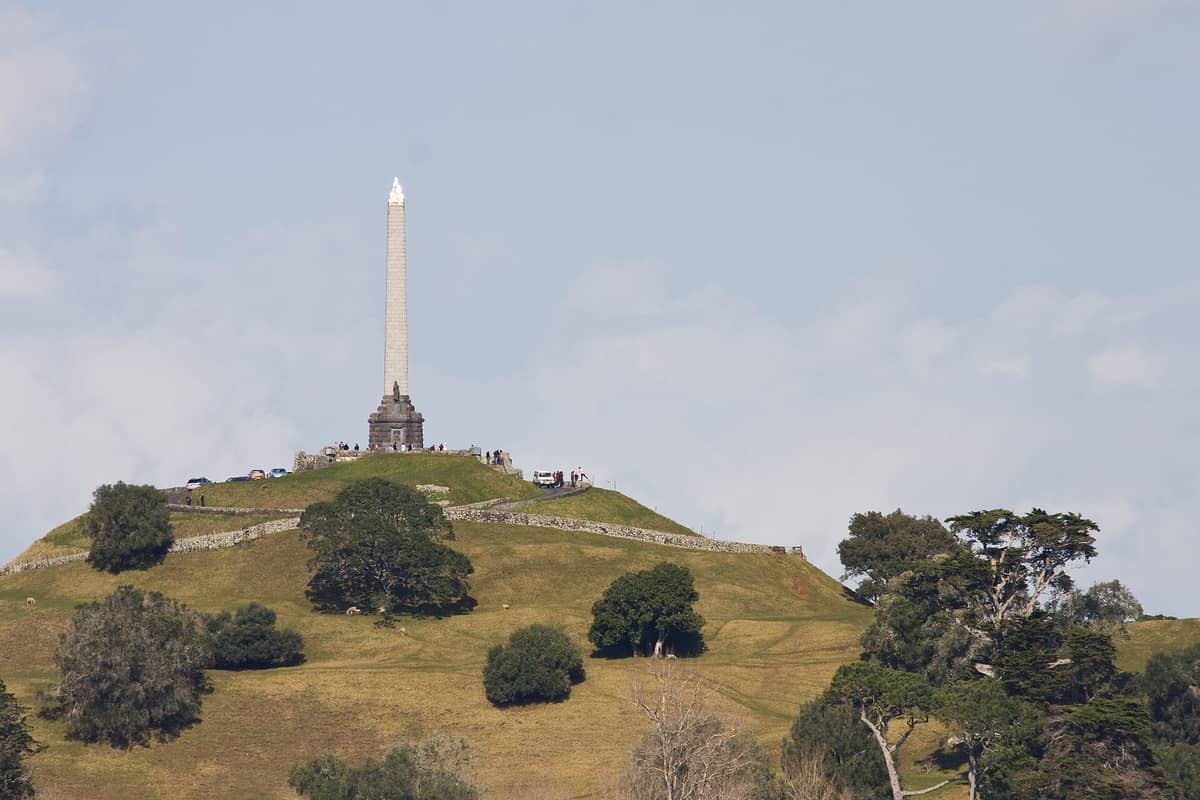
Maungakiekie / One Tree Hill is a 183.5-metre volcanic cone in the Epsom suburb of Auckland, sitting within One Tree Hill Domain, adjacent to Cornwall Park. It is among the most culturally significant landmarks in Tāmaki Makaurau Auckland: a pre-European Māori pā of considerable scale, a working sheep-grazed hillside, and a summit crowned by a 21-metre stone obelisk bequeathed by early settler and civic figure Sir John Logan Campbell as a memorial to Māori people. Campbell himself is buried on the summit beside the obelisk.
The summit road has been closed to vehicles since 2018, which means everyone walks up. That single change has significantly improved the experience: the path is quieter, the sheep graze right alongside the track, and the ascent feels earned rather than incidental. You will not mistake this for a casual stroll in a city park. The upper slopes are steep enough to get your heart rate up, and the wind at the summit can be sharp even on a clear day.
💡 Local tip
Start from the Manukau Road entrance to One Tree Hill Domain at 672 Manukau Road, Epsom. Auckland Council notes visitor parking near the start of the summit road. The summit road is walking-only, so allow time for a proper climb rather than a quick stop.
The Archaeology and History Behind the Landscape
Maungakiekie is not just a scenic hill. It is one of New Zealand's largest pre-European archaeological sites. The terraced earthworks that ring its slopes are the physical remains of a substantial Māori pā, a fortified settlement that made use of the volcanic cone's natural defensibility. These terraces are visible to any attentive walker: broad flat cuts into the hillside that once held dwellings, storage pits, and defensive works. The scale of the site becomes more apparent as you climb.
Auckland sits on the Tāmaki Makaurau volcanic field, a geologically young and still-active field of around 53 individual volcanoes. Maungakiekie is one of the larger cones in the urban landscape. The rock beneath your feet is basalt, dark and dense, and in places it breaks through the grass in sharp outcrops near the summit.
For a broader understanding of how Auckland's volcanic landscape shapes the city, the Auckland volcanic cones guide puts Maungakiekie in useful context alongside other cones like Maungawhau / Mount Eden and Ōtāhuhu / Mount Richmond.
The obelisk at the summit was constructed following Campbell's instructions and is a genuine piece of 19th-century civic symbolism: a pākehā settler acknowledging, in stone and in perpetuity, the people whose land the city was built upon. It is not a triumphalist monument. Standing beside it, reading the inscription, carries more weight than most plaques in the city manage.
Tickets & tours
Live prices and dates from our booking partner. If you book, we may earn a commission at no extra cost to you.
Luggage Storage in Auckland
From 5 €Instant confirmationFree cancellationNew Zealand West Coast discovery tour
From 100 €Instant confirmationFree cancellation13,000ft skydiving experience in Auckland
From 195 €Instant confirmationFree cancellationDiscover Auckland City Tour
From 88 €Instant confirmationFree cancellation
The Walk Up: What to Expect on the Ground
The summit path begins at the Manukau Road entrance and winds steadily upward through Cornwall Park's grazed grassland. The lower section passes through tree cover, but the upper half is open to the sky. Sheep and occasionally cattle share the park and are accustomed to walkers; they tend to cluster near the track in the morning and move to shadier spots by midday.
The path surface is mostly grass and compacted earth, with some gravel sections. After rain it becomes slippery in places, particularly on the steeper upper slopes. Sturdy footwear is strongly recommended. Sandals or flat-soled shoes are likely to cause problems on the descent, where the gradient catches people off guard.
At the summit, the obelisk dominates the immediate view, but the 360-degree panorama quickly draws the eye outward. On a clear day you can see the Hauraki Gulf to the east, the Waitākere Ranges to the west, the Manukau Harbour to the south, and the city's skyline to the north. The Sky Tower is identifiable from up here, as are several other volcanic cones scattered across the urban area.
⚠️ What to skip
The upper slopes have no shelter from wind or rain. Auckland's weather can shift quickly at any time of year. Bring a light waterproof layer even on days that look settled from the city below.
Time of Day and Crowd Patterns
Early morning, between 6:30 and 8:30 am, is when the hill belongs almost entirely to locals: dog walkers, joggers doing laps of the park, and the occasional dedicated photographer chasing soft light on the obelisk. The grass holds dew until the sun clears the eastern ridge, and the city sounds below are muted. This is the quietest and, by most measures, the most atmospheric time to visit.
By mid-morning on weekends and during school holidays, the number of visitors increases noticeably. Families with children, groups of tourists, and weekend hikers all arrive through the 10 am to 1 pm window. The summit becomes genuinely crowded on fine weekend afternoons in summer, when the park below fills with picnickers and the summit track becomes a steady stream of people.
Late afternoon, from around 4 pm onwards, is worth considering as an alternative to mid-morning. The crowds thin, the light turns golden on the terraced slopes, and the city below starts showing its evening face. Sunset from the summit, when conditions cooperate, can be striking, though cloud cover is unpredictable. Check conditions before heading up late in the day, as parts of the park may be less well-lit once darkness falls.
Cornwall Park: The Broader Setting
Maungakiekie sits beside Cornwall Park, a 172-hectare working farm and public park that Sir John Logan Campbell donated to the people of Auckland in 1901. The park includes tree-lined avenues, a historic homestead, public picnic areas, and grazing livestock. It is a genuinely pleasant place to spend time beyond just the summit walk. The Cornwall Park grounds are worth exploring at their own pace, especially the avenue of mature trees along the lower circuit paths.
Vehicle access to the summit road closed in 2018, making access to the maunga walking-only for ordinary visitors. The lower roads within Cornwall Park are still driveable and there is parking available, but the summit itself is a walking experience. This is, on balance, an improvement: the hill feels less like a tourist stop and more like an actual landscape.
Photography, Accessibility, and Practical Notes
For photography, the obelisk reads best in the hour after sunrise and the hour before sunset, when the stone takes on warmth from low-angle light. The wide-angle view from the summit is best captured in clear morning conditions before haze develops over the harbour. A compact tripod is useful for sunrise visits when light levels are low.
Accessibility is limited. The Auckland Council path description notes the route is steep in places and best suited to confident walkers. Vehicle access to the summit is available for visitors with limited mobility who cannot safely walk to the top; contact Auckland Council for current access guidance before visiting.
One Tree Hill pairs naturally with Mount Eden (Maungawhau), Auckland's other prominent volcanic summit, which sits a few kilometres to the north and offers a different vantage on the city. A half-day combining both cones is a practical itinerary for anyone with a strong interest in Auckland's volcanic landscape or Māori heritage. Both are free and accessible without a car, though transit connections between them require some planning via the AT journey planner.
If you are building a broader day around the area, the Auckland 3-day itinerary includes practical suggestions for combining volcanic cone walks with other city highlights, including the waterfront and inner-city neighbourhoods.
Who Should Think Twice Before Visiting
Visitors who are looking primarily for a flat, easy park stroll may find the summit walk more demanding than expected. There are flatter walking options within Cornwall Park itself, but the summit is genuinely steep on its upper section. Anyone with limited mobility or difficulty on uneven surfaces should assess the route honestly rather than assuming it will be manageable.
The summit view, while genuinely good, is sometimes overpromised. On overcast days, which are common in Auckland's autumn and winter, the panorama disappears into grey cloud and the experience becomes more about the archaeology and the obelisk than the scenery. That is still worth the walk, but it is a different experience from a clear summer morning.
Travellers primarily motivated by urban scenery and city skyline views, rather than natural or historical context, might find Auckland Sky Tower a more reliable option for guaranteed panoramic visibility, regardless of cloud cover.
Insider Tips
- Arrive before 8 am on weekdays if you want the summit largely to yourself. The park opens to early walkers and the light in summer is excellent well before most tourists arrive.
- The terraced earthworks on the slopes are easy to miss if you stay on the main path. Slow down on the upper sections and look at the hillside itself: the wide horizontal cuts are the archaeological remains of the pā.
- Cornwall Park's vehicle gates have separate operating hours from the park's pedestrian access. Check Cornwall Park's current gate hours if you are planning to drive in early or stay late.
- The wind at the summit is consistently stronger than conditions at the base. A light windproof layer is worth packing even on warm days.
- Dogs are welcome in Cornwall Park, but livestock grazing means dogs must be on a leash at all times. Dogs are welcome in Cornwall Park, but livestock grazing means dogs must be on a leash at all times.
Who Is One Tree Hill (Maungakiekie) For?
- History-curious travellers who want context for the Māori landscape that became Auckland
- Photographers looking for a summit vantage point with foreground interest (the obelisk) and wide harbour views
- Families with older children who can handle a moderate uphill walk
- Early risers who prefer to see a landmark before the crowds arrive
- Auckland visitors wanting a free half-day activity that combines exercise, scenery, and genuine cultural significance
Nearby Attractions
Combine your visit with:
- Auckland Botanic Gardens
Spread across 64 hectares in Manurewa, the Auckland Botanic Gardens offer free entry every day of the year, with themed garden collections, 10 hectares of native forest, and a visitor centre on site. It sits south of the city centre and rewards a longer visit than most people initially plan for.
- Auckland Zoo
Auckland Zoo has been part of the city's fabric since 1922, sitting in the Western Springs precinct with a collection that spans native New Zealand wildlife and international species. This guide covers everything from ticket prices and transit options to the best time of day to arrive and which exhibits deliver the most.
- Bastion Point (Takaparawhau)
Takaparawhau, known widely as Bastion Point, is a grassy headland in Ōrākei where Māori history, colonial conflict, and sweeping Waitematā Harbour views converge. It costs nothing to visit, carries centuries of significance, and rewards visitors who take time to understand what they are standing on.
- Bethells Beach (Te Henga)
Bethells Beach, officially Te Henga (Bethells Beach), is a raw, dramatic stretch of black-sand coastline about 45 minutes west of central Auckland. With rolling dunes, a freshwater lagoon, strong surf, and zero phone coverage, it delivers a genuine wilderness experience rare for a city of 1.6 million people.
Planning a trip? Discover personalized activities with the Nomado app.