Nuraghe Palmavera: Alghero's Bronze Age Village Worth the Detour
Nuraghe Palmavera is one of northwestern Sardinia's most accessible and rewarding nuragic sites, set just outside Alghero along the road to Capo Caccia. A twin-towered central complex surrounded by the ruins of roughly 50 stone huts, it offers a rare, grounded encounter with Sardinia's ancient Nuragic civilization — without the crowds of more famous sites.
Quick Facts
- Location
- SS 127 bis, km 45.450, between Alghero and Porto Conte — about 12 km northwest of Alghero city centre
- Getting There
- By car: follow SS 127 bis toward Porto Conte/Capo Caccia. By bus: ARST lines 9320 or 9321 from Alghero toward Porto Conte; alight at Lazzaretto Beach (about 20-min walk) or Bivio Le Bombarde (about 15-min walk)
- Time Needed
- 1 to 1.5 hours for a thorough visit; combine with Anghelu Ruju for a half-day
- Cost
- €5 full / €4 reduced. Combined ticket with Anghelu Ruju Necropolis: €8 full / €6 reduced. Audio guide: €3. Free for children under 12. Verify current prices before visiting.
- Best for
- History enthusiasts, archaeology visitors, families with curious teenagers, road-trippers heading to Capo Caccia
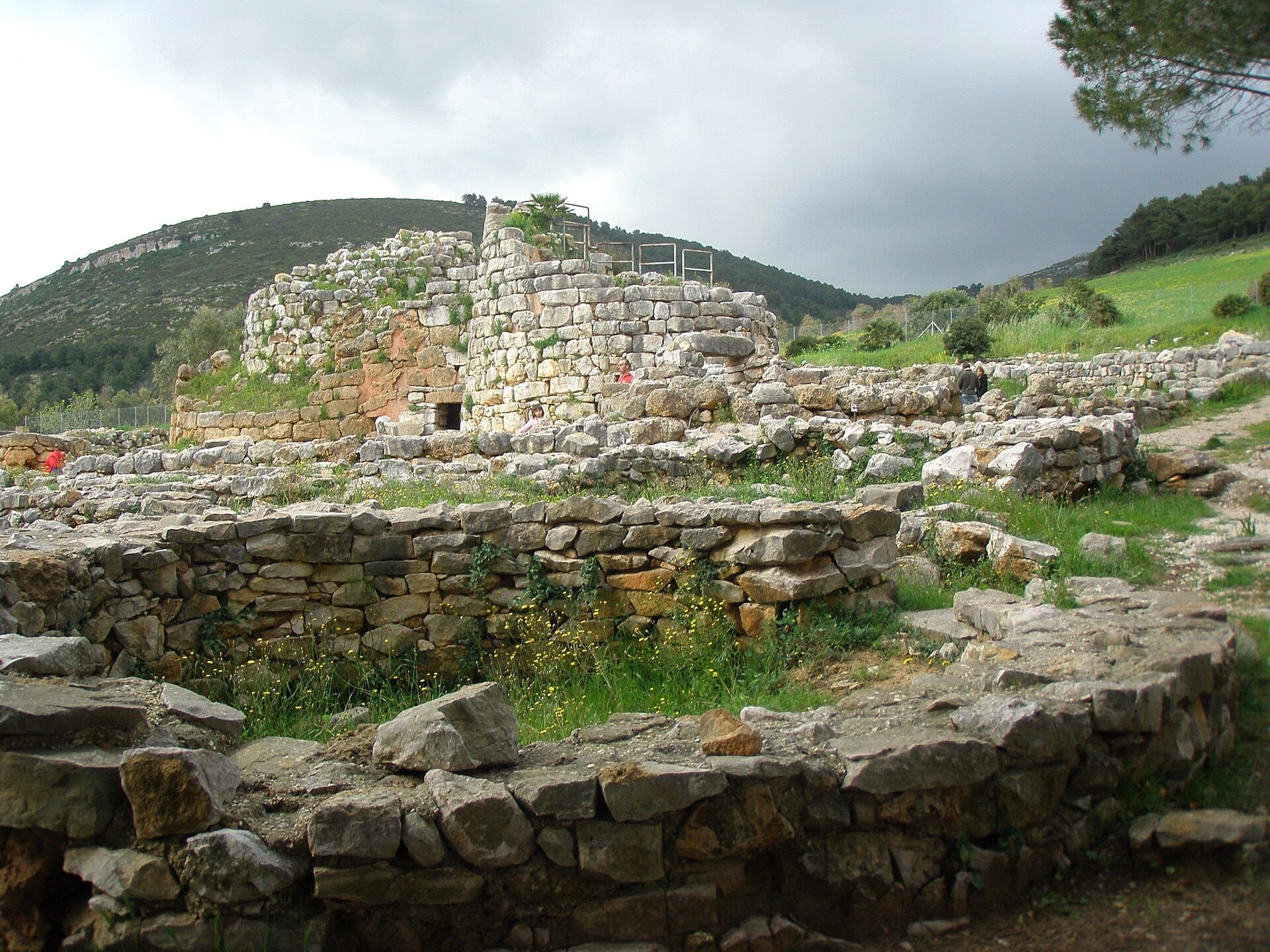
What Nuraghe Palmavera Actually Is
Nuraghe Palmavera is a nuragic complex dating to the Bronze Age, constructed in multiple phases beginning around the 15th to 14th century BCE and used until approximately the 8th century BCE. At its heart stands a central body built from local limestone, featuring at least two main towers joined by a connecting structure. Around this central nuraghe, the remains of a substantial village survive: roughly 50 stone huts are visible today, though archaeological evidence suggests the original settlement was approximately three to four times larger.
The site's official Italian name is Complesso Nuragico di Palmavera, sometimes rendered as Villaggio Nuragico Palmavera. In English it is referred to as Nuraghe Palmavera or the Palmavera Nuragic Complex. Whatever you call it, the site represents a rare opportunity to walk through the actual footprint of a 3,500-year-old Sardinian community rather than simply viewing a single tower in isolation.
The complex sits within the Porto Conte natural area, close to the road connecting Alghero to Capo Caccia and the famous Neptune's Grotto. Most visitors encounter it as a stop on that coastal drive, but it deserves more than a quick glance.
The Historical Context: Why This Place Existed
Sardinia's Nuragic civilization is one of the most architecturally distinctive prehistoric cultures in the Mediterranean. Between roughly 1800 and 500 BCE, Nuragic builders constructed thousands of stone towers — called nuraghi — across the island, many of which formed the cores of larger settlements. Nuraghe Palmavera fits this pattern: the towers served as the central authority point of a community that relied on agriculture, pastoralism, and likely trade with other Mediterranean cultures.
The village met a violent end. Archaeological evidence points to a destructive fire, probably at the end of the 8th century BCE, that brought the settlement's active life to a close. Pottery finds indicate the site was used sporadically in Punic and Roman times afterward — suggesting it held some residual significance even after the Nuragic period ended. For broader context on Sardinia's prehistoric monuments, the Sardinia nuragic sites guide covers the island's most important complexes alongside Palmavera.
ℹ️ Good to know
One of the most intriguing features at Palmavera is a circular stone hut often identified as a 'meeting hut' or assembly space, larger than the domestic huts around it. A stone model of a nuraghe was found here, now held in a museum, suggesting the space had a ceremonial or communal function.
Tickets & tours
Hand-picked options from our booking partner. Prices are indicative; availability and final rates are confirmed when you complete your booking.
Tour of the Nuraghe of Barumini and Casa Zapata from Cagliari
From 101 €Instant confirmationFree cancellationVineyard Guided Tour and 7 Wine Tasting in Palau
From 84 €Instant confirmationFree cancellationFull-Day Sailboat Tour in La Maddalena Archipelago from Cannigione
From 112 €Instant confirmationFree cancellationHiking excursion to the Devil's Saddle
From 35 €Instant confirmationFree cancellation
Walking the Site: What You See and How It Unfolds
The entrance leads through a small ticket area where you can pick up an audio guide for around €3 — worth it if you want to connect the stone shapes in front of you to specific periods and functions. Without explanation, the hut outlines can feel abstract; with even a basic narrative, they become legible as a community.
The path through the site is compact but not cramped. The central nuraghe rises to a modest height compared to some of Sardinia's more dramatic towers, but the surrounding village gives it scale. Walking between the hut bases, you get a genuine spatial sense of how people actually lived here: the proximity of structures, the orientation of doorways, the variation in hut sizes suggesting different uses. The stone is local limestone, pale and porous, with a texture that catches afternoon light in a way that photographs tend to flatten.
The terrain is uneven throughout. Paths are compacted earth and loose stone, and the hut floors are archaeological surfaces rather than prepared walkways. Visitors with limited mobility should be aware that navigation through the village section is physically demanding. The area immediately around the main tower is more manageable, but accessing the full village circuit requires careful footing.
If you are combining this with a visit to the Anghelu Ruju necropolis, a combined ticket saves money and the two sites make a logical pairing: one shows how Nuragic people lived, the other how they treated their dead. Anghelu Ruju is about 10 km back toward Alghero, so plan the sequence according to your direction of travel.
Time of Day and Seasonal Conditions
The site is open-air and fully exposed to Sardinian sun for most of its circuit. In July and August, midday temperatures in this part of northwestern Sardinia regularly exceed 30°C and can climb toward 38°C on peak days. Visiting in the morning, shortly after the 10:00 opening time, makes a practical difference: the stone is cooler, the light is more directional for photography, and crowds on the site itself are minimal.
Spring and autumn visits — roughly April through early June and September through October — offer the most comfortable conditions. The site stays open until 18:00 in April, May, and October, and until 19:00 from June through September; from November through March, hours are limited to 10:00–14:00, which narrows the window considerably but makes for a quiet, uncrowded experience in the low season.
💡 Local tip
Bring water and wear a hat. There is almost no shade on the village circuit during summer months. The site has no café or water point, so arrive prepared, particularly if you are visiting between June and August.
This site sits within the broader Porto Conte area, which is also home to the Parco Naturale Porto Conte. The surrounding scrubland gives Palmavera a landscape context that feels authentically Sardinian: low maquis vegetation, rocky outcrops, and the faint scent of wild rosemary and cistus in warmer months. This is not a manicured archaeological park — it is a site that sits within real Sardinian terrain.
Photography and Practical Logistics
The best photography conditions at Nuraghe Palmavera are in the morning, when low-angle light gives the limestone towers definition and depth. By midday in summer, the bleached stone and flat overhead light produce images that struggle to convey the structure's mass. Late afternoon, approaching the 19:00 closure in peak season, also produces warm tones worth waiting for — though this depends on cloud cover.
Wide-angle shots work well for capturing the relationship between the central towers and the village huts. Close-up details of the stone coursing reveal the precision of Nuragic construction: these walls were built without mortar, relying entirely on the careful fitting of shaped stone blocks. That detail is easy to miss from a distance but becomes striking up close.
Parking is available at the site entrance at no additional charge. There is no requirement to pre-book tickets, and the site rarely sells out — though summer weekends can bring enough visitors to the central tower area to make it feel crowded. Visiting Tuesday through Friday reduces this noticeably. The ticket office accepts cash; card payment availability should be confirmed locally before visiting.
Is This Worth Your Time?
Nuraghe Palmavera is not Sardinia's most dramatic nuragic monument. Su Nuraxi di Barumini, a UNESCO World Heritage Site in the island's center, is larger, better documented, and more fully excavated. Nuraghe Santu Antine in the Sassari province is taller and arguably more architecturally imposing. What Palmavera offers instead is accessibility — both geographically and experientially. It is easy to reach from Alghero, the layout is compact and walkable in under two hours, and the combination of central towers plus village huts gives a more complete picture of Nuragic life than a single tower alone provides.
For visitors already planning a day trip toward Capo Caccia to see the Grotte di Nettuno, adding Palmavera costs little extra time and adds genuine depth to the day. For visitors with a strong interest in Sardinian prehistory, it is a worthwhile destination in its own right. For visitors primarily focused on beaches and coastal scenery, it may feel like a detour that interrupts the flow of the day — though even then, the modest ticket cost and hour spent is rarely regretted.
⚠️ What to skip
Visitors with limited mobility should be aware that the village hut circuit involves uneven terrain, loose stone, and no paved path. The area around the main tower entrance is more manageable, but the full site circuit is not wheelchair accessible in its current state. Contact the site directly for current accessibility conditions.
If you are building a broader itinerary around the Alghero area and want to understand how nuragic culture fits into Sardinia's long history, the things to do in Sardinia guide places sites like Palmavera within a useful island-wide framework.
Insider Tips
- The combined ticket with Anghelu Ruju Necropolis (€8 full) is better value than buying separately and the two sites tell complementary stories about the same culture. If you buy the combined ticket at Palmavera, keep it for Anghelu Ruju.
- The audio guide is useful here. Without narrative context, the hut outlines can seem repetitive. The roughly €3 cost is worth it to understand which structures served which functions.
- Visit on a weekday morning in shoulder season (May, early June, or September) for the best combination of comfortable temperatures, good light, and minimal crowds at the central tower.
- The bus connection from Alghero (lines 9320/9321) runs seasonally and frequency drops outside summer. If you are not renting a car, confirm the return bus times before you go — the last bus back can be earlier than you expect.
- Stone surfaces inside the nuraghe can be slippery, particularly if there has been recent rain or morning dew. Closed-toe shoes with grip are more practical than sandals, even in summer.
Who Is Nuraghe Palmavera For?
- History and archaeology enthusiasts looking for a hands-on encounter with Nuragic civilization
- Road-trippers combining a drive from Alghero to Capo Caccia with a cultural stop
- Families with teenagers who engage with ancient history and can handle uneven terrain
- Photographers interested in prehistoric architecture and Mediterranean landscape
- Travelers who have already seen the obvious coastal highlights around Alghero and want something different
Nearby Attractions
Other things to see while in Alghero:
- Bastioni di Alghero
The Bastioni di Alghero are a continuous promenade along the medieval and 16th-century fortifications that frame the old city on its seaward side. Free to walk at any hour, they offer some of the most compelling views in northwest Sardinia, from the coral-blue water below the walls to the distant outline of Capo Caccia across the gulf.
- Capo Caccia
Capo Caccia is a towering limestone promontory on Sardinia's northwestern coast, forming the western boundary of the Capo Caccia – Isola Piana Marine Protected Area. The clifftop belvederes are free and open to all, while the famous Grotte di Nettuno lie below, reached by a vertiginous staircase or seasonal boat.
- Centro Storico di Alghero
The historic centre of Alghero is one of the Mediterranean's most atmospheric old towns, where Catalan Gothic architecture, honey-coloured ramparts, and a language that isn't quite Italian create a quarter that feels unlike the rest of Sardinia. Entry is free, the streets run to the sea, and it rewards slow exploration at almost any hour.
- Domus de Janas di Anghelu Ruju
Cut into sandstone on a flat plain 6 km from Alghero, the Necropoli di Anghelu Ruju contains 38 prehistoric tombs dating back to around 3200 BC. It is the most extensive hypogean burial site in northern Sardinia and one of the most significant Neolithic monuments in the entire Mediterranean.