New York Botanical Garden: The Complete Visitor Guide
Spanning 250 acres in The Bronx, the New York Botanical Garden combines world-class plant collections, a landmark Victorian glasshouse, and one of the last old-growth forests in New York City. Here is everything you need to plan a visit worth the trip.
Quick Facts
- Location
- 2900 Southern Blvd., Bronx, NY 10458
- Getting There
- Metro-North Harlem Line to Botanical Garden Station (direct). Subway B/D/4 to Bedford Park Blvd., then Bx25/Bx26 bus.
- Time Needed
- 3–5 hours for a thorough visit; half a day if attending a special exhibition
- Cost
- All-Garden Pass: $35 weekday / $39 weekend (adult). NYC residents: $15 grounds-only pass. Free grounds entry Wed 10–11 a.m. for NYC residents with proof of residency.
- Best for
- Plant enthusiasts, families with children, architecture lovers, photographers, anyone needing a full escape from Midtown
- Official website
- www.nybg.org
What the New York Botanical Garden Actually Is
The New York Botanical Garden (NYBG) is not a city park with flower beds. It is a fully accredited research institution and museum, founded in 1891, that happens to occupy 250 acres of Bronx terrain. It holds living collections of over one million plants, a research library of botanical literature, and 50 distinct gardens and plant collections. The site is a National Historic Landmark, and the combination of scientific rigor and sheer landscape beauty is what separates it from any comparable attraction in the New York metro area.
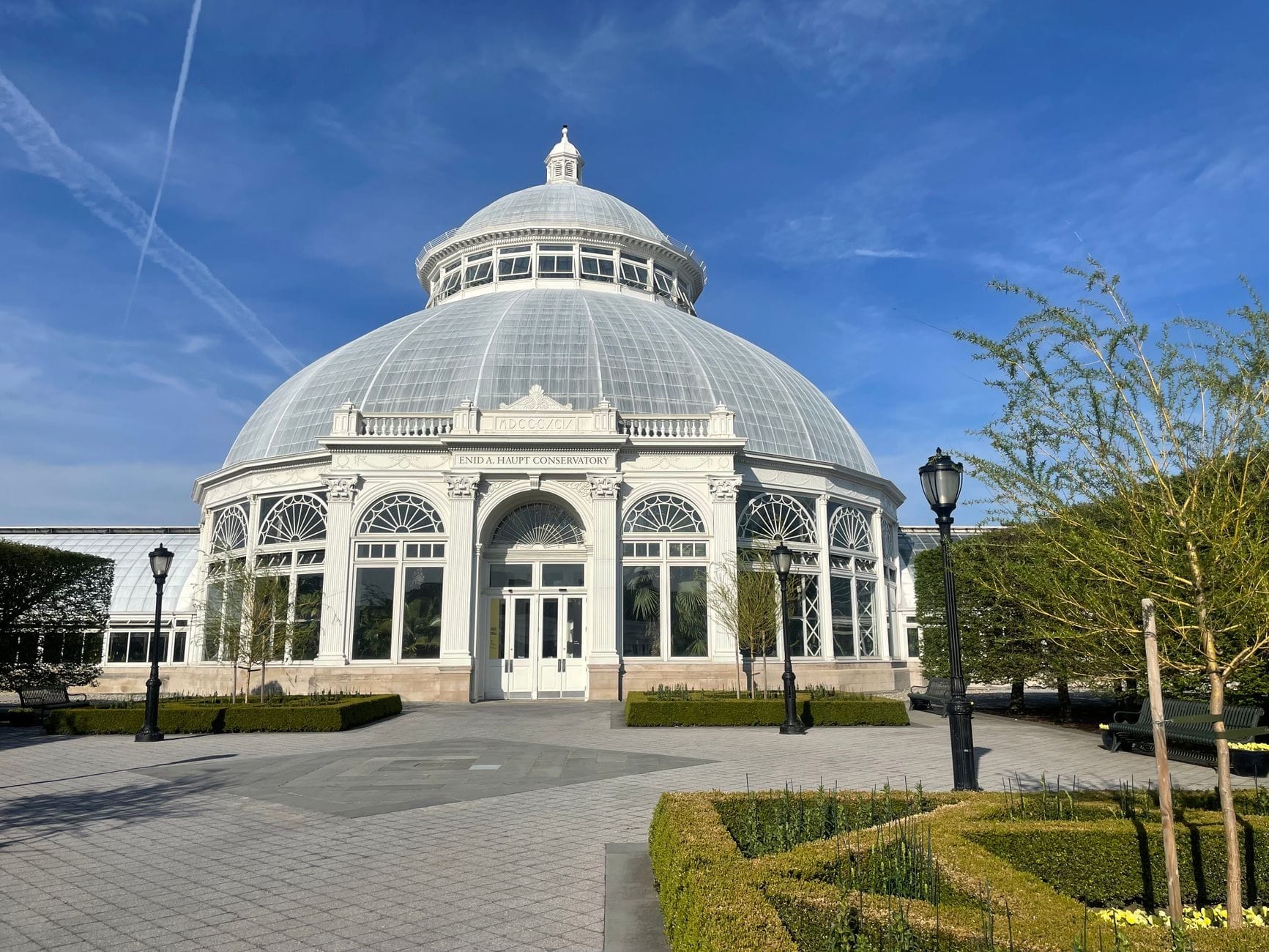
At the center of the grounds stands the Enid A. Haupt Conservatory, a nine-gallery Victorian glasshouse built in 1902 and modeled on the Great Palm House at Kew Gardens. It is the largest Victorian-style glasshouse in the United States. Beyond it, spreading across the northern section of the property, is a 50-acre tract of old-growth forest, one of the largest remaining fragments of the original forest that once covered New York City. These two features alone justify the journey to The Bronx.
💡 Local tip
The fastest and most scenic way to arrive is the Metro-North Harlem Line local train to Botanical Garden Station. The station platform puts you directly at the Mosholu Entrance in under 25 minutes from Grand Central Terminal, with no transfers and no subway crowding.
The Enid A. Haupt Conservatory: The Crown of the Garden
The Conservatory is the first thing most visitors aim for, and it earns that priority. The building's iron and glass frame rises against the sky in a way that still reads as extraordinary, even standing next to the steel towers of modern Manhattan visible on clear days to the south. Step inside and the temperature rises, the air thickens, and the sound of the city disappears entirely.
Inside, the galleries move from tropical rainforest to desert, from aquatic plants to seasonal rotating exhibitions. The Palm Court, a soaring central dome, shelters trees that have been growing here for decades. The textures are dense: ridged bark on cycads that predate the dinosaurs, waxy leaves catching light, root systems splaying above the soil. On winter mornings especially, when the outdoor gardens are bare, the Conservatory functions as the garden's emotional core.
Seasonal exhibitions transform specific galleries throughout the year. The Holiday Train Show, held annually from late November through January, fills the Conservatory with thousands of model trains running through miniature New York City landmarks crafted entirely from plant materials. It draws large crowds, particularly on weekends. If you are visiting during that period, consider a weekday morning arrival to avoid queues at the Conservatory entrance.
ℹ️ Good to know
The Conservatory is included with the All-Garden Pass. If you purchase the NYC Resident Grounds Access Pass (outdoor only), Conservatory entry is not included and must be purchased separately.
Tickets & tours
Hand-picked options from our booking partner. Prices are indicative; availability and final rates are confirmed when you complete your booking.
Botanical mixology class in New York City
From 115 €Instant confirmationSpirit of New York Dinner Cruise
From 161 €Instant confirmationFree cancellationNew York City Highlights bike tour
From 70 €Instant confirmationFree cancellationNew York Statue of Liberty and Ellis Island tour by ferry
From 55 €Instant confirmation
The Thain Family Forest: Old Growth in The Bronx
The 50-acre Thain Family Forest is the part of the NYBG that surprises visitors the most. New York City is not associated with old-growth trees, but this forest has never been cleared. Tulip trees, oaks, and maples tower above a layered understory of shrubs and wildflowers, with the Bronx River running along one edge. Walking the forest trails, you lose all urban reference points within a few minutes.
The forest is most dramatic in spring, when the understory blooms before the canopy closes in, and in October, when the foliage turns. Midweek visits in those seasons produce some of the quietest, most rewarding stretches of walking available anywhere in New York City. Early mornings amplify the effect: birdsong, light filtering through the upper canopy, and almost no other visitors. The forest trails are unpaved but well-maintained, and the terrain is gentle enough for most visitors without special footwear, though waterproof shoes are sensible after rain.
For visitors planning a broader day in the borough, the forest connects thematically with the Bronx Zoo, which borders the southern edge of the NYBG property. The two institutions share a stretch of Bronx Park and can be combined for a full day, though each deserves several hours independently.
Gardens, Collections, and What to Prioritize
The NYBG contains 50 distinct garden areas. Trying to see all of them in a single visit produces exhaustion rather than appreciation. The following collections reward the most time.
- Peggy Rockefeller Rose Garden: Designed in 1916 and featuring over 650 varieties across formal geometric beds. Peak bloom falls roughly in mid-June. The rose scent on a warm morning is striking enough that even visitors with no particular interest in roses tend to linger.
- Rock Garden: A naturalistic slope planted with alpine and rock-garden species, particularly colorful in late spring.
- Native Plant Garden: Opened in 2013, this 3.5-acre garden showcases plants native to the northeastern United States within a landscape design that manages to feel both structured and wild.
- Azalea Garden: Best visited in late April to early May, when thousands of azaleas flower simultaneously beneath a canopy of mature trees.
- Children's Adventure Garden: A hands-on science and nature space suitable for children roughly ages 2 to 12, with plant-based activities, a boulder maze, and water features.
The Garden Tram Tour, included with the All-Garden Pass, covers the main landscape in about 20 minutes and provides useful orientation on a first visit. It does not replace walking, but it gives you a sense of the property's scale before you commit to a route. On a hot summer afternoon, it also provides a welcome break.
Practical Walkthrough: Hours, Tickets, and Getting There
The NYBG is open Tuesday through Sunday, 10:00 a.m. to 6:00 p.m., and on select Monday federal holidays. The garden is closed on Mondays outside those holiday exceptions, which trips up visitors who check hours casually without noticing the day of the week.
Ticket pricing depends on both the pass type and the day. The All-Garden Pass covers the Conservatory, Tram Tour, exhibitions, and all outdoor gardens. On weekdays, adult admission is $35; on weekends, $39. Seniors and students pay $31 on weekdays and $35 on weekends. Children ages 2 to 12 pay $15 on weekdays and $17 on weekends. Children under 2 enter free. NYC residents can purchase a Grounds Access Pass for outdoor gardens only at reduced rates ($15 adult, $7 senior or student, $4 child), available Tuesday and Thursday through Sunday with proof of New York City residency purchased at the gate. On Wednesdays, NYC residents receive free grounds-only access all day (with proof of residency), and NYC residents enter the grounds free between 10:00 and 11:00 a.m.
💡 Local tip
If you plan to visit more than once a year, a membership almost certainly pays for itself. Members also receive early-access privileges for popular exhibitions and discounted parking.
By Metro-North, take the Harlem Line local from Grand Central Terminal to Botanical Garden Station. The trip takes roughly 20 to 25 minutes and deposits you directly at the Mosholu Entrance. This is the most reliable transit option, particularly on weekends when subway service can be irregular. By subway, take the B, D, or 4 train to Bedford Park Blvd. and then board the Bx25 or Bx26 bus, or walk approximately 20 minutes. The 2 train to Allerton Ave. provides access to the East Gate via a walk along Bronx Park East. Several MTA bus lines, including the Bx19 and Bx12, serve the Main Entrance at 2900 Southern Blvd. Onsite parking is available at approximately $22 per vehicle.
The NYBG fits naturally into a broader exploration of The Bronx. Visitors interested in the borough's culture and food scene should consult our NYC architecture guide for context on the Conservatory's place in the city's built heritage, and check the Bronx neighborhood guide for what to do before or after.
How the Experience Changes by Season and Time of Day
Spring (April to early June) is the strongest season for a first visit. Flowering trees and bulbs arrive in sequence from late March onward, the Azalea Garden peaks in late April, and the rose garden begins by early June. The forest understory is at its most colorful before the full canopy closes. Temperatures are generally mild, and the property has not yet reached peak summer attendance.
Summer brings full-canopy shade in the forest, strong color in the herbaceous gardens, and the longest opening hours for outdoor exploration. It also brings heat, humidity, and the Garden's largest crowds, particularly on weekend afternoons. Arriving at opening time (10:00 a.m.) on a summer weekday gives you the first hour in near-solitude before school and family groups arrive in force.
Autumn is the second-strongest season. Foliage in the forest peaks between mid-October and early November, and the garden staff stages seasonal plantings of ornamental grasses and late-blooming perennials. The light in late afternoon in October has a particular quality in the forest that is worth planning around. Winter is the quietest period outdoors, but the Conservatory comes into its own, and the Holiday Train Show from late November through January draws consistent crowds.
Weather significantly affects the experience at the NYBG, more so than at indoor-only attractions. For advice on planning around New York City's seasonal patterns, the best time to visit New York City guide covers monthly conditions in detail.
Photography, Accessibility, and Honest Limitations
Photography conditions at the NYBG are excellent for much of the year. The Conservatory's glass architecture produces even, diffuse light that works well without flash. Early morning in the rose garden, when dew sits on the petals and direct light is angled low, is as good a macro photography opportunity as you will find in the city. The forest interior is shaded enough that overcast days often produce better results than direct sun.
Accessibility across the grounds is generally good: paved paths connect the main gardens, and the Tram Tour is an option for visitors who cannot cover long distances on foot. The forest trails are unpaved, which limits accessibility in that section. Visitors with specific accessibility needs should consult NYBG directly before visiting, as the MTA website covers station-level accessibility for Metro-North and subway approaches.
Honest limitation worth noting: the NYBG is a large property and the all-garden experience requires real walking. Visitors who expect a compact, contained attraction may find the distances between collections more taxing than anticipated, particularly with young children. The Tram Tour helps, but it is not a substitute for walking if you want to experience the forest or spend time in individual garden areas. Food options on the grounds are limited to the Garden Cafe near the main entrance; the options are adequate but not special, and bringing your own snacks or water is practical, especially on a long visit.
Visitors looking for a different kind of green space in the city might also consider Wave Hill in the northwest Bronx, which offers intimate cultivated gardens with Hudson River views, or Brooklyn Botanic Garden for a more compact but equally curated botanical experience.
Insider Tips
- The Wednesday free grounds window (10:00–11:00 a.m. for NYC residents) is the quietest entry point of the week. Arrive at 10:00 a.m., complete a full forest loop, and reach the rose garden before the first tour groups arrive.
- The Conservatory is warmest and most photogenic on cold, grey winter days when the contrast between the glasshouse interior and the bare outdoor landscape is at its strongest. Bring a layer you can remove.
- Metro-North trains from Grand Central run frequently enough that you do not need to plan around schedules the way you would for some commuter lines. But check the return schedule before you leave, as trains to Grand Central from Botanical Garden Station become less frequent in the late afternoon on weekdays.
- The Garden Tram departs from near the Conservatory entrance. Do the tram on arrival to orient yourself, then walk back through the sections that caught your attention.
- Special exhibitions often sell out on weekends, particularly the Holiday Train Show. Book tickets online in advance and select a specific entry time slot to avoid being turned away at the Conservatory on busy weekend days.
Who Is New York Botanical Garden For?
- Plant and horticulture enthusiasts who want research-grade collections in a serious landscape setting
- Families with children ages 4 and up, particularly for the Children's Adventure Garden and the Tram Tour
- Photographers seeking botanical and architectural subjects with good natural light
- City visitors who need a full half-day away from Midtown crowds and noise
- Travelers visiting in spring or autumn who want foliage and flowering displays at their peak
Nearby Attractions
Other things to see while in The Bronx:
- Arthur Avenue — The Real Little Italy
Arthur Avenue in the Belmont neighborhood of The Bronx is the most genuine Italian-American commercial strip left in New York City. Unlike its Manhattan counterpart, this is a working neighborhood where third-generation butchers, hand-rolled cigars, and fresh pasta made on-site are still the daily norm, not tourist theatre.
- Bronx Zoo
One of the largest urban zoos in the world, the Bronx Zoo stretches across more than 265 acres of hardwood forest in The Bronx, housing over 11,000 animals from 640-plus species. Whether you have three hours or a full day, knowing how the grounds work before you arrive makes all the difference.
- Pelham Bay Park
Pelham Bay Park is New York City's largest public park, covering 2,772 acres of salt marshes, coastal forest, wetlands, and 13 miles of Long Island Sound shoreline. Three times the size of Central Park, it sits at the northeastern tip of The Bronx and remains genuinely off the tourist trail.
- Wave Hill
Perched above the Hudson River in Riverdale, Wave Hill is a 28-acre public garden and cultural center that combines horticultural artistry with sweeping views of the Palisades. Open year-round, with free admission on Thursdays until noon, it rewards visitors who take the time to reach it.