Necropolis del Puig des Molins: Ibiza's Ancient City of the Dead
Hidden on a small hill just 500 metres from Ibiza Town's old walls, the Necropolis del Puig des Molins is one of the most significant Phoenician and Punic burial sites in the world. Spanning nearly 5 hectares with around 3,000 tombs cut into the rock, this UNESCO World Heritage site offers a rare encounter with 2,700 years of history beneath the surface of a sun-bleached hillside.
Quick Facts
- Location
- C/ Vía Romana 31, 07800 Eivissa (Ibiza Town), Balearic Islands, Spain
- Getting There
- 10-minute walk west of Dalt Vila; local buses and taxis serve the area
- Time Needed
- 1.5 to 2.5 hours for museum and outdoor necropolis
- Cost
- Admission is currently free via official MAEF listings (fees may change — verify directly with the museum)
- Best for
- History enthusiasts, archaeology lovers, cultural travellers
- Official website
- maef.eu/en/museo-puig-des-molins
What You're Actually Visiting
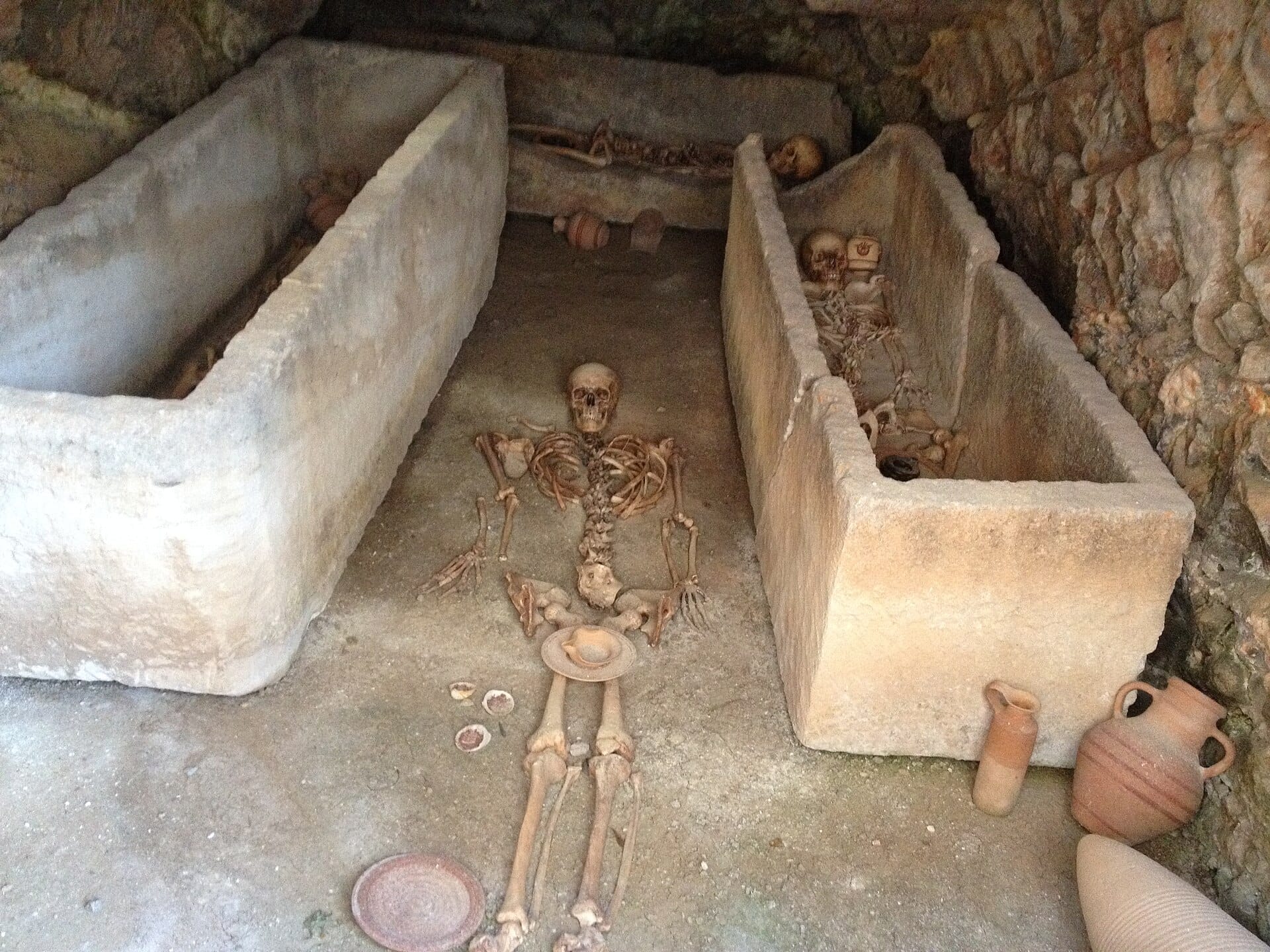
The Necropolis del Puig des Molins is not just a burial ground. It is one of the ancient world's largest and best-preserved Phoenician and Punic cemeteries, officially named the Museo Monográfico y Necrópolis Púnica de Puig des Molins. It sits on a low hill on the western edge of Ibiza Town, and nearly everything about it is understated: the entrance is modest, the hillside looks quiet, and yet beneath your feet lie roughly 3,000 tombs that span the period from the mid-7th century BC through to the late Roman and early medieval periods.
The site covers nearly 5 hectares. Of the estimated 3,000 tombs, about 340 are visible externally. The rest remain underground, preserved in a subterranean network of hypogea: rock-cut burial chambers that drop into the hillside and were used repeatedly across Phoenician, Punic, and later Roman periods. The attached museum holds the artefacts recovered from those graves, including terracotta figurines, glass unguentaria, amulets, and jewellery that reveal remarkably consistent funerary traditions over more than a millennium.
ℹ️ Good to know
Opening hours as of recent listings: Tuesday to Thursday 09:00–15:00, Friday 09:00–15:00 and 17:00–20:00, Saturday 09:00–14:00, Sunday 10:00–14:00, Monday closed. Hours vary seasonally and on public holidays — always confirm directly with the museum before visiting.
The History Behind the Hill
When Phoenician settlers founded the city of Ibiza in the middle of the 7th century BC, they designated this hill as the city's necropolis almost immediately. The choice was deliberate: the ancients placed their dead on elevated ground separate from the living, yet close enough to maintain a relationship between the city and its cemetery. That relationship lasted, across Phoenician, Punic and Roman times, for many centuries.
The Punic period, roughly 6th to 2nd century BC, was when the necropolis reached its greatest density. Ibiza (known to the Carthaginians as Ibosim) was a significant western Mediterranean trading hub, and its cemetery reflects that wealth. Grave goods imported from across the Phoenician world — Egyptian-style faience amulets, Carthaginian masks, Rhodian perfume flasks — have been found in the hypogea. During the Roman period, burial practices shifted, but the site continued in use. Later Christian burials were added in the early medieval period, with the sequence closing sometime in the early centuries AD.
The site was declared a Historical and Artistic Monument by Spain in 1931, and in 1999 it was included in Ibiza's UNESCO World Heritage designation under the title "Ibiza, Biodiversity and Culture." That designation covers four distinct elements of the island's heritage: Dalt Vila, the Phoenician settlement of Sa Caleta, the Posidonia seagrass meadows, and Puig des Molins itself.
To understand how this site fits into the broader story of Ibiza's ancient and medieval layers, the Dalt Vila walls and bastions and the Ibiza Cathedral above them are part of the same UNESCO inscription — and both are walkable from Puig des Molins in under fifteen minutes.
Tickets & tours
Hand-picked options from our booking partner. Prices are indicative; availability and final rates are confirmed when you complete your booking.
Sunset boat tour with tapas, open bar and water sports in Ibiza
From 70 €Instant confirmationFree cancellationEscape Tour self-guided, interactive city challenge in Ibiza
From 30 €Instant confirmationPrivate Sunset Cruise on a Maritime Classic in Ibiza
From 750 €Instant confirmationFree cancellationIbiza to Formentera boat trip with open bar and water sports
From 69 €Instant confirmationFree cancellation
Inside the Museum
The modern museum building is calm and well-organised. Signage is available in Spanish, Catalan, and English. The collection is displayed chronologically, so you move from early Phoenician imports through the Punic peak and into the Roman and late antique periods. The standout pieces are the terracotta figurines of the goddess Tanit, which appear in quantity: stylised, haunting, and repeated across centuries of production. There are also masks, amulets shaped as the eye of Horus, and small glass vessels for oils and perfumes.
The display cases are well-lit and the interpretive panels give enough context without becoming academic. For visitors without a background in ancient history, the museum does a solid job of explaining the Phoenician funerary worldview: the dead needed provisions, protection, and a connection to the divine. The objects in the graves were not decorative — they were functional in the context of the afterlife. That perspective shifts how you look at what might otherwise seem like a collection of small clay figures.
💡 Local tip
Spend time in the museum before visiting the outdoor necropolis. Understanding the burial sequence and what was found in the hypogea makes the hillside and the tomb openings significantly more meaningful when you reach them.
The Outdoor Necropolis and Hypogea
The outdoor section is where Puig des Molins becomes genuinely unusual. The hillside is dotted with tomb openings: rectangular shafts cut into the pale limestone, descending into small burial chambers below. Some of the hypogea are accessible to visitors, and when you enter them, the temperature drops noticeably, the light narrows, and the scale compresses. These chambers are not cavernous — they are intimate, low-ceilinged, and cut from the raw rock by hand.
Visitors entering the underground areas are provided with hard hats for safety. This is not a theatrical touch; the ceilings of some hypogea are genuinely low and uneven. Wear closed shoes with grip: the floors can be dusty and the shaft descents are steep. The claustrophobic or those with mobility limitations should note that access involves narrow stairways and crawl-height passages in some chambers. If in doubt, confirm specific access conditions with the museum before arriving.
The outdoor hill area is open and partially shaded by pine trees. In the morning, before midday heat sets in, the site has a peculiar stillness: tourist traffic is light, the sound of Ibiza Town below is distant, and you are walking between tomb openings that were last used over a thousand years ago. The contrast with the beach crowds fifteen minutes away is total.
Practical Walkthrough: How to Plan Your Visit
The necropolis is at C/ Vía Romana 31, roughly 500 metres west of Ibiza Town's old walls. From the port area or the base of Dalt Vila, it is an easy 5–10-minute walk on flat ground, following Via Romana westward. The street is residential and quiet. There is no dramatic signage or tourist fanfare at the entrance; the building is modest and easy to miss if you are not watching for it.
Admission is currently free according to official MAEF listings, making it one of the most accessible cultural sites on the island. Fees can change, so check directly with the museum or the official MAEF website before your visit. The site is small enough that you do not need a guided tour to navigate it, though guided tours are available and add considerable depth to the hypogea visit.
Plan for 1.5 to 2.5 hours, more if you read the panels carefully or take a guided tour. The site pairs naturally with a walk up to the castle at Dalt Vila or a visit to the Ibiza Museum of Contemporary Art for a half-day of cultural Ibiza Town. Both are within comfortable walking distance.
Photography and Time-of-Day Considerations
The outdoor hillside photographs well in morning light, when low sun throws shadows across the tomb openings and the limestone glows a warm ochre. By midday, the light is harsh and flat. The museum interior is poorly suited to phone photography in low-light conditions, though flash photography of the artefacts is typically restricted — check on arrival.
The site is quietest on weekday mornings, particularly Tuesday through Thursday. Friday afternoon opening (17:00 to 20:00) offers a useful option for those spending midday at the beach, though you will likely have the site to yourself either way — Puig des Molins never draws the crowds that gather at the port or Dalt Vila.
If you are building an itinerary around Ibiza Town's cultural layer, the Dalt Vila guide covers the walkable historic core in detail, including the cathedral, the walls, and the best approach routes up from the port.
Who Should Not Bother
Puig des Molins is not for everyone, and it is worth being direct about that. If ancient history and funerary archaeology are not interests you would actively choose to pursue, the site will feel low-impact: a quiet hill with stone openings in the ground and a small museum of old objects. The site lacks audio-visual spectacle, reconstruction displays, or interactive elements that might engage a general tourist without prior interest.
Families with young children may find the hypogea access difficult and the museum content abstract for younger visitors. Visitors with claustrophobia or significant mobility limitations should contact the museum in advance to understand exactly which sections are accessible to them. The outdoor terrain includes uneven paths and sloping ground.
Insider Tips
- Visit on a Friday afternoon when the museum opens from 17:00 to 20:00. Visitor numbers drop sharply after the midday rush, and the evening light on the hillside is considerably better than the harsh midday glare.
- Ask at the entrance whether a guided hypogea visit is available that day. The underground chambers are accessible independently, but a guide explains the burial sequence, the reuse of chambers across generations, and the specific finds from each tomb type — context that the panels alone do not fully convey.
- Wear closed shoes with a firm sole. The hypogea shaft descents are steep, the floor surfaces inside are irregular, and sandals or smooth-soled shoes make the access uncomfortable and potentially slippery.
- The museum is part of the MAEF network (Museo Arqueológico de Eivissa i Formentera), which includes a second site in Dalt Vila. If you are seriously interested in Ibiza's ancient history, both sites together give a complete picture — the necropolis covers burial culture, while the Dalt Vila museum covers urban life.
- Admission is currently free according to official MAEF information, which makes this one of the best-value cultural visits on the island — though fees may change, so confirm before you go. Do not skip it on the assumption that free means minor: the Punic collection here is genuinely significant in western Mediterranean archaeology.
Who Is Necropolis del Puig des Molins For?
- History and archaeology enthusiasts looking for depth beyond beach tourism
- Travellers already exploring Dalt Vila who want to extend their half-day with an easy 10-minute walk
- Photography focused on ancient texture: limestone, shadow, and the geometry of tomb openings
- UNESCO heritage collectors covering all four elements of Ibiza's World Heritage inscription
- Anyone seeking a genuinely quiet hour in Ibiza Town with almost no tourist crowds
Nearby Attractions
Other things to see while in Ibiza Town (Eivissa):
- Figueretas Beach
Platja de ses Figueretes is a free, accessible urban beach in the Figueretas suburb of Ibiza Town, roughly 15 minutes on foot from the old town. With calm, shallow water, summer ferry connections, and a promenade lined with cafes and restaurants, it serves families, budget travellers, and anyone who wants a beach day without leaving the city.
- Ibiza Port & Marina Botafoch
Stretching along the north side of the Port of Ibiza, the marina known as Botafoc Ibiza offers a flat, walkable promenade lined with restaurants, boutiques, and some of the best views of Dalt Vila's UNESCO-listed walls. Whether you arrive by sea or on foot, this is where the island introduces itself.
- Pacha Ibiza
Open since 1973, Pacha Ibiza is the island's most enduring nightlife institution. Located in Ibiza Town on Avenida 8 d'Agost, it draws serious clubbers with world-class DJ bookings, multiple rooms, and a distinct glamour that has outlasted every trend in electronic music. This guide covers what to expect inside, how the experience shifts across the night, and whether it deserves a place in your itinerary.
- Sant Jordi Flea Market (Rastro)
Every Saturday morning, the old Sant Jordi racecourse transforms into Ibiza's most authentic flea market. Free to enter and open year-round, the Mercadillo de Sant Jordi draws a mix of locals, expats, and sharp-eyed visitors hunting for vintage clothing, antiques, handmade goods, and the kind of random objects that make flea markets worth the early alarm. It is one of the few market experiences on the island that feels genuinely rooted in local life rather than designed for tourism.