Castle of Ibiza (Castell d'Eivissa): What to Expect at the Top of Dalt Vila
Perched at the summit of Ibiza Town's UNESCO-listed old city, the Castle of Ibiza (Castell d'Eivissa) is the island's oldest continuously occupied defensive site. Visitors today explore the exterior, two free bastions, and sweeping views over the harbour and open sea — the main castle building itself remains closed to the public.
Quick Facts
- Location
- Plaça de la Catedral s/n, Dalt Vila, 07800 Eivissa (Ibiza), Spain
- Getting There
- ALSA bus line L45 to Dalt Vila–Convent stop, then walk uphill via Carrer Major or Carrer de Joan Roman
- Time Needed
- 45–90 minutes at the castle; allow extra time for the uphill walk through Dalt Vila
- Cost
- Free — exhibitions in Sant Jaume and Sant Pere bastions and access to the grounds have no admission fee
- Best for
- History buffs, photographers, and anyone wanting a panoramic view above Ibiza Town
What the Castle of Ibiza Actually Is
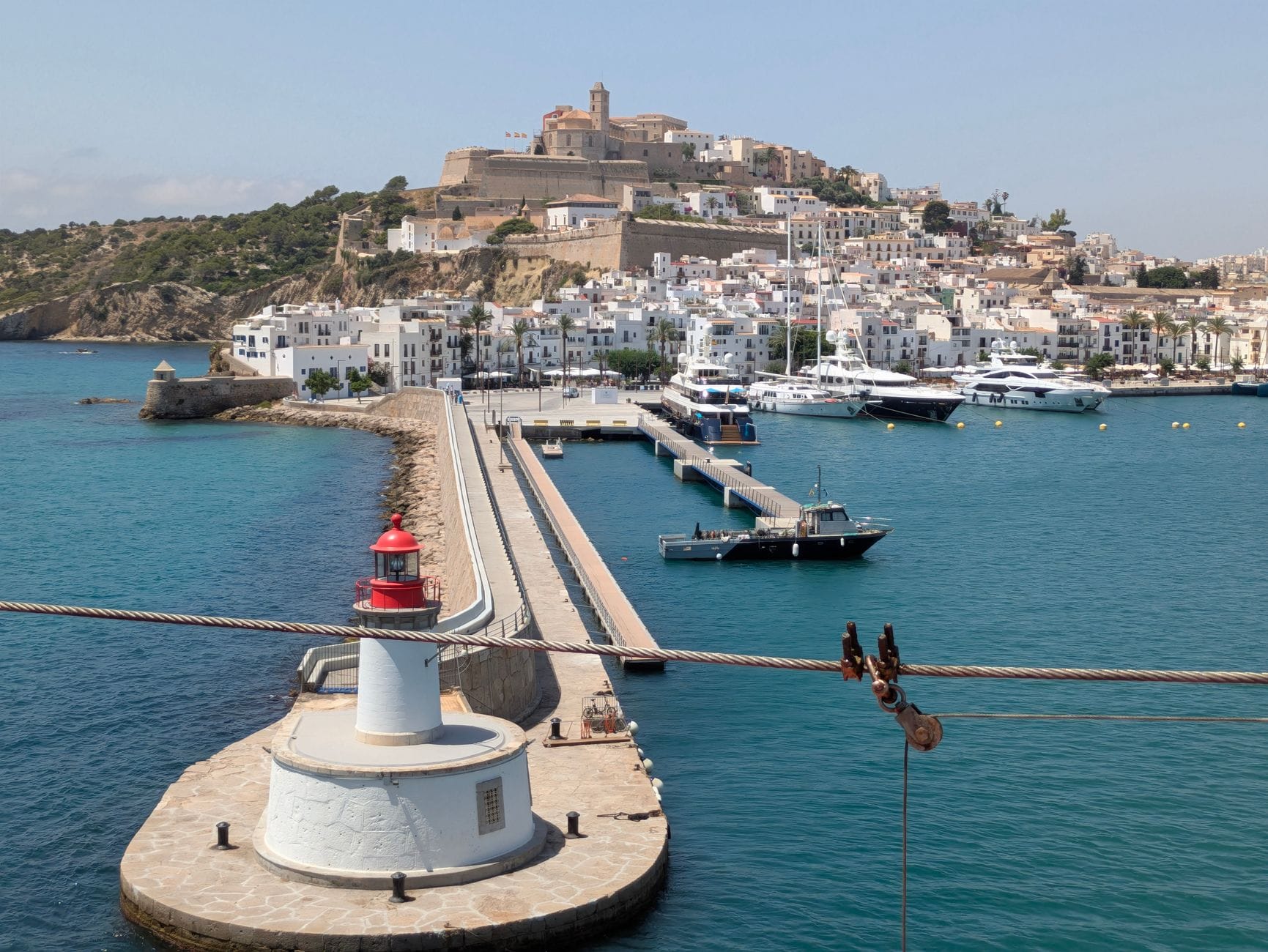
The Castle of Ibiza, known locally as Castell d'Eivissa or Castillo de Ibiza, sits at the absolute crown of Dalt Vila, the fortified upper town that UNESCO inscribed as part of the 'Ibiza, Biodiversity and Culture' World Heritage Site in 1999. It is not a single building so much as a layered complex accumulated over roughly 2,700 years: Phoenician occupation from around the 7th century BC, a Moorish Almudaina keep with medieval origins, Renaissance-era bastions from the 16th century, and 18th-century infantry barracks that give the complex its current silhouette.
The main castle building is currently closed to visitors. What you can access — freely and without a ticket — are the Sant Jaume and Sant Pere bastions, designed by Italian military engineer Giovanni Battista Calvi in the mid-16th century and representing accomplished Renaissance defensive architecture in the western Mediterranean. The surrounding grounds and the roads threading around the complex offer some of the highest and widest views on the island.
ℹ️ Good to know
The main castle interior is not open to the public. Plan your visit around the Sant Jaume and Sant Pere bastions, the exterior grounds, and the views rather than an interior tour.
A Brief History Worth Knowing Before You Go
Few hilltop sites in Spain carry this many distinct historical layers in such a compact space. Phoenician settlers established themselves on this acropolis around the 7th century BC, recognising it as defensible high ground above a natural harbour. Carthaginian, Roman, and Byzantine periods each left their marks before the Moorish conquest introduced the Almudaina, a fortress-palace type common across the medieval Islamic world. The Almudaina of Ibiza dates to the Middle Ages and its structural bones are still visible in parts of the complex today.
After the Aragonese reconquest of the island in 1235, the castle became a Christian stronghold. The 16th century brought the most dramatic architectural transformation: with Ottoman naval power threatening the western Mediterranean, the Spanish Crown commissioned Giovanni Battista Calvi — the same engineer who worked on Mallorca's defences — to redesign the fortifications. His Renaissance bastions replaced earlier medieval walls with the angular geometry of early modern military science, built to absorb cannon fire rather than simply resist it.
The 18th-century infantry barracks were added later and now form the most visually dominant part of the complex seen from below. Together, the full site is part of the same UNESCO heritage designation that covers the Dalt Vila walls and bastions, the Puig des Molins necropolis, and the Ses Salines natural area — an unusual heritage listing that spans both cultural monuments and natural landscape.
Tickets & tours
Hand-picked options from our booking partner. Prices are indicative; availability and final rates are confirmed when you complete your booking.
Sunset boat tour with tapas, open bar and water sports in Ibiza
From 70 €Instant confirmationFree cancellationEscape Tour self-guided, interactive city challenge in Ibiza
From 30 €Instant confirmationPrivate Sunset Cruise on a Maritime Classic in Ibiza
From 750 €Instant confirmationFree cancellationIbiza to Formentera boat trip with open bar and water sports
From 69 €Instant confirmationFree cancellation
The Experience: Walking Up to the Castle
Getting to Castell d'Eivissa is itself part of the experience. From the Portal de ses Taules — the main gateway into Dalt Vila — the cobblestone lanes climb steadily through the old town, past whitewashed walls, potted geraniums, and the occasional cat stretched across a doorstep. The route via Carrer Major is the most direct; Carrer de Joan Roman offers a slightly gentler gradient. Either way, wear shoes with grip: the original stone is smooth and uneven, and in morning shadow it can be slippery.
The walk takes around 15 minutes at a leisurely pace from the main gate, longer if you stop at the Ibiza Cathedral or the terrace overlooks along the way. The air smells of old stone warmed by the sun, with herbs from window boxes adding a faint aromatic note in summer. By the time you reach the castle esplanade, the effort feels earned. The silence at the top — relative to the port below — is one of the most unexpected qualities of the site.
⚠️ What to skip
The lanes leading to the castle are steep and paved with uneven cobblestones. Visitors with limited mobility will find access very difficult. There is no lift or alternative accessible route to the castle level.
The Bastions and What's Inside
The Sant Jaume and Sant Pere bastions are the main publicly accessible structures at the castle level. Both host free exhibitions that change periodically; in the past these have included archaeological finds from the site and displays on the island's Phoenician and Punic heritage. The exhibition spaces themselves are modest — the bastions are thick-walled and relatively small inside — but the quality of interpretation is reasonable and the context they provide for the castle complex is genuinely useful.
The bastions open Tuesday through Sunday and are closed on Mondays and bank holidays. Hours vary by season: from October to March, typical opening hours are around 10:00–15:00 on weekdays and 10:00–13:00 on Sundays; from April to mid-October, they generally open 10:00–14:00 Tuesday to Sunday with additional afternoon hours on many days. Check current local listings or the municipal website before you go, as schedules can change.
The main castle building — the Almudaina complex with its Tower of Homage, the former governor's residence, and the 16th-century Ses Voltes — is not open to the public. You can see the exterior clearly from the esplanade and from points lower in Dalt Vila, but access inside is restricted. This is worth knowing before building expectations around an interior tour.
The Views: What You'll Actually See from the Top
The panorama from the castle esplanade is the main event for most visitors, and it delivers. To the south and east, Ibiza harbour spreads out below, with the ferry terminals, the long breakwater, and the open sea beyond. On clear days — which are frequent given the island's Mediterranean climate — the outline of Formentera is clearly visible across the strait. To the north and west, the rooftops of Dalt Vila fall away in tiers, with the Cathedral of Ibiza directly below and the newer districts of Ibiza Town spreading toward the horizon.
Early morning light, from around 8:00 to 10:00, hits the harbour from a low angle and gives the scene a depth and warmth that midday light flattens out. Late afternoon, as the sun drops toward the west, the castle walls turn gold and the sea takes on a deeper blue. For dedicated sunset viewing, the Sunset Strip in San Antonio on the other side of the island has a more unobstructed western horizon, but the castle's elevated position produces its own quality of evening light that rewards staying a little longer than planned.
Practical Details for Your Visit
ALSA bus line L45 runs to the Dalt Vila–Convent stop, which puts you at the base of the old town rather than the castle itself — the uphill walk still applies. A taxi to the Portal de ses Taules is a reasonable option, particularly in summer heat, though vehicles cannot enter the walled city itself. From the port area of Ibiza Town, the walk up through Dalt Vila typically takes around 25 to 30 minutes at a comfortable pace.
There are no cafes or water vendors at the castle level. Bring water, especially between June and September when temperatures regularly exceed 30°C by late morning. Sunscreen is essential — the esplanade is fully exposed. The nearest toilets are in the lower sections of Dalt Vila, near the Cathedral.
The castle visit pairs naturally with the Ibiza Cathedral directly below it, and the Ibiza Museum of Contemporary Art lower in the old town. Combined, these make a coherent half-day circuit of Dalt Vila without significant backtracking.
Photography Tips
The castle exterior photographs best from below — from the lower terraces of Dalt Vila or from across the harbour — where you capture the full mass of the 18th-century barracks rising above the Renaissance walls. From the esplanade itself, the view outward is the primary subject: use the stonework of the bastions as a foreground frame for harbour shots. Wide-angle lenses make the most of the spatial relationship between the walls and the sea below.
Early morning on weekdays is the least crowded window. By 11:00 in summer, the esplanade fills with visitors who have walked up from the cruise ship terminal, and by noon the light is harsh and flat. If you are serious about photography, the 8:00 to 9:30 window is worth setting an alarm for.
Who Should Skip This, and Who Will Love It
Visitors expecting an interior castle tour with guided rooms, period furnishings, or walk-through exhibits will be disappointed. The main building is closed, and the bastions offer modest exhibition spaces rather than a grand museum experience. If your interest is purely in a 'visited a castle' experience, manage expectations accordingly.
Likewise, anyone with significant mobility limitations should be aware that the steep cobblestone approach is not manageable in a wheelchair and is strenuous even for able-bodied visitors in summer heat. The Ibiza port area below offers excellent views of the castle and Dalt Vila from a flat, accessible walkway — a worthwhile alternative perspective.
For travellers with genuine curiosity about Mediterranean history, the site rewards careful attention. The stratified architecture — Phoenician site, Moorish keep, Renaissance bastion, Baroque barracks — tells a compressed version of the island's entire history in stone. Combine this with the views and the free admission, and the castle represents one of the most intellectually satisfying two hours available in Ibiza Town.
Insider Tips
- Arrive at bastion opening time on a Tuesday or Wednesday morning in summer. The crowds from cruise ships typically arrive after 10:30, giving you a clear 30 to 60 minutes at the top in relative quiet.
- The approach via Carrer de Joan Roman rather than Carrer Major adds a few extra minutes but passes through a quieter residential section of Dalt Vila with some of the best-preserved medieval building facades on the route.
- The view of the castle from the harbour esplanade below, looking up at the full height of the complex against the sky, is frequently more dramatic than the view from the castle itself. Spend five minutes at the waterfront before heading up.
- The bastions close in the early afternoon most days, with seasonal afternoon openings that can extend later, but the esplanade and exterior grounds around the castle have no specific closing time — early evening visits for the light and quiet are entirely possible without entering the bastions.
- Check the bastion exhibition schedule before visiting: the free exhibitions change periodically and one or both bastions may be between shows. The views and the architecture are worthwhile regardless, but it is useful to know in advance.
Who Is Castle of Ibiza (Castell d'Eivissa) For?
- History and archaeology enthusiasts interested in Phoenician, Moorish, and Renaissance military architecture
- Photographers wanting elevated views of Ibiza harbour and, on clear days, Formentera
- Travellers doing a full Dalt Vila circuit who want to understand the site at the top of the old town
- Budget-conscious visitors: the bastions and grounds are free, making this one of the highest-quality no-cost experiences on the island
- Early risers who want to see Ibiza Town before the crowds arrive
Nearby Attractions
Other things to see while in Dalt Vila:
- Dalt Vila Walls & Bastions
The Murallas de Dalt Vila are the 16th-century Renaissance fortification walls encircling Ibiza Town's historic upper quarter. Free to enter at any hour, they form the architectural backbone of a UNESCO World Heritage Site and offer the island's most commanding views of the harbour and open sea.
- Ibiza Cathedral (Catedral de Santa Maria d'Eivissa)
Perched near the highest point of Ibiza's UNESCO-listed Old Town, the Catedral de Santa Maria d'Eivissa is a Gothic tower wrapped in Baroque stone, with sweeping views over the harbour and the Mediterranean beyond. Entry is free, the climb is steep, and the reward is genuine.
- Ibiza Museum of Contemporary Art (MACE)
The Ibiza Museum of Contemporary Art, known as MACE, sits inside a 1727 Hall of Arms and Prova military storehouse in Dalt Vila's UNESCO-listed old town. Free to enter and often overlooked by visitors focused on beaches and nightlife, it offers a quiet, layered experience that combines modern Ibizan art with underground archaeology reaching back to the Phoenician era.
- Museu Puget
Tucked inside a centuries-old manor house in Dalt Vila, Museu Puget holds around 130 paintings and drawings by Narcís Puget Viñas and his son Narcís Puget Riquer. It is free to enter, small enough to visit in under an hour, and offers a rare, unhurried window into how Ibiza looked before the tourists arrived.